
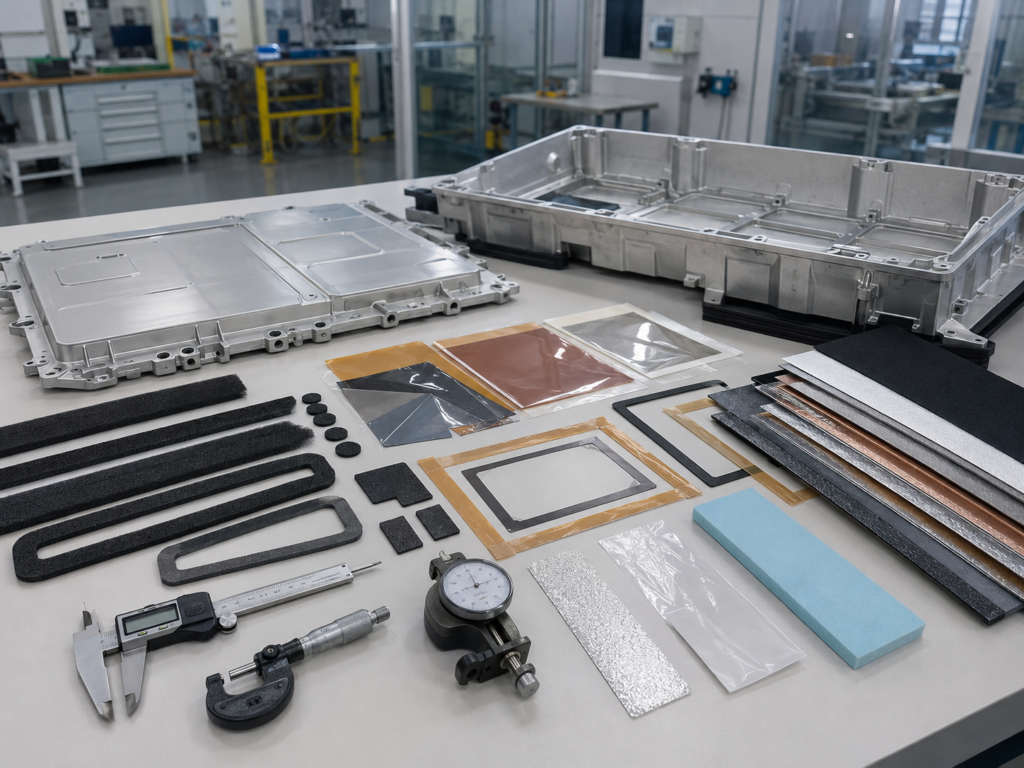
Automotive battery covers do more than close a battery pack. They help protect sensitive components from dust, moisture, vibration, heat, electrical risk, and mechanical damage. In electric vehicles, the battery system is one of the most important and expensive assemblies, so even small material choices around the cover can affect safety, durability, and production stability.
At Sanken, we manufacture custom die cut parts for automotive and EV battery applications. These parts may include foam gaskets, rubber seals, PET insulation films, PI insulation films, protective films, adhesive tape frames, cushioning pads, and thermal insulation materials.
For us, battery cover materials are not only about protection. They also support insulation, sealing, lightweight design, easier assembly, and reliable mass production.
Why Battery Cover Materials Matter in Automotive Manufacturing
An automotive battery cover sits around a very demanding environment. It may need to handle heat, vibration, dust, moisture, compression, and long-term assembly pressure. It may also need to support electrical insulation and protect the battery pack from external damage.
The cover itself may be made from metal, composite, or engineering plastic materials. But around the cover, many functional materials are needed to help the whole system work properly.
These materials can help with:
- Electrical insulation
- Gap sealing
- Dust protection
- Moisture resistance
- Vibration cushioning
- Surface protection
- Thermal management
- Compression control
- Assembly support
This is where precision die cutting becomes useful. Battery cover materials often need to be converted into custom shapes with accurate holes, clean edges, stable thickness, adhesive backing, and easy liner removal.
A small insulation film or foam gasket may not look impressive at first glance.
But if it fails, the result can be very expensive.
And nobody wants a battery project delayed because a tiny sealing pad did not behave.
Poor material selection or unstable processing can create problems during assembly and long-term use. A gasket may be slightly too thin. A film may shift by a few millimeters. A liner may be difficult to peel. A foam pad may lose compression after repeated stress.
These small problems can lead to poor sealing, water or dust ingress, adhesive lifting, insulation failure, gasket deformation, dimensional mismatch, assembly delays, and inconsistent batch quality.
This is why we always suggest reviewing the application before production. Drawings are important, but the working environment tells us what the material really needs to survive.
Common Materials Used Around Automotive Battery Covers
Different battery cover applications require different material performance. Foam is often used for sealing, cushioning, gap filling, and compression control. Rubber can provide stronger sealing, dust protection, shock absorption, and long-term durability.
For electrical safety, PET and PI films are commonly selected for insulation and heat resistance. Adhesive tapes help bond, mount, and position battery cover materials during assembly, while protective films help prevent surface damage during transportation, handling, or production.
Common battery cover materials include:
| Material Type | Main Function | Common Battery Cover Use |
|---|---|---|
| Foam | Sealing, cushioning, gap filling | Cover gaskets, compression pads, anti-vibration pads |
| Rubber | Sealing, shock absorption, dust protection | Rubber seals, edge gaskets, protective pads |
| PET Film | Electrical insulation, protection | Insulation barriers, module protection films |
| PI Film | Heat resistance, electrical insulation | High-temperature insulation areas |
| Adhesive Tape | Bonding, positioning, assembly support | Adhesive-backed gaskets, tape frames |
| Protective Film | Surface protection | Cover protection during handling and assembly |
| Thermal Insulation Material | Heat management | Battery pack insulation and protection areas |
Material selection should always match the real working condition. A soft foam may help fill a gap, but it may not provide enough compression recovery. A film may provide insulation, but it still needs the right thickness, shape, and edge quality. A tape may bond well during sampling, but fail if the surface, pressure, or temperature is not considered.
The material is important.
The structure is just as important.
How Battery Cover Materials Support Insulation, Sealing, and Protection
Battery cover materials often need to do more than one job.
In automotive battery applications, one component may support electrical insulation, gap sealing, dust protection, moisture resistance, cushioning, and assembly stability at the same time.
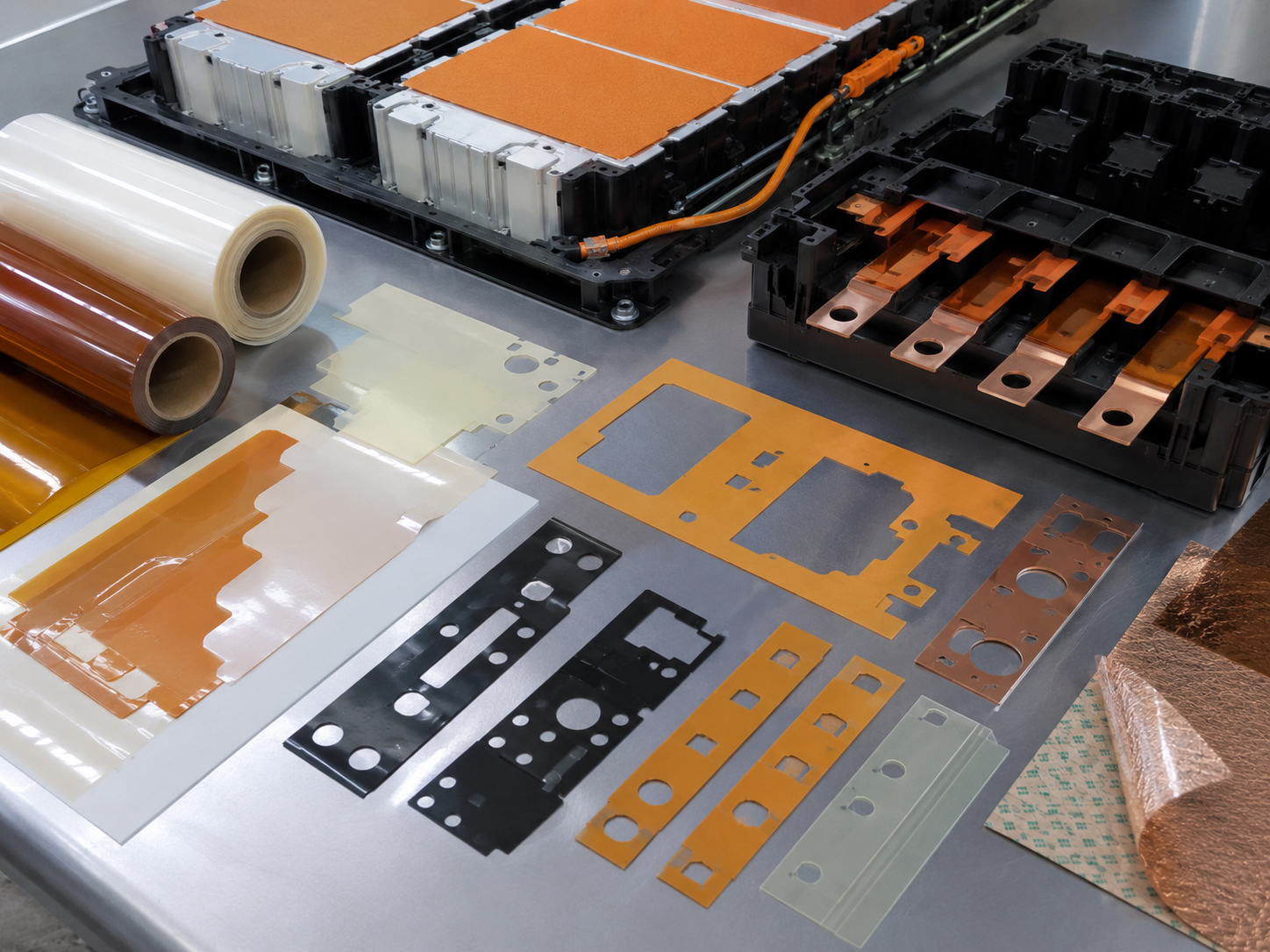
For electrical safety, materials such as PET film, PI film, insulation paper, and adhesive-backed insulation films are often used around battery modules, busbars, terminals, wiring areas, and metal structures.
These materials help create separation between conductive parts and nearby surfaces.
For sealing and protection, foam gaskets, rubber seals, sponge pads, and adhesive-backed materials can help block dust, moisture, air leakage, and unwanted movement.
Foam is often selected for soft sealing and gap filling.
Rubber may be used when stronger sealing performance, durability, or compression recovery is required.
A battery cover material may look simple, but the details matter.
The part may need:
- Precise hole positioning
- Clean die-cut edges
- Stable thickness
- Controlled adhesive backing
- Easy liner removal
- Reliable compression performance
Adhesive backing can make assembly faster.
But the adhesive must match the real surface and working environment. A tape that performs well on one plastic housing may not behave the same way on coated metal, aluminum, or textured surfaces.
This is why we review both the drawing and the application before production.
The drawing tells us the shape.
The working environment tells us what the material needs to survive.
How Do These Materials Help With Lightweight Design?
Lightweight design is important in automotive manufacturing, especially for electric vehicles. Reducing unnecessary weight can help improve driving range, energy efficiency, and vehicle performance.
Battery cover materials can support lightweight design by replacing heavier solutions with thinner, more functional, or better-integrated material structures.
For example:
- Foam can provide sealing and cushioning with low weight.
- Films can provide insulation without adding bulky layers.
- Adhesive-backed materials can reduce the need for extra fasteners.
- Laminated materials can combine sealing, insulation, and bonding in one part.
- Custom die cut shapes can reduce material waste and avoid unnecessary coverage.
The goal is not always to use the thinnest material.
The goal is to use the right material in the right position.
A lightweight part still needs to perform. If it fails, the cost of rework will be much heavier than the material itself.
That is why we look at both weight reduction and functional reliability when developing battery cover materials.
Why Die Cutting Is Important for Battery Cover Materials
Battery cover materials usually need to match complex shapes, holes, edges, ribs, mounting points, and assembly spaces. Manual cutting or rough processing can create unstable dimensions and poor repeatability.
Precision die cutting services help convert functional materials into clean, repeatable, assembly-ready parts.
Die cutting can help control:
- Outer shape
- Inner holes
- Edge quality
- Material thickness
- Adhesive area
- Release liner design
- Layer alignment
- Assembly direction
- Batch consistency
For battery cover components, die cutting is often combined with material conversion, adhesive lamination, kiss cutting, and packaging design.
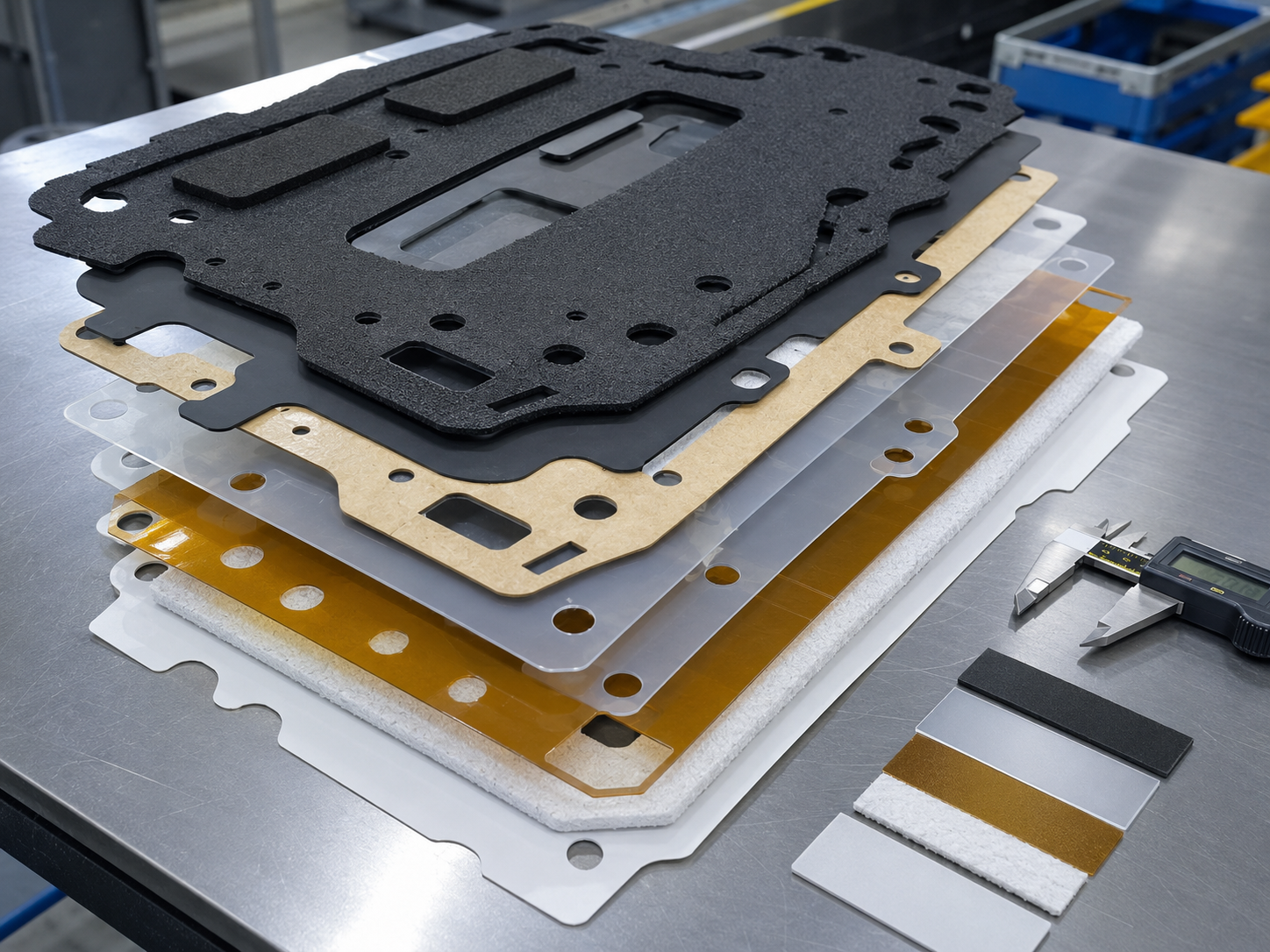
This is especially useful for multilayer structures. A single battery cover part may include foam, tape, film, and release liner. If these layers are not aligned properly, the part may be difficult to install or may fail during use.
How Sanken Supports OEM and ODM Battery Cover Projects
Sanken supports both OEM and ODM projects for automotive battery cover materials and related die cut components.
For OEM projects, customers may already have drawings, samples, material specifications, or clear tolerance requirements. In this case, we can support material conversion, die cutting, lamination, inspection, and mass production delivery.
For ODM projects, the material or structure may not be fully confirmed yet. We can help review the application problem and suggest possible material structures based on insulation, sealing, cushioning, heat resistance, adhesive performance, compression behavior, and production feasibility.
Our support can include:
- Material review
- Material sourcing
- Foam, rubber, tape, and film converting
- Adhesive lamination
- Multilayer structure development
- Precision die cutting
- Kiss cutting
- Sample development
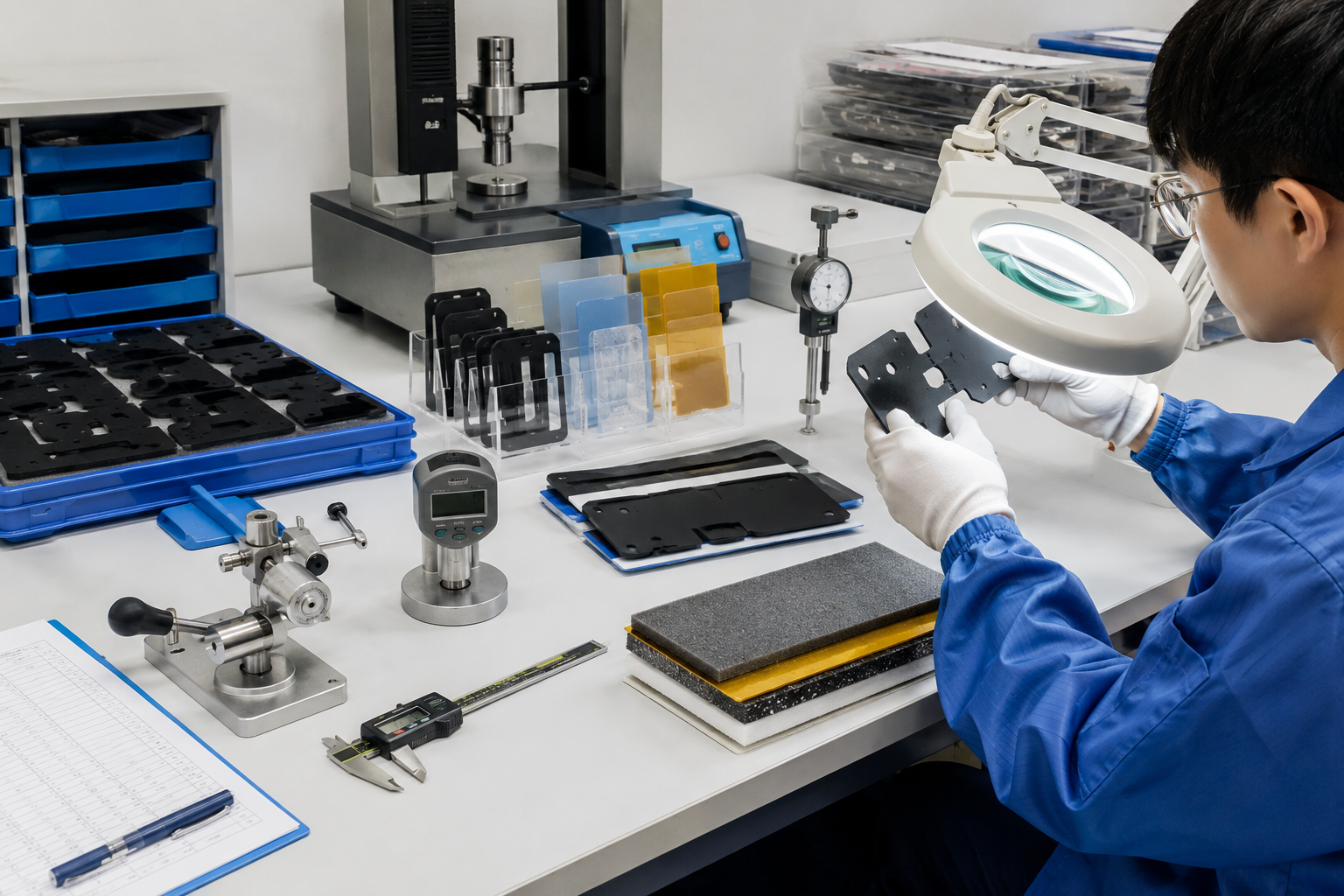
- Inspection support
- Assembly-ready packaging
- Mass production delivery
Our role is not only to follow a drawing.
We can also help customers turn an application problem into a practical battery cover material solution.
From Material Selection to Production Support
Battery cover materials often need to balance insulation, sealing, protection, weight, and assembly efficiency. In some projects, the customer already has drawings and material specifications. In other projects, the structure is still being developed.
Both situations are workable for us.
At Sanken, we can support OEM and ODM projects from material selection to sample development and mass production. If the material is not confirmed yet, we can help compare foam, rubber, film, tape, and laminated structures based on the application environment.
A complete drawing is helpful, but it is not the only starting point.
A clear problem is also enough for us to begin the discussion.
Related Articles
You may also find these articles helpful:
- Die Cut Materials for EV Battery Packs: Sealing, Insulation, and Thermal Management
- 6 Advantages of Precision Die Cutting for Automotive Components
- Custom Die Cut Parts Manufacturer | Foam, Tape, Film & Rubber
- Automotive Die-Cut Components
Conclusion
Automotive battery cover materials help improve insulation, sealing, protection, lightweight design, and assembly stability.
At Sanken, we convert foam, rubber, tape, film, and laminated materials into custom die cut components for automotive battery cover applications.
If you need battery cover gaskets, insulation films, protective pads, or custom laminated materials, send us your drawing, sample, material specification, or application requirement.