
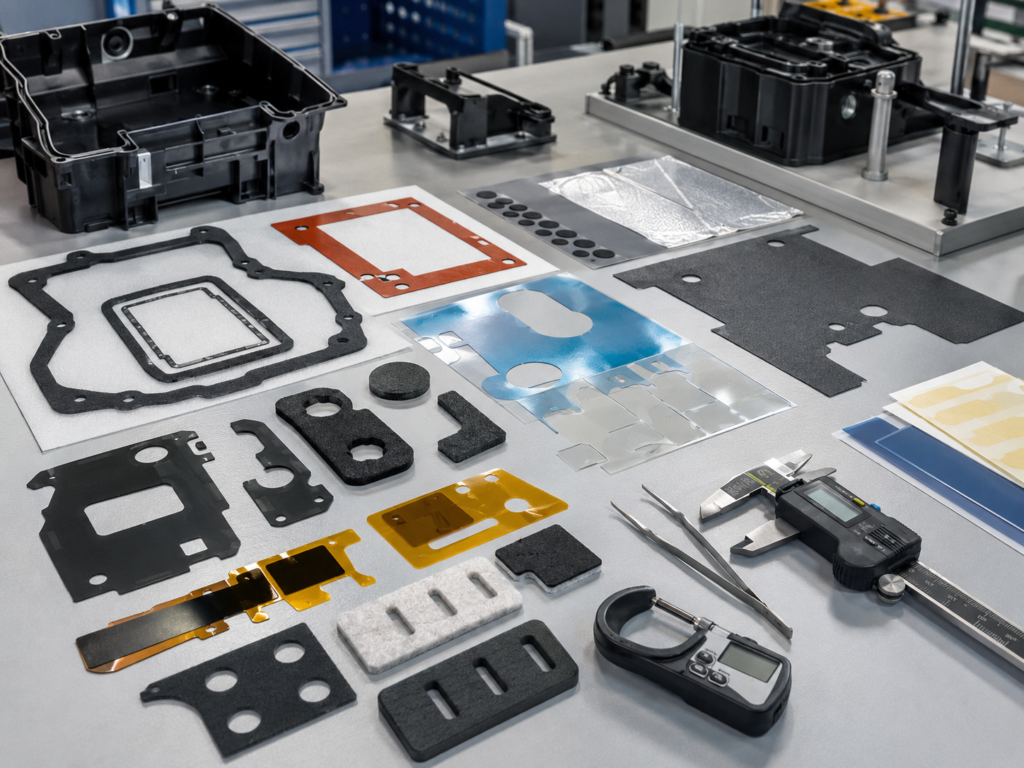
Automotive components are often judged by big systems, such as engines, batteries, displays, sensors, doors, and seats. But in real production, many problems start with very small functional parts. A foam gasket may move, a rubber seal may not compress evenly, an adhesive tape part may lift after assembly, or an insulation film may shift out of position.
These problems may look small, but they can create noise, leakage, rework, delays, and customer complaints. At Sanken, we use precision die cutting to manufacture custom foam, rubber, film, non-woven, and adhesive tape components for automotive OEM applications.
For us, die cutting is not just cutting material into a shape. It is about helping automotive customers make parts that fit better, seal better, assemble faster, and perform more reliably in mass production.
Why Precision Die Cutting Matters in Automotive Manufacturing
Modern vehicles use many functional materials.
These materials help with sealing, cushioning, bonding, insulation, dust protection, heat management, sound control, and vibration reduction.
Common automotive die cut materials include:
- Foam
- Rubber
- Non-woven felt
- PET film
- PI film
- Double-sided adhesive tape
- Protective film
- Thermal insulation materials
- EMI shielding materials
- Multilayer laminated materials
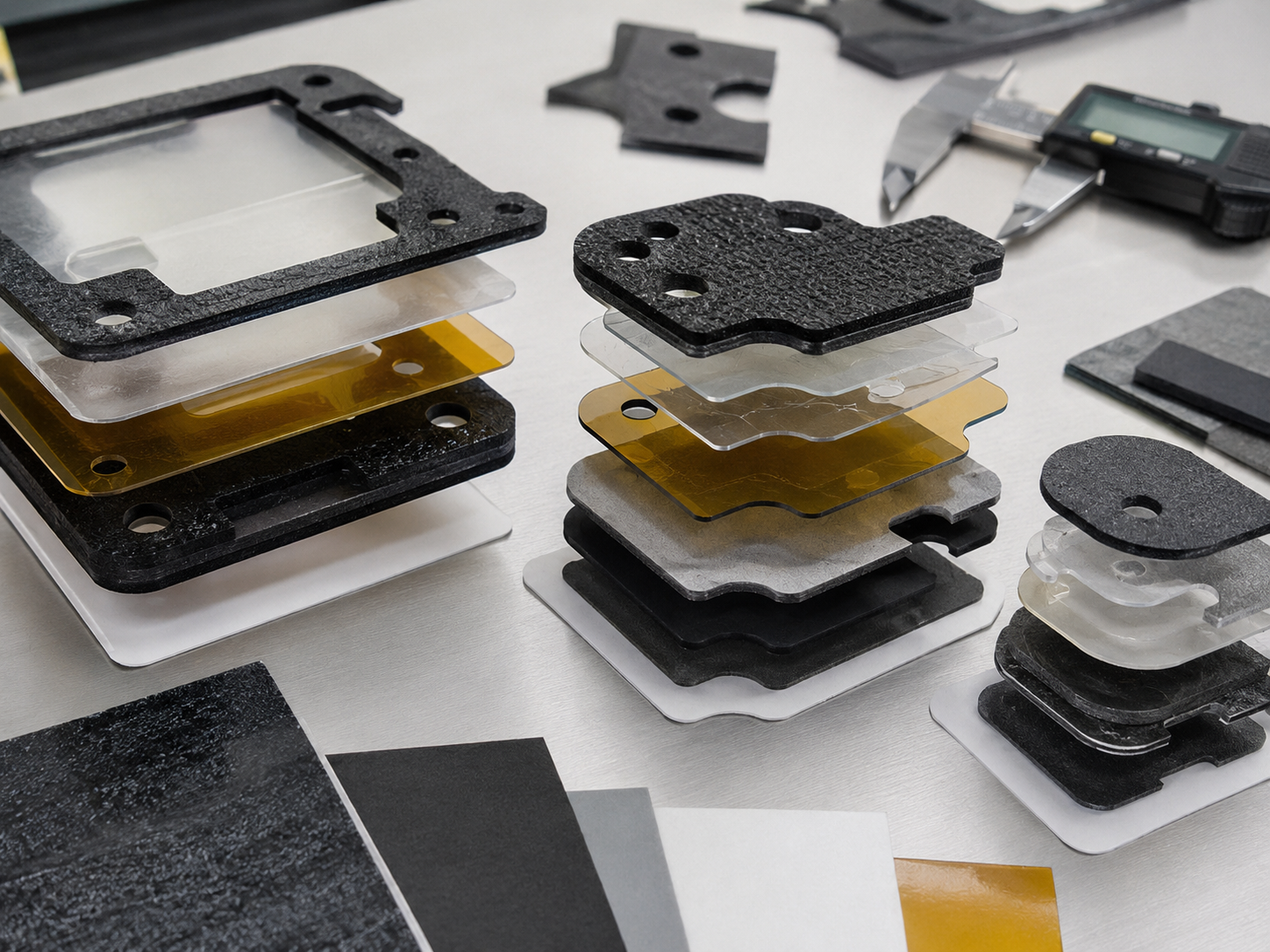
These materials are often converted into custom shapes through precision die cutting services.
The final part may be small, but the technical requirement is often much bigger than it looks. A custom die cut component may need precise hole positioning, clean cut edges, stable thickness, controlled adhesive backing, easy liner removal, and reliable performance under compression, vibration, heat, and long-term use.
This is why automotive buyers should not treat die cut parts as simple accessories. A low-cost part can become expensive if it causes assembly failure.
And nobody wants to stop a production line because of a tiny gasket.
1. Better Dimensional Accuracy for Automotive Die-Cut Parts
The first advantage is accuracy.
Automotive components often work inside tight spaces.
A foam pad may need to fit around clips, screws, ribs, holes, or curved plastic housings.
A rubber gasket may need to seal a gap without affecting assembly.
An adhesive tape frame may need to match the exact shape of a sensor, display, lighting module, or interior trim part.
If the part is too large, it may wrinkle.
If it is too small, it may fail to seal.
If the hole position is wrong, the operator may need extra time to adjust it.
That means lower efficiency.
Precision die cutting helps control:
- Outer dimensions
- Inner holes
- Edge quality
- Adhesive position
- Layer alignment
- Material thickness
- Release liner structure
- Application direction
For automotive OEM projects, this accuracy helps reduce rework and improve assembly consistency.
At Sanken, we manufacture custom die cut parts based on drawings, samples, material requirements, and application needs.
Our goal is not only to make the sample look correct.
Our goal is to make repeated production stay correct.
2. Flexible Material Choices for Different Automotive Applications
The second advantage is material flexibility.
There is no single material that works for every automotive component.
Different applications require different material performance.
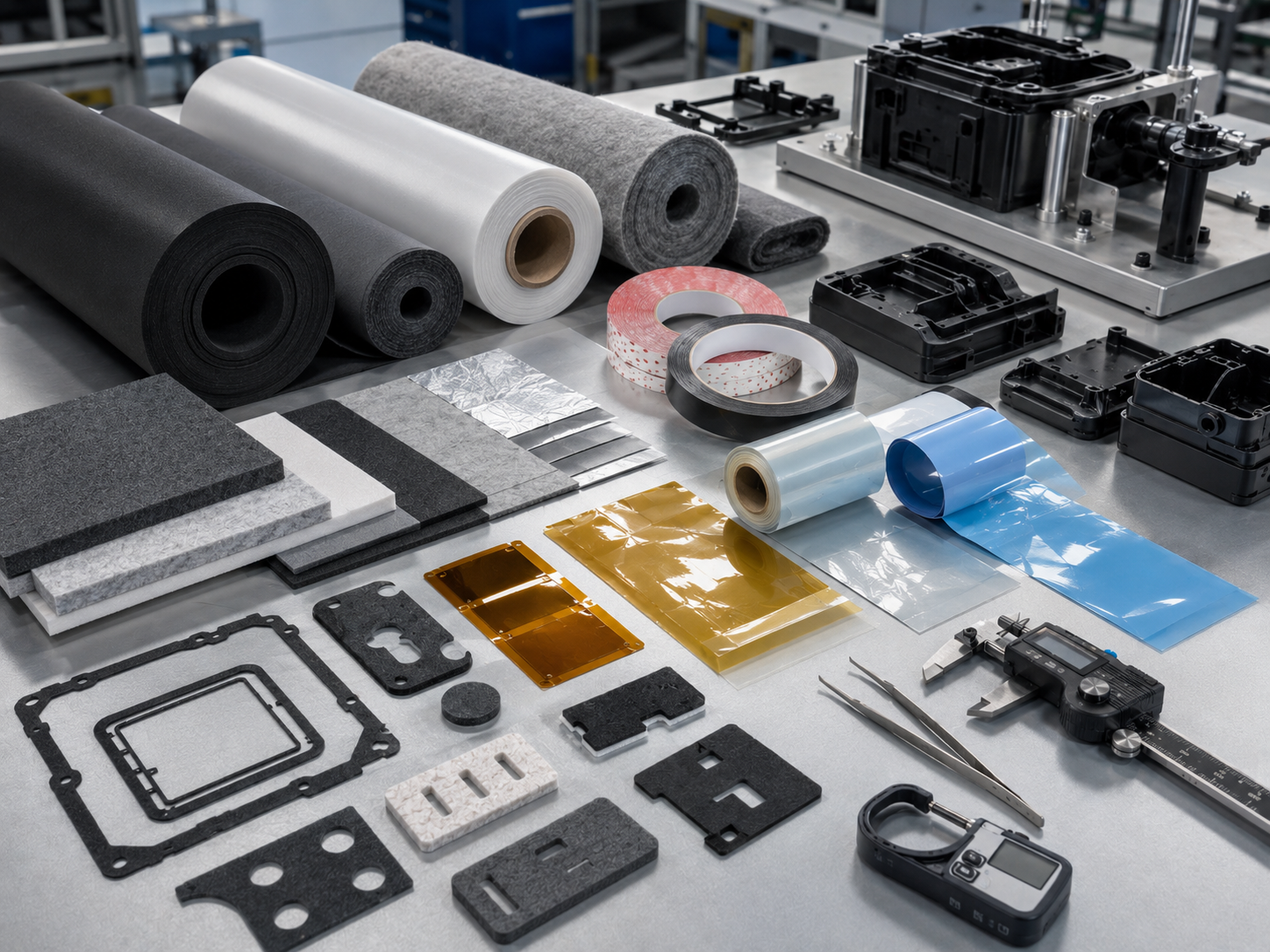
Each material has its own role in automotive die cutting. Foam helps with cushioning, sealing, gap filling, and vibration reduction.
Rubber provides sealing, dust protection, and shock absorption.
Non-woven felt is useful for sound absorption and anti-rattle protection.
For electrical and thermal applications, PET and PI films can provide insulation and heat resistance.
Adhesive tapes support bonding, mounting, and positioning, while protective films keep surfaces safe during transportation and assembly.
At Sanken, we work with materials such as:
| Material Type | Main Function | Common Automotive Use |
|---|---|---|
| EVA / PE / PU Foam | Cushioning, sealing, gap filling | Interior trim, HVAC, lighting, housings |
| EPDM / Silicone / NBR Rubber | Sealing, shock absorption, dust protection | Gaskets, pads, sealing parts |
| Non-Woven Felt | Noise reduction, anti-rattle, vibration control | Door panels, dashboards, acoustic areas |
| Double-Sided Tape | Bonding, mounting, positioning | Trim parts, displays, modules |
| PET / PI Film | Electrical insulation, heat resistance | Electronics, battery systems, sensors |
| Protective Film | Surface protection | Displays, panels, optical surfaces |
Material selection is one of the most important parts of an automotive die cutting project.
A foam may look soft enough, but lose compression after long-term use.
A tape may bond well during sampling, but fail after heat aging.
A film may have good insulation, but crack during assembly if the structure is wrong.
This is why we always want to understand the real application before production.
The drawing tells us the shape.
The application tells us the risk.
3. Improved Sealing, Cushioning, and Component Protection
The third advantage is better sealing and protection.
Many automotive die cut parts are used to stop problems before they happen.
They help block:
- Dust
- Moisture
- Air leakage
- Water ingress
- Heat transfer
- Light leakage
- Surface scratches
- Unwanted movement
- Noise and vibration
In automotive interiors, die cut foam and felt parts can reduce squeaks, rattles, and vibration.
In lighting systems, foam gaskets and films can help prevent dust, moisture, and light leakage.
In automotive electronics, insulation films and cushioning pads can protect modules from vibration and electrical contact.
In EV battery systems, die cut pads, films, and insulation materials can support spacing, compression, thermal protection, and electrical safety.
A good die cut component often works quietly, the driver may never see it.
The assembly worker may only touch it for a few seconds, but if it fails, everyone notices.
That is why sealing and protection parts must be designed with the real working environment in mind.
4. Easier Assembly with Custom Die-Cut Components
The fourth advantage is assembly efficiency.
Automotive manufacturers care about unit price.
Of course they do.
But they also care about assembly time, production flow, and repeatability.
A part that is difficult to peel, align, or apply can slow down the line.
A poorly designed adhesive liner can waste time.
A part that needs manual trimming can create inconsistency.
A well-designed die cut component can make assembly easier.
For example:
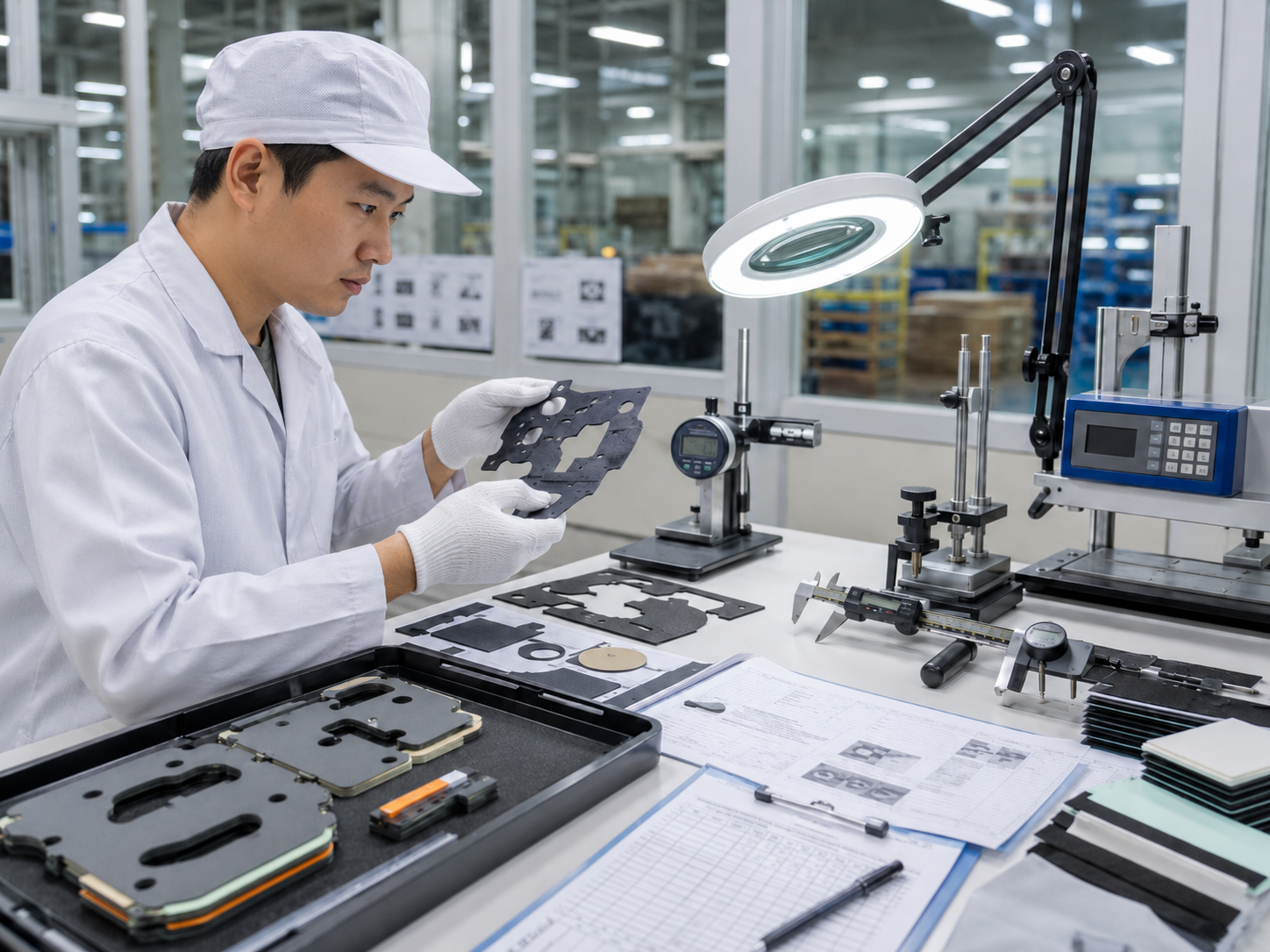
- A pre-cut adhesive tape frame can replace manual tape cutting.
- A kiss-cut foam gasket can improve peeling and positioning.
- A laminated foam-and-tape part can reduce secondary bonding steps.
- A release liner tab can help operators apply the part faster.
- A kit-packed component can simplify line-side assembly.
Precision die cutting can support different delivery formats, including:
- Individual pieces
- Sheets
- Rolls
- Kiss-cut parts on liner
- Custom assembly kits
- Layered laminated parts
- Adhesive-backed components
This is important for OEM production.
A small part should not slow down a big assembly line.
When a die cut part is designed correctly, it helps workers assemble faster and with fewer mistakes.
That is real cost saving.
Not the exciting kind.
But the kind purchasing teams actually care about.
5. Stable Quality from Prototyping to Mass Production
The fifth advantage is production stability.
A good sample is important, but mass production is the real test.
Many suppliers can make one good sample. Fewer suppliers can keep the same quality across repeated batches.
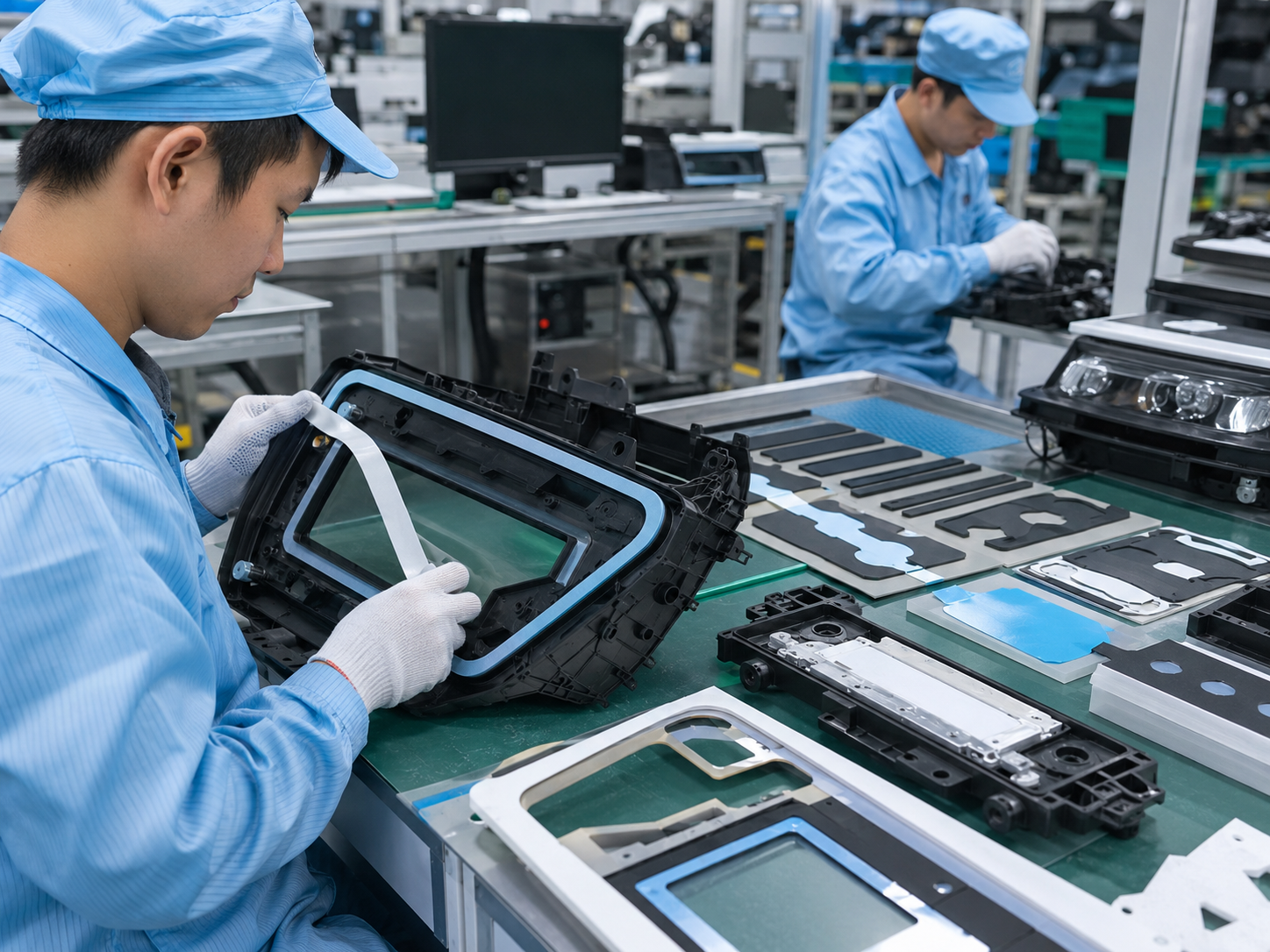
Automotive projects require stable control over:
- Raw material batches
- Tooling condition
- Cutting pressure
- Lamination accuracy
- Adhesive placement
- Waste removal
- Edge cleanliness
- Packaging protection
- Final inspection
Common mass production problems include:
- Size variation
- Adhesive overflow
- Rough edges
- Fiber shedding
- Material stretching
- Poor liner release
- Layer misalignment
- Part deformation during packaging
At Sanken, we support projects from material review and sample development to tooling confirmation, production inspection, packaging, and delivery.
Our goal is not only to make the first part right, but to make the thousandth and ten-thousandth part still right.
For automotive OEM customers, this consistency matters.
It reduces rework; protects delivery schedules; helps keep assembly lines stable.
6. Reduced Supply Chain Complexity with One-Stop Manufacturing
The sixth advantage is simpler supply chain management.
Many automotive die cut components are not made from one material only.
A single part may include foam, adhesive tape, film, liner, printed marks, or multilayer laminated structures.
If each process is handled by a separate supplier, communication becomes complicated. Foam may come from one source, tape from another, while lamination, die cutting, and packaging may all be managed by different teams.
When a problem appears, it becomes difficult to trace the root cause. Was it the material? The adhesive? The lamination process? The cutting tolerance? Or the packaging method?
This is why a one-stop die cutting manufacturer can make the whole project easier to control.
At Sanken, we support:
- Material sourcing
- Material conversion
- Lamination
- Precision die cutting
- Kiss cutting
- Hot pressing
- Spraying gluing
- Stamping support
- Silk screen printing
- Inspection
- Packaging
- Export delivery
For overseas OEM customers, this can reduce communication cost and make project management easier.
It also helps customers move from drawing review to mass production with fewer delays.
Where These Advantages Apply in Automotive Manufacturing
These six advantages can be seen across many automotive applications, including:
- Automotive interior trim & electronics
- Door panels and dashboard systems
- EV battery packs
- Lighting systems
- HVAC components
- Speaker and acoustic systems
- Anti-rattle and NVH areas
For example, foam pads and non-woven felt can help reduce noise and vibration inside the cabin. PET and PI insulation films can protect electronic modules and battery components. Adhesive tape frames can support bonding and assembly for displays, sensors, lights, and plastic housings.
For more detailed application examples, read our full guide:
Where Are Die Cut Parts Used in Automotive Manufacturing?
Related Articles
You may also find these articles helpful:
- Custom Die Cut Parts Manufacturer | Foam, Tape, Film & Rubber
- Precision Die Cutting Services
- Die Cut Materials for EV Battery Packs: Sealing, Insulation, and Thermal Management
Conclusion
Precision die cutting helps automotive components achieve better accuracy, sealing, protection, assembly efficiency, mass production stability, and supply chain control.
At Sanken, we help automotive OEM customers turn foam, rubber, tape, film, and non-woven materials into reliable custom die cut parts.
If you need custom automotive die-cut components, send us your drawing, sample, material specification, or application requirement. Our team can help review the material, structure, tolerance, and production feasibility before mass production.