
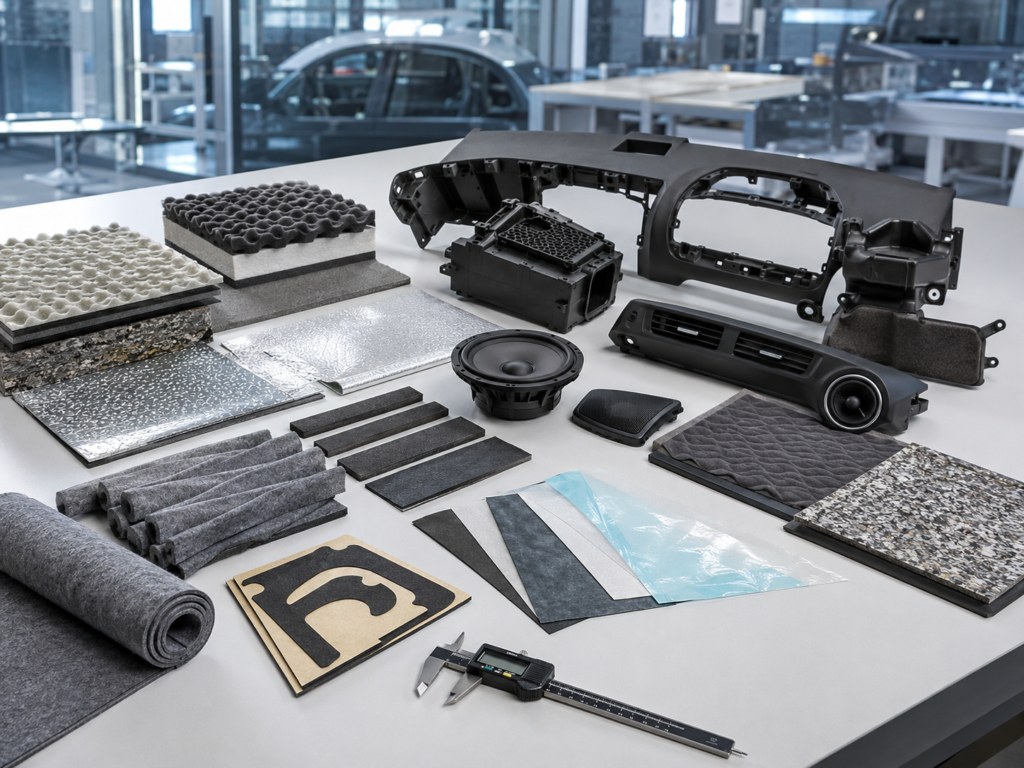
A quiet vehicle does not happen by accident. Behind the door panel, dashboard, floor, roof, speaker area, and interior trim, many small materials are working together to control noise, vibration, and harshness.
These materials are known as automotive NVH materials. They may include foam, rubber, non-woven felt, adhesive tape, insulation films, damping pads, and multilayer laminated components. Most of them are not visible after assembly, but they strongly affect comfort, quality, and the driving experience.
At Sanken, we manufacture custom die-cut parts for automotive NVH applications. Our job is to convert functional materials into precise shapes that help OEM customers reduce rattling, absorb sound, seal gaps, cushion contact points, and improve assembly stability.
For us, NVH control is not only about making a vehicle quieter. It is also about helping every small part fit correctly, stay in place, and perform reliably in mass production.
What Are Automotive NVH Materials?
NVH stands for Noise, Vibration, and Harshness.
Automotive NVH materials are functional materials used to reduce noise, absorb vibration, cushion contact, seal gaps, and improve comfort inside the vehicle.
Common NVH materials include:
- Foam
- Rubber
- Non-woven felt
- Acoustic felt
- Sponge
- Adhesive tape
- Butyl damping material
- PET film
- Protective film
- Multilayer laminated materials
- Thermal and acoustic insulation materials
Each material has a different role. Foam is often used for cushioning, sealing, gap filling, and anti-rattle protection. Rubber helps with vibration absorption, sealing, and impact resistance. Non-woven felt is useful for sound absorption and friction reduction between interior parts.
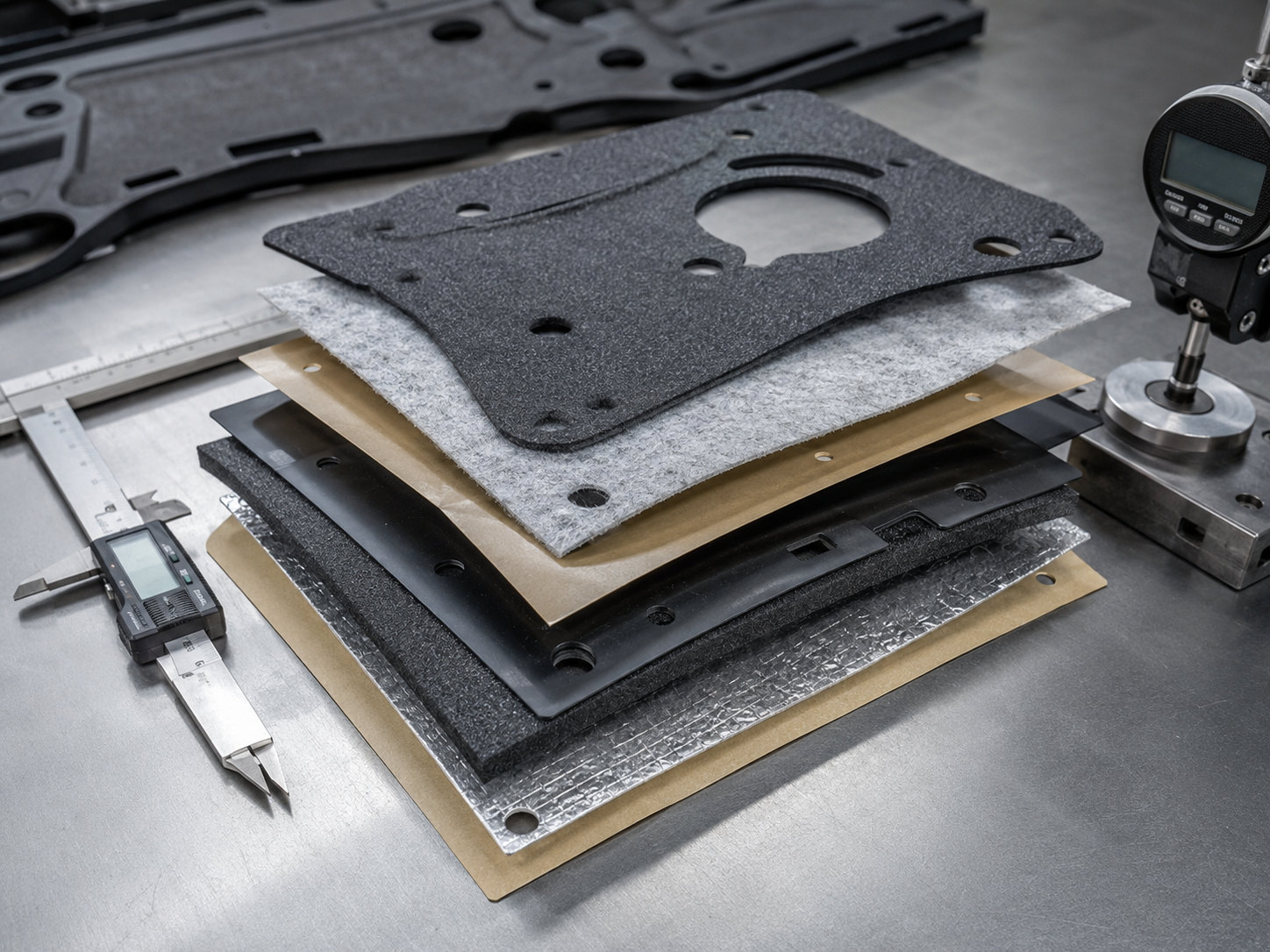
For bonding and assembly, adhesive tapes help attach NVH parts to plastic, metal, foam, or fabric surfaces. In some applications, multilayer materials combine foam, felt, film, and adhesive backing to achieve more than one function in a single part.
That is where precision die cutting becomes important. The material must not only perform well. It also needs to be cut, laminated, and supplied in a shape that fits the final assembly.
How Do NVH Materials Reduce Noise and Vibration?
NVH materials usually reduce noise and vibration through three main methods: absorption, damping, and isolation.
Absorption helps reduce reflected sound inside the vehicle. Materials such as non-woven felt, acoustic foam, and other porous materials can absorb sound energy and help lower cabin noise.
Damping helps reduce vibration from panels, plastic parts, speakers, motors, road surfaces, or moving components. Foam pads, rubber cushions, and adhesive-backed damping materials can help absorb impact, reduce movement, and make the structure feel more stable.
Isolation helps separate two surfaces so they do not rub, buzz, rattle, or transfer vibration to each other. Felt strips, foam pads, rubber spacers, and cushioning materials are often used between plastic components, metal panels, trim parts, electronic modules, and decorative surfaces.
In automotive interiors, the goal is not always to remove all sound. The real goal is to control unwanted sound and vibration so the vehicle feels quieter, tighter, and better built.
For example, foam pads can fill small gaps and prevent plastic parts from moving. Rubber pads can absorb impact and reduce vibration transfer. Felt strips can reduce friction and prevent squeaks between surfaces. Adhesive-backed damping materials can help reduce panel vibration.
The right material depends on the real working condition. Important factors include:
- Compression requirement
- Thickness
- Density
- Hardness
- Temperature resistance
- Adhesive strength
- Surface type
- Long-term compression recovery
- Assembly method
- Expected vibration environment
A material that works well in one area may not work well in another. A soft foam may be good for cushioning, but not suitable if strong compression recovery is required. A rubber pad may handle vibration better, but may not provide the same acoustic absorption as felt.
This is why material selection matters before die cutting begins.
A very small felt strip can sometimes solve a very annoying noise problem.
That is why I always say: the smallest part in the car may be the one saving the biggest headache.
Where Are Automotive NVH Materials Used?
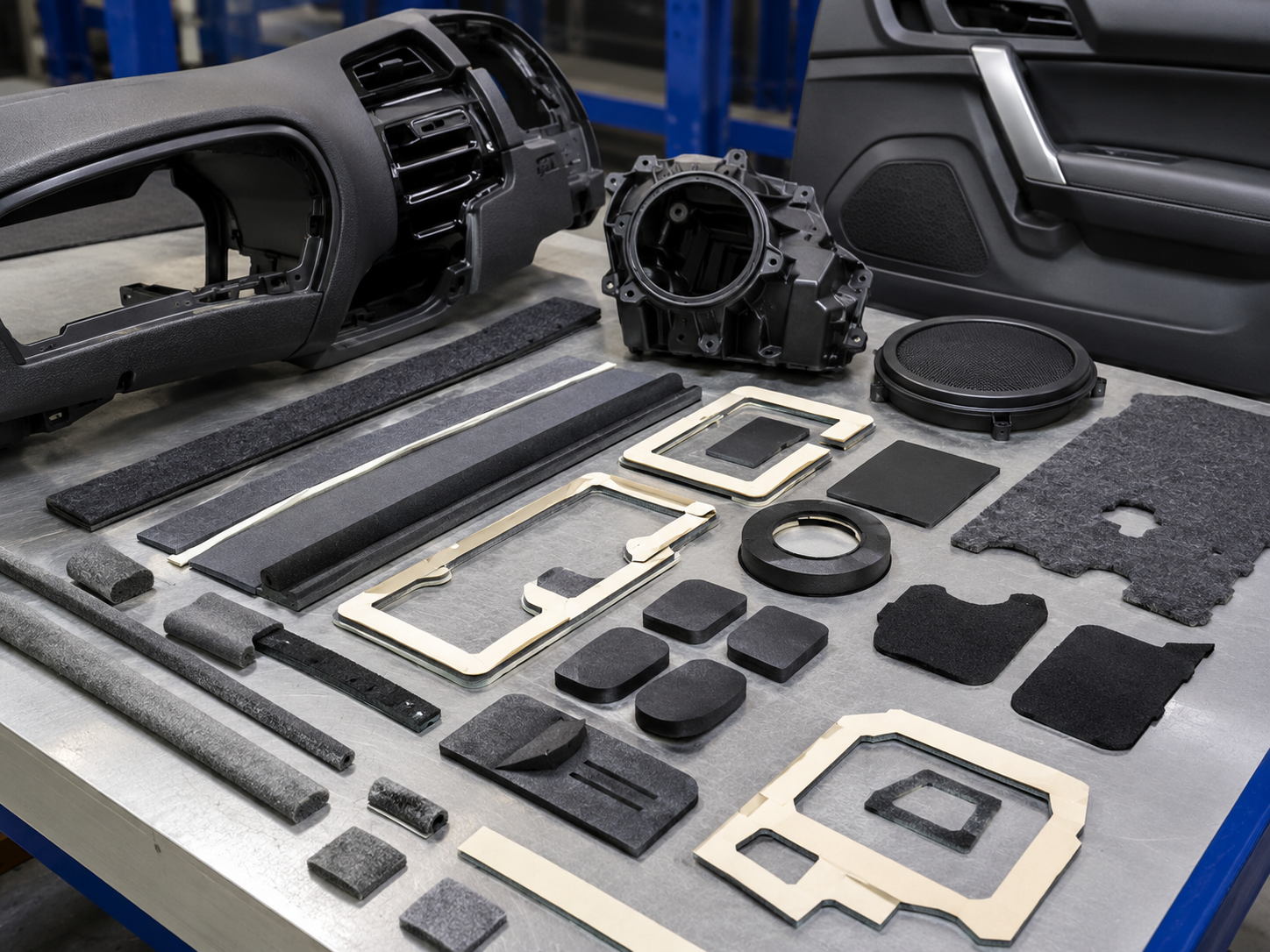
Automotive NVH materials are used in many areas of a vehicle. They are often hidden behind panels, under covers, around modules, or between assembled parts.
Common application areas include:
- Door panels
- Dashboard systems
- Center consoles
- Roof liners
- Floor insulation
- Seats
- Speaker systems
- HVAC components
- Battery packs
- Trunk areas
- Wheel arch areas
- Interior trim
- Electronic modules
- Wire harness areas
In door panels, foam and felt parts can help reduce rattling and vibration. In dashboards, NVH pads and strips can reduce squeaks between plastic components. Around speakers, foam gaskets can improve sealing and reduce unwanted vibration.
In EV battery systems, insulation pads, foam compression parts, and protective films can support spacing, safety, and vibration protection. For more detailed automotive application examples, you can read our guide here:
Where Are Die Cut Parts Used in Automotive Manufacturing?
Why Die Cutting Is Important for NVH Materials
NVH materials are not useful if they do not fit the application.
A foam pad must match the correct contact area. A felt strip must follow the right shape. A rubber cushion must align with the assembly position. An adhesive-backed part must be easy to peel, position, and apply.
This is why custom die-cut components are widely used for automotive NVH projects.
Die cutting helps control:
- Shape
- Size
- Thickness
- Hole position
- Edge quality
- Adhesive area
- Release liner design
- Assembly direction
- Layer alignment
For OEM production, stable dimensions are very important. A part that works during sampling must also work during repeated mass production.
That means the supplier must understand not only cutting, but also materials, adhesive behavior, lamination, packaging, and production consistency.
At Sanken, we often support projects where the part looks simple on the drawing, but the real function is more complex. The shape may be simple. The requirement is not.
Common Types of Die-Cut NVH Components
Automotive NVH parts can be made in many forms depending on the application.
Common die-cut NVH components include:
| Component Type | Common Function | Typical Application |
|---|---|---|
| Foam Pads | Cushioning, gap filling, anti-rattle | Door panels, dashboards, trim parts |
| Felt Strips | Sound absorption, friction reduction | Interior trim, plastic contact areas |
| Rubber Pads | Vibration damping, sealing, impact protection | Housings, brackets, modules |
| Speaker Foam Gaskets | Sealing and vibration control | Speaker systems, audio modules |
| Adhesive-Backed NVH Parts | Easy mounting and positioning | Interior and electronic assemblies |
| Insulation Films | Protection and isolation | Electronics, EV battery systems |
| Multilayer Laminated Parts | Combined sealing, bonding, cushioning | Complex OEM assemblies |
The best structure depends on the problem the customer wants to solve.
Sometimes the answer is a soft foam.
Sometimes it is felt.
Sometimes it is rubber.
Sometimes it is a laminated structure with foam, tape, film, and release liner.
The material choice and die-cutting process should work together.
How Sanken Supports Automotive NVH Projects
Sanken provides custom die cutting and material conversion support for automotive NVH components.
Our support can include:
- Material review
- Material sourcing
- Foam, rubber, felt, film, and tape converting
- Adhesive lamination
- Multilayer material bonding
- Precision die cutting
- Kiss cutting
- Hot pressing
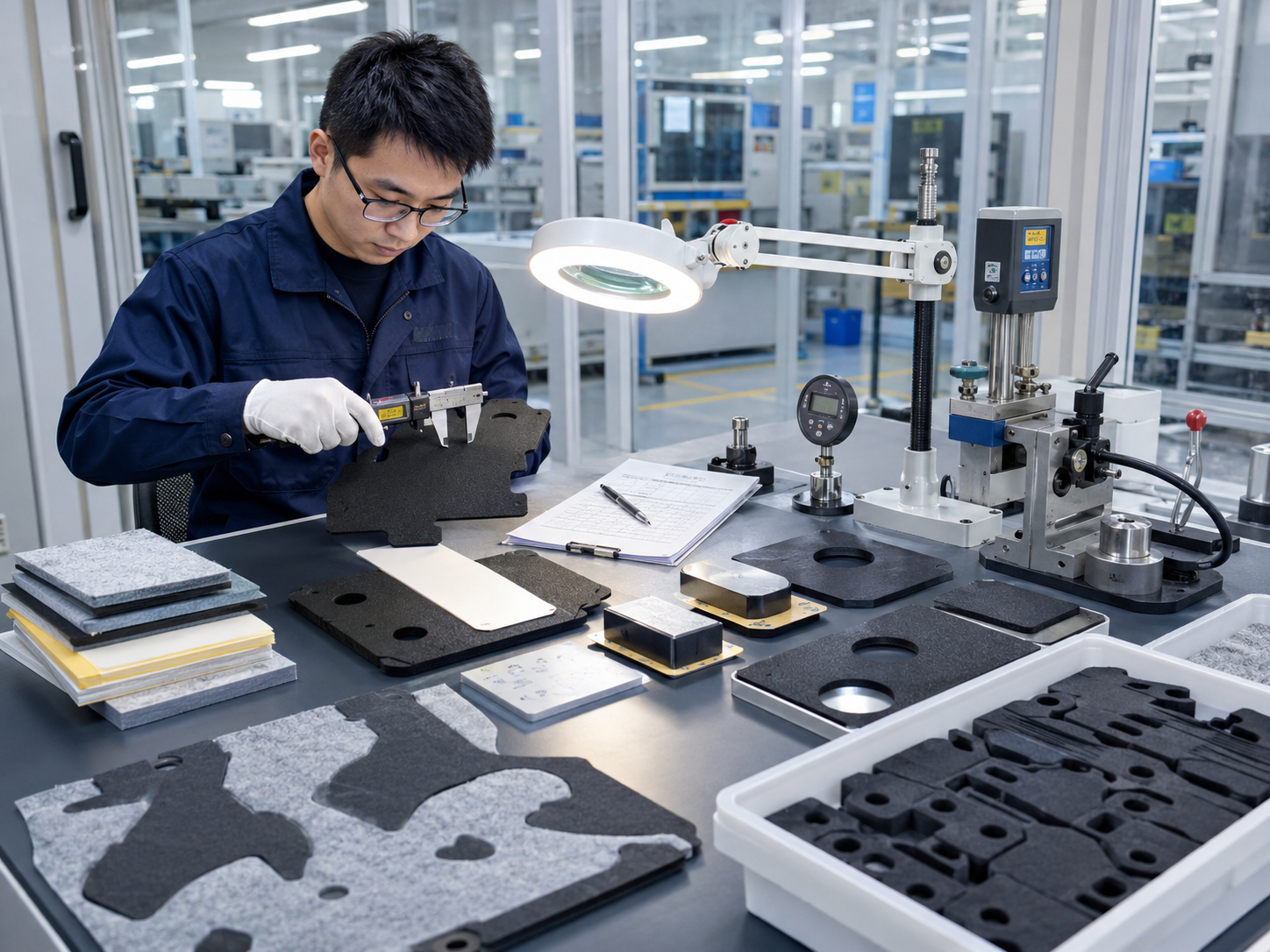
- Inspection
- Packaging
- Mass production delivery
We work with materials such as foam, rubber, non-woven felt, adhesive tape, PET film, PI film, protective film, and laminated structures. These materials can be converted into custom parts for sealing, cushioning, sound absorption, vibration damping, insulation, and surface protection.
For OEM customers, our goal is to make the part easier to apply, easier to control, and more stable in production.
If a customer already has a drawing, sample, material specification, or application problem, we can help review the die-cutting feasibility before mass production.
What Information Helps Us Support Your Automotive NVH Project?
You do not need to prepare every detail before contacting us.
For OEM projects, drawings, samples, and material specifications can help us quote and develop samples faster. For ODM projects, even if the material or structure is not fully confirmed, we can still support early-stage development based on the application problem.
To help us understand your project, you can share any information you already have, such as:
- Application area
- Noise or vibration problem
- Existing sample or reference part
- Required material type, if known
- Thickness or space limitation
- Adhesive requirement, if needed
- Temperature or working environment
- Estimated production volume
- Packaging or assembly preference
If you are not sure which foam, felt, rubber, tape, or laminated material is suitable, we can help compare options based on cushioning, sealing, acoustic absorption, vibration damping, adhesive strength, compression recovery, and production feasibility.
Our role is not only to follow a drawing. We can also help customers develop a practical NVH solution from material selection to die cutting, lamination, sampling, and mass production.
A clear drawing is helpful.
But a clear problem is also a good starting point.
Related Articles
You may also find these articles helpful:
- Where Are Die Cut Parts Used in Automotive Manufacturing?
- 6 Advantages of Precision Die Cutting for Automotive Components
- Custom Die Cut Parts Manufacturer | Foam, Tape, Film & Rubber
- Precision Die Cutting Services
- Automotive Die-Cut Components
Conclusion
Automotive NVH materials help reduce noise, vibration, and harshness through sealing, cushioning, absorption, damping, and isolation.
At Sanken, we convert foam, rubber, felt, film, and adhesive materials into custom die-cut NVH components for automotive OEM applications.
If you need automotive NVH parts, send us your drawing, sample, material specification, or application requirement. Our team can help review the material, structure, tolerance, and production feasibility before mass production.