
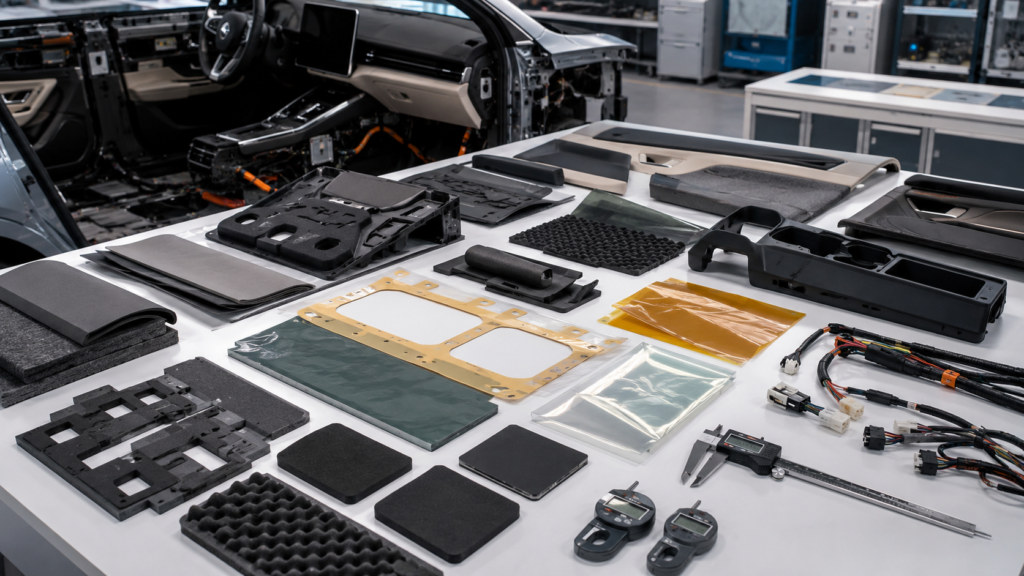
Electric vehicle interiors are quieter, smarter and more electronics-heavy than traditional vehicle cabins.
That is good for drivers.
It is also a challenge for OEM engineers.
When the cabin becomes quieter, small rattles, vibration, poor bonding, visible surface defects and assembly gaps become much easier to notice.
At Sanken, we use precision die cutting to manufacture foam, non-woven felt, rubber, adhesive tape, PET film, PI film, protective film and laminated components for EV interior assembly.
Choosing the right die cut interior component is not only about shape.
It is about material, thickness, adhesive structure, tolerance, cleanliness, delivery format and long-term reliability.
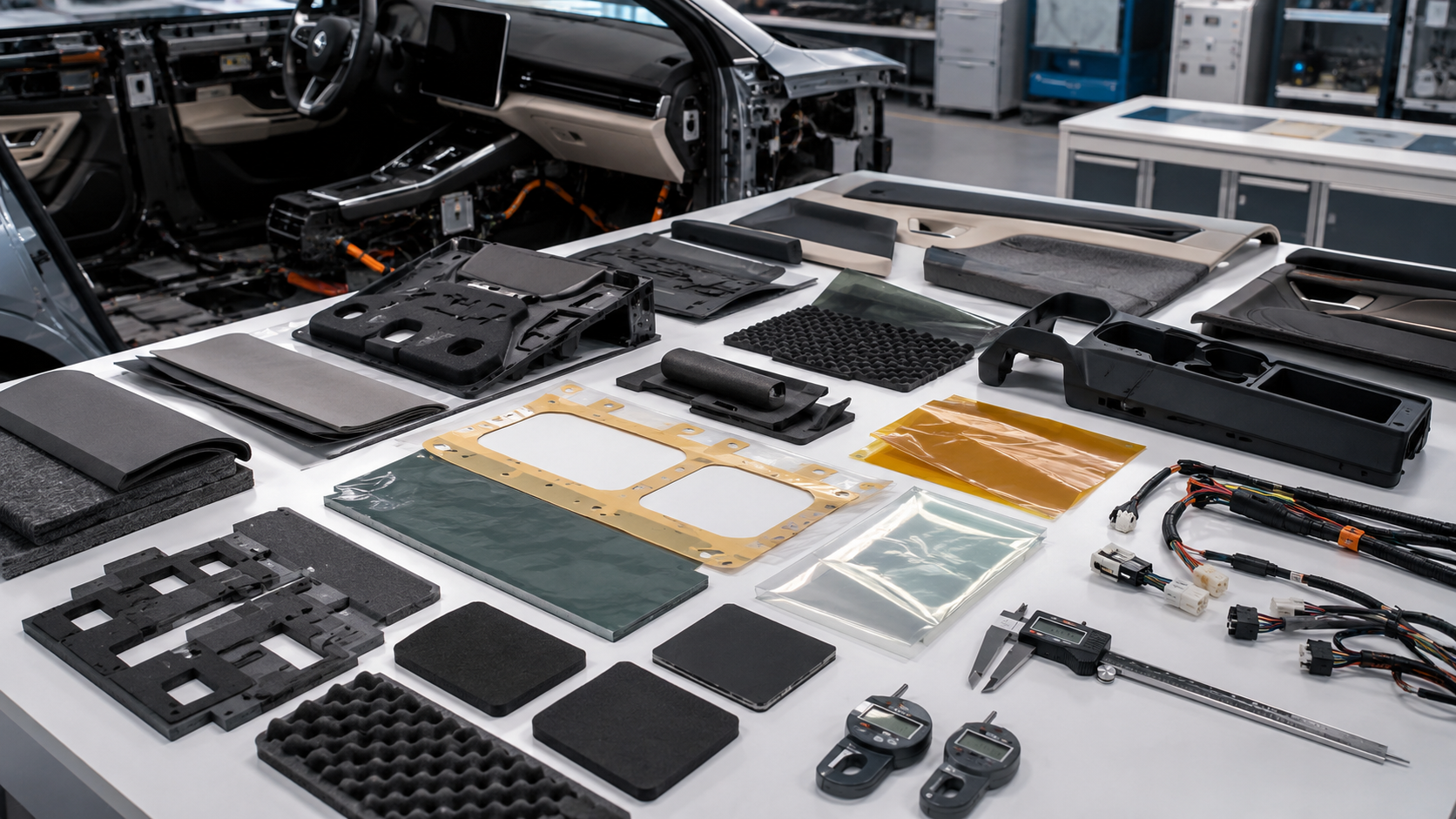
Start With the Function of the Part
Before choosing a material, we first ask what the part needs to do.
A foam pad, felt strip, adhesive frame and protective film may all be die cut components.
But their functions are different.
| Function | Common Die Cut Component |
|---|---|
| Anti-rattle control | Foam pads, felt strips, rubber pads |
| Noise reduction | Non-woven felt, foam, laminated NVH materials |
| Surface protection | Protective films, temporary masking films |
| Bonding | Double-sided tape frames, adhesive-backed foam |
| Electrical insulation | PET films, PI films |
| Light blocking | Black PET films, foam spacers |
| Cushioning | Foam pads, rubber pads |
| Dust sealing | Foam gaskets, adhesive foam seals |
For EV interiors, the wrong material may still fit the drawing.
But it may fail during assembly, vibration testing or long-term use.
That is why function comes first.
Match Materials to EV Interior Applications
Different interior areas need different die cut materials.
A dashboard anti-rattle pad does not need the same material as a display bonding frame.
A wire harness protection pad does not need the same material as a protective film for a decorative panel.
| EV Interior Area | Recommended Die Cut Parts |
|---|---|
| Dashboard | Foam pads, felt strips, PET films, adhesive-backed cushioning parts |
| Center console | Protective films, adhesive tape frames, foam spacers |
| Door panels | Felt pads, foam strips, rubber cushioning pads |
| Display modules | Protective films, black light-blocking films, adhesive frames |
| Wire harness areas | PET films, foam tape, non-woven felt protection pads |
| Seat assemblies | Foam cushioning pads, felt anti-squeak parts |
| HVAC ducts | Foam seals, vibration pads, air sealing strips |
| Interior lighting | Black films, adhesive tapes, foam spacers |
For vehicle programs, automotive die cut components are often selected to improve sealing, bonding, insulation, NVH control, protection and assembly stability.
A small hidden part can decide whether the interior feels premium or cheap.
No pressure, little gasket.
Choose the Right Foam, Felt, Rubber or Film
Material selection is the most important step.
Foam is useful for cushioning, gap filling and anti-rattle control.
Non-woven felt is useful for anti-squeak and sound absorption.
Rubber is useful for stronger vibration damping.
PET and PI films are useful for insulation and protection.
Protective films are useful for surfaces that must stay clean during handling and assembly.
| Material | Best Used For |
|---|---|
| PE foam | General cushioning and gap filling |
| EVA foam | Shock absorption and soft support |
| EPDM foam | Durable sealing and anti-rattle applications |
| PU foam | Soft compression and surface cushioning |
| Non-woven felt | NVH control and anti-squeak protection |
| Rubber | Vibration damping and impact control |
| PET film | Electrical insulation and surface protection |
| PI film | Heat-resistant insulation |
| Protective film | Scratch and contamination protection |
| Adhesive tape | Bonding, mounting and positioning |
For sealing or cushioning areas, foam gaskets and sealing components may be used around HVAC ducts, interior electronics housings, door panels and display assemblies.
Material choice should be based on the real working environment.
Not only price.
Not only thickness.
Not only what worked in another project.
Check Thickness, Compression and Fit
EV interior components often fit into narrow spaces.
If the part is too thick, the trim may not close.
If the part is too thin, vibration or noise may remain.
If the compression is unstable, the same part may perform differently from batch to batch.
We usually check:
- Material thickness
- Compression gap
- Compression recovery
- Density or hardness
- Surface flatness
- Assembly pressure
- Long-term aging behavior
This is especially important for foam pads, felt strips and rubber damping parts.
A die cut NVH part should reduce noise without creating new assembly problems.
That sounds obvious.
It is also where many projects fail.
Review Adhesive Backing Carefully
Many EV interior die cut components use adhesive backing.
Adhesive makes assembly faster.
It also keeps parts in the correct position.
But adhesive selection must match the bonding surface.
EV interiors may include plastic, painted surfaces, metal, glass, fabric, rubber, foam and textured decorative materials.
These surfaces do not bond the same way.
Common adhesive-backed components include:
- Adhesive foam pads
- Felt pads with PSA backing
- Double-sided tape frames
- Protective films with pull tabs
- Rubber pads with adhesive
- PET-backed adhesive parts
- Laminated foam and film structures
A good adhesive component should peel smoothly, stay flat, bond accurately and resist lifting after heat, vibration and aging.
If the adhesive lifts after assembly, the part is no longer hidden.
It becomes a problem.
Consider Display and Optical Surface Requirements
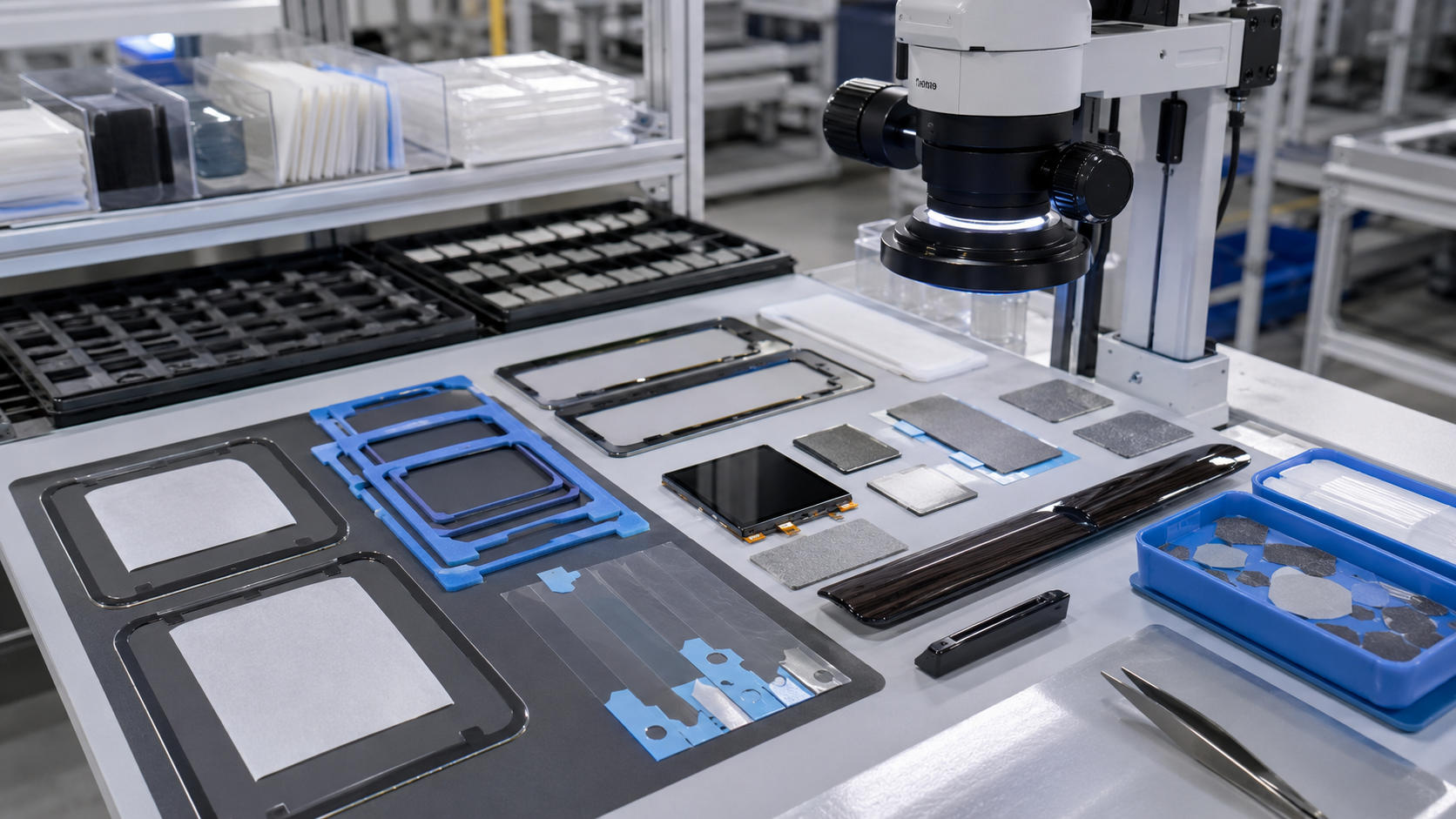
EV interiors often use large displays, touch panels, decorative films and glossy surfaces.
These areas require clean and precise die cut components.
Common parts include:
- Protective films
- Black light-blocking films
- OCA-related adhesive structures
- Foam spacers
- PET insulation films
- Adhesive tape frames
- Dust protection films
For display and protective film projects, optical film die cut components must be controlled carefully.
Dust, scratches, bubbles, adhesive overflow, film curling and poor liner release can all create visible defects.
The part may be small.
The defect may be very visible.
That is a bad combination.
Choose the Right Die Cutting Process
The right process depends on material, design and production volume.
Some parts are better made by flatbed die cutting.
Some are better made through rotary or roll-to-roll processing.
Some adhesive-backed parts need kiss cutting, so the part is cut while the release liner remains intact.
| Process | Best Used For |
|---|---|
| Flatbed die cutting | Thicker foam, rubber, felt and sheet materials |
| Rotary die cutting | High-volume roll materials and adhesive tapes |
| Kiss cutting | Adhesive-backed parts on release liner |
| Half cutting | Multilayer structures with controlled depth |
| Lamination + die cutting | Foam, film, adhesive and liner combinations |
For roll materials and high-volume adhesive-backed EV interior parts, roll-to-roll die cutting can improve consistency and production efficiency.
For process comparison, buyers can also review rotary and flatbed die cutting when choosing between production methods.
Check Tolerance and Edge Quality
Interior parts often have strict fit requirements.
A foam spacer that shifts may affect display assembly.
A felt pad that is too large may wrinkle.
A protective film with poor edge quality may create particles.
A tape frame with poor liner release may slow down assembly.
Important inspection points include:
| Inspection Item | Why It Matters |
|---|---|
| Dimensions | Ensures correct fit |
| Thickness | Controls compression and assembly gap |
| Hole position | Supports accurate positioning |
| Edge quality | Reduces particles and poor fitting |
| Adhesive placement | Prevents bonding failure |
| Liner release | Improves assembly efficiency |
| Surface cleanliness | Protects appearance-sensitive parts |
| Packaging condition | Prevents deformation before use |
For EV interiors, consistency is not optional.
The approved sample must match mass production.
Plan the Delivery Format Early
A good die cut component should be easy to use on the production line.
The delivery format can affect assembly speed, operator handling and defect risk.
| Delivery Format | Suitable Use |
|---|---|
| Individual pieces | Simple assembly or low-volume projects |
| Sheets | Manual picking and organized assembly |
| Rolls | Automated or high-volume application |
| Kiss-cut on liner | Adhesive-backed foam, felt, film and tape parts |
| Kits | Multi-part EV interior modules |
| Trays or bags | Parts that need deformation or surface protection |
For manual assembly, die cut parts supplied in sheets can make picking and placement easier.
For high-volume production, rolls may improve speed.
For interior modules with many small parts, kits can reduce missing parts and simplify assembly.
The best packaging is boring.
No deformation.
No sticking.
No missing parts.
No drama.
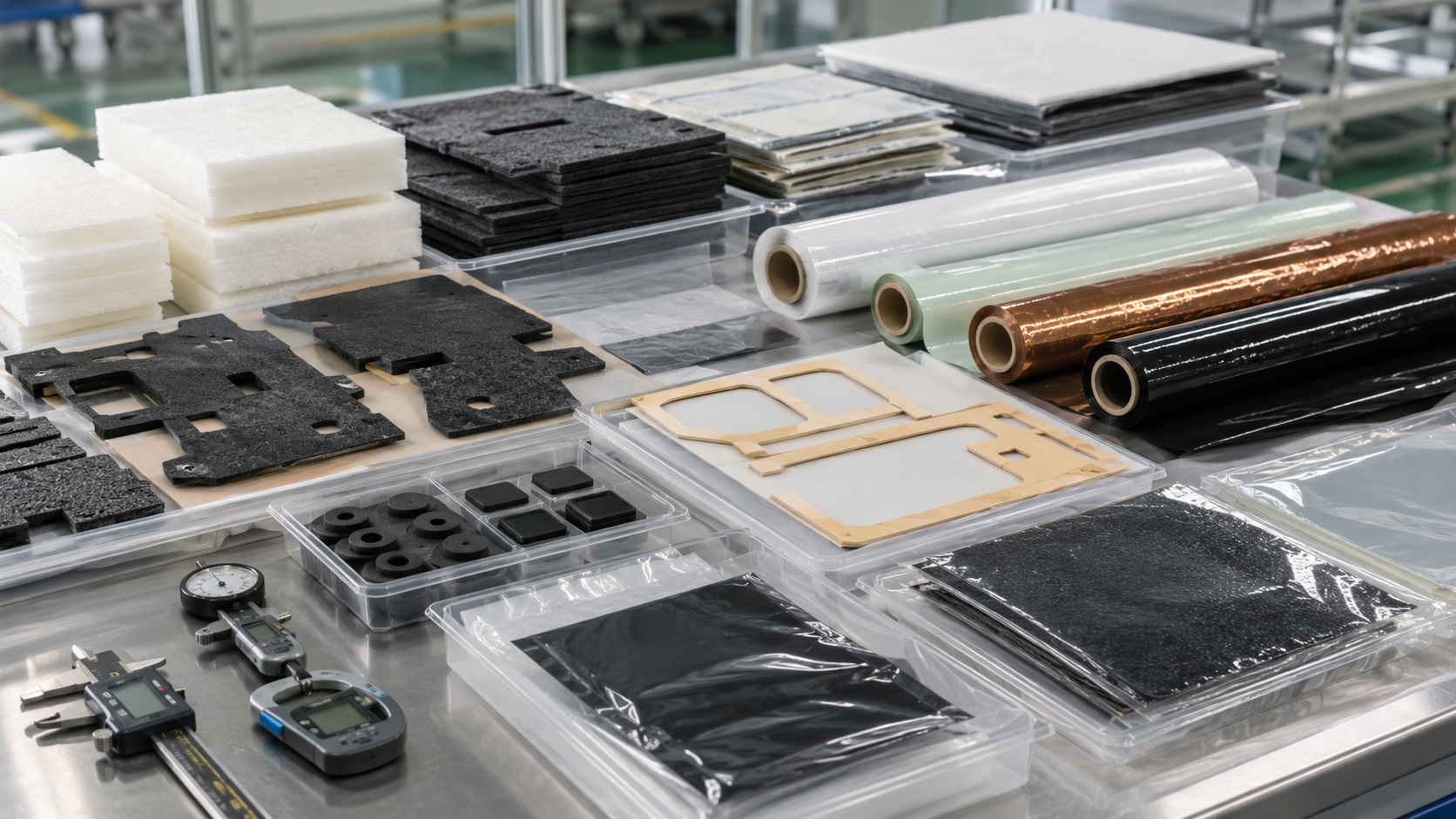
Buyer Checklist Before Choosing EV Interior Die Cut Parts
Before starting a project, prepare as much information as possible.
This helps reduce trial errors and speed up sampling.
Useful details include:
- Drawing or sample
- Interior application area
- Material preference
- Function requirement
- Thickness and tolerance
- Adhesive requirement
- Bonding surface
- Compression gap
- Noise or vibration issue
- Surface protection requirement
- Temperature range
- Cleanliness requirement
- Annual volume
- Delivery format
- Packaging preference
If the material is not confirmed, we can help compare foam, felt, rubber, PET film, PI film, protective film, adhesive tape and laminated structures.
For new OEM programs, buyers can also review how to choose the right die cutting manufacturer before moving from sample approval to mass production.
Need Die Cut Interior Components for Electric Vehicles?
Choosing EV interior die cut components requires a balance of material performance, bonding reliability, NVH control, surface protection, tolerance and assembly efficiency.
If you need custom die cut parts for OEM assembly, send us your drawing, sample, application location, material requirement, adhesive structure, tolerance, annual volume and packaging preference.
Sanken can help review material selection, die cutting method, lamination structure, inspection points and delivery format before mass production.
Conclusion
EV interior die cut components help reduce noise, protect surfaces, support bonding, control vibration, insulate electronics and improve assembly stability. The right choice depends on material, thickness, adhesive backing, tolerance, cleanliness and delivery format. Choose the component by function first. The shape comes after.
Related Articles
You may also find these articles helpful:
- What Die Cut Parts Are Used in Electric Vehicle Interior Assembly?
- Why Vehicles Have Noise and Vibration Problems — and How Die Cut NVH Parts Help
- Where Are Die Cut Parts Used in Automotive Manufacturing?
- What Is Die Cutting in Automotive OEM Manufacturing? Materials, Process, and Applications
- How Automation Improves Precision Die Cutting for Automotive OEM Parts
- Adhesive Backed Die Cut Components for OEM Assembly
- How Die Cutting Transforms Raw Materials Into Precision Components