
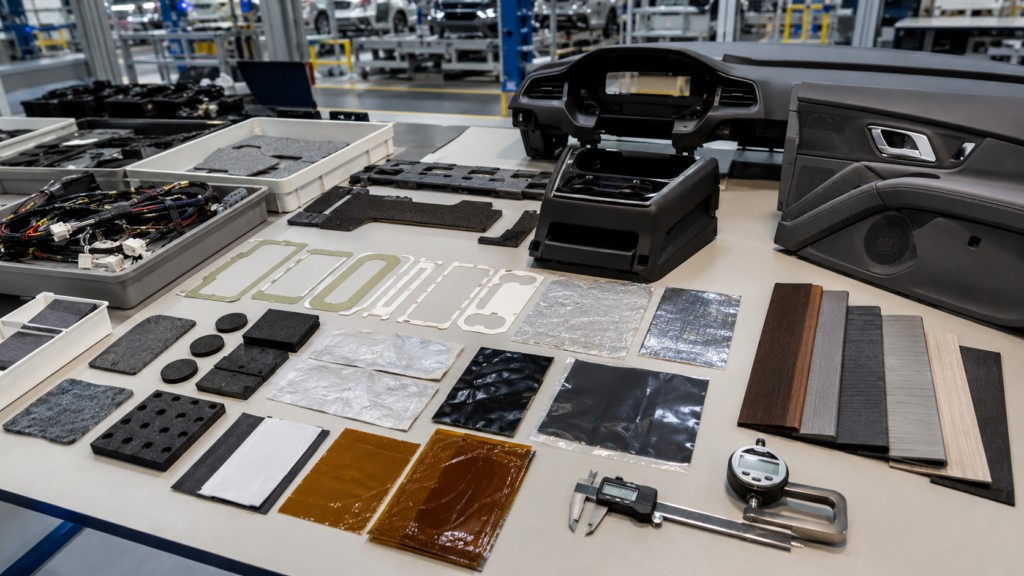
Electric vehicle interiors look clean, quiet and high-tech.
But behind the display, dashboard, door trim, center console, seats and wiring, many small die cut parts are doing the quiet work.
At Sanken, we use precision die cutting to manufacture foam, non-woven felt, rubber, adhesive tape, PET film, PI film, protective film and laminated parts for automotive OEM assembly.
These parts are usually hidden after installation.
But they help reduce noise, control vibration, protect surfaces, support bonding, seal gaps and make EV interior assembly more stable.
Why EV Interiors Need Die Cut Parts
EV interiors have more electronics, larger displays and quieter cabins than traditional vehicles.
That creates new assembly challenges.
When the cabin is quieter, small rattles become easier to hear.
When the display is larger, bonding and protection become more important.
When more electronic modules are used, insulation and dust protection matter more.
When lightweight design is required, foam, film and adhesive components often replace heavier parts.
For automotive die cut components, the value is not only the shape.
The value is stable function inside the final vehicle.
Common Die Cut Parts Used in EV Interior Assembly
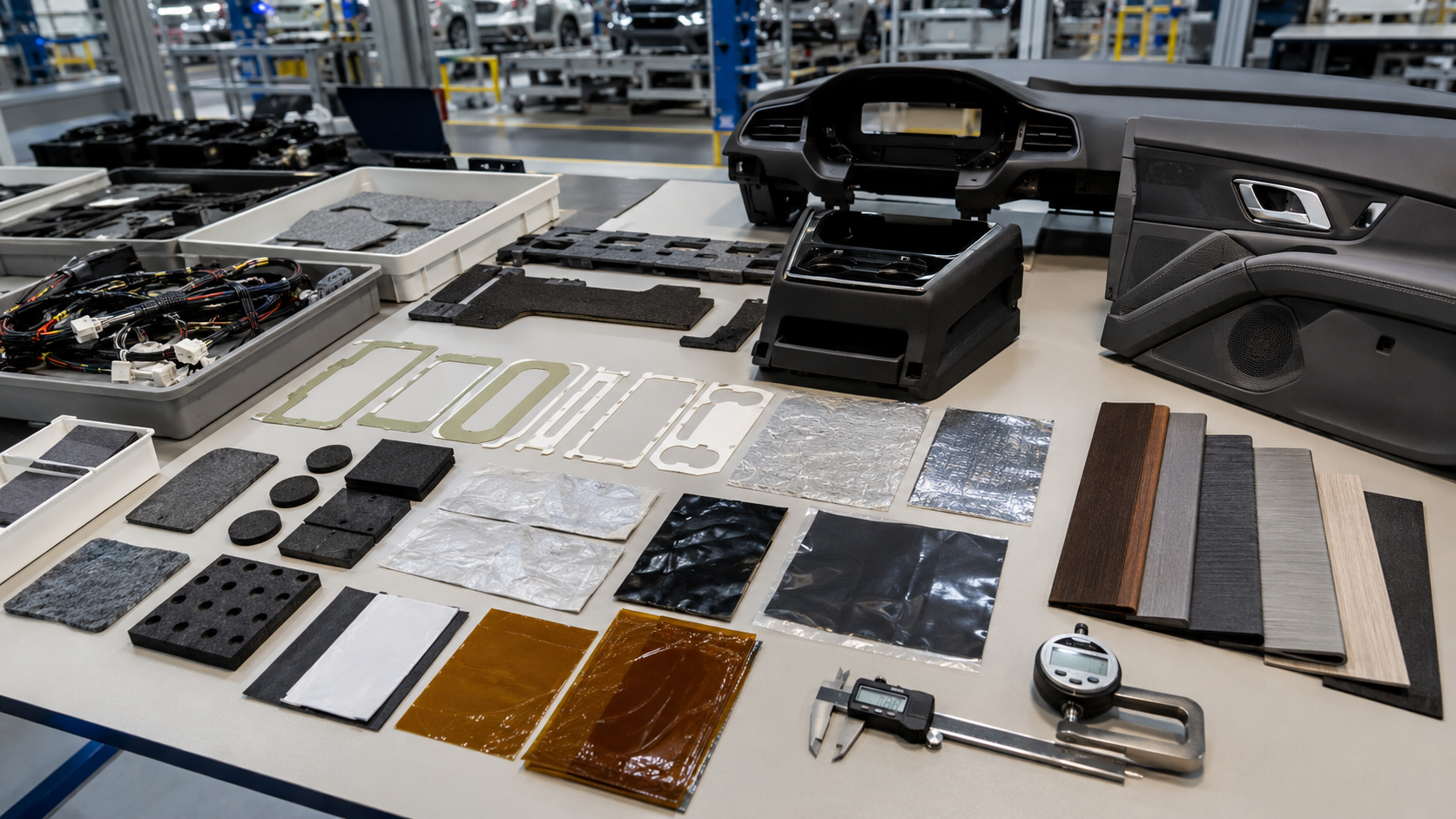
EV interior assembly uses many soft and functional die cut parts.
| Die Cut Part | Main Function |
|---|---|
| Foam pads | Cushioning, gap filling and anti-rattle protection |
| Non-woven felt pads | NVH control, anti-squeak and surface cushioning |
| Adhesive tape frames | Bonding, mounting and positioning |
| PET insulation films | Electrical insulation and protection |
| PI insulation films | Heat-resistant insulation in selected areas |
| Protective films | Surface protection during production and assembly |
| Rubber pads | Vibration damping and impact protection |
| Black light-blocking films | Prevent light leakage around display areas |
| EMI shielding materials | Reduce electromagnetic interference |
| Laminated structures | Combine bonding, cushioning, insulation and protection |
A single EV interior module may use several of these materials together.
That is why material converting and die cutting must work as one process.
Dashboard and Instrument Panel Parts
The dashboard is one of the most important EV interior areas.
It contains displays, vents, trim panels, electronic controls, wiring and decorative surfaces.
Die cut parts used in dashboard assembly may include:
- Foam anti-rattle pads
- Non-woven felt strips
- Adhesive-backed cushioning pads
- PET insulation films
- Protective films
- Rubber damping pads
- Display bonding tape frames
- Light-blocking film parts
These parts help prevent noise between plastic surfaces, protect decorative parts and support stable assembly.
If the foam is too thick, the trim may not fit.
If the felt pad is too thin, the noise may remain.
If the adhesive is weak, the part may lift after heat or vibration.
Small mistake.
Large complaint.
Center Console and Control Panel Parts
EV center consoles often include touch panels, switches, storage areas, lighting parts, charging modules and decorative panels.
Die cut parts are used for bonding, cushioning, sealing and surface protection.
Common examples include:
| Area | Typical Die Cut Parts |
|---|---|
| Touch control panel | Protective films, adhesive frames, PET films |
| Decorative panel | Surface protection films and foam pads |
| Storage area | Felt pads and anti-rattle foam |
| Charging module area | Insulation films and dust seals |
| Ambient lighting area | Black films and foam spacers |
For optical and display-related interiors, optical film die cut components may be used with protective films, light-blocking films, adhesive frames and foam spacers.
Clean cutting and clean packaging are important here.
A particle, scratch or adhesive overflow may create visible defects.
Display and Infotainment Assembly
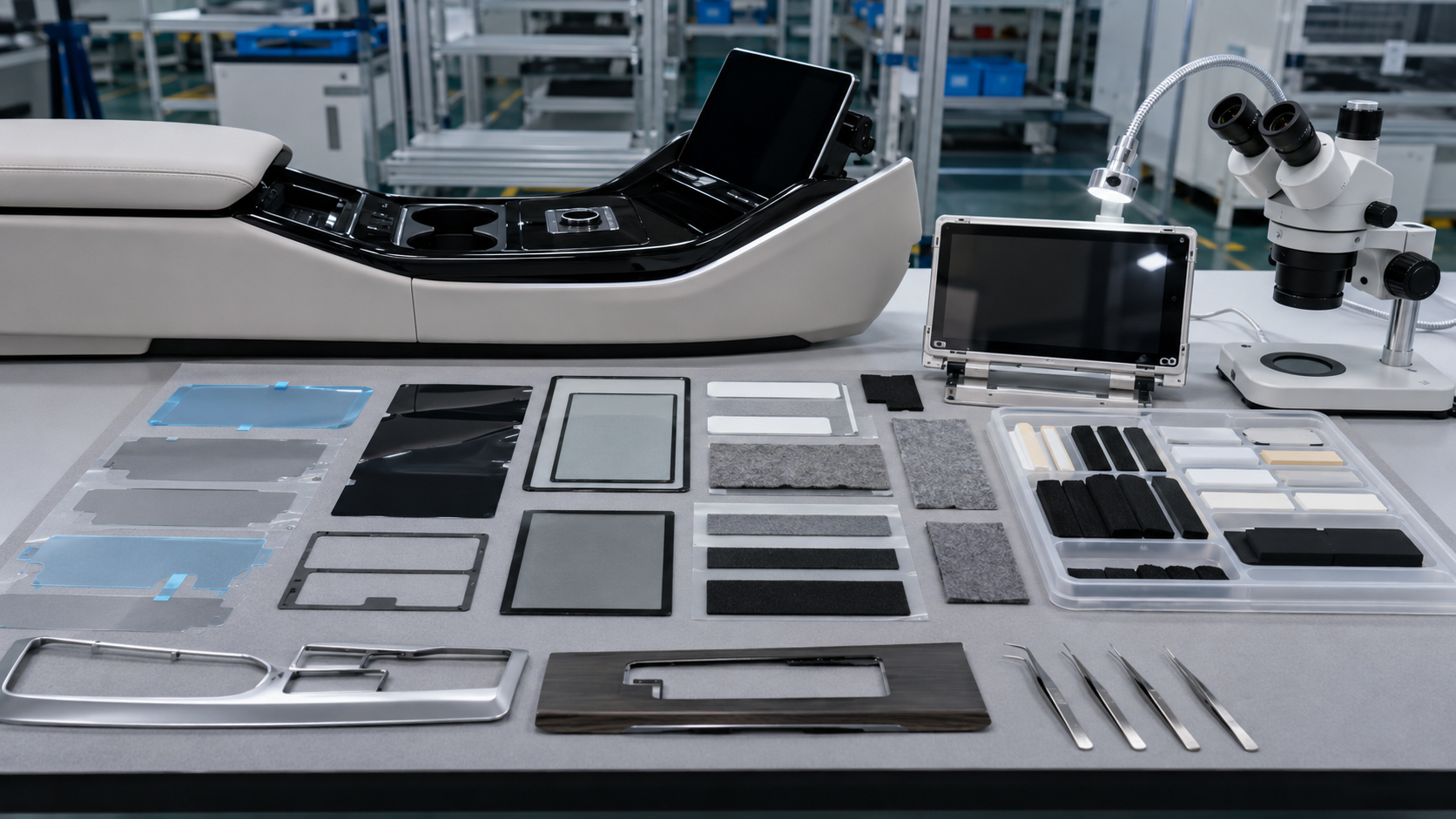
EV interiors often use wide displays, touch screens and infotainment systems.
These modules need thin, accurate and clean die cut components.
Common die cut parts include:
- Protective films
- OCA-related adhesive structures
- Double-sided adhesive tape frames
- Black PET light-blocking films
- Foam spacers
- PET insulation films
- EMI shielding parts
- Dust protection seals
Display parts need good dimensional accuracy.
They also need clean edges, stable adhesive position and smooth liner release.
If a tape frame shifts, bonding may fail.
If a protective film leaves residue, the surface may be rejected.
If a black film is not accurate, light leakage may appear.
This is why die cut display parts must be controlled from material selection to packaging.
Door Panels and Trim Assembly
Door panels use many die cut foam, felt and adhesive parts.
These parts reduce noise, prevent rattling and protect contact areas.
Common applications include:
- Felt pads between plastic trim parts
- Foam strips for gap filling
- Adhesive-backed anti-rattle pads
- Rubber cushioning pads
- Protective films for decorative surfaces
- Foam seals around speaker areas
- Wire harness protection pads
For sealing and cushioning needs, foam gaskets and sealing components can support door panels, speaker housings, interior trim and electronic module assembly.
The key is compression control.
The part must be soft enough to cushion, but stable enough to keep its function after long-term use.
Wire Harness and Interior Electronics Protection
EV interiors include many wiring systems, sensors, switches, control units and lighting modules.
Die cut parts help protect these components from vibration, abrasion, dust and contact damage.
Common materials include PET film, foam tape, non-woven felt, rubber pads and adhesive-backed insulation films.
For wire harness protection, flexibility matters.
The part must protect the cable without making installation difficult.
For electronic modules, insulation and cleanliness matter.
The part must cover the right area, stay in position and avoid particles.
This is where PET film, PI film, adhesive structures and clean die cutting become important.
Seats, HVAC and Acoustic Areas
EV cabin comfort depends heavily on NVH control.
NVH means noise, vibration and harshness.
Because EV powertrains are quieter, interior noise from trim, HVAC, seats and panels becomes more noticeable.
Die cut NVH parts may be used in:
| Interior Area | Die Cut NVH Parts |
|---|---|
| Seats | Foam pads, felt strips and cushioning parts |
| HVAC ducts | Foam seals and vibration pads |
| Speaker areas | Foam seals and acoustic cushioning |
| Floor and side panels | Felt pads and sound absorption parts |
| Motor or electronic areas | Rubber damping pads and foam insulation |
| Door panels | Anti-squeak felt and foam strips |
Non-woven felt, foam and rubber materials can help reduce rattling, absorb sound and isolate vibration.
For EV interiors, a quiet cabin is not only comfort.
It is part of the product experience.
How These Parts Are Manufactured
Most EV interior die cut parts are made through material converting and precision die cutting.
The process depends on material, thickness, adhesive structure and delivery format.
For foam processing details, buyers can review how die cutting works from foam rolls to finished parts.
A typical process includes:
| Step | Purpose |
|---|---|
| Application review | Confirm function, location and assembly method |
| Material selection | Choose foam, felt, film, rubber or adhesive material |
| Lamination | Combine adhesive, film, foam or liner if needed |
| Tooling design | Prepare die cutting tool based on drawing |
| Die cutting | Cut pads, frames, strips, films or gaskets |
| Waste removal | Remove unwanted material cleanly |
| Inspection | Check size, thickness, edge quality and adhesive position |
| Packaging | Protect parts from deformation, dust and damage |
For roll materials and high-volume adhesive-backed parts, roll-to-roll die cutting can improve consistency and production efficiency.
Delivery Formats for EV Interior Assembly
Delivery format affects how easily operators use the parts.
Some parts should be supplied in sheets.
Some should be supplied on rolls.
Some should be supplied as kits for specific modules.
| Delivery Format | Suitable Use |
|---|---|
| Sheets | Manual picking and organized assembly |
| Rolls | Automated or high-volume application |
| Kiss-cut on liner | Adhesive-backed foam, film and tape parts |
| Individual pieces | Simple assembly or low-volume use |
| Kits | Multi-part interior module assembly |
| Trays or bags | Parts needing deformation protection |
For assembly planning, this article explains how die cut parts supplied in sheets, rolls, or kits affect handling and production efficiency.
Good delivery format can reduce peeling difficulty, missing parts, deformation and line delays.
What Buyers Should Check Before Production
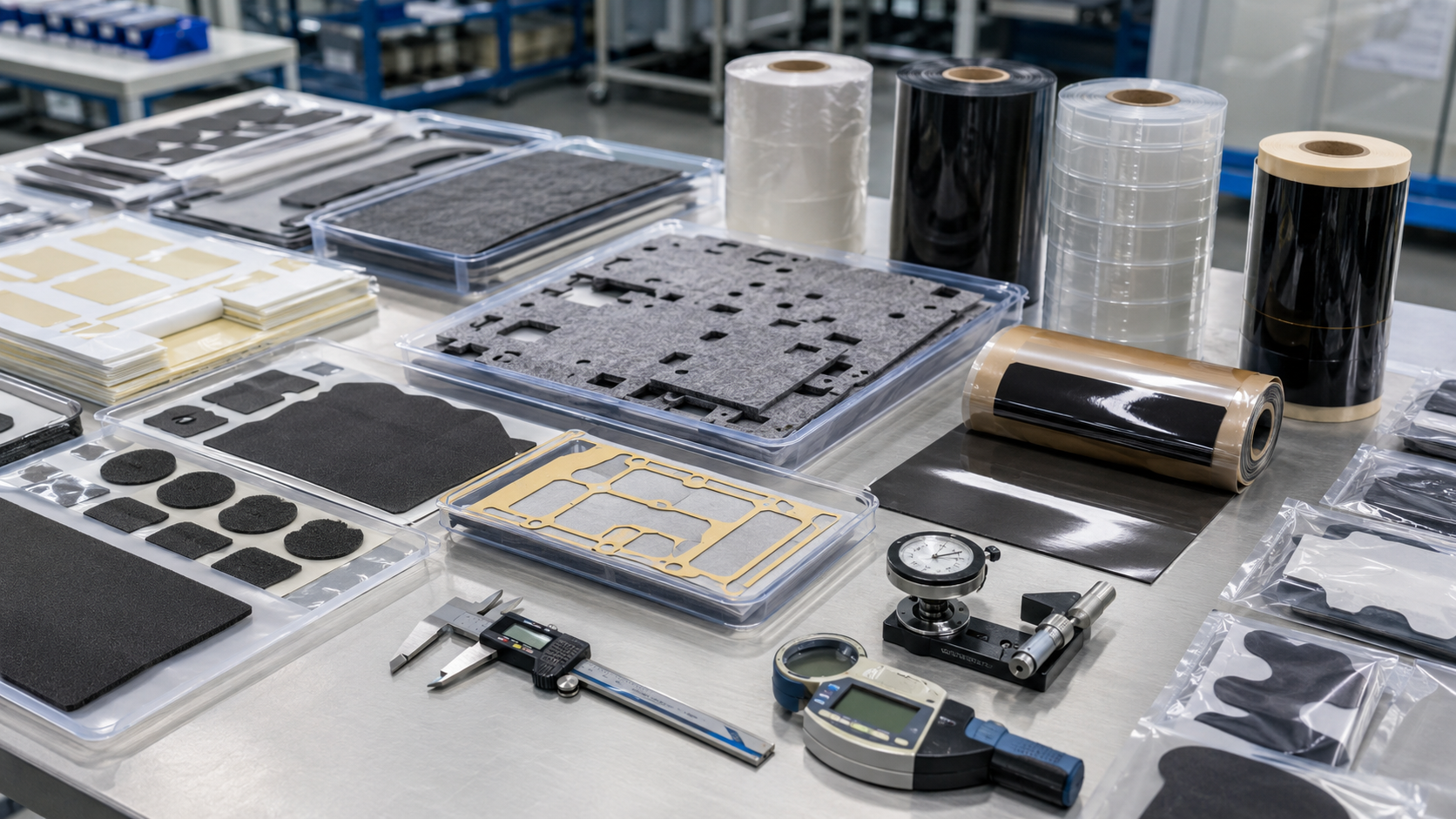
Before starting an EV interior die cut project, we recommend preparing clear project information.
Helpful details include:
- Drawing or sample
- Application location
- Material requirement
- Thickness and tolerance
- Adhesive requirement
- Bonding surface
- Compression gap
- Temperature range
- Noise or vibration issue
- Cleanliness requirement
- Annual volume
- Delivery format
- Packaging preference
- Testing requirement
If the material is not confirmed, we can help compare foam, non-woven felt, rubber, PET film, PI film, adhesive tape and laminated structures.
For new projects, buyers can also review how to choose the right die cutting manufacturer before moving from sample approval to mass production.
Need Die Cut Parts for Electric Vehicle Interior Assembly?
EV interior assembly needs many hidden die cut parts for bonding, cushioning, protection, insulation, NVH control and sealing.
The right material and delivery format can make assembly more stable and reduce production problems.
If you need custom die cut parts for OEM assembly, send us your drawing, sample, application location, material requirement, adhesive structure, tolerance, annual volume and packaging preference.
Sanken can help review material selection, die cutting method, lamination structure, inspection points and delivery format before mass production.
Related Articles
You may also find these articles helpful:
- Where Are Die Cut Parts Used in Automotive Manufacturing?
- What Is Die Cutting in Automotive OEM Manufacturing? Materials, Process, and Applications
- How Automation Improves Precision Die Cutting for Automotive OEM Parts
- Why Vehicles Have Noise and Vibration Problems — and How Die Cut NVH Parts Help
- Adhesive Backed Die Cut Components for OEM Assembly
- The Hidden Manufacturing Process Inside Cars, Phones and Medical Devices
- How Die Cutting Transforms Raw Materials Into Precision Components
Conclusion
Electric vehicle interior assembly uses many die cut parts, including foam pads, felt NVH parts, adhesive tape frames, PET films, protective films, rubber pads and laminated components. These hidden parts help improve bonding, cushioning, noise control, protection, insulation and assembly stability in modern EV cabins.