
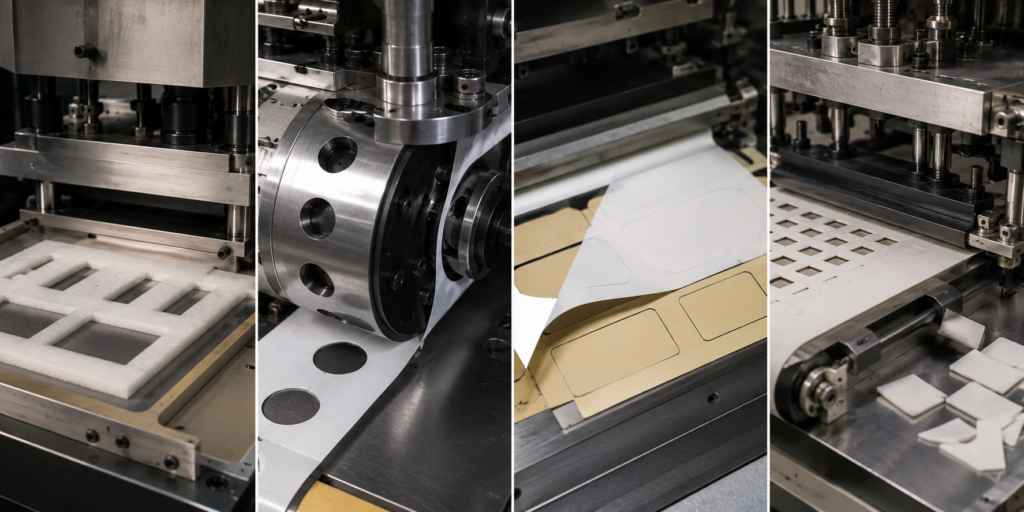
What Are the Facts About Die Cutting?
Die cutting is a manufacturing process that uses a shaped tool, called a die, to cut materials into specific shapes with repeatable accuracy. It is widely used for foam pads, rubber gaskets, adhesive tape parts, non-woven components, protective films, insulation layers, labels, packaging inserts, and multilayer industrial parts.
For OEM buyers and engineers, the most important fact about die cutting is this: die cutting is not only about cutting a shape. It is about making parts that fit, assemble, protect, seal, cushion, insulate, bond, or reduce noise consistently in mass production.
A die-cut part may look simple, but if the material, tolerance, adhesive, liner, tooling, or process is wrong, the final product may suffer from poor fit, edge defects, adhesive lifting, fiber shedding, compression failure, or assembly delays.
At Sanken Manufacturing, we help customers convert foam, rubber, non-woven fabric, adhesive tape, PET film, TPU film, insulation materials, and composite materials into precision die-cut components for automotive, electronics, medical, packaging, and industrial applications.
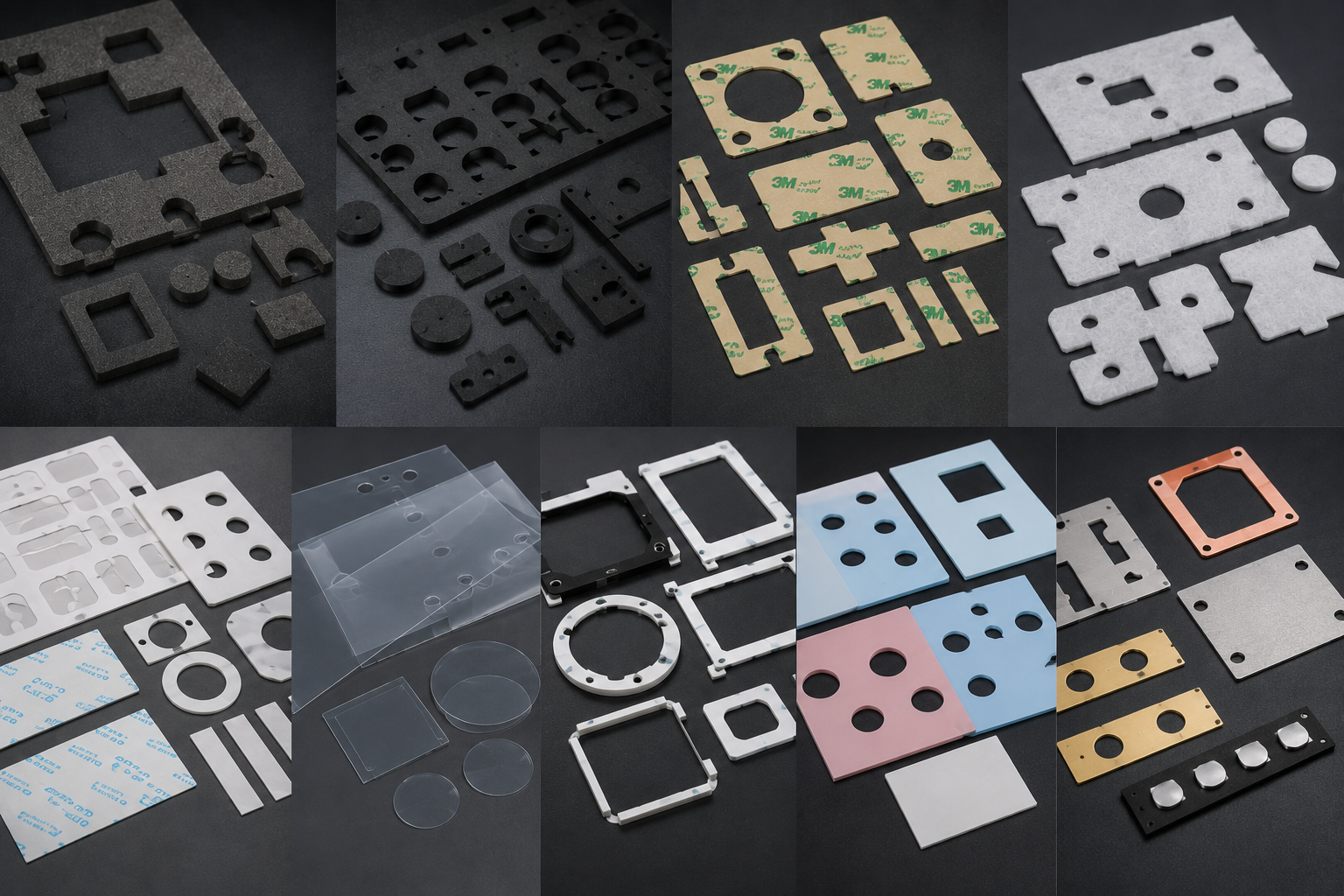
Fact 1: Die Cutting Uses a Custom Tool Called a Die
The word “die” refers to the custom cutting tool used to create a specific shape.
A die can cut:
- Outer profiles
- Holes
- Slots
- Windows
- Gaskets
- Pads
- Strips
- Spacers
- Protective liners
- Adhesive-backed parts
Once the die is made, it can produce the same shape repeatedly. This is why die cutting is useful for mass production.
Manual cutting may work for a few samples, but it cannot provide the same repeatability for thousands or millions of parts.
Fact 2: Die Cutting Works With Many Materials
Die cutting is used across many industries because it can process a wide range of flexible and semi-rigid materials.
Common die-cut materials include:
| Material | Common Die-Cut Use |
|---|---|
| EVA foam | Cushioning pads, packaging inserts, anti-rattle parts |
| PE foam | Spacers, liners, protective pads |
| PU foam | Acoustic pads, soft cushioning layers |
| Rubber | Gaskets, seals, vibration damping parts |
| Non-woven fabric | Filters, acoustic pads, dust barriers |
| Adhesive tape | Mounting strips, bonding parts, assembly aids |
| PET film | Insulation, protective layers, electronic parts |
| TPU film | Flexible protective parts and soft films |
| Optical film | Display protection and functional layers |
| Composite materials | Multilayer sealing, cushioning, and insulation parts |
The material must be selected based on the final application. A material that is easy to cut may still fail if it cannot handle compression, heat, humidity, vibration, or bonding requirements.
Fact 3: Die Cutting Is Different From Simple Cutting
Die cutting is not the same as cutting with scissors, knives, or basic blades.
Simple cutting is usually manual and inconsistent. Die cutting uses tooling and controlled pressure to create repeatable parts.
This matters when the part must meet:
- Dimensional requirements
- Assembly fit
- Edge quality standards
- Adhesive alignment
- Hole position accuracy
- Thickness stack-up requirements
- Production volume targets
For industrial customers, consistency is often more important than one perfect sample.
A supplier must be able to produce the same quality repeatedly.
Fact 4: There Are Different Types of Die Cutting
Different die-cutting methods are used for different materials and production needs.
Flatbed Die Cutting
Flatbed die cutting uses a flat die and pressure to cut sheet materials.
It is often used for:
- Thick foam pads
- Rubber gaskets
- Non-woven acoustic parts
- Packaging inserts
- Prototype and medium-volume production
Rotary Die Cutting
Rotary die cutting uses a cylindrical die to process roll materials continuously.
It is commonly used for:
- Adhesive tapes
- Thin films
- Labels
- Protective films
- High-volume roll-to-roll parts
Kiss Cutting
Kiss cutting cuts only the top layer of a material while leaving the release liner intact.
It is useful for:
- Adhesive-backed foam
- Double-sided tape parts
- Protective films
- Labels
- Medical adhesive components
- Electronics assembly parts
Steel Rule Die Cutting
Steel rule die cutting uses sharp steel blades formed into a custom shape.
It is commonly used for foam, rubber, paper, non-woven fabric, packaging materials, and many flexible components.
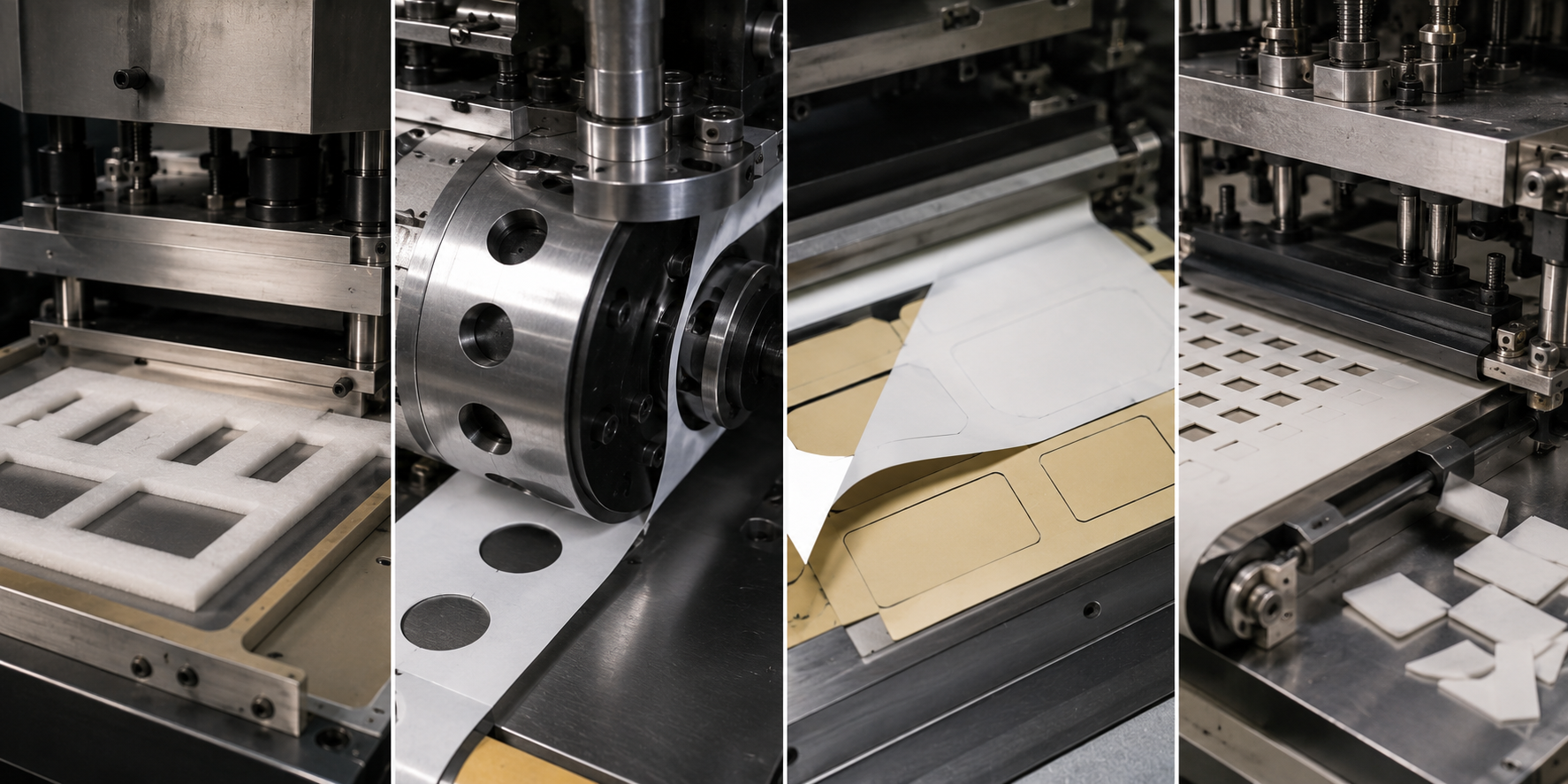
Fact 5: Die-Cut Tolerance Depends on the Material
Many buyers assume die cutting always creates the same tolerance, but this is not true.
Tolerance depends on:
- Material type
- Thickness
- Density
- Elasticity
- Adhesive backing
- Part size
- Hole size
- Shape complexity
- Tooling design
- Production method
Soft materials behave differently from hard materials.
Foam can compress.
Rubber can rebound.
Adhesive can flow.
Non-woven fabric can fray or shed fibers.
Thin films can stretch or curl.
This means tolerance must be discussed based on the actual material and final function.
For example, a PET film part may hold tighter tolerance than a thick soft foam pad. A rubber gasket may need a different tolerance strategy because rubber can deform after cutting.
Fact 6: Die Cutting Can Improve Assembly Efficiency
One major benefit of die cutting is that it can turn raw material into ready-to-assemble parts.
For example:
- Foam pads can be supplied with adhesive backing.
- Tape parts can be kiss cut on release liners.
- Gaskets can be packed in sheets for fast handling.
- Protective films can include pull tabs.
- Multilayer components can be pre-laminated.
This helps reduce manual work, improve placement accuracy, and speed up production.
For OEM buyers, this can be more valuable than simply reducing material cost.
A well-designed die-cut part can reduce labor time, scrap, and assembly errors.
Fact 7: Die Cutting Is Often Used for Hidden Functional Parts
Many die-cut parts are not visible to the final user.
They may be hidden inside:
- Car doors
- Dashboards
- Display modules
- Battery packs
- Medical devices
- Speakers
- Industrial machines
- Packaging trays
- Electronic housings
Even though these parts are hidden, they perform important functions.
They may reduce noise, absorb vibration, seal gaps, protect surfaces, insulate electricity, block dust, or cushion delicate components.
A small die-cut foam pad may prevent a vehicle rattle.
A thin die-cut PET film may protect an electronic circuit.
A rubber gasket may prevent leakage.
A non-woven pad may absorb sound inside a product.
Small parts often prevent large problems.
Fact 8: Adhesive Selection Is Critical
Many die-cut parts include adhesive backing.
Adhesive can make assembly easier, but it also creates risk if not selected correctly.
Poor adhesive selection may cause:
- Edge lifting
- Peeling
- Delamination
- Adhesive residue
- Weak bonding
- Liner separation
- Difficult application
- Failure after heat aging
The adhesive must match the material surface and the final application environment.
For example, bonding to plastic, metal, glass, foam, rubber, or coated surfaces may require different adhesive systems.
At Sanken, we review the full structure: base material, adhesive, release liner, bonding surface, temperature, compression, and assembly method.
Fact 9: Edge Quality Matters
Edge quality affects both appearance and performance.
Poor die-cut edges can cause:
- Loose fibers
- Rough surfaces
- Burrs
- Dust
- Adhesive overflow
- Poor sealing
- Difficult installation
- Higher rejection rates
For electronics, optical films, medical components, and clean assembly products, edge cleanliness is especially important.
For non-woven materials, the supplier must control fiber shedding.
For adhesive films, the supplier must prevent adhesive bleeding.
For foam parts, the supplier must avoid compression deformation.
For rubber parts, the supplier must manage rebound and tearing risk.
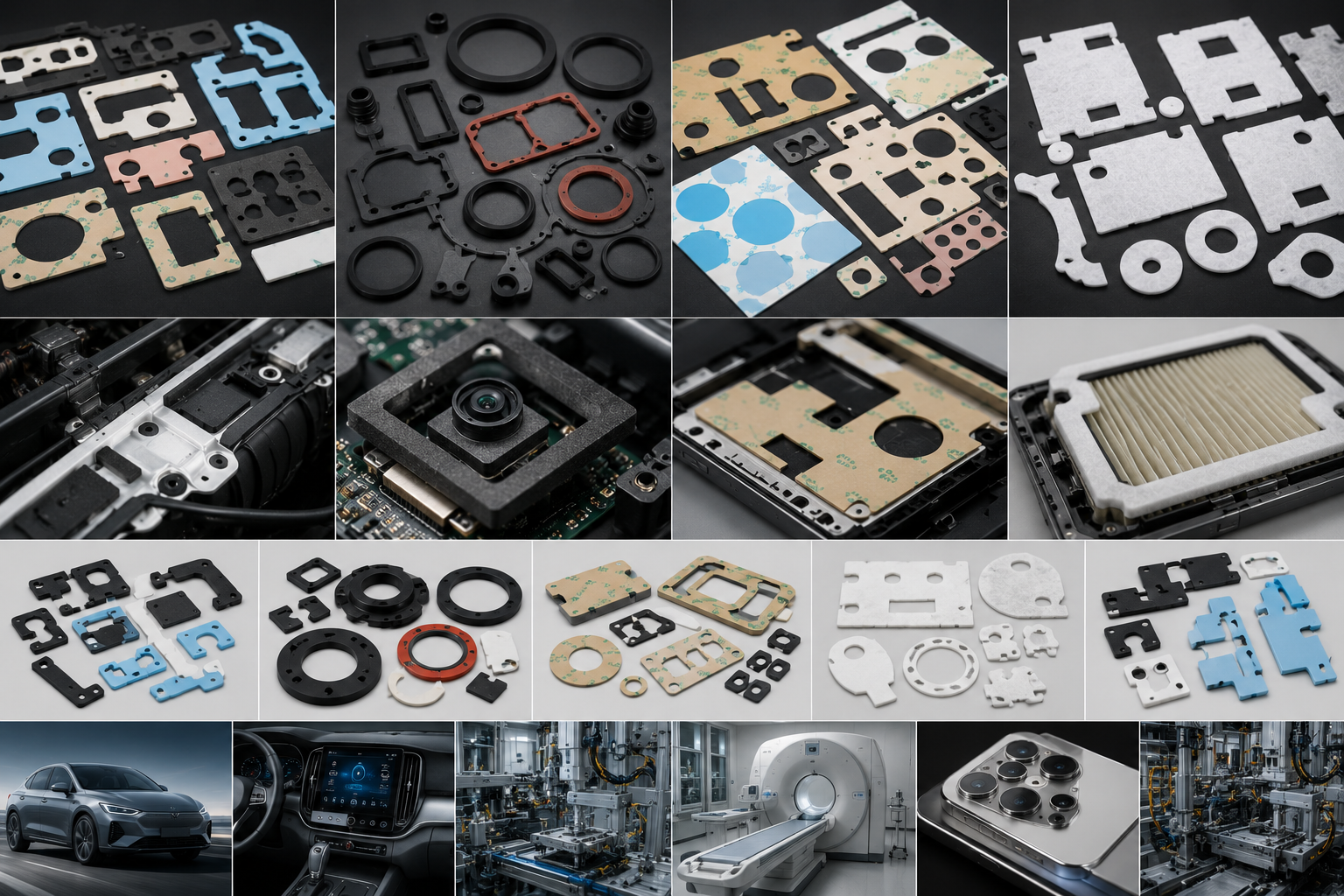
Fact 10: Die Cutting Can Support Multilayer Structures
Many modern products need more than one material function.
A part may need cushioning, bonding, insulation, sound absorption, sealing, and protection at the same time.
This is why multilayer die-cut components are common.
Examples include:
| Structure | Function |
|---|---|
| Foam + adhesive | Cushioning and easy installation |
| Non-woven + adhesive | Dust protection and bonding |
| PET film + adhesive | Insulation and protection |
| Foam + film | Cushioning and surface stability |
| Rubber + adhesive | Sealing and assembly support |
| Non-woven + foam | Acoustic absorption and cushioning |
| Optical film + liner | Display protection and clean assembly |
Multilayer die cutting requires strong process control because each layer may behave differently during cutting, lamination, and waste stripping.
Fact 11: Die Cutting Reduces Waste When Designed Correctly
Good die-cut design can improve material utilization.
This is important when materials are expensive, laminated, adhesive-backed, or used in high volume.
Waste reduction depends on:
- Part layout
- Roll width
- Sheet size
- Nesting design
- Waste stripping method
- Material direction
- Production format
A supplier with converting experience can help customers reduce waste before mass production starts.
This can lower total cost without reducing material quality.
Fact 12: Die Cutting Requires Early Design Review
Many die-cut problems can be avoided if the supplier is involved early.
Before tooling, buyers should confirm:
- What is the final application?
- What material should be used?
- Does the part need adhesive backing?
- What tolerance is truly required?
- Will the part face heat, humidity, compression, or vibration?
- Will it be applied manually or automatically?
- Are there small holes or narrow strips?
- Does the material need lamination?
- What edge quality is required?
- Is the project for prototype testing or mass production?
These questions help avoid wrong materials, unrealistic tolerance, poor adhesion, and tooling changes.
How Sanken Helps Customers With Die-Cut Components
At Sanken Manufacturing, we focus on helping customers solve real production problems.
Our capabilities include:
- Precision die cutting
- Kiss cutting
- Foam converting
- Rubber processing
- Non-woven fabric converting
- Adhesive tape lamination
- Film converting
- Protective film processing
- Hot pressing
- Injection molding support
- Custom assembly
- Prototype and mass production support
We work with customers in automotive, electronics, medical, packaging, and industrial markets.
Our goal is not simply to cut a shape. Our goal is to help customers receive stable, reliable, ready-to-assemble components that reduce production risk and improve product performance.
Conclusion
The key facts about die cutting are simple but important. Die cutting uses a custom die to cut materials into repeatable shapes. It works with foam, rubber, adhesive tape, non-woven fabric, films, and composite materials. It improves consistency, assembly efficiency, material utilization, and production stability.
However, successful die cutting depends on the right material, realistic tolerance, proper tooling, adhesive compatibility, edge quality, and process control.
For OEM buyers, die cutting is not only a manufacturing step. It is a way to reduce risk, improve assembly, and create functional components that perform reliably in the final product. At Sanken Manufacturing, we help customers develop precision die-cut parts that solve real challenges in automotive, electronics, medical, packaging, and industrial applications.