
What Is the Difference Between Perforation and Die Cutting?
Perforation and die cutting are two widely used converting processes in packaging, printing, labels, consumer electronics, medical products, automotive components, and industrial manufacturing.
Although both processes involve cutting materials using specialized tooling, they serve very different purposes and produce significantly different results.
Many product designers, purchasing managers, and engineers confuse perforation with die cutting because both use cutting dies and can be performed on similar equipment. However, selecting the wrong process can affect product functionality, assembly efficiency, customer experience, and manufacturing costs.
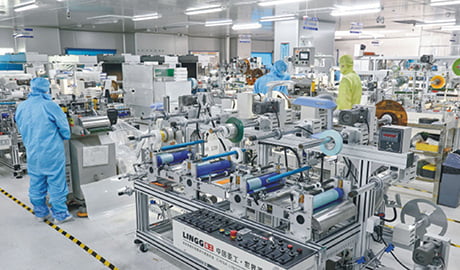
At Sanken Manufacturing Co., Ltd., we help OEM manufacturers develop precision converting solutions involving die cutting, kiss cutting, perforating, laminating, and material processing for a wide range of industrial applications.
So what exactly is the difference between perforation and die cutting?
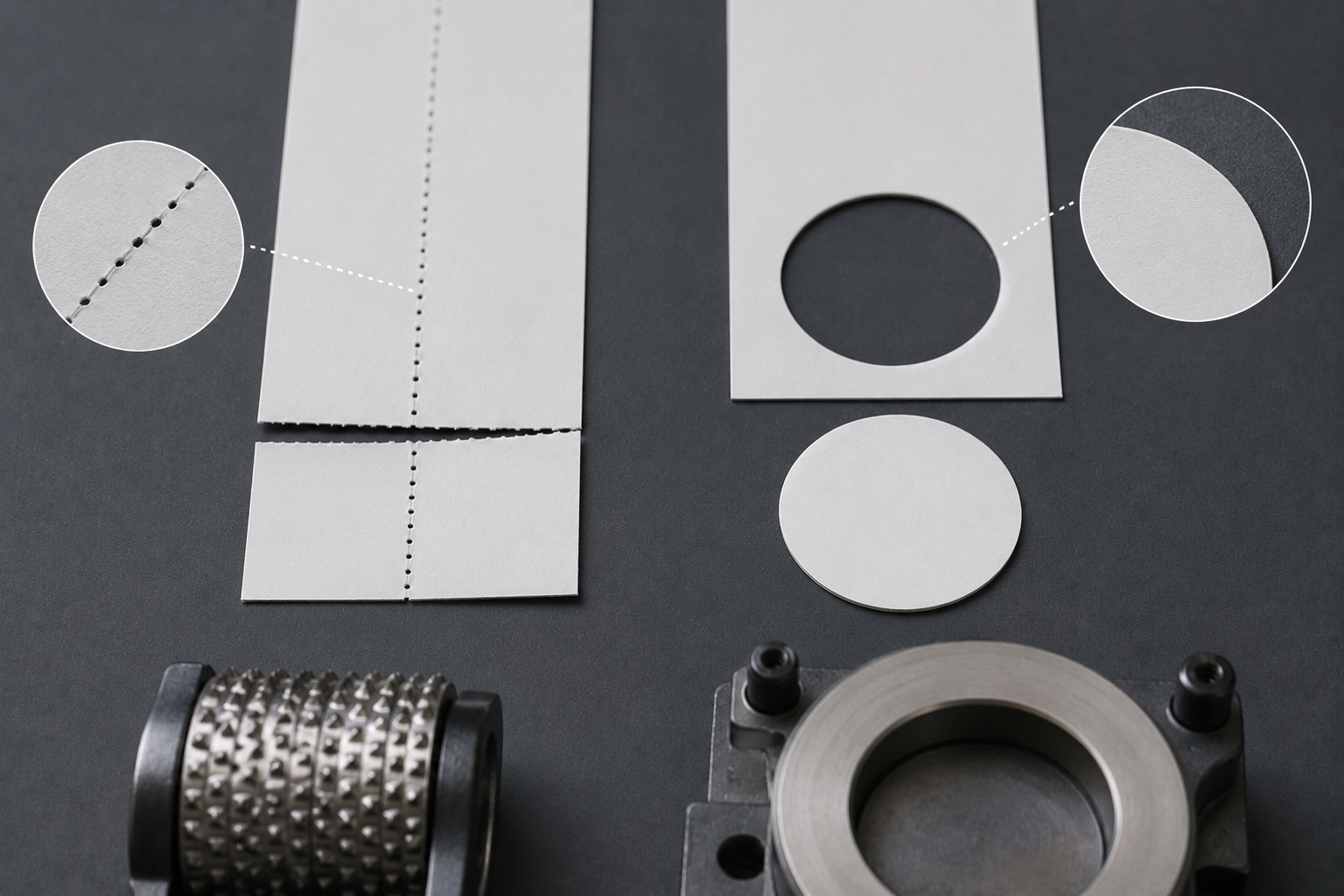
Understanding these two processes helps manufacturers choose the most effective converting solution for their products.
What Is Perforation?
Perforation is a cutting process that creates a series of small holes or partial cuts along a predetermined line.
Unlike a complete cut, perforation leaves small material bridges connecting the material.
These bridges allow the material to remain attached until separation is required.
How Perforation Works
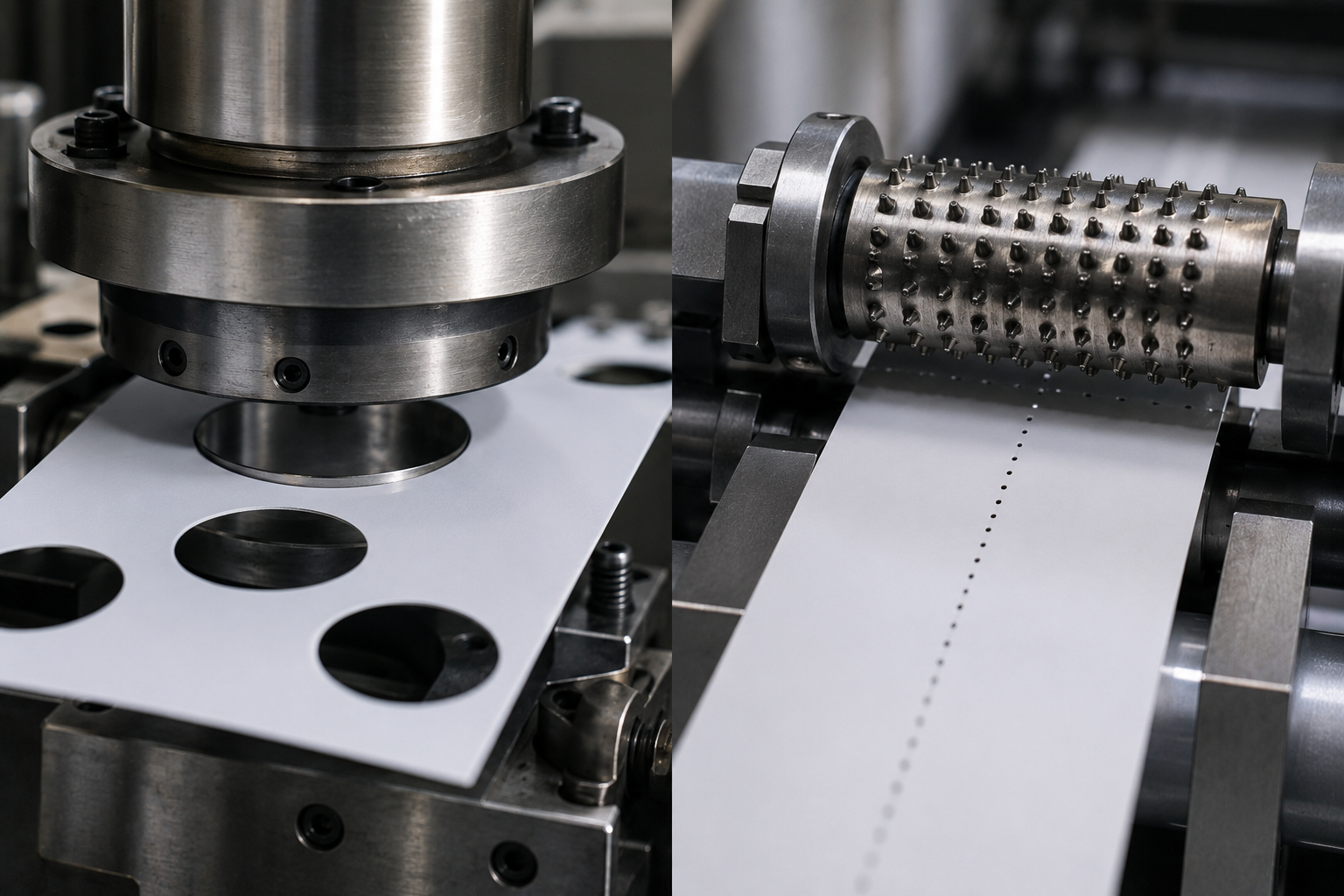
A perforating tool creates alternating:
- Cut sections
- Uncut sections
The result is a tearable line.
Common perforation patterns include:
| Type | Description |
|---|---|
| Micro Perforation | Very small tear points |
| Standard Perforation | Medium tear resistance |
| Heavy Perforation | Easier separation |
| Custom Perforation | Application-specific design |
The pattern can be customized according to tearing force requirements.
Typical Applications
Perforation is commonly used for:
- Coupons
- Tickets
- Packaging tear strips
- Mailing materials
- Medical packaging
- Protective liners
The goal is controlled separation rather than complete part removal.
What Is Die Cutting?
Die cutting is a converting process that completely cuts through material to create a finished shape or component.
A steel rule die or precision rotary die applies pressure to cut the material according to a specific design.
How Die Cutting Works
The die follows the desired geometry and completely separates the part from surrounding material.
Common die-cut products include:
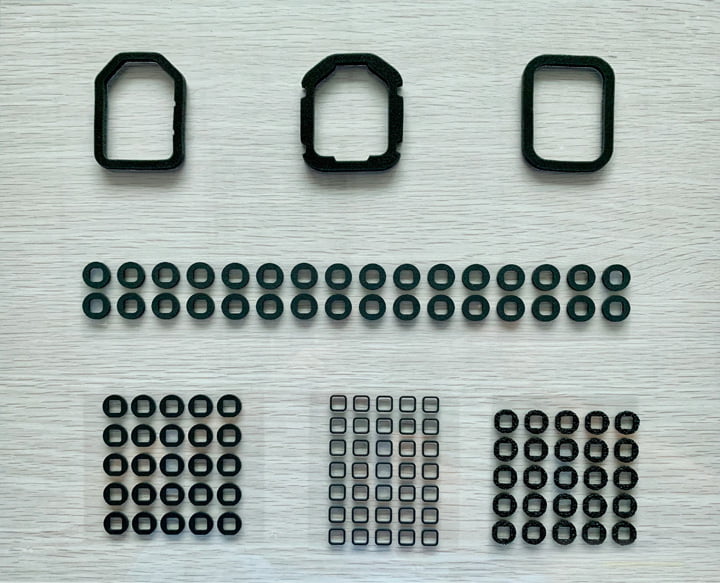
- Adhesive gaskets
- Foam components
- Insulation materials
- Optical films
- EMI shielding parts
- Labels
- Packaging inserts
The finished part is ready for assembly or use.
Types of Die Cutting
Common die-cutting methods include:
| Process | Description |
|---|---|
| Full Die Cutting | Complete material separation |
| Kiss Cutting | Cuts material but leaves liner intact |
| Rotary Die Cutting | High-speed continuous processing |
| Flatbed Die Cutting | Suitable for thicker materials |
Each process is selected based on product requirements.
Main Difference Between Perforation and Die Cutting
The fundamental difference lies in whether the material remains connected.
Perforation
Perforation:
- Creates partial cuts
- Leaves material attached
- Allows controlled tearing
Die Cutting
Die cutting:
- Creates complete cuts
- Separates finished parts
- Produces final component shapes
This distinction determines which process is appropriate for a particular application.
Visual Comparison
| Feature | Perforation | Die Cutting |
|---|---|---|
| Complete Cut | No | Yes |
| Material Separation | Controlled Tear | Immediate |
| Finished Part Creation | No | Yes |
| Tear Line Function | Yes | No |
| Assembly Component Production | Limited | Excellent |
Manufacturers should select the process based on the product's intended function.
Advantages of Perforation
Perforation provides several benefits when controlled separation is required.
Easy User Removal
Consumers can easily separate:
- Coupons
- Receipts
- Labels
- Packaging sections
No tools are required.
Material Retention
Because the material remains attached:
- Parts are not lost during production
- Packaging integrity is maintained
- Handling becomes easier
This is especially useful in packaging applications.
Lower Processing Complexity
In some applications, perforation can reduce processing requirements compared with complete die cutting.
Advantages of Die Cutting
Die cutting offers unique advantages for component manufacturing.
Precise Custom Shapes
Die cutting allows manufacturers to create:
- Complex geometries
- Small openings
- Multi-feature designs
- Precision components
This flexibility supports modern product designs.
Improved Assembly Efficiency
Pre-cut components can be:
- Picked automatically
- Positioned accurately
- Installed quickly
This improves manufacturing productivity.
Tight Tolerances
Precision die cutting supports:
- Consistent dimensions
- Repeatable production
- High-quality assemblies
These capabilities are essential in electronics and medical industries.
Applications in Packaging
Packaging is one of the largest markets for both technologies.
Perforation Applications
Common examples include:
- Tear-open cartons
- Easy-open pouches
- Retail packaging
- Shipping documents
Perforation improves user convenience.
Die Cutting Applications
Examples include:
- Packaging inserts
- Protective pads
- Product trays
- Structural packaging components
Die cutting helps create custom packaging solutions.
Applications in Consumer Electronics
Perforation and die cutting serve different purposes in electronics manufacturing.
Perforation Uses
Applications may include:
- Release liners
- Protective films
- Temporary assembly aids
Die Cutting Uses
Far more common in electronics production.
Examples include:
- PET frame tapes
- Optical films
- EMI shielding materials
- Thermal management components
- Battery insulation materials
Precision die cutting enables accurate component manufacturing.
Applications in Medical Products
Medical devices frequently use both processes.
Perforation
Used for:
- Sterile package opening features
- Medical pouches
- Disposable products
Die Cutting
Used for:
- Medical adhesives
- Diagnostic components
- Wearable patches
- Gaskets
Each process serves a distinct functional purpose.
Cost Considerations
Cost depends on several factors.
Perforation Costs
Generally lower when:
- Simple tear lines are required
- Minimal material removal occurs
Die Cutting Costs
May involve:
- More complex tooling
- Higher precision requirements
- Additional material handling
However, die cutting often reduces assembly costs by supplying ready-to-use components.
Manufacturers should evaluate total production cost rather than tooling cost alone.
Choosing Between Perforation and Die Cutting
The decision depends on the intended product function.
Choose perforation when:
- Material must remain attached
- Controlled tearing is required
- User separation is desired
Choose die cutting when:
- A finished component is needed
- Precise shapes are required
- Automated assembly is involved
Understanding the final application is the key to selecting the correct process.
How Sanken Supports Converting Projects
At Sanken Manufacturing Co., Ltd., we provide precision converting solutions for industrial materials used in electronics, automotive products, medical devices, and consumer goods.
Our capabilities include:
- Precision die cutting
- Rotary die cutting
- Kiss cutting
- Perforation processing
- Laminating
- Foam converting
- Optical film processing
- EMI shielding component manufacturing
- Rapid prototyping
- High-volume production
We help customers select the most efficient converting technology according to product requirements and manufacturing goals.
Frequently Asked Questions
Is perforation a type of die cutting?
Perforation uses similar tooling principles but does not completely cut through the material. It is generally considered a separate converting process.
Can the same machine perform both processes?
Yes. Many rotary and flatbed converting systems can perform both perforation and die cutting depending on tooling configuration.
Which process is better for adhesive components?
Die cutting is typically preferred because it creates finished components ready for assembly.
Why do packaging products use perforation?
Perforation allows consumers to easily open or separate sections without completely removing material during manufacturing.
Conclusion
Perforation and die cutting may appear similar, but they serve fundamentally different purposes.
Perforation creates controlled tear lines while keeping materials connected, whereas die cutting completely separates materials to create finished components.
Choosing the correct process improves product functionality, manufacturing efficiency, user experience, and overall product quality.
At Sanken, we help OEM manufacturers develop customized perforation and precision die-cutting solutions that support high-performance products across multiple industries.