

What Are Foam Sheets Used For? A Practical Guide for OEM Buyers
Foam sheets are used for cushioning, sealing support, vibration reduction, sound control, insulation, surface protection, packaging, and custom die-cut components. They may look simple, but the wrong foam sheet can create serious production problems.
A buyer may choose foam only by thickness or price. Later, the part collapses under pressure, peels after adhesive backing, smells after heat exposure, or fails to fit during assembly. That is why foam sheet selection should start from the final application, not from the material name alone.
For OEM buyers, the better question is not only “What are foam sheets used for?” The better question is: “Which foam sheet structure can solve my product problem with stable mass production performance?”
At Sanken Manufacturing, we help customers convert EVA foam, PE foam, PU foam, EPDM foam, rubber foam, adhesive-backed foam, and multilayer foam materials into precision die-cut parts for automotive, electronics, packaging, medical equipment, consumer products, and industrial applications.
What Are Foam Sheets?
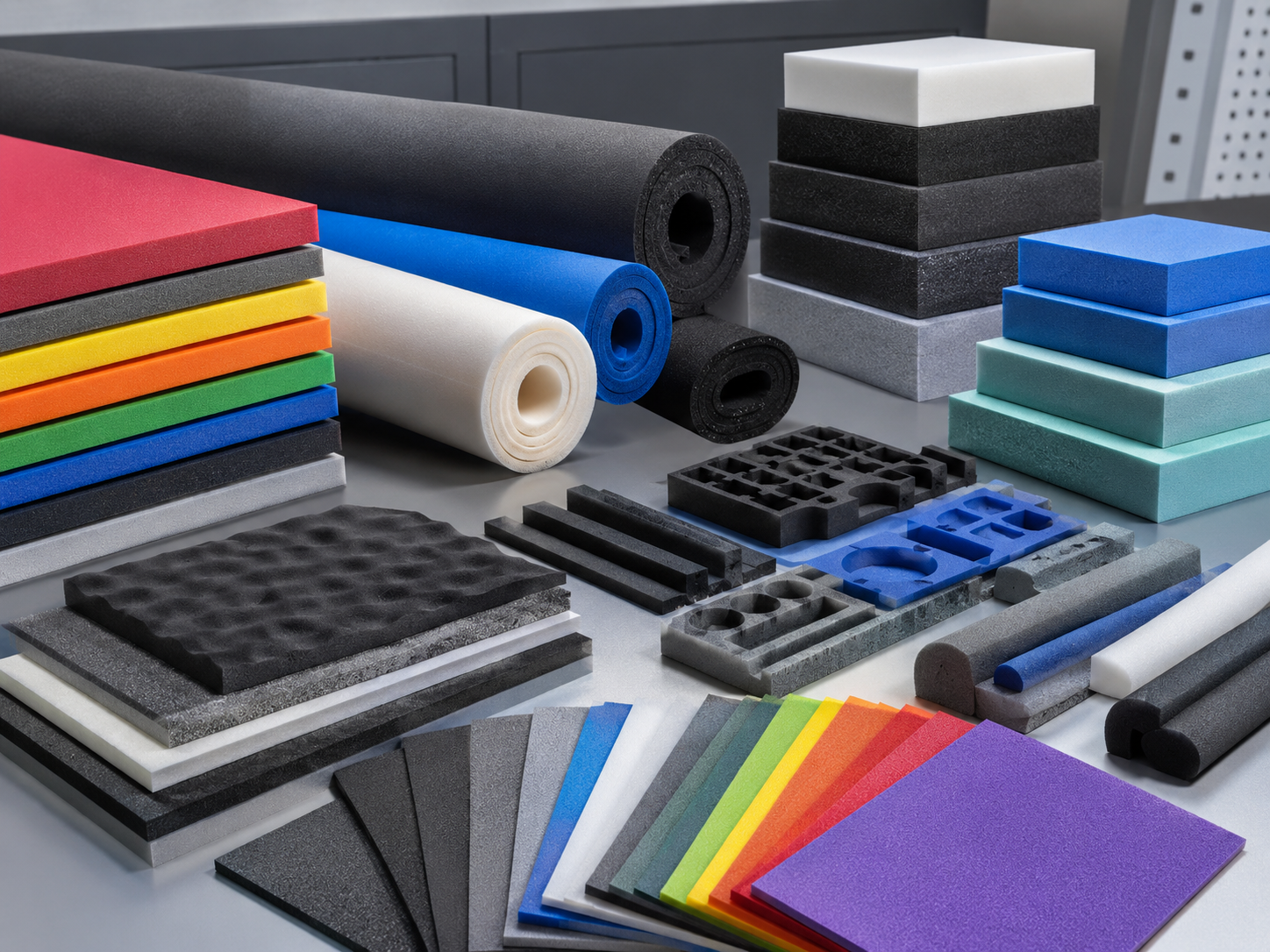
Foam sheets are flat foam materials supplied in sheets or rolls. They are made with a cellular structure, which means the material contains many small air pockets.
This structure gives foam sheets several useful properties:
- Lightweight
- Soft and compressible
- Shock absorbing
- Good for cushioning
- Useful for vibration reduction
- Easy to cut into shapes
- Suitable for adhesive backing
- Available in many densities and thicknesses
Common foam sheet materials include:
| Foam Sheet Type | Main Features | Common Applications |
|---|---|---|
| EVA foam | Flexible, cushioning, easy to die cut | Packaging, automotive pads, protective parts |
| PE foam | Lightweight, stable, moisture resistant | Packaging, insulation, spacers |
| PU foam | Soft, cushioning, sound absorption | Acoustic pads, comfort layers |
| EPDM foam | Weather resistant, sealing support | Automotive and industrial sealing |
| Rubber foam | Elastic, durable, sealing performance | Gaskets, vibration pads |
| Adhesive-backed foam | Easy installation | Assembly pads, anti-rattle parts |
Each foam type has its own strengths. The right choice depends on pressure, temperature, environment, adhesive needs, and product function.
Foam Sheets for Cushioning and Protection
One of the most common uses of foam sheets is cushioning.
Foam sheets absorb impact and reduce pressure between surfaces. This makes them useful for protecting products during shipping, handling, assembly, and daily use.
Typical cushioning applications include:
- Packaging inserts
- Tool case liners
- Electronics protection
- Medical equipment packaging
- Protective pads
- Transport trays
- Product separators
For packaging, foam sheet quality affects both protection and presentation. If the foam is too soft, the product may move during shipping. If it is too hard, it may not absorb impact well. If the cut is inaccurate, the product may not fit securely.
This is why many customers move from hand-cut foam to precision-cut foam inserts after the product design becomes stable.
Foam Sheets for Automotive Applications
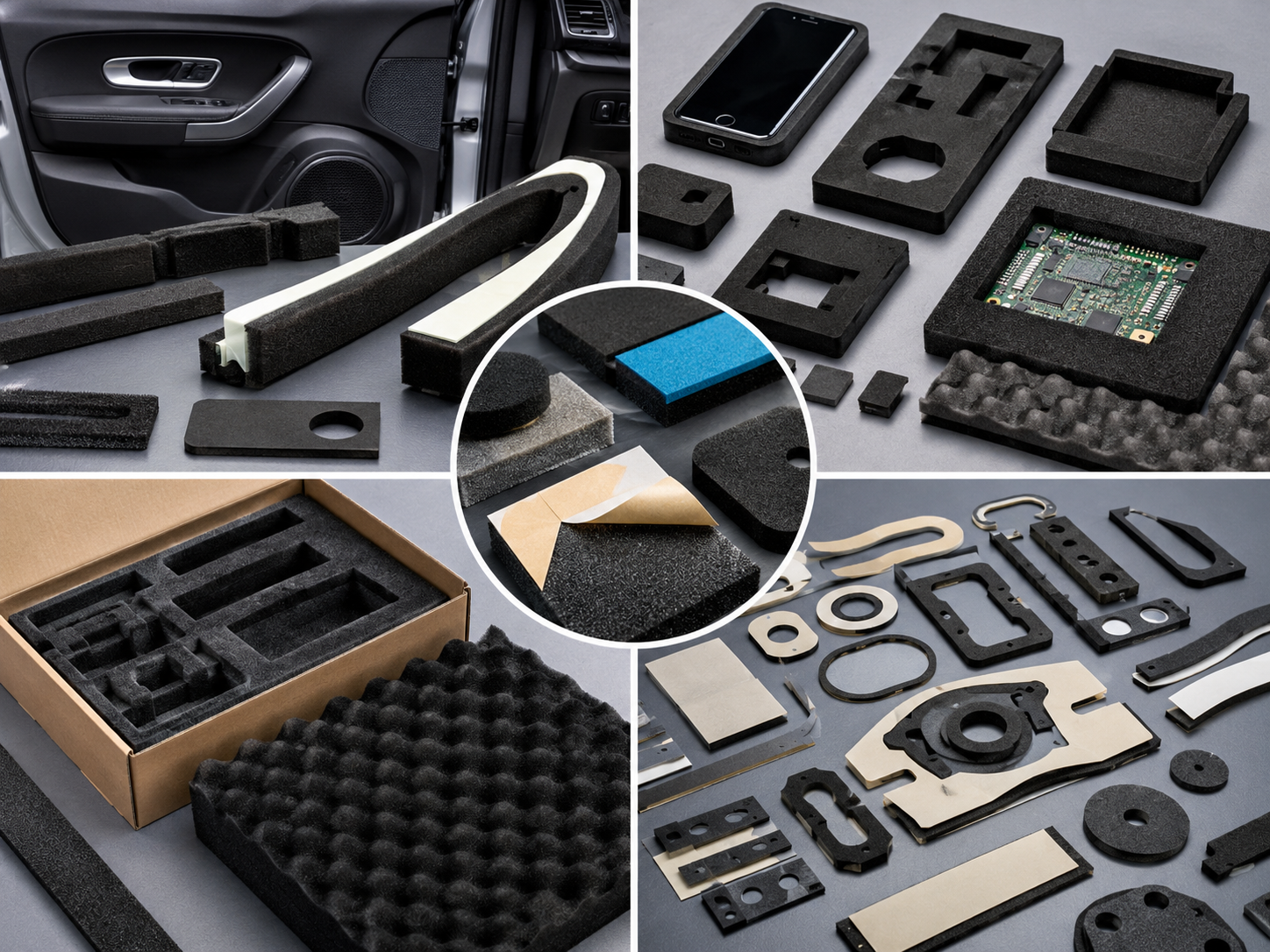
Automotive interiors use many foam sheet components, often hidden behind trim panels.
Common uses include:
- Door trim cushioning pads
- Dashboard spacers
- Anti-rattle pads
- Wire harness protection
- Trunk liner support
- Interior panel gap filling
- Light sealing support
- Acoustic and vibration-control parts
In cars, foam sheets help reduce squeaks, rattles, buzzing, and contact noise.
This is especially important in electric vehicles. EV cabins are quieter because there is no engine noise, so passengers notice small interior sounds more easily. A small foam pad in the right location can improve the perceived quality of the whole vehicle.
But automotive foam sheet selection must be careful. Buyers should consider heat resistance, odor, compression recovery, flame resistance, adhesive aging, and long-term durability.
A foam sheet that looks acceptable in a sample may fail after heat aging or long-term compression.
Foam Sheets for Electronics Protection
Electronics products often use foam sheets in tight spaces.
Foam sheets can protect delicate components from shock, vibration, dust, and assembly pressure.
Common electronics uses include:
- Battery cushioning pads
- Speaker damping parts
- Camera module protection
- Display protection pads
- Dust sealing layers
- PCB protection
- Internal assembly spacers
- Protective packaging inserts
For electronics, accuracy is critical.
If the foam is too thick, it may press against sensitive components. If it is too soft, it may not protect the part. If the edge is rough, it may create particles or poor appearance.
This is where precision die cutting and clean converting become important.
At Sanken, we help customers control foam thickness, adhesive backing, part shape, and cutting quality to improve electronics assembly reliability.
Foam Sheets for Sealing and Gap Filling
Foam sheets are often used to fill gaps or support light sealing.
They can help block dust, reduce airflow, prevent direct contact, and improve assembly fit.
Common sealing-related uses include:
- Foam gaskets
- Gap filler strips
- Dust barriers
- Light moisture barriers
- Panel contact pads
- Door and cover support parts
- Industrial equipment liners
However, buyers should not assume all foam sheets are good sealing materials.
For strong waterproof, airtight, or oil-resistant sealing, rubber, EPDM foam, silicone foam, or other specialty materials may be better.
Foam sheets are very useful for light sealing and compression support, but the final choice depends on pressure, environment, and sealing requirement.
Foam Sheets for Sound and Vibration Control
Foam sheets can help reduce noise and vibration.
They are commonly used to control:
- Rattling
- Squeaking
- Buzzing
- Impact noise
- Contact noise
- Light vibration transfer
In automotive interiors, appliances, electronics, and industrial equipment, foam sheets are often placed between hard surfaces to reduce direct contact.
For stronger acoustic performance, foam may be combined with:
- Non-woven fabric
- Acoustic felt
- Rubber
- Adhesive layers
- Barrier films
- Aluminum foil
This creates a multilayer structure that can provide cushioning, absorption, damping, insulation, and bonding at the same time.
For OEM buyers, this is important because one foam sheet alone may not solve every acoustic problem. The structure must match the noise source.
Foam Sheets for Insulation
Foam sheets can also provide thermal insulation and electrical support, depending on the material type.
Typical insulation uses include:
- Battery pack cushioning
- Thermal protection layers
- Equipment insulation pads
- HVAC support materials
- Protective liners
- Electronic device spacers
Some foam sheets help slow heat transfer. Others provide cushioning around sensitive parts.
For applications involving heat, buyers should confirm temperature resistance before approval. Low-cost foam may shrink, harden, or release odor under high temperature.
Foam Sheets for Adhesive-Backed Parts
Many foam sheet products are laminated with adhesive.
Adhesive-backed foam sheets allow fast installation and easy positioning.
They are used for:
- Anti-rattle pads
- Mounting strips
- Protective pads
- Foam spacers
- Cushioning washers
- Assembly support parts
- Gaskets and light seals
The adhesive system is just as important as the foam itself.
Poor adhesive selection may cause:
- Edge lifting
- Peeling
- Delamination
- Weak bonding
- Liner separation
- Difficult installation
At Sanken, we review the foam surface, adhesive type, release liner, application surface, and working environment together. This helps reduce bonding problems before mass production.
Foam Sheets in Die-Cut and Converted Products
Raw foam sheets are only the starting point.
Most OEM customers need finished foam components that can go directly into assembly.
Common converted foam products include:
- Die-cut foam pads
- Foam gaskets
- Foam washers
- Foam strips
- Protective liners
- Packaging inserts
- Adhesive-backed foam parts
- Multilayer foam assemblies
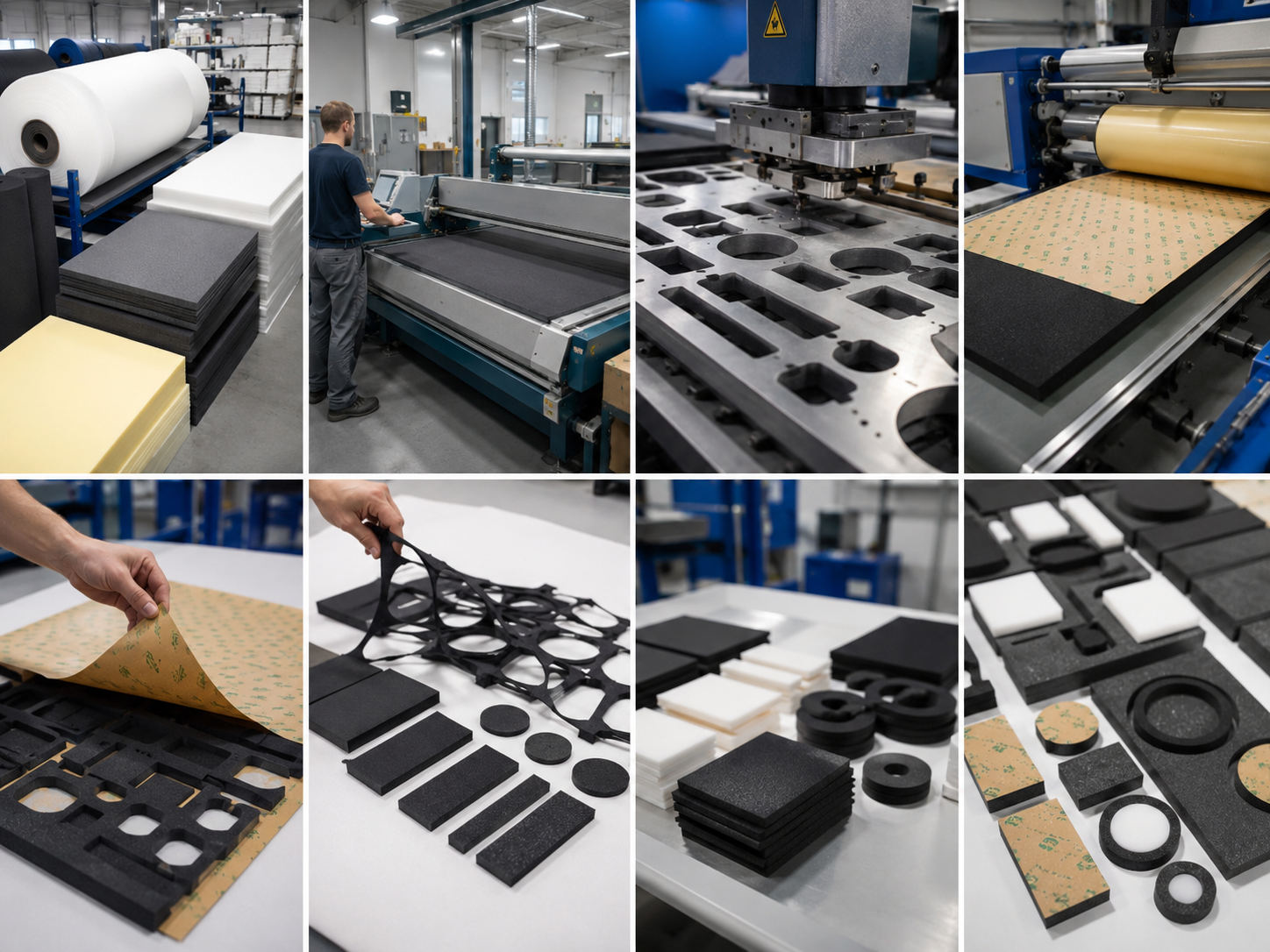
Precision converting can include:
- Slitting
- Laminating
- Die cutting
- Kiss cutting
- Hot pressing
- Waste stripping
- Assembly support
For high-volume production, professional converting helps improve repeatability, reduce scrap, and make assembly more efficient.
Common Problems When Buyers Choose the Wrong Foam Sheet
Foam sheet problems often appear after production starts.
Common issues include:
| Problem | Possible Cause |
|---|---|
| Foam collapses | Wrong density or poor compression recovery |
| Adhesive lifts | Adhesive not matched to foam surface |
| Parts do not fit | Poor cutting accuracy or foam deformation |
| Strong odor | Low-grade material or poor heat aging |
| Rough edges | Wrong cutting tool or poor process control |
| Weak cushioning | Density or thickness not matched to load |
| High scrap rate | Poor material layout or unstable converting |
These problems increase cost and delay delivery.
A cheaper foam sheet is not always cheaper if it causes quality failures.
How to Choose the Right Foam Sheet
Before choosing foam sheets, buyers should ask:
- What function must the foam perform?
- Does it need cushioning, sealing, protection, or vibration control?
- What thickness and density are required?
- Will the foam stay under compression?
- Will it face heat, humidity, UV, oil, or chemicals?
- Does it need adhesive backing?
- Does it require flame resistance or odor control?
- What die-cut tolerance is required?
- Will the part be assembled manually or automatically?
- Is this for prototype testing or mass production?
These questions help suppliers recommend the right foam material and converting method.
How Sanken Helps Customers With Foam Sheet Projects
At Sanken Manufacturing, we focus on solving the customer’s real application problem.
We support foam sheet projects with:
- Material selection
- Foam slitting
- Adhesive lamination
- Precision die cutting
- Kiss cutting
- Hot pressing
- Multilayer converting
- Custom assembly
- Prototype and mass production support
We work with foam, rubber, adhesive tapes, non-woven fabrics, films, and composite materials.
For customers, this means fewer suppliers, faster development, better part consistency, and lower production risk.
Conclusion
Foam sheets are used for cushioning, protection, sealing support, vibration reduction, sound control, insulation, packaging, and custom die-cut components. They are widely used in automotive, electronics, medical equipment, packaging, consumer products, and industrial applications.
For OEM buyers, the best foam sheet is not simply the cheapest or softest option. It is the material structure that matches the application, converts cleanly, bonds reliably, and performs consistently in mass production. At Sanken Manufacturing, we help customers turn foam sheets into reliable, ready-to-assemble components that solve real manufacturing problems.