

Why Is Foam Good in Reducing the Propagation of Sound?
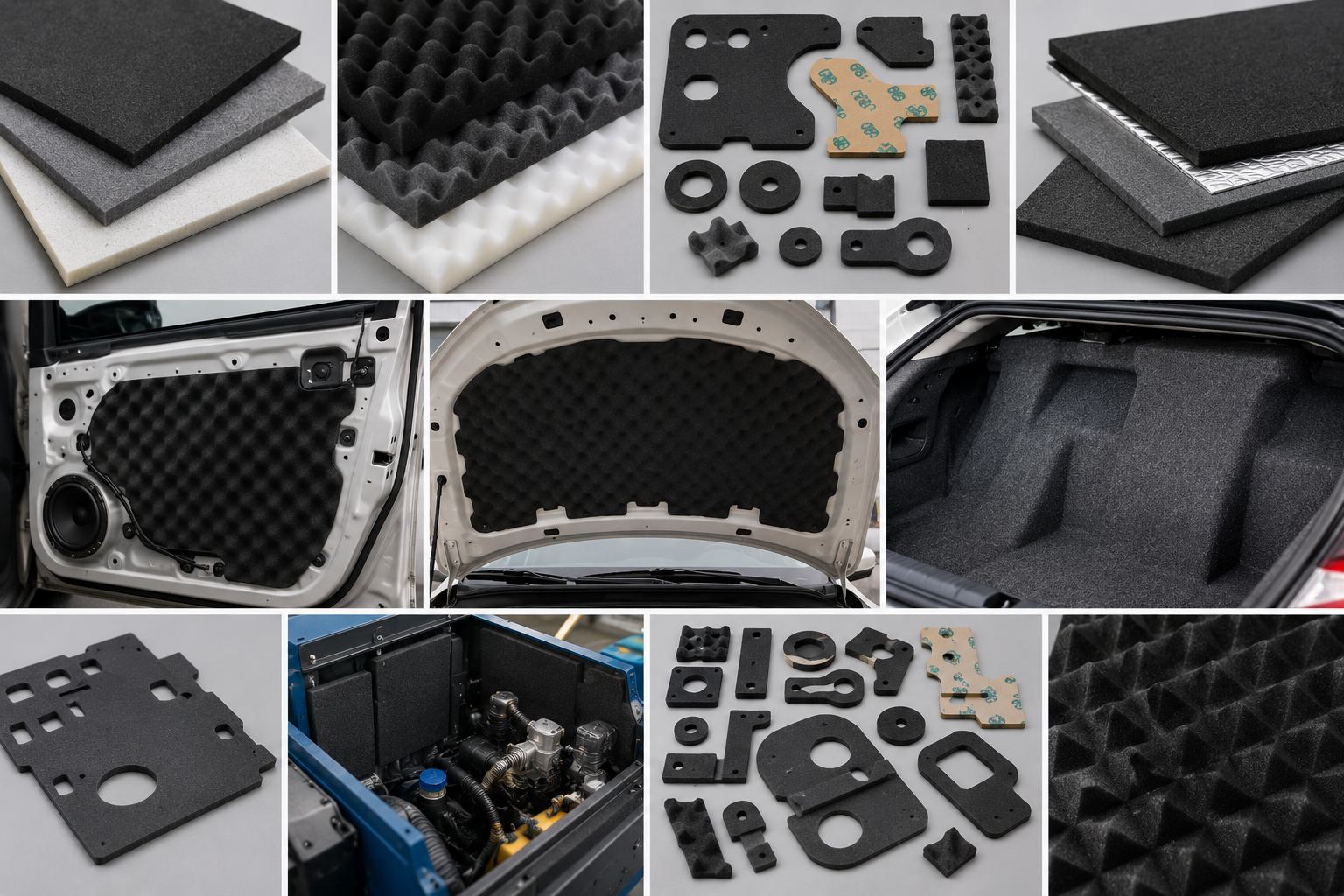
Foam is good at reducing the propagation of sound because its porous structure traps moving air, creates friction inside tiny cells, and converts part of the sound energy into heat. This helps reduce echo, vibration transfer, contact noise, and airborne sound movement inside products, vehicles, equipment, and interior assemblies.
However, foam does not solve every noise problem by itself.
For OEM buyers and engineers, the real question is not only “Does foam reduce sound?” The better question is: “Which foam structure can reduce the specific noise problem in my product without creating assembly, durability, or cost issues?”
At Sanken Manufacturing, we help customers select, laminate, die cut, and convert foam, non-woven fabric, rubber, adhesive tape, and composite acoustic materials into customized components for automotive interiors, electronics, industrial equipment, packaging, and medical device applications.
How Sound Travels Through Materials
Sound is vibration energy.
It travels through air, solids, and structures as waves. In industrial products, unwanted sound may come from several sources:
- Airborne noise
- Impact noise
- Contact noise
- Panel vibration
- Mechanical movement
- Structural resonance
- Friction between parts
A single material rarely solves all types of noise.
For example, road noise inside a vehicle is different from a rattling plastic panel. A speaker cavity issue is different from machine vibration. A foam pad used for anti-rattle control is different from a thick acoustic absorber used behind interior trim.
This is why sound reduction starts with identifying the noise source.
Why Foam Helps Reduce Sound Propagation
Foam reduces sound mainly through its internal structure.
Most foam materials contain many small cells or pores. When sound waves enter the foam, air particles move inside these pores. This movement creates friction against the cell walls.
That friction reduces sound energy.
In simple terms:
Foam slows down and weakens sound waves by forcing them to move through a complex, porous structure.
This is especially useful for reducing sound reflection, echo, vibration transfer, and contact noise.
Open-Cell Foam vs Closed-Cell Foam
Not all foam works the same way.
The cell structure has a major impact on acoustic performance.
| Foam Type | Structure | Acoustic Behavior |
|---|---|---|
| Open-cell foam | Connected pores | Better for sound absorption |
| Closed-cell foam | Sealed cells | Better for cushioning, sealing, and vibration control |
| Semi-closed foam | Mixed structure | Balanced performance depending on design |
Open-Cell Foam
Open-cell foam allows air and sound waves to enter the material more easily.
This makes it useful for sound absorption.
Common uses include:
- Acoustic panels
- Equipment noise reduction
- Interior sound control
- Speaker cavity treatment
- Automotive trim absorption layers
Closed-Cell Foam
Closed-cell foam does not allow air to pass through easily.
It is usually better for cushioning, sealing, shock absorption, and vibration isolation.
Common uses include:
- Anti-rattle pads
- Sealing strips
- Protective liners
- Foam gaskets
- Vibration support pads
For sound control, closed-cell foam often works better when used as part of a multilayer system.
Sound Absorption vs Sound Blocking
Many buyers confuse sound absorption and sound blocking.
They are not the same.
Sound Absorption
Sound absorption reduces reflected sound inside a space or cavity.
Foam is often good at absorption because it has a porous structure.
Sound Blocking
Sound blocking prevents sound from passing through a barrier.
This usually requires mass and density.
Materials used for sound blocking may include:
- Rubber sheets
- Dense barrier films
- Heavy acoustic composites
- Mass-loaded materials
- Multilayer structures
Foam alone is usually not the best sound-blocking material because it is lightweight.
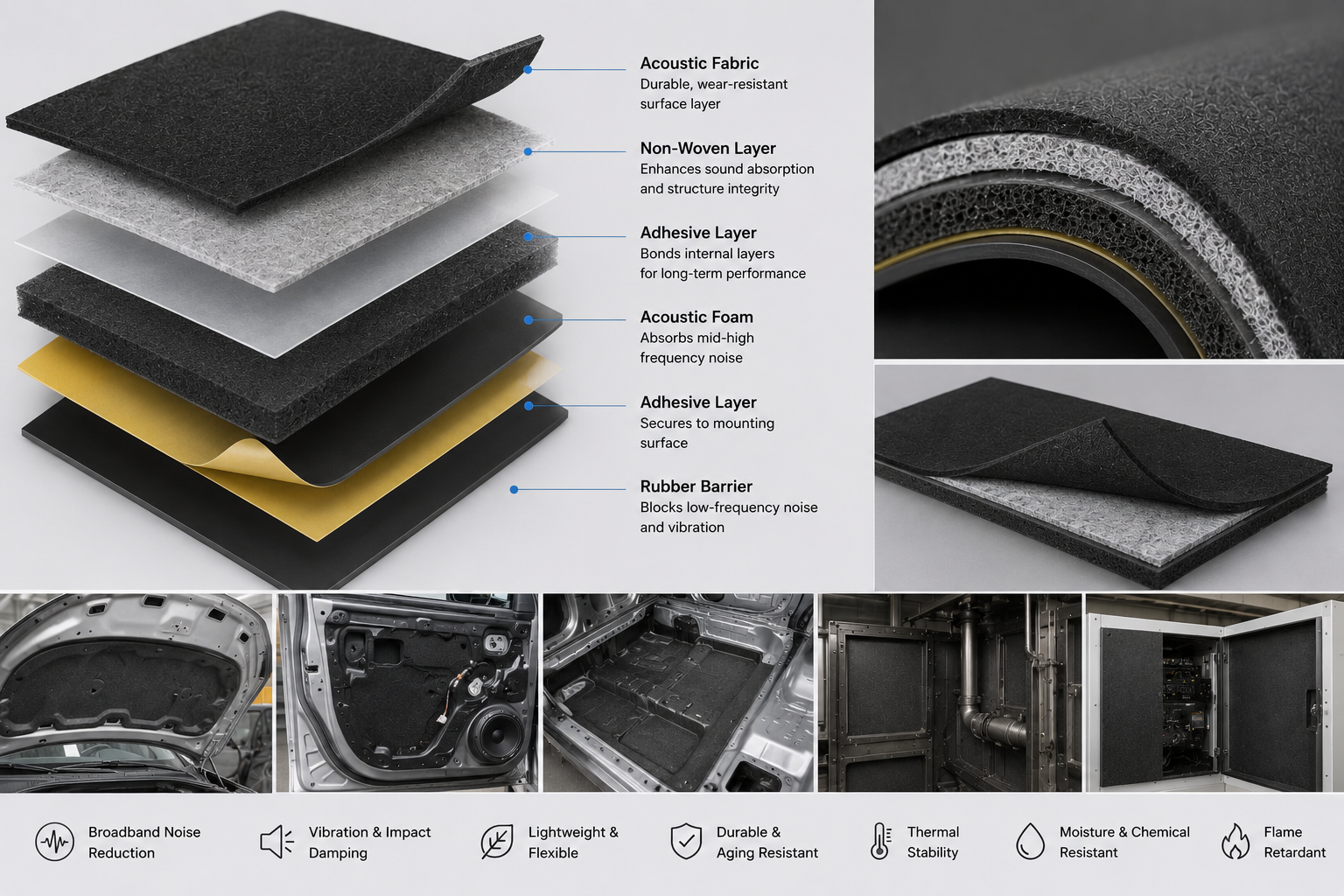
This is why automotive and industrial acoustic systems often combine foam with rubber, non-woven fabric, adhesive layers, or barrier films.
Why Foam Works Well for Contact Noise
Foam is especially useful when noise comes from contact between two surfaces.
In real products, many noise complaints come from small movements:
- Plastic trim rubbing
- Metal parts touching
- Loose panels vibrating
- Wire harness movement
- Covers tapping against housings
- Interior parts shifting during operation
Foam can act as a soft buffer.
It prevents hard surfaces from touching directly. This reduces rattling, squeaking, buzzing, and impact noise.
This is one reason foam is widely used in automotive interiors and electronics assemblies.
Why Foam Helps With Vibration
Sound and vibration are closely related.
When a part vibrates, it can create noise. Foam can reduce vibration transfer by absorbing some movement and separating contact surfaces.
Foam is often used for:
- Anti-vibration pads
- Cushioning spacers
- Panel support strips
- Equipment liners
- Protective pads
- Interior trim support
The right foam can reduce vibration energy before it becomes audible noise.
However, foam density and compression behavior must be selected carefully. If the foam is too soft, it may collapse. If it is too hard, it may transfer vibration instead of damping it.
Foam in Automotive Noise Reduction
Automotive manufacturers use foam because vehicles contain many different noise paths.
Foam may be used in:
- Door panels
- Dashboards
- Floor systems
- Headliners
- Trunk liners
- Wheel arch areas
- Wire harness zones
- EV battery protection areas
- Interior trim contact points
For electric vehicles, foam becomes even more important. EV cabins are quieter because there is no engine noise masking small sounds. Passengers can notice tire noise, road noise, wind noise, squeaks, and rattles more easily.
A small die-cut foam pad placed correctly can prevent a future noise complaint.
For OEM buyers, this means foam is not only a material cost. It is part of the customer experience.
Foam in Electronics and Industrial Equipment
Foam is also used in electronics and industrial equipment to reduce sound propagation and vibration.
Common applications include:
- Speaker cushioning
- Battery protection
- Fan noise control
- Housing spacers
- Motor vibration pads
- Equipment panel liners
- Dust and noise protection layers
In electronics, the available space is often limited. The foam must be thin, accurate, clean, and stable.
This is why precision die cutting matters. A foam part that is too thick may create assembly pressure. A part that is too thin may not reduce vibration. A rough edge may affect cleanliness or appearance.
Why Density and Thickness Matter
Foam acoustic performance depends heavily on density and thickness.
Density
Density affects how the foam resists compression and interacts with sound energy.
Low-density foam may be soft and lightweight, but it may not provide enough support. High-density foam may improve durability but may reduce softness.
Thickness
Thicker foam can often absorb more sound, especially lower-frequency sound. But thicker foam also requires more assembly space.
In many products, engineers must balance acoustic performance with available space, weight, cost, and compression behavior.
This is why foam selection should not be based only on appearance.
Buyers should confirm:
- Foam type
- Thickness
- Density
- Compression recovery
- Heat resistance
- Adhesive compatibility
- Aging behavior
- Die-cut tolerance
- Final installation environment
When Foam Alone Is Not Enough
Foam is useful, but it is not a magic soundproofing material.
Foam alone may not be enough when the product needs:
- Strong airborne sound blocking
- Heavy structural noise control
- High-temperature performance
- Oil or chemical resistance
- Strong waterproof sealing
- Long-term high compression recovery
In these cases, foam may need to be combined with other materials.
Common acoustic composite structures include:
| Structure | Purpose |
|---|---|
| Foam + adhesive tape | Easy installation and anti-rattle control |
| Foam + non-woven fabric | Sound absorption and surface protection |
| Foam + rubber | Better vibration isolation and sound blocking |
| Foam + film | Surface protection and dimensional stability |
| Foam + aluminum layer | Thermal reflection and noise support |
| Foam + felt | Improved acoustic absorption |
At Sanken, many customer projects involve multilayer structures because one material alone cannot meet all functional requirements.
Common Buyer Mistakes
Choosing Foam Only by Softness
Soft foam does not always mean better sound reduction. It may collapse under pressure and lose performance.
Ignoring Compression Set
If foam remains compressed for a long time, it may not recover. This affects acoustic and anti-rattle performance.
Using Foam for Full Sound Blocking
Foam absorbs sound well, but dense barriers are usually needed for strong sound blocking.
Ignoring Adhesive Performance
Many foam acoustic parts require adhesive backing. If the adhesive fails, the part loses function.
Not Testing the Real Noise Source
A foam sample may look good, but the final product may still make noise if the source is structural vibration, air leakage, or poor assembly fit.
Why Precision Die Cutting Matters for Acoustic Foam Parts
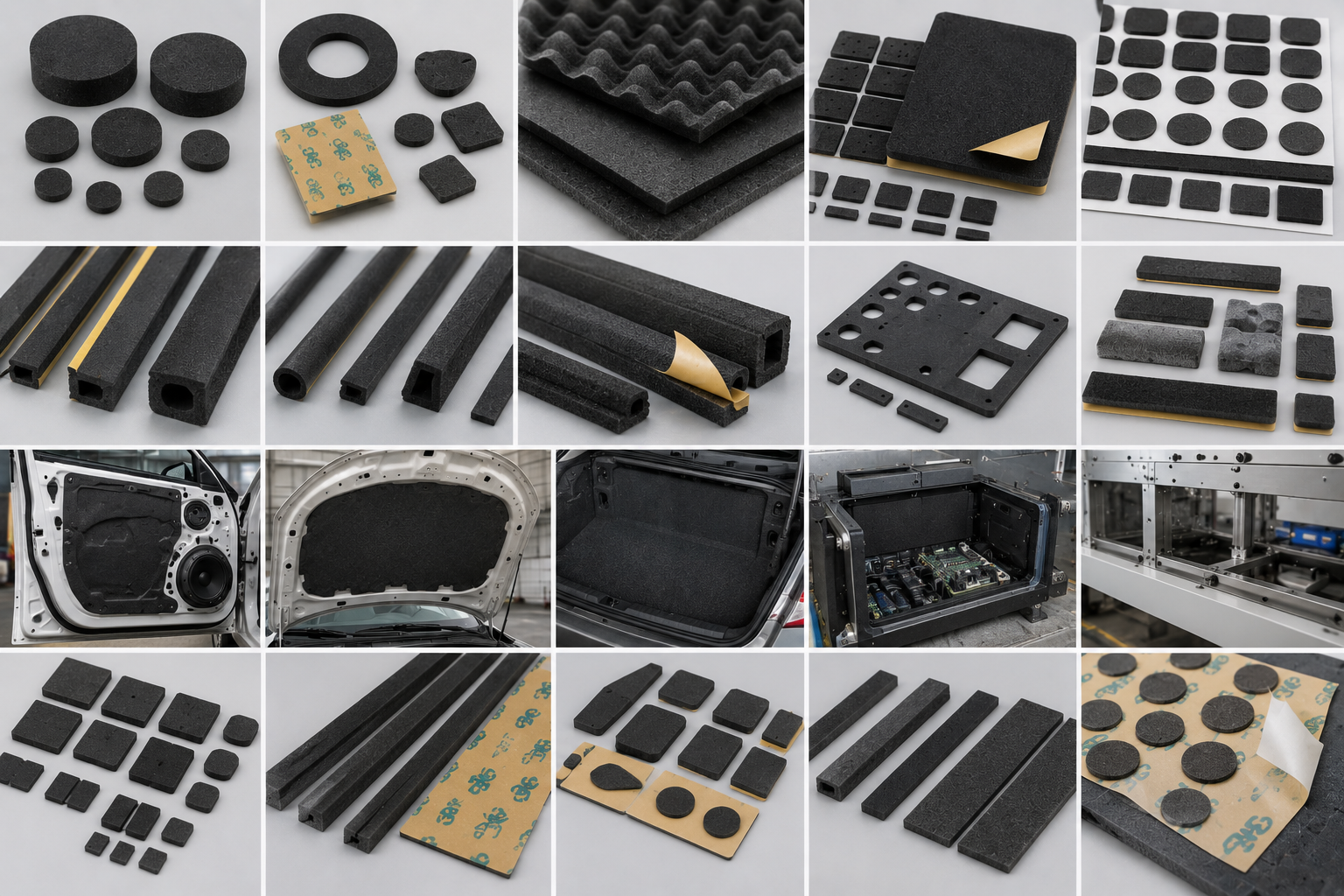
Foam acoustic components often need accurate shapes.
They may include:
- Holes
- Slots
- Thin strips
- Complex contours
- Adhesive backing
- Multilayer lamination
- Kiss-cut liners
- Assembly tabs
Poor cutting can create:
- Rough edges
- Dimensional variation
- Adhesive misalignment
- Poor fit
- Gaps in acoustic coverage
- Assembly delays
- Higher scrap rates
Precision die cutting helps ensure that the foam part fits correctly and performs consistently.
What Buyers Should Confirm Before Choosing Acoustic Foam
Before choosing foam for sound reduction, buyers should ask:
- What type of noise needs to be reduced?
- Is the noise airborne, structural, impact, or contact noise?
- Does the part need absorption, damping, sealing, or blocking?
- What foam type is suitable?
- What thickness and density are required?
- Will the foam stay compressed?
- Does it need adhesive backing?
- Will it face heat, humidity, vibration, or aging?
- What die-cut tolerance is needed?
- Is a multilayer acoustic structure required?
These questions help avoid wrong material selection and reduce development risk.
How Sanken Helps Customers With Foam Sound Reduction
At Sanken Manufacturing, we help customers turn acoustic material ideas into production-ready components.
Our capabilities include:
- Foam material selection
- Precision die cutting
- Adhesive lamination
- Foam converting
- Non-woven fabric converting
- Rubber processing
- Film lamination
- Hot pressing
- Kiss cutting
- Custom assembly
- Prototype and mass production support
We help customers evaluate material structure, part design, adhesive performance, tolerance, and assembly method.
Our goal is not only to cut foam into shape. Our goal is to help customers reduce noise problems, improve product quality, and achieve stable mass production.
Conclusion
Foam is good at reducing the propagation of sound because its porous structure creates friction, absorbs vibration energy, and reduces contact noise between surfaces. Open-cell foam is often better for sound absorption, while closed-cell foam is useful for cushioning, sealing, and vibration control.
For OEM applications, foam works best when the material structure matches the noise source. In many automotive, electronics, and industrial projects, foam is combined with non-woven fabric, rubber, adhesive tape, or film to create a more effective acoustic solution.
At Sanken Manufacturing, we help customers select, laminate, die cut, and convert foam-based acoustic components that solve real noise problems and support reliable production.