
Over Time, Does Latex Hold Its Shape Better Than Foam?
Yes, latex generally holds its shape better than many common foam materials over time, especially when compared with low-density PU foam or basic cushioning foam. Latex is naturally elastic, resilient, and resistant to permanent compression. However, the answer depends on the type of foam, density, load, temperature, humidity, usage environment, and application design.
For OEM buyers, the better question is not only “Does latex last longer than foam?” The real question is: “Which material will maintain the required thickness, rebound, cushioning, sealing, or support performance throughout the product’s service life?”
This matters because shape retention affects product quality. A cushion that flattens, a gasket that loses compression, a packaging insert that deforms, or an automotive pad that no longer fills a gap can all create customer complaints, assembly problems, and warranty risk.
At Sanken Manufacturing, we help customers select, die cut, laminate, and convert foam, rubber, non-woven fabric, adhesive tape, and composite materials into custom components for automotive, electronics, medical, packaging, and industrial applications.
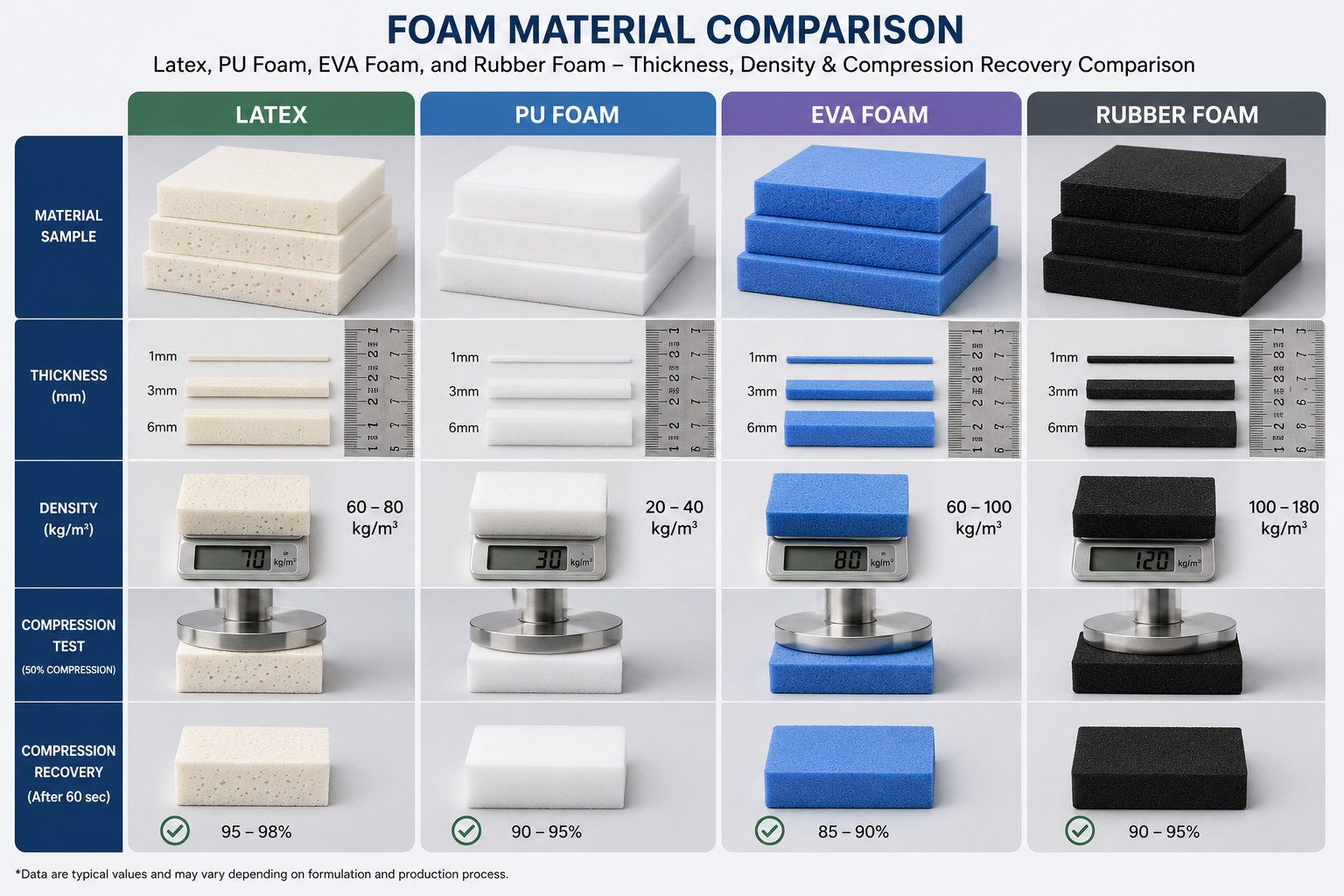
What Does Shape Retention Mean?
Shape retention means a material can return close to its original form after being compressed, bent, stretched, or loaded over time.
For industrial components, shape retention may include:
- Thickness recovery
- Compression set resistance
- Elastic rebound
- Dimensional stability
- Long-term cushioning performance
- Sealing pressure retention
- Resistance to flattening
A material may feel soft and comfortable at first, but that does not mean it will perform well after months or years of compression.
This is why buyers should evaluate long-term behavior, not only initial touch or sample appearance.
Why Latex Often Holds Its Shape Well
Latex is known for strong elasticity and rebound.
It can compress under pressure and recover after the pressure is removed. This makes latex suitable for applications that require repeated compression and long-term support.
Latex may offer:
- Good resilience
- Strong rebound
- Comfortable support
- Better resistance to permanent flattening
- Long service life in suitable environments
This is why latex is widely used in mattresses, cushions, medical support products, comfort pads, and some specialty cushioning applications.
However, latex is not automatically the best material for every industrial project. It may be more expensive than many foams, and it may not be suitable where oil resistance, chemical resistance, weather resistance, or strict dimensional die-cutting requirements are more important.
Why Some Foam Materials Lose Shape Faster
“Foam” is a broad category.
Different foam materials behave very differently.
Common foam types include:
| Foam Type | General Shape Retention Behavior |
|---|---|
| Low-density PU foam | Soft, but may compress and flatten faster |
| High-density PU foam | Better durability and support |
| EVA foam | Good cushioning, but may take compression set under long-term load |
| PE foam | Lightweight and stable, often good for packaging |
| EPDM foam | Better aging and sealing performance in demanding environments |
| Rubber foam | Good elasticity and sealing support |
| Silicone foam | Strong heat resistance and compression recovery |
Low-cost foam often loses shape because its cell structure collapses under repeated pressure.
Higher-density or specialty foam can perform much better.
So it is not correct to say latex is always better than all foam. Latex often outperforms basic foam, but engineered foam materials may be better for specific OEM applications.
Latex vs Foam: Shape Retention Comparison
| Requirement | Latex | Common Foam |
|---|---|---|
| Rebound | Usually excellent | Depends on foam type |
| Long-term comfort | Strong | Strong if high-density |
| Compression recovery | Usually strong | Varies widely |
| Lightweight design | Moderate | Often better |
| Die-cut processing | Possible, but material-dependent | Usually easier |
| Cost control | Often higher | Often lower |
| Industrial sealing | Limited | EPDM or rubber foam may be better |
| Heat resistance | Moderate | Depends on material type |
| Moisture resistance | Depends on formulation | Depends on foam type |
For buyers, the best choice depends on function.
Latex is often better for comfort and rebound. Foam is often better for lightweight cushioning, cost control, die-cut shapes, adhesive-backed parts, packaging inserts, and industrial assemblies.
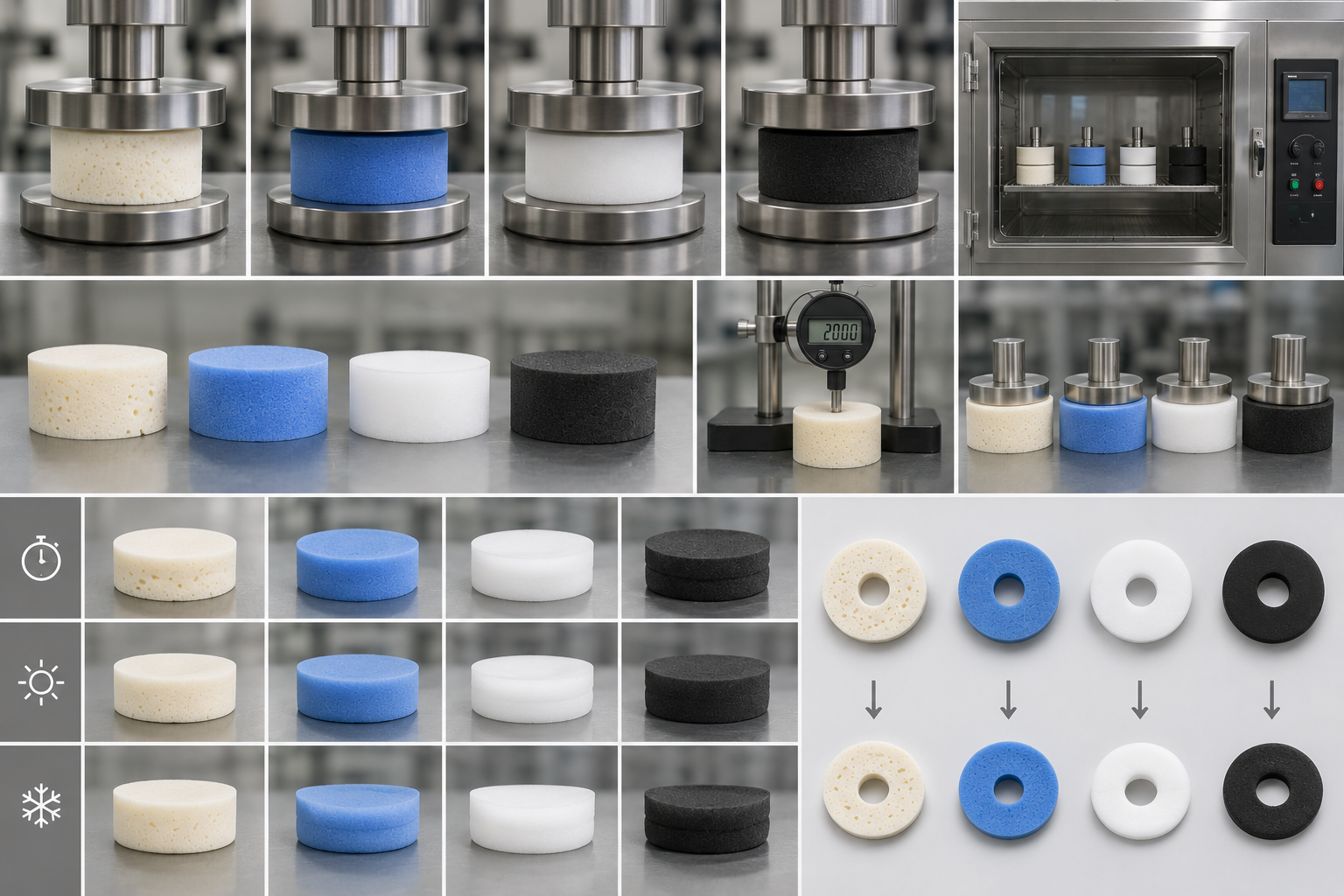
Compression Set: The Key Test Buyers Should Understand
Compression set is one of the most important indicators of long-term shape retention.
It measures how much a material fails to recover after being compressed for a certain time under defined conditions.
A low compression set means the material recovers well.
A high compression set means the material stays flattened.
This matters for:
- Gaskets
- Seals
- Cushioning pads
- Anti-rattle parts
- Foam spacers
- Packaging inserts
- Automotive interior pads
- Electronics protection components
For example, if a foam gasket loses thickness after months of compression, it may no longer seal properly. If an automotive foam pad flattens, it may stop preventing rattles. If a packaging insert deforms, it may no longer protect the product.
When Latex Is the Better Choice
Latex may be a better option when the product requires:
- Strong rebound
- Long-term comfort
- Repeated compression recovery
- Soft but supportive feel
- Premium cushioning performance
- Reduced flattening under body weight
Typical examples include:
- Mattresses
- Seat cushions
- Medical support cushions
- Comfort padding
- Ergonomic products
- Premium protective layers
If user comfort and long-term rebound are the main goals, latex can be an excellent material.
When Foam Is the Better Choice
Foam may be the better choice when the part requires:
- Lightweight structure
- Custom die-cut shapes
- Adhesive backing
- Lower material cost
- Packaging protection
- Gap filling
- Vibration reduction
- Sound damping
- Light sealing support
- Easy lamination with other materials
For example, EVA foam, PE foam, PU foam, and EPDM foam are widely used in OEM applications because they can be converted into precise parts.
Common foam components include:
- Die-cut pads
- Foam gaskets
- Adhesive-backed strips
- Protective liners
- Packaging inserts
- Anti-rattle pads
- Cushioning spacers
- Acoustic insulation parts
For automotive, electronics, and industrial applications, foam may be more practical than latex because it is easier to customize, laminate, cut, and integrate into assemblies.
Why Material Density Matters
Density strongly affects shape retention.
A low-density foam may feel soft and inexpensive, but it may collapse quickly under pressure.
A higher-density foam usually provides better support and longer service life.
However, higher density can also increase cost, weight, and stiffness.
Buyers should not choose only by thickness. A thick low-density foam may perform worse than a thinner high-density foam.
Important questions include:
- What load will the material carry?
- How long will it stay compressed?
- Will it need to recover after pressure?
- What temperature will it face?
- Is softness or support more important?
- Does the part need adhesive backing?
- Will the material be die cut?
The correct density depends on the final function.
Environmental Aging Also Affects Shape Retention
Over time, material shape can be affected by:
- Heat
- Humidity
- UV exposure
- Oil
- Chemicals
- Long-term compression
- Repeated vibration
- Poor adhesive compatibility
- Improper storage
Latex can age if exposed to heat, UV, ozone, or certain chemicals. Foam can also degrade depending on its polymer type and density.
For automotive and industrial applications, environmental testing is often more important than a simple hand-feel comparison.
A material that performs well at room temperature may fail after heat aging or humidity exposure.
Why Die Cutting and Converting Quality Matter
Even a good material can fail if it is processed poorly.
For shape-sensitive components, converting problems may include:
- Uneven thickness
- Rough edges
- Compression during cutting
- Adhesive misalignment
- Poor lamination
- Material deformation
- Incorrect tolerance
Foam and latex-like elastomer materials can compress during cutting. If tooling pressure is not controlled, the final part may vary in size or shape.
At Sanken Manufacturing, we support customers with precision die cutting, adhesive lamination, foam converting, rubber processing, non-woven fabric converting, and custom assembly. This helps customers receive stable parts that match both drawing requirements and real assembly conditions.

What Buyers Should Confirm Before Choosing Latex or Foam
Before choosing between latex and foam, buyers should confirm:
- What function must the material perform?
- Does the part need comfort, cushioning, sealing, or vibration control?
- How long will the material remain compressed?
- What compression recovery is required?
- Will it face heat, humidity, UV, oil, or chemicals?
- Does the part need adhesive backing?
- What thickness and density are needed?
- What tolerance is required after cutting?
- Is the part for prototype testing or mass production?
- Can the supplier support material selection and converting together?
These questions help avoid choosing a material that looks good during sampling but fails in real use.
How Sanken Helps Customers Choose the Right Material
At Sanken Manufacturing, we do not recommend latex, foam, or rubber based only on material name.
We first look at the customer’s problem:
- Is the part flattening too quickly?
- Is the gasket losing sealing pressure?
- Is the cushion not recovering?
- Is the adhesive lifting?
- Is the foam deforming during die cutting?
- Is the assembly gap inconsistent?
- Is the part failing after heat aging?
Then we help customers choose a more suitable material structure.
This may be foam, rubber foam, EVA foam, EPDM foam, non-woven composite, adhesive-backed foam, or a laminated multilayer solution.
Our goal is to help customers reduce failure risk, improve part consistency, and support stable mass production.
Conclusion
Latex generally holds its shape better than many basic foam materials over time because it has strong elasticity and rebound. However, it is not always better than every foam. High-density PU foam, EPDM foam, rubber foam, silicone foam, and engineered foam composites may perform better in specific industrial, automotive, electronics, or sealing applications.
For OEM buyers, the right decision depends on compression set, density, temperature, environment, adhesive needs, die-cut tolerance, and final product function. At Sanken Manufacturing, we help customers select and convert foam, rubber, non-woven, adhesive, and composite materials into reliable components that maintain performance throughout real-world use.