
Why Use PVC Insulation Film Die Cutting for Electronic Products?
As electronic devices become thinner, more powerful, and increasingly compact, the demand for reliable insulation materials continues to grow.
Whether inside smartphones, power supplies, battery packs, displays, industrial controllers, or consumer electronics, electrical insulation plays a critical role in protecting sensitive components and ensuring long-term product reliability.
Among various insulation materials available today, PVC insulation film remains a popular and cost-effective choice for many electronic applications.
However, raw PVC film alone is rarely sufficient for modern product designs. Manufacturers often require precise shapes, mounting holes, adhesive integration, and complex geometries that can only be achieved through precision die cutting.
This is why PVC insulation film die cutting has become an essential converting process in the electronics industry.
At Sanken, we help OEM manufacturers convert PVC insulation films into precision-engineered components that simplify assembly, improve safety, and reduce manufacturing costs.
What Is PVC Insulation Film?
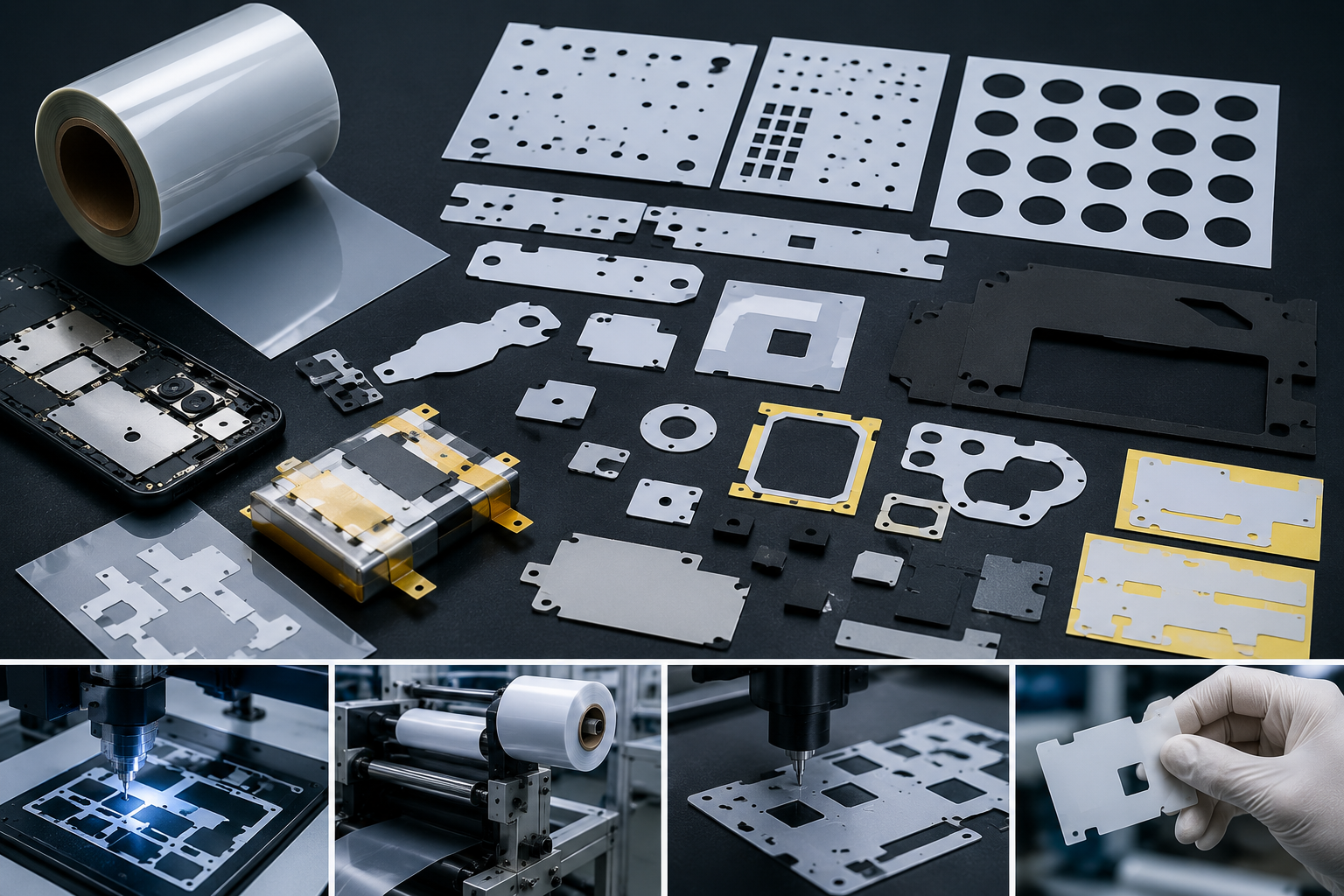
PVC (Polyvinyl Chloride) insulation film is a flexible polymer material designed to provide electrical insulation and mechanical protection.
It is widely used because of its excellent balance of performance and affordability.
Key characteristics include:
- Good electrical insulation
- Flexible construction
- Flame-retardant options
- Chemical resistance
- Moisture resistance
- Easy processability
- Cost efficiency
These properties make PVC film suitable for a wide range of electronic applications.
Why Electrical Insulation Matters in Electronics
Electronic products contain densely packed circuits and conductive components.
Without proper insulation, manufacturers may encounter:
- Short circuits
- Electrical leakage
- Component damage
- Reduced product lifespan
- Safety risks
Insulation films create protective barriers that help isolate electrical pathways and maintain stable system operation.
As device complexity increases, insulation becomes even more critical.
Why Die Cutting Is Necessary
Electronic assemblies rarely use insulation films directly from a roll.
Most applications require:
- Precise dimensions
- Complex contours
- Mounting holes
- Window openings
- Adhesive backing
Die cutting converts PVC film into ready-to-install components that fit specific product designs.
Benefits include:
- Faster assembly
- Improved consistency
- Reduced labor costs
- Better product quality
For OEM production, die cutting often becomes essential.
Common Applications in Consumer Electronics
Consumer electronics are among the largest users of die-cut PVC insulation films.
Applications include:
Smartphones
PVC films help provide:
- Circuit insulation
- Component isolation
- Protective barriers
Tablets and Laptops
Used for:
- Electrical separation
- Internal protection
- Cable insulation
Wearable Devices
Thin die-cut insulation components support compact electronic designs.
As electronics become smaller, precision-converted insulation materials become increasingly important.
Applications in Power Supply Systems
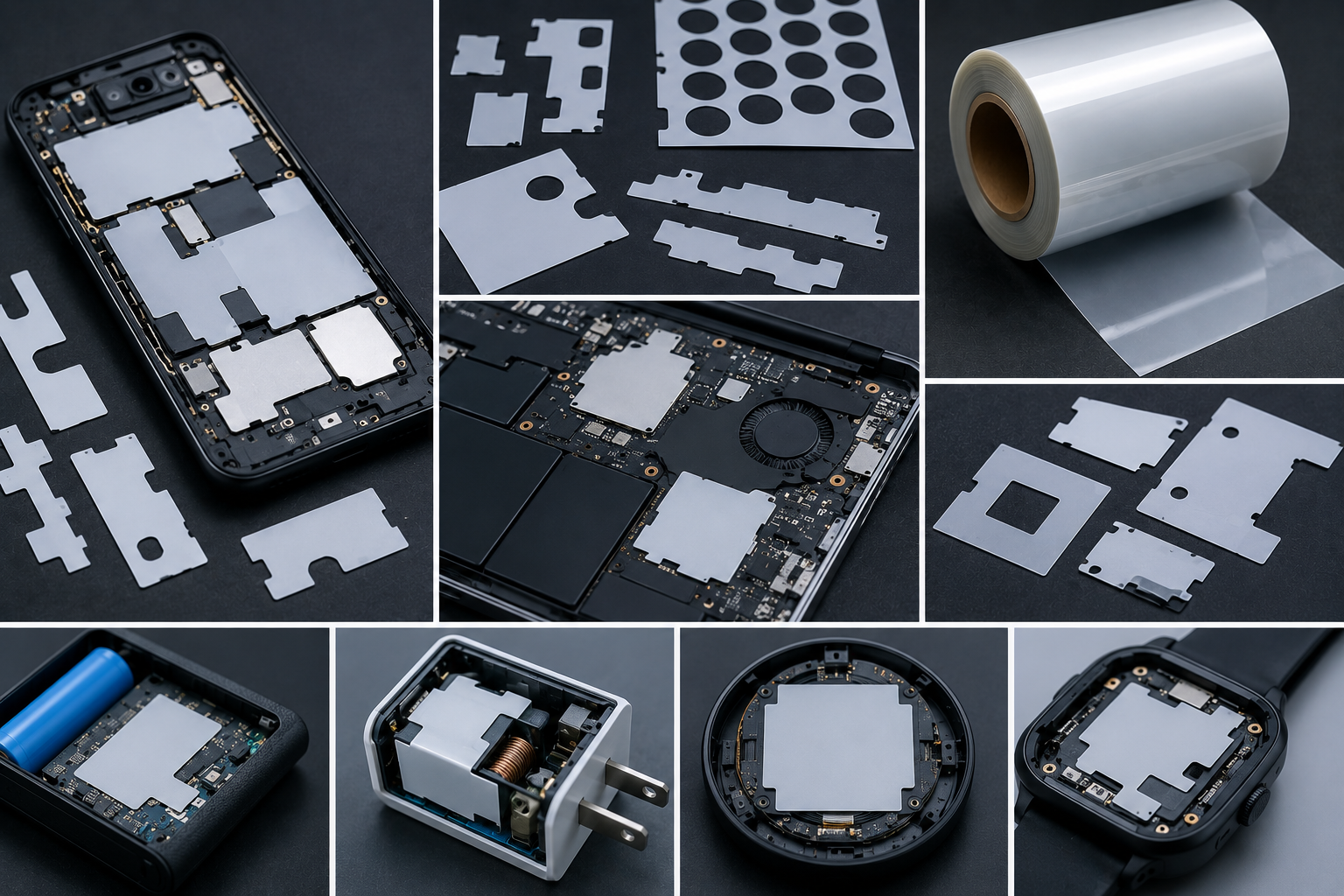
Power supply assemblies contain multiple voltage levels and electrical pathways.
PVC insulation films are commonly used to:
- Prevent short circuits
- Separate conductive components
- Protect internal structures
Typical applications include:
- AC adapters
- Chargers
- Industrial power supplies
- Power distribution modules
Reliable insulation contributes directly to product safety and performance.
Battery Pack Protection
Modern battery systems require multiple layers of protection.
PVC insulation films are frequently used in:
- Lithium battery packs
- Portable electronics batteries
- Energy storage systems
Functions include:
- Electrical isolation
- Component separation
- Surface protection
Proper insulation helps reduce the risk of electrical failure and improves overall system reliability.
Cable and Wire Insulation Applications
PVC has long been used in wire and cable protection.
Die-cut PVC film components may also support:
- Wire routing
- Cable management
- Connector protection
Advantages include:
- Flexibility
- Durability
- Easy installation
These applications remain common across numerous electronic industries.
Cost Advantages Compared with Other Insulation Materials
One reason PVC remains popular is its affordability.
Compared with some specialty insulation materials, PVC offers:
| Property | PVC Film Advantage |
|---|---|
| Material Cost | Economical |
| Processing Cost | Low |
| Availability | Widely Available |
| Converting Efficiency | Excellent |
For high-volume OEM programs, these advantages can generate significant savings.
When project requirements permit, PVC often provides an attractive balance between performance and cost.
Supports Complex Product Designs
Modern electronic products frequently contain intricate internal layouts.
PVC insulation films can be die cut into:
- Irregular shapes
- Micro components
- Multi-opening structures
- Thin-profile assemblies
Precision die cutting enables insulation materials to fit seamlessly into compact product architectures.
This design flexibility helps engineers optimize available space.
Easy Integration with Adhesive Systems
Many insulation components require positioning during assembly.
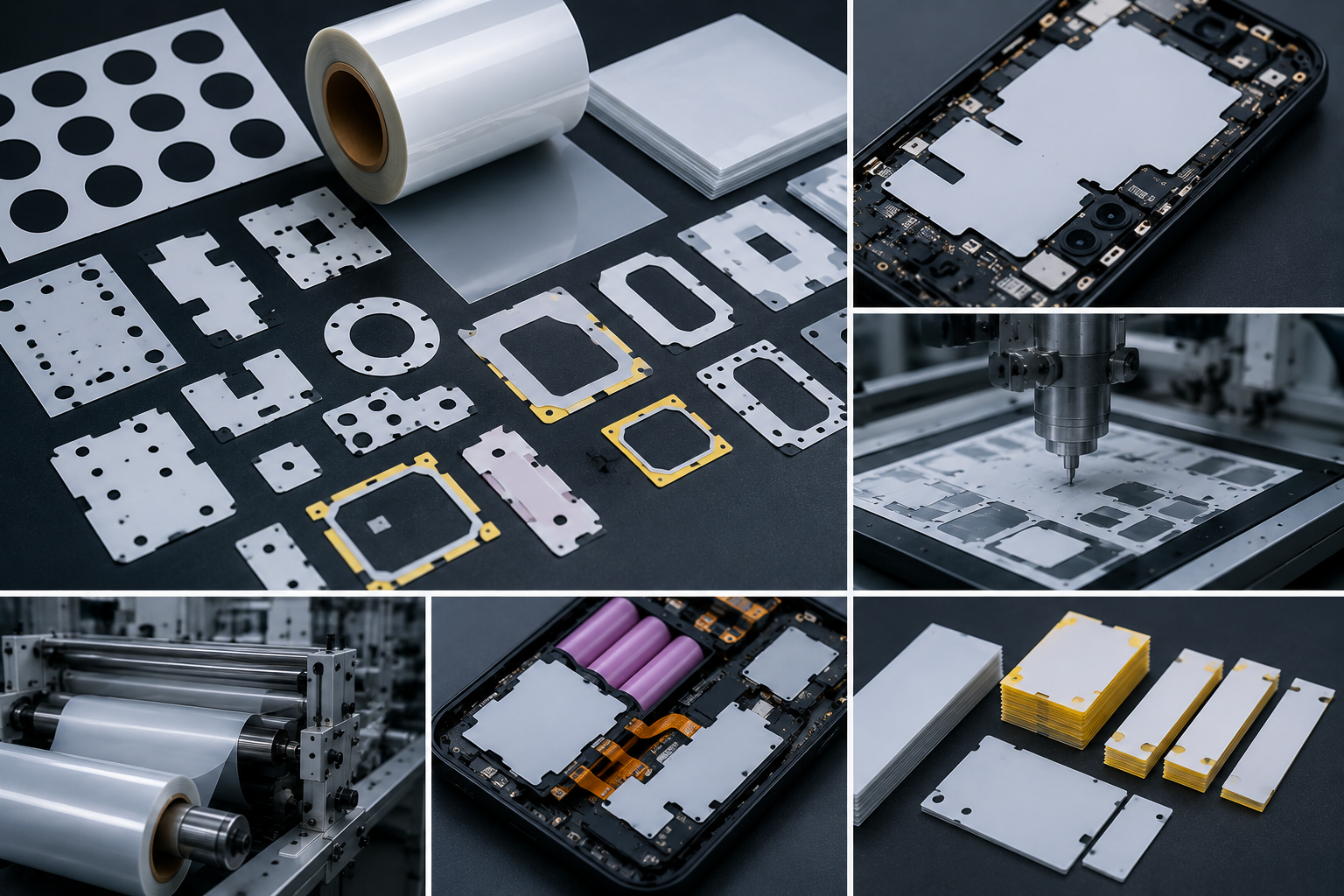
To simplify installation, PVC films can be combined with pressure-sensitive adhesives.
Benefits include:
- Faster assembly
- Improved positioning accuracy
- Reduced labor requirements
- Consistent installation quality
Die-cut adhesive-backed components arrive ready for production use.
This approach is widely used in electronics manufacturing.
Flame Retardancy for Enhanced Safety
Certain PVC insulation films are formulated to meet flame-retardant requirements.
This provides additional protection in applications involving:
- Power electronics
- Electrical devices
- Battery systems
- Industrial equipment
Enhanced fire resistance contributes to improved product safety and compliance.
Material selection should always be based on the specific application requirements.
Why Precision Matters in PVC Film Die Cutting
Even though PVC is relatively easy to process, precision remains essential.
Poor converting can lead to:
- Dimensional variation
- Assembly issues
- Misalignment
- Material waste
Precision die cutting helps ensure:
- Accurate dimensions
- Clean edges
- Consistent quality
- Repeatable performance
For automated assembly systems, consistency is especially important.
How Sanken Supports PVC Insulation Film Converting
At Sanken, we help OEM customers transform PVC insulation films into production-ready components.
Our capabilities include:
- Precision die cutting
- Kiss cutting
- Multi-layer lamination
- Adhesive integration
- Prototype development
- High-volume manufacturing
We support applications across:
- Consumer electronics
- Power supplies
- Battery systems
- Industrial equipment
- Automotive electronics
By combining material expertise with advanced converting technologies, we help customers improve product reliability while reducing manufacturing complexity.
Conclusion
PVC insulation film remains one of the most practical and cost-effective insulation materials used in electronic products.
When combined with precision die cutting, it provides customized solutions that improve electrical safety, assembly efficiency, and product reliability.
From consumer electronics and power supplies to battery systems and industrial equipment, die-cut PVC insulation components continue to play a vital role in modern electronic manufacturing.
At Sanken, we help OEM customers convert PVC insulation films into precision-engineered components that meet demanding performance and production requirements.