
How Are Non-Woven Fabrics Made? A Practical Guide for OEM Buyers and Engineers
Non-woven fabrics are made by bonding fibers into engineered sheets for filtration, insulation, acoustic control, cushioning, and industrial OEM components.
Snippet: Learn how non-woven fabrics are made, including fiber selection, web formation, bonding, finishing, die cutting, and Sanken’s custom non-woven converting support.
How Are Non-Woven Fabrics Made?
Non-woven fabrics are produced directly from fibers, without weaving or knitting yarns together.
Instead of forming a traditional textile structure, manufacturers open loose fibers, arrange them into a web, bond the web, and finish the material according to the required application.
This makes non-woven fabric highly flexible as an engineering material. It can be soft or rigid, thin or thick, breathable or dense, absorbent or water-resistant.
For OEM buyers and engineers, the manufacturing process matters because it directly affects thickness, weight, strength, air permeability, acoustic performance, insulation, and die-cut accuracy.
1. Fiber Selection
The first step is choosing the right fiber.
Common fibers used in non-woven fabric manufacturing include:
- Polyester fiber
- Polypropylene fiber
- Viscose fiber
- Recycled fiber
- Low-melting-point fiber
- Specialty functional fiber
Each fiber creates different performance characteristics.
Polyester is often selected for strength, heat resistance, and dimensional stability. Polypropylene is lightweight and commonly used in filtration and protective layers. Low-melting-point fibers can help bond the web during thermal processing.
For automotive, appliance, electronics, and industrial applications, fiber selection should not be based only on price. Engineers also need to consider temperature exposure, compression behavior, flame resistance, acoustic absorption, airflow, thickness tolerance, and long-term durability.
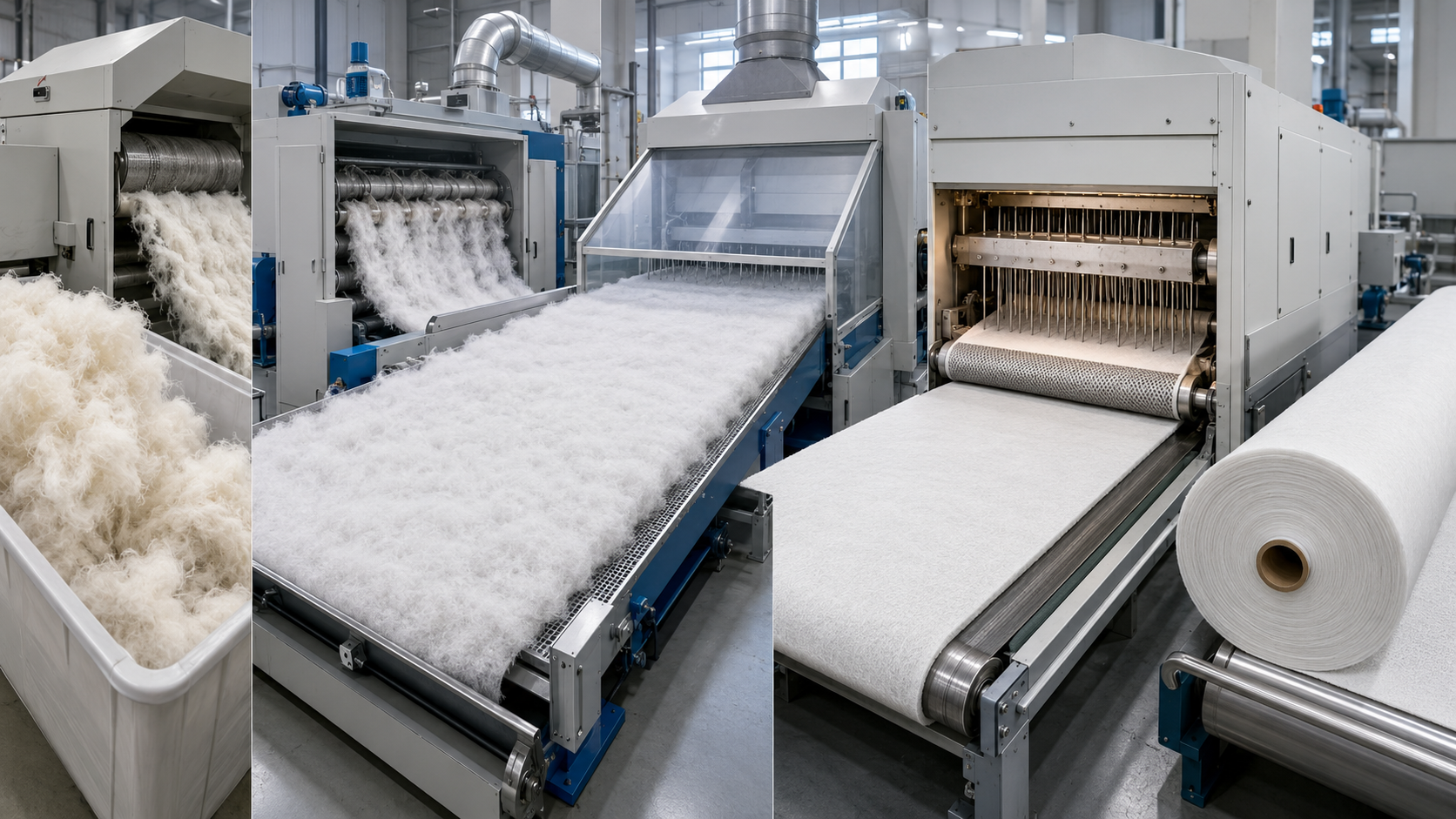
2. Opening and Blending
After raw fibers are selected, they are opened and blended.
Opening separates compressed fiber bales into loose fibers. Blending mixes different fibers together to create a consistent material formula.
This step is important because poor blending can cause uneven thickness, weak areas, inconsistent density, and unstable product performance.
In OEM manufacturing, stable blending helps ensure that every batch performs consistently during die cutting, lamination, hot pressing, and final assembly.
| Process Step | Purpose | Why It Matters |
|---|---|---|
| Fiber selection | Defines base performance | Controls strength, softness, heat resistance, and cost |
| Opening | Loosens compressed fibers | Improves web formation |
| Blending | Mixes fiber types evenly | Supports stable material performance |
| Web formation | Arranges fibers into a sheet | Controls thickness and uniformity |
| Bonding | Gives the web strength | Determines durability and structure |
Main Methods Used to Make Non-Woven Fabrics
After fibers are opened and blended, they must be formed into a web and bonded. Different bonding methods create different non-woven structures.
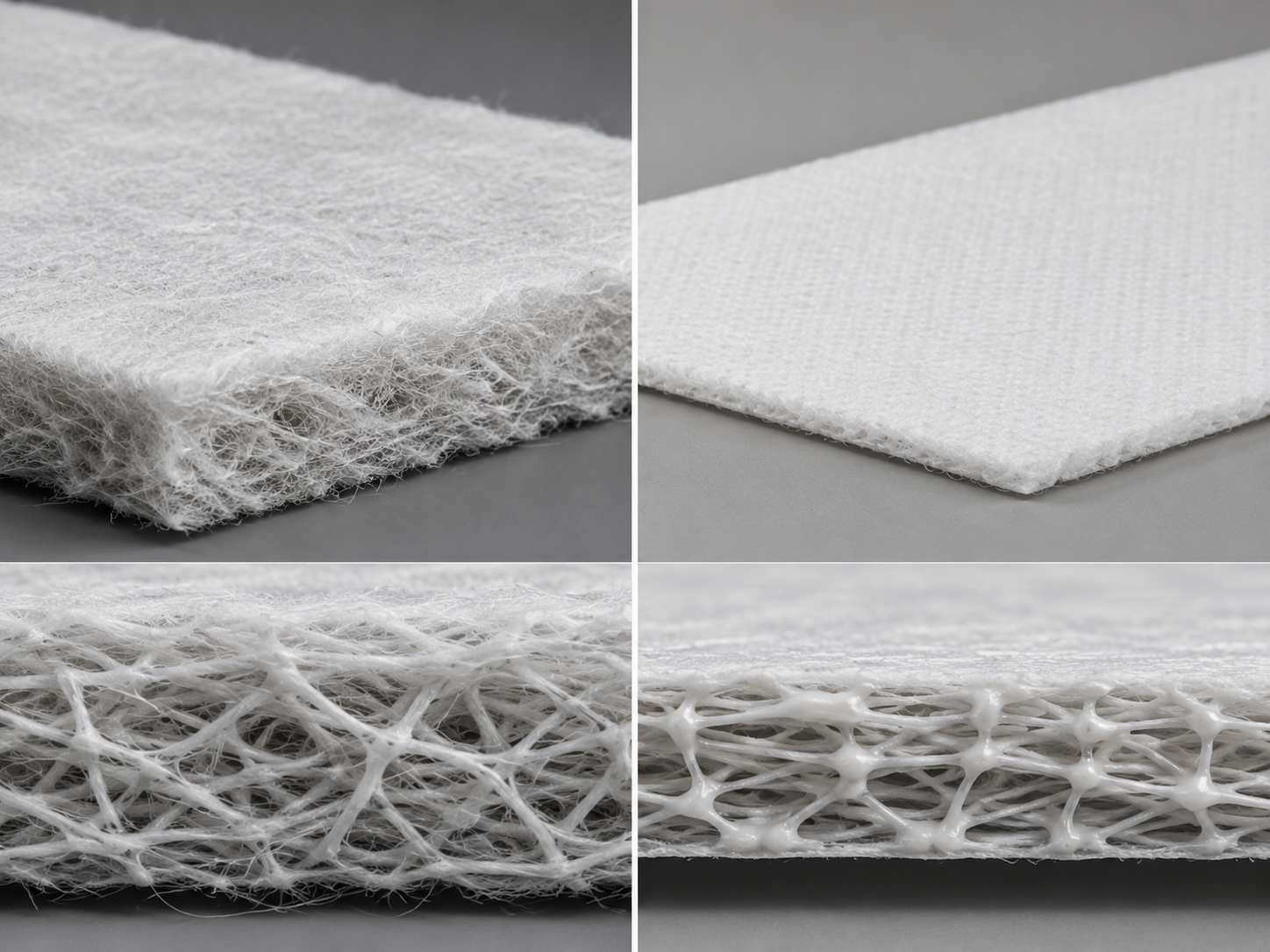
1. Needle-Punched Non-Woven Fabric
Needle punching is one of the most common methods for industrial non-woven fabrics.
In this process, barbed needles repeatedly punch through the fiber web. The needles mechanically entangle the fibers, creating a strong felt-like structure.
Needle-punched non-woven fabric is widely used when the material needs:
- Good thickness
- Breathability
- Sound absorption
- Cushioning
- Mechanical strength
- Stable shape after converting
This type of non-woven fabric is common in automotive acoustic pads, hood insulation, dashboard insulation, floor under covers, trunk trim, wheel liners, appliance pads, filtration layers, and industrial cushioning parts.
For OEM projects, needle-punched material can be customized by fiber formula, basis weight, thickness, density, and width.
2. Thermal Bonded Non-Woven Fabric
Thermal bonding uses heat to bond fibers together.
This process often uses low-melting-point fibers or bicomponent fibers. When heated, part of the fiber softens and bonds with surrounding fibers. After cooling, the web becomes a stable sheet.
Thermal bonded non-woven fabric can offer a cleaner surface, improved dimensional stability, and controlled stiffness.
It is often used when the application requires shape retention, low linting, or compatibility with heat forming.
3. Chemical Bonded Non-Woven Fabric
Chemical bonding uses binders or adhesives to hold the fibers together.
This method can create materials with specific hand feel, flexibility, stiffness, or surface properties. It is suitable for some filtration, wiping, protective, and specialty industrial applications.
However, chemical bonding must be carefully selected for OEM use. Engineers should evaluate odor, VOC requirements, temperature resistance, aging behavior, and compatibility with adhesive lamination or other assembly processes.
4. Hot Pressing and Forming
Some non-woven fabrics are further processed by hot pressing.
Hot pressing uses heat, pressure, and tooling to shape the material into a flat or three-dimensional component. This is especially useful for automotive and industrial parts that must fit a specific installation space.
Examples include:
- Hood insulation pads
- Dashboard insulation pads
- Battery insulation covers
- Floor under covers
- Wheel liner components
- Trunk side trim
- Appliance acoustic pads
Hot pressing can improve installation stability and reduce secondary assembly work for OEM customers.
Key Performance Factors Engineers Should Consider
Non-woven fabric is not only a roll material. Its performance depends on both material design and processing control.
Thickness and Basis Weight
Thickness affects cushioning, insulation, acoustic absorption, sealing, and part fit.
Basis weight affects strength, density, cost, and overall performance. A heavier material may improve sound absorption or durability, but it may also increase cost and weight.
For automotive lightweight design, engineers often need to balance acoustic performance, thermal insulation, and part weight.
Density and Air Permeability
Density controls how compact the material is.
A low-density non-woven fabric may provide better cushioning and sound absorption. A higher-density material may provide stronger structure, better shape stability, or improved filtration support.
Air permeability is especially important for filter layers, acoustic materials, and ventilation-related components.
Compression and Recovery
Many non-woven parts are installed between two surfaces.
In these applications, compression behavior is critical. The material must compress enough to fit into the assembly, but it should not collapse permanently under load.
Good recovery helps maintain sealing, cushioning, and noise-reduction performance over time.
Cutting and Converting Stability
For OEM production, the material must be easy to convert into finished parts.
Poorly controlled non-woven fabric may create dust, loose fibers, rough edges, uneven die-cut shapes, or unstable laminated parts.
That is why material selection and converting capability should be considered together.
| Performance Factor | Impact on Final Part |
|---|---|
| Thickness | Affects fit, cushioning, insulation, and sound absorption |
| Basis weight | Influences strength, cost, and performance |
| Density | Controls airflow, stiffness, and compression |
| Heat resistance | Supports automotive and appliance applications |
| Die-cut quality | Ensures accurate assembly and stable mass production |
| Surface condition | Affects lamination, bonding, and cleanliness |
Common Applications of Non-Woven Fabrics
Non-woven fabrics are used across many industries because they can be engineered for different functions.
Automotive Applications
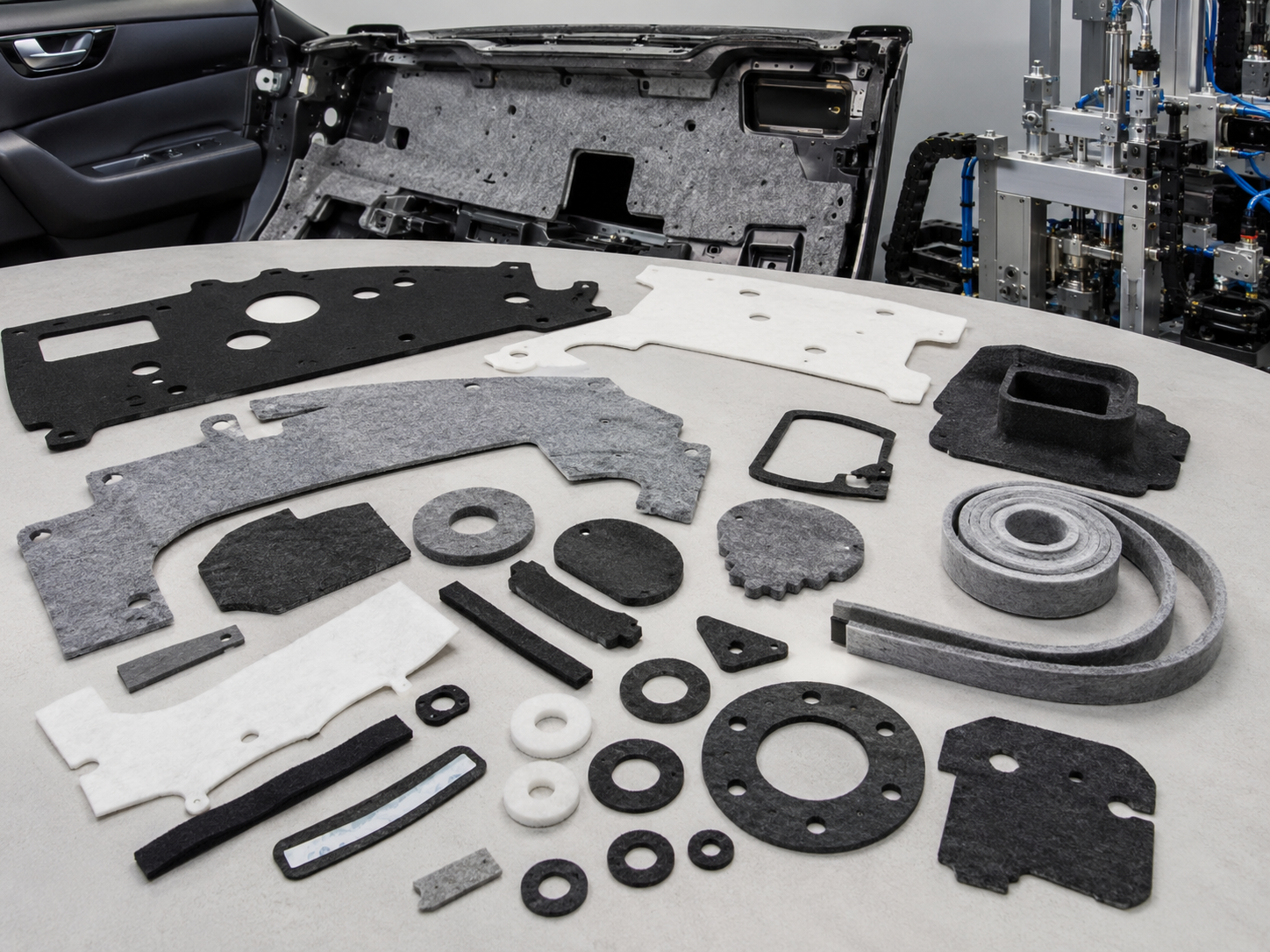
Automotive manufacturers use non-woven fabrics for sound absorption, thermal insulation, dust protection, vibration control, cushioning, and lightweight design.
Common automotive applications include:
- Hood insulation pads
- Dashboard insulation pads
- Battery insulation covers
- Floor under covers
- Wheel liners
- Trunk trim
- HVAC filter layers
- Interior acoustic pads
- Door panel cushioning
- Air conditioner components
Compared with some molded plastic parts, non-woven components can help reduce weight, improve acoustic performance, and simplify part design.
Appliance and Electronics Applications
In household appliances, non-woven fabric can be used for dust protection, vibration damping, sound reduction, filtration, and insulation.
Examples include vacuum cleaner filters, washing machine pads, refrigerator insulation parts, air conditioner filters, and small motor protection components.
In electronics, non-woven materials may be used as protective layers, dust barriers, cushioning pads, spacers, or insulation components.
Industrial Applications
Industrial applications often require customized material performance.
Non-woven fabric may be used for filtration, equipment protection, packaging, sealing, anti-vibration pads, thermal insulation, surface protection, and functional liners.
For these applications, OEM customers usually need more than standard roll material. They need the material converted into accurate shapes with consistent tolerances.
How Sanken Supports Non-Woven Fabric OEM Projects
At Sanken, non-woven fabric is treated as a functional engineering material, not just a soft textile.
We support OEM customers from material selection to finished component manufacturing. This helps purchasing managers, sourcing teams, and engineers reduce development risk and simplify the supply chain.
Material Selection and Custom Development
Sanken can help evaluate non-woven material options based on application requirements such as thickness, weight, density, compression, acoustic performance, thermal resistance, bonding method, and installation environment.
For projects that require customized performance, Sanken supports material formula development and specification adjustment.
Precision Die Cutting and Custom Converting
Sanken provides precision die cutting and custom converting for non-woven materials, foam, rubber, adhesive tape, insulation materials, sealing materials, EMI shielding materials, and thermal management materials.
For non-woven fabric components, we can support:
- Precision die cutting
- Kiss cutting
- Slitting
- Adhesive lamination
- Foam lamination
- Hot pressing
- Forming
- Rapid prototyping
- Mass production supply
This allows customers to receive ready-to-install components instead of managing multiple suppliers for raw material, adhesive processing, cutting, and forming.
OEM Manufacturing Support
Sanken works with OEM customers in automotive, electronics, appliance, and industrial markets.
Our role is to help turn non-woven fabric into reliable functional parts. Whether the project requires acoustic insulation, cushioning, filtration, dust protection, thermal insulation, or sealing support, Sanken can assist from early sample testing to stable mass production.
For engineers, this means faster design validation. For purchasing teams, it means a more efficient supply chain. For OEM manufacturers, it means consistent quality and scalable production support.
Conclusion
Non-woven fabrics are made through fiber preparation, web formation, bonding, finishing, and converting. Sanken helps OEM customers turn these materials into reliable custom components.