
How to Choose Non-Woven Fabric for Precision Die Cutting Applications?
Choosing non-woven fabric for precision die cutting is not just about thickness, color, or price. The wrong material can cause loose fibers, rough edges, poor adhesive bonding, unstable dimensions, and assembly problems during mass production.
For OEM buyers, the better question is not only “Which non-woven fabric should I buy?” The real question is: “Which non-woven structure can be die cut cleanly, assembled smoothly, and perform reliably in my final product?”
At Sanken Manufacturing, we help customers select, laminate, die cut, and convert non-woven fabrics into functional components for automotive interiors, electronics protection, medical equipment, filtration, packaging, acoustic insulation, and industrial applications.
Why Non-Woven Fabric Selection Matters in Die Cutting
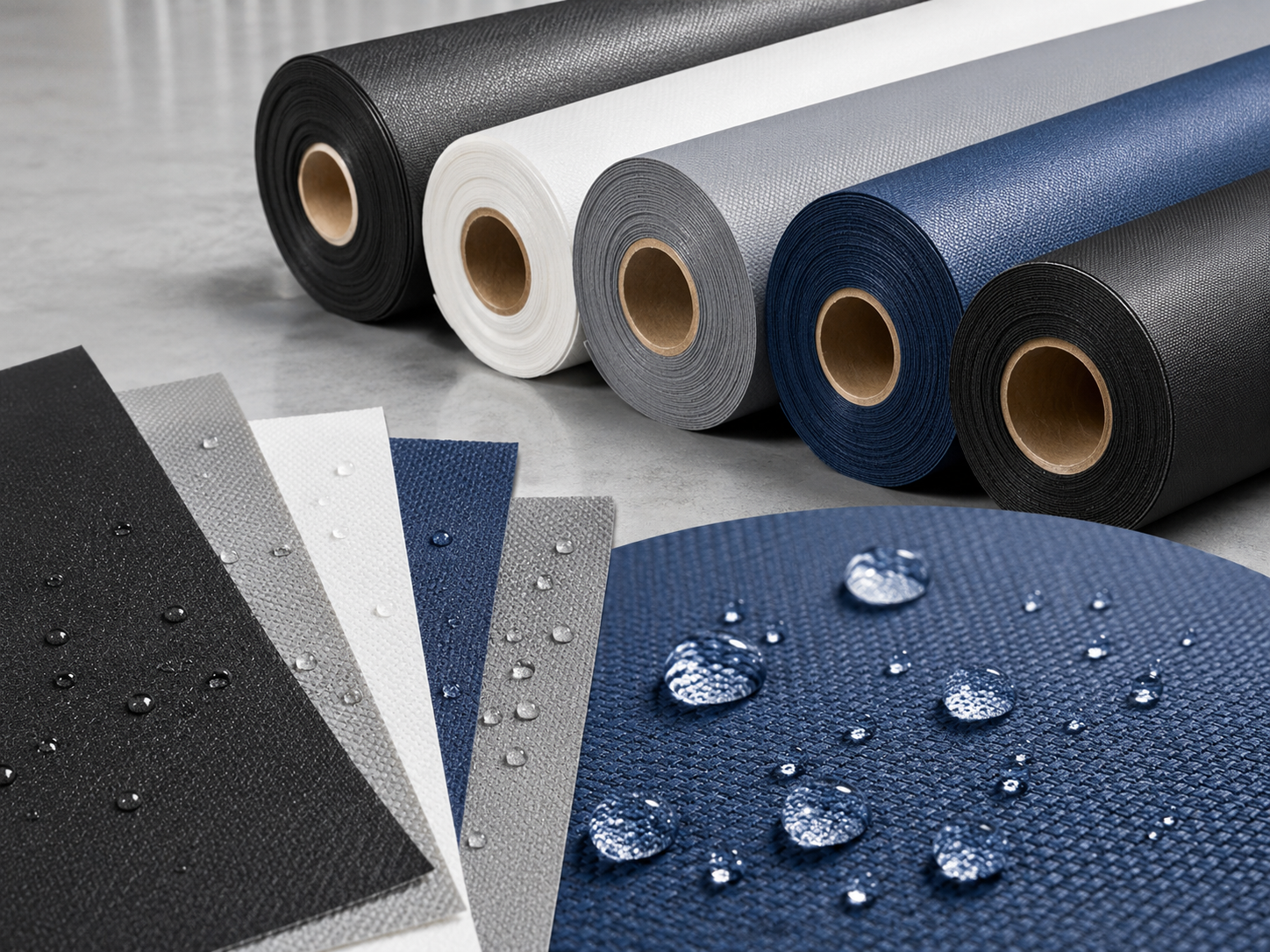
Non-woven fabric is made by bonding fibers together without weaving or knitting. This structure gives it useful properties such as softness, breathability, filtration, cushioning, sound absorption, and lightweight protection.
But the same fiber structure can also create challenges during die cutting.
If the fabric is too loose, the cut edge may shed fibers.
If the bonding is weak, the part may deform.
If the thickness is unstable, the final component may not fit.
If the surface is difficult to bond, adhesive-backed parts may lift or peel.
For buyers, this means material selection must match both the final application and the converting process.
A material that looks good in roll form may not perform well after cutting, laminating, or assembly.
Start With the Final Application
Before choosing any non-woven fabric, define what the part must do.
Different applications require different material logic.
| Application | Key Requirement |
|---|---|
| Automotive interior | Heat resistance, odor control, acoustic performance |
| Electronics protection | Clean edges, low fiber shedding, dimensional accuracy |
| Filtration | Airflow, pore structure, particle capture |
| Medical equipment | Cleanliness, softness, safety requirements |
| Packaging | Cushioning, appearance, cost control |
| Industrial assembly | Durability, bonding, compression behavior |
This is why the same “non-woven fabric” cannot serve every project.
For example, a soft spunlace non-woven may work well for wipes, but it may not be ideal for automotive acoustic pads. A needle-punched PET non-woven may be strong for insulation, but it may be too thick or too fibrous for small electronic parts.
The right material starts with the real use case.
Choose the Right Fiber Material
The fiber type strongly affects performance.
Common non-woven fiber materials include:
| Fiber Type | Main Advantages | Common Applications |
|---|---|---|
| Polyester / PET | Durable, heat resistant, dimensionally stable | Automotive, filtration, insulation |
| Polypropylene / PP | Lightweight, moisture resistant, cost-effective | Medical, hygiene, packaging |
| Viscose | Soft, absorbent | Wipes, medical layers |
| Cotton | Natural, absorbent | Specialty medical and hygiene products |
| Blended fibers | Balanced performance | Custom industrial applications |
For precision die cutting, PET non-woven fabric is often selected because it has good strength, heat resistance, and dimensional stability.
For disposable or lightweight applications, PP non-woven may be more cost-effective.
For automotive and electronics buyers, the material should not be selected by price alone. It must also support clean cutting, stable assembly, and long-term performance.
Check Thickness and Density
Thickness and density are two of the most important factors.
A thicker material may provide better cushioning or sound absorption, but it may also be harder to cut cleanly.
A low-density material may feel soft and economical, but it may deform easily during die cutting.
A high-density material may hold shape better, but it may cost more and reduce breathability.
Buyers should confirm:
- Required thickness
- Thickness tolerance
- Material density
- Compression behavior
- Part size
- Assembly space
- Cutting tolerance
For automotive sound insulation pads, thickness and density affect acoustic performance.
For electronics protection parts, thickness affects assembly pressure.
For filtration parts, density affects airflow and filtration efficiency.
The correct balance depends on the final function.
Consider Fiber Bonding Strength
Non-woven fabrics are made using different bonding methods.
Common methods include:
- Needle punching
- Thermal bonding
- Chemical bonding
- Spunbonding
- Meltblown processing
- Hydroentanglement
Each method creates a different structure.
Needle-punched non-woven fabric is thicker and useful for acoustic and cushioning applications.
Thermally bonded non-woven fabric has a cleaner and more uniform structure.
Meltblown non-woven fabric is useful for filtration.
Spunlace non-woven fabric is soft and suitable for wipes or medical products.
For die cutting, bonding strength matters because it affects edge quality.
If the fibers are not bonded strongly enough, the part may fray, shed fibers, or lose shape after cutting.
For clean assembly environments, such as electronics or medical equipment, low fiber shedding is especially important.
Evaluate Edge Quality Before Mass Production
Edge quality is one of the biggest concerns in precision die cutting.
Poor edges can cause:
- Loose fibers
- Rough appearance
- Dust contamination
- Poor adhesive bonding
- Assembly difficulty
- Customer complaints
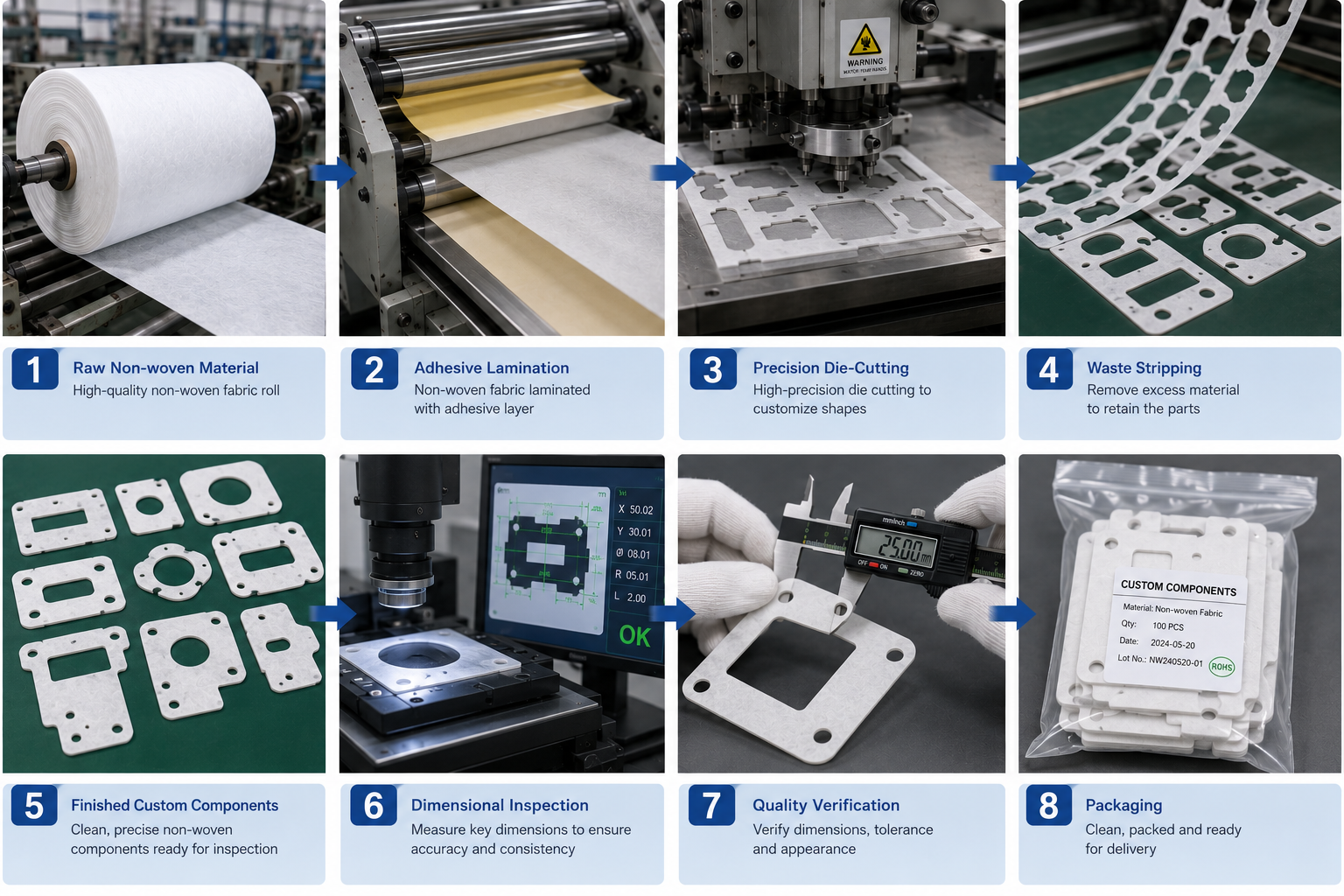
Before approving the material, buyers should ask for sample cutting trials.
A good trial should check:
- Edge cleanliness
- Fiber shedding
- Dimensional accuracy
- Hole quality
- Adhesive performance
- Waste stripping behavior
- Part handling stability
This step is very important.
Some non-woven materials look stable before cutting but release fibers after die cutting. Others cut well in simple shapes but fail in narrow strips or small holes.
At Sanken, we evaluate material behavior during sample development so customers can avoid problems before tooling and mass production.
Decide Whether Adhesive Backing Is Needed
Many die-cut non-woven parts require adhesive backing.
Adhesive-backed non-woven fabric is used for:
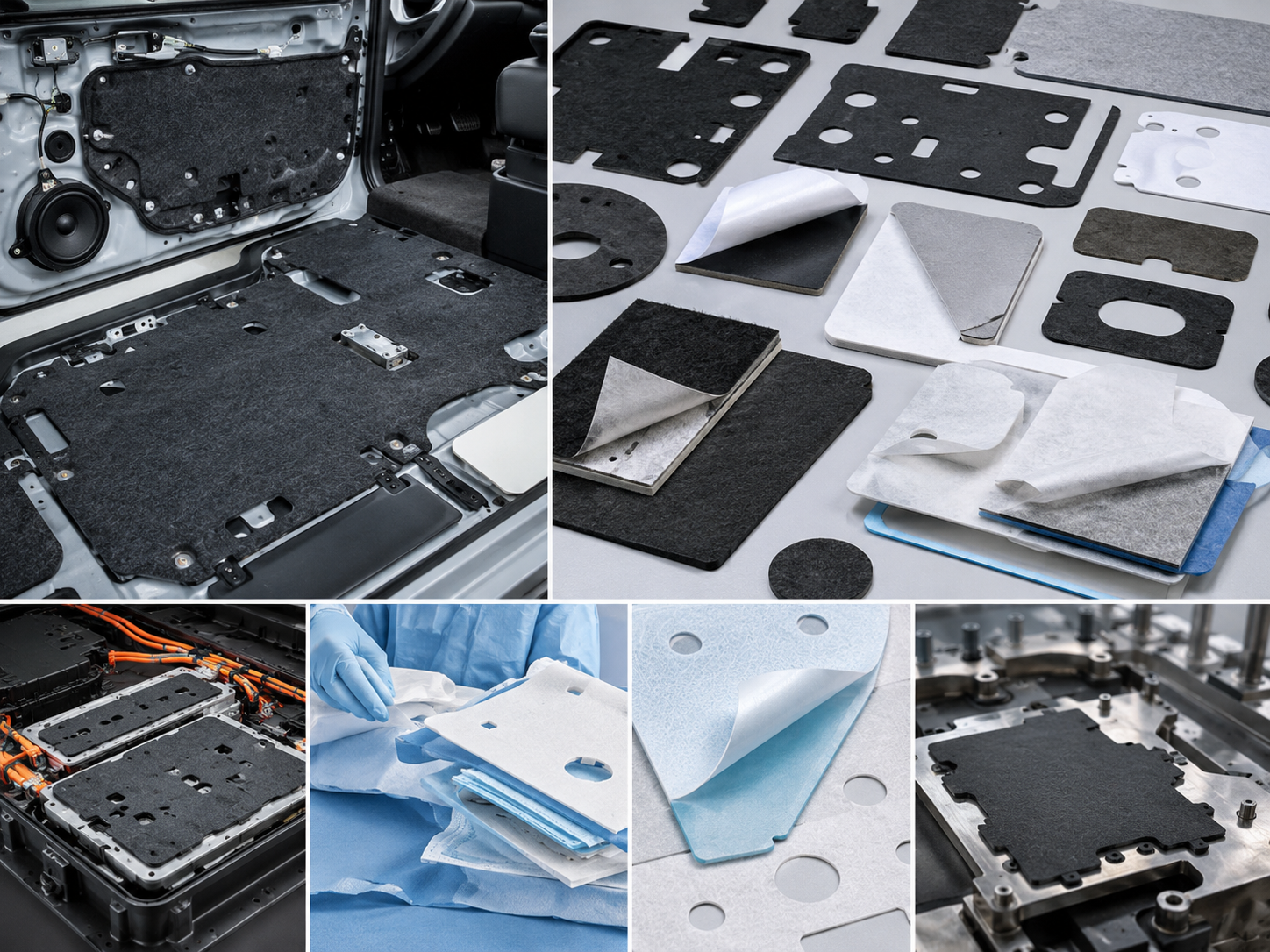
- Automotive interior pads
- Dust protection layers
- Electronic cushioning parts
- Acoustic insulation parts
- Medical device components
- Industrial assembly pads
But adhesive selection must match the non-woven surface.
Some non-woven fabrics have rough, porous, or fibrous surfaces. If the adhesive does not bond properly, problems may occur:
- Edge lifting
- Delamination
- Weak peel strength
- Adhesive transfer
- Difficult application
- Liner separation
For this reason, buyers should evaluate the complete structure:
non-woven fabric + adhesive + release liner + final application surface
Not just the fabric alone.
Match the Cutting Method to the Material
Different cutting methods can be used for non-woven fabric.
| Cutting Method | Best For |
|---|---|
| Flatbed die cutting | Thick sheets, prototypes, custom shapes |
| Rotary die cutting | Roll-to-roll high-volume production |
| Kiss cutting | Adhesive-backed parts on liner |
| Laser cutting | Some prototypes, but heat risk must be checked |
| CNC cutting | Thick materials or sample development |
For mass production, die cutting is usually more stable and efficient than manual cutting.
For adhesive-backed non-woven parts, kiss cutting is often useful because the part stays on the release liner and can be peeled easily during assembly.
For thick acoustic pads, flatbed die cutting may be more suitable.
The best method depends on material thickness, tolerance, part shape, production volume, and assembly method.
Think About Tolerance Early
Tolerance should be discussed before production starts.
Non-woven fabric is softer and more flexible than hard plastic or metal. It may stretch, compress, or shift during cutting.
Tolerance depends on:
- Material thickness
- Density
- Fiber structure
- Adhesive backing
- Part size
- Hole size
- Cutting method
- Tooling design
Buyers sometimes request very tight tolerances without considering material behavior. This may increase cost or create unrealistic expectations.
A good converting supplier should review the drawing and explain what tolerance is practical for the selected material.
This helps avoid disputes and redesign later.
Check Heat, Aging, and Environmental Requirements
Non-woven parts often work inside demanding products.
For automotive, electronics, and industrial use, buyers should confirm:
- Heat resistance
- Humidity resistance
- UV exposure
- Flame resistance
- Odor performance
- Compression aging
- Adhesive aging
- Chemical exposure
- Long-term dimensional stability
Automotive interior parts may face high cabin temperatures.
Electronic parts may face heat from batteries or circuits.
Industrial parts may face dust, vibration, or moisture.
A material that performs well at room temperature may not perform well after aging.
This is why application testing is important before mass production.
Avoid Choosing Only by Unit Price
Low-cost non-woven fabric can become expensive if it causes production problems.
Hidden costs may include:
- High scrap rate
- Slow assembly
- Poor bonding
- Contamination
- Dimensional failure
- Rework
- Delayed delivery
- Customer complaints
A better purchasing decision should consider total application cost.
Sometimes a slightly better material saves money by reducing rejects and improving assembly efficiency.
For OEM buyers, the best non-woven fabric is not always the cheapest. It is the material that performs reliably with the lowest total risk.
What Should Buyers Confirm Before Ordering?
Before choosing non-woven fabric for precision die cutting, buyers should ask:
- What is the final application?
- What fiber material is required?
- What thickness and density are needed?
- Does the part need adhesive backing?
- What cutting method will be used?
- What tolerance is required?
- Is fiber shedding acceptable?
- Will the part face heat, humidity, vibration, or compression?
- Does it need flame resistance or odor control?
- Is this for prototype testing or mass production?
These questions help the supplier recommend the correct material and converting process.
How Sanken Helps Customers Choose Better Non-Woven Materials
At Sanken Manufacturing, we support customers from material selection to finished component production.
Our capabilities include:
- Non-woven fabric converting
- Precision die cutting
- Kiss cutting
- Adhesive lamination
- Foam bonding
- Rubber and film lamination
- Hot pressing
- Slitting
- Custom assembly
- Prototype and mass production support
We work with automotive, electronics, medical, filtration, packaging, and industrial customers.
Our value is not only cutting material into shape. We help customers reduce material risk, improve edge quality, solve adhesive problems, control tolerance, and simplify supplier management.
For buyers who need stable mass production, this integrated support can prevent many problems before they appear on the production line.
Conclusion
Choosing non-woven fabric for precision die cutting requires more than selecting thickness and price. Buyers must consider fiber type, bonding method, density, edge quality, adhesive compatibility, tolerance, application environment, and mass production stability.
For OEM applications, the right non-woven material should cut cleanly, bond reliably, assemble smoothly, and perform consistently in the final product. At Sanken Manufacturing, we help customers select, laminate, die cut, and convert non-woven fabrics into reliable components for automotive, electronics, medical, filtration, packaging, and industrial applications.