
How To Control Dust Pollution During Mass Production Of Optical Film Die Cutting?
Optical films are among the most sensitive materials used in modern electronics. Whether the application involves smartphones, tablets, automotive displays, LCD modules, touch panels, or optical backlight systems, even a tiny dust particle can become a costly defect.
Many manufacturers focus heavily on die-cutting accuracy, dimensional tolerances, and material performance. However, in real production environments, dust contamination often causes more quality issues than the die-cutting process itself.
At Sanken, we frequently see customers struggling with white spots, bubbles, scratches, poor adhesion, and optical defects that can all be traced back to one root cause: dust pollution.
The challenge becomes even greater during mass production, where millions of parts move through the factory every month.
So how can manufacturers effectively control dust pollution during optical film die cutting?
Why Is Dust Such A Serious Problem For Optical Films?
Unlike foam, rubber, or industrial gaskets, optical films interact directly with light.
A particle that measures only a few microns may become highly visible once a display is illuminated.
Common defects caused by dust include:
- Bright spots
- Dark spots
- Surface bumps
- Air bubbles
- Optical distortion
- Adhesive failure
- Display appearance defects
In many cases, the finished product passes dimensional inspection but fails visual inspection because of contamination.
For high-end consumer electronics and automotive displays, even a single visible particle may result in rejection.
Where Does Dust Come From?
Many factories focus on cleaning the workshop while ignoring the actual sources of contamination.
Dust typically originates from several areas.
Raw Materials
Contamination may already exist on:
- Optical films
- Release liners
- Protective films
- Packaging materials
Incoming material inspection is the first defense against contamination.
Production Equipment
Equipment can generate particles through:
- Mechanical friction
- Worn rollers
- Aging belts
- Improper maintenance
Regular preventive maintenance is essential.
Operators
Human beings are often the largest source of particles inside a clean production environment.
Common contaminants include:
- Hair
- Skin flakes
- Clothing fibers
- Cosmetic residues
Without proper cleanroom procedures, contamination risk increases dramatically.
Environmental Sources
External dust may enter through:
- Air conditioning systems
- Open doors
- Logistics movement
- Material transfers
Controlling airflow is critical.
Build The Right Cleanroom Environment
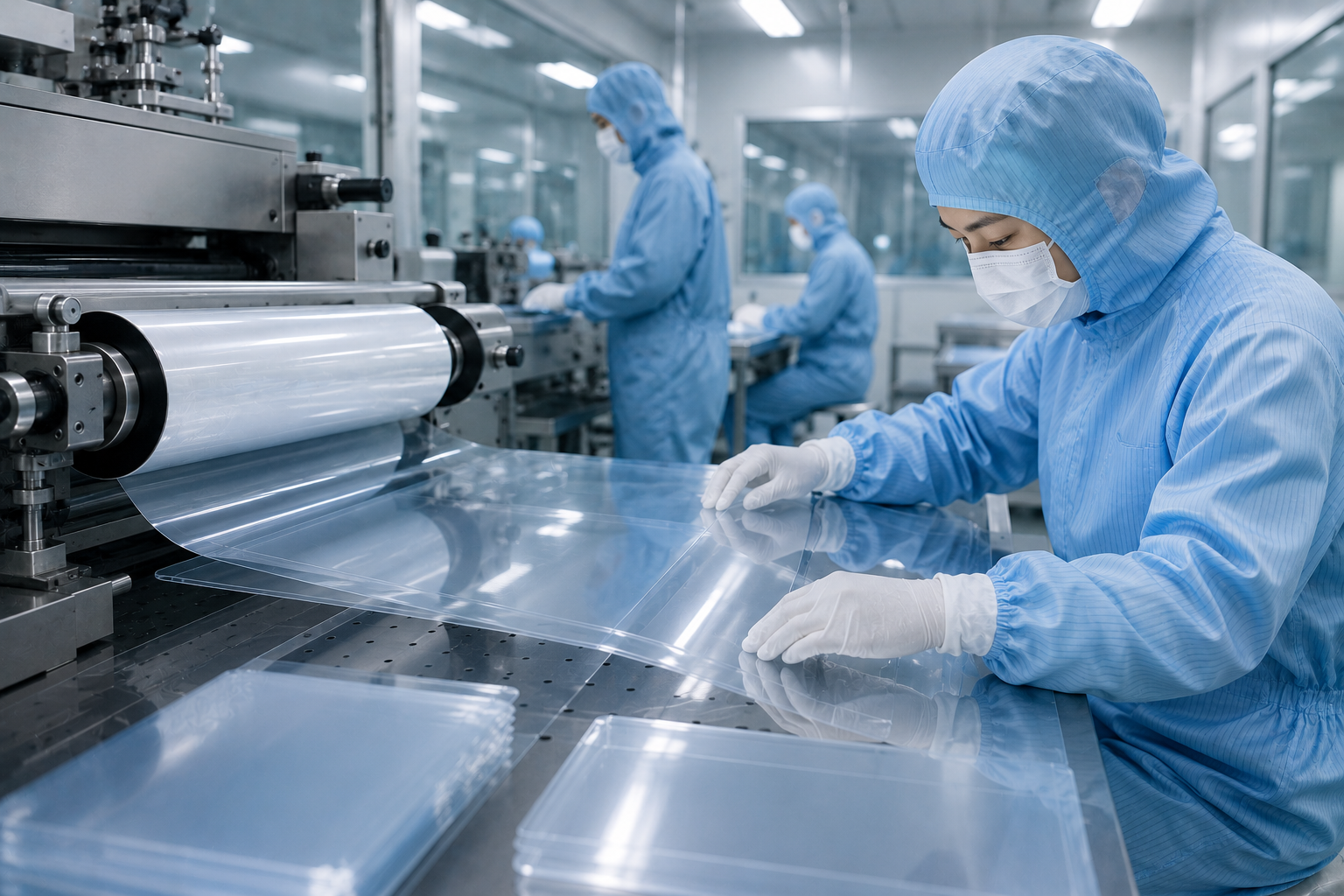
The most effective way to reduce dust contamination is to prevent particles from entering the production area.
For optical film die cutting, many manufacturers use:
- ISO Class 7 cleanrooms
- ISO Class 8 cleanrooms
- Localized clean booths
- Laminar airflow systems
The required cleanliness level depends on:
- Product specifications
- Customer requirements
- Optical sensitivity
For automotive display applications, cleanliness requirements are often more stringent than those for standard industrial products.
Control Airflow Direction
Many companies underestimate the importance of airflow.
Particles naturally move with air currents.
A well-designed airflow system can continuously remove contaminants before they settle on optical surfaces.
Key measures include:
- HEPA filtration systems
- Positive pressure environments
- Laminar airflow workstations
- Controlled air circulation
The goal is simple:
Prevent airborne particles from landing on optical films.
Implement Strict Operator Management
Even the cleanest factory can fail if operators do not follow proper procedures.
Best practices include:
Cleanroom Garments
Operators should wear:
- Dust-free uniforms
- Hair covers
- Face masks
- Cleanroom gloves
- Shoe covers
Entry Procedures
Personnel entering the production area should pass through:
- Air showers
- Sticky mats
- Hand cleaning stations
Training Programs
Employees must understand:
- Dust contamination risks
- Proper material handling
- Cleanroom behavior standards
Human discipline often determines cleanroom effectiveness.
Optimize Material Handling
Optical films should spend as little time exposed to the environment as possible.
Recommended practices include:
- Keeping protective liners attached until necessary
- Using covered transport trays
- Minimizing manual handling
- Storing materials in sealed packaging
Every additional handling step creates another contamination opportunity.
Reduce Particle Generation During Die Cutting
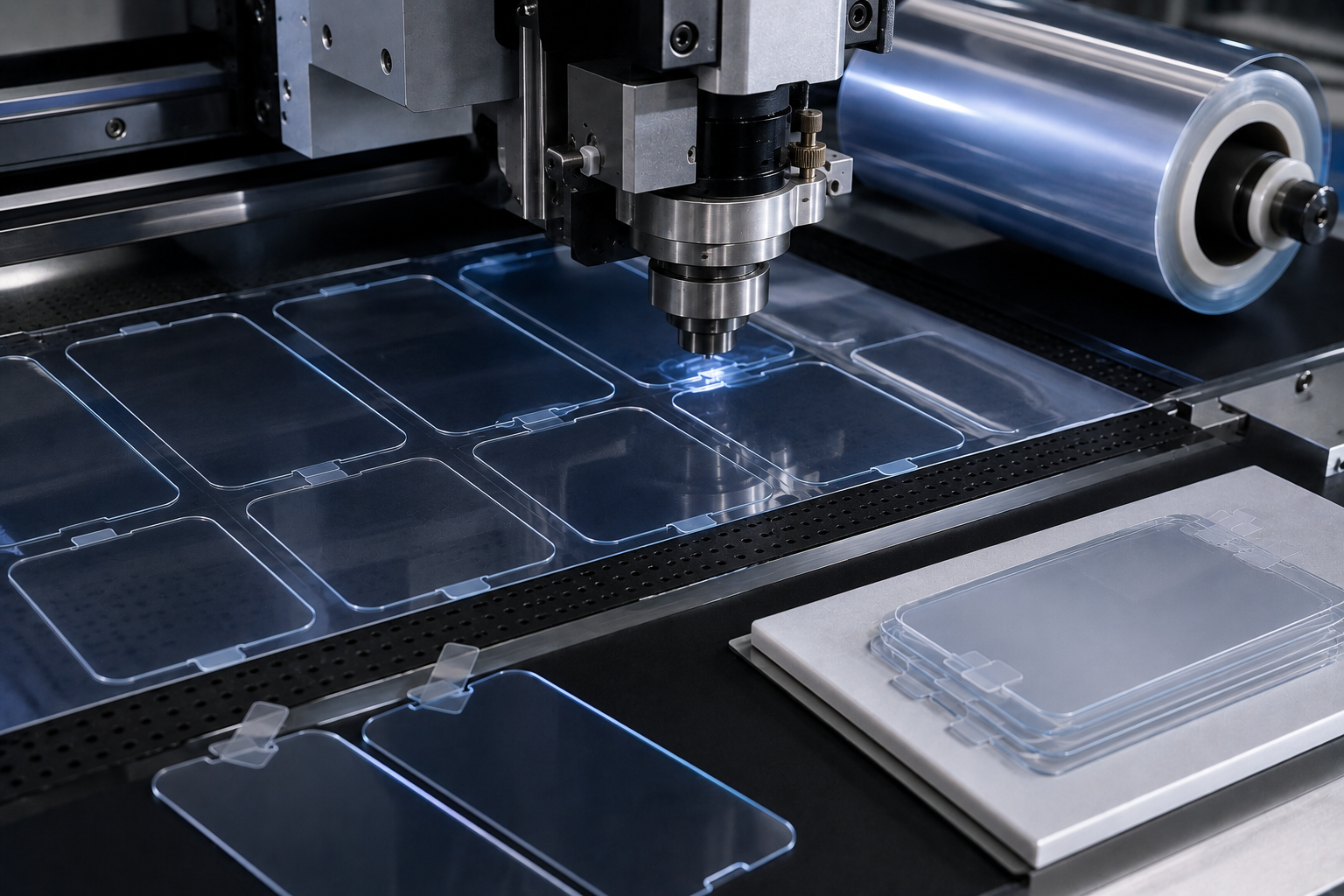
The die-cutting process itself can generate particles.
This is especially true when:
- Blades become worn
- Cutting pressure is excessive
- Material compatibility is poor
To reduce contamination:
Use High-Precision Tooling
Sharp, properly maintained tooling helps minimize:
- Burr generation
- Edge dust
- Material fragmentation
Optimize Cutting Parameters
Adjusting:
- Cutting force
- Speed
- Material tension
can significantly reduce particle generation.
Perform Regular Tool Maintenance
Worn tools often become hidden contamination sources.
Preventive maintenance schedules are critical.
Control Static Electricity
Static electricity is one of the most overlooked contamination risks in optical film production.
Static charges attract airborne particles directly onto film surfaces.
The result can be:
- Embedded dust
- Visual defects
- Assembly failures
Effective anti-static measures include:
- Ionizing bars
- ESD-safe equipment
- Grounding systems
- Humidity control
For optical film converting, static management should never be optional.
Establish Continuous Cleaning Procedures
Cleanrooms do not stay clean automatically.
Regular cleaning is required for:
- Workstations
- Rollers
- Conveyors
- Inspection equipment
- Storage areas
Many successful manufacturers establish cleaning schedules based on:
- Production volume
- Product sensitivity
- Customer requirements
Consistency matters more than occasional deep cleaning.
Strengthen Quality Inspection
Even with preventive controls, inspection remains essential.
Many optical film manufacturers utilize:
Visual Inspection
Operators identify:
- Dust particles
- Surface defects
- Foreign matter
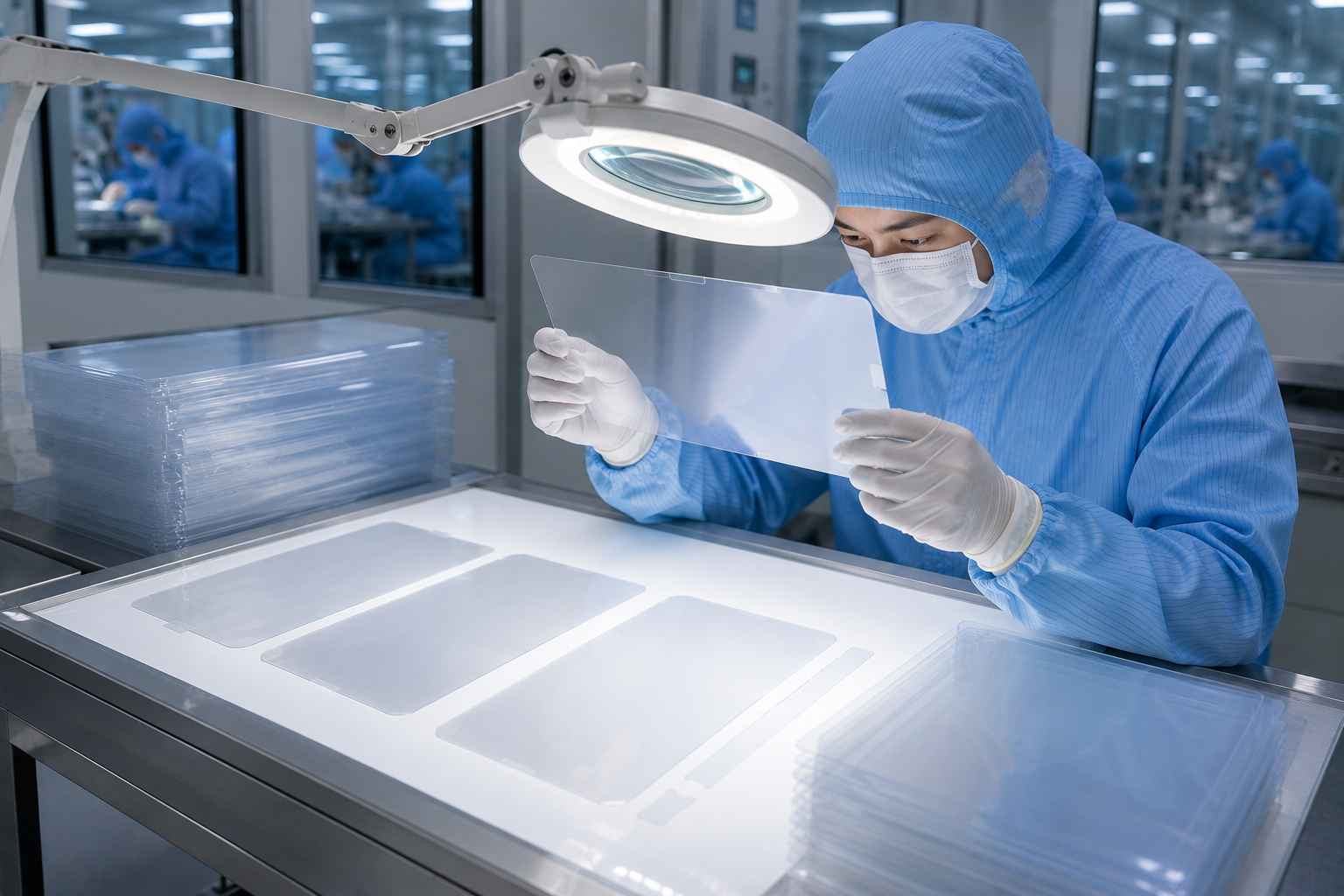
Backlight Inspection
Illumination systems make contamination more visible.
Automated Vision Systems
Machine vision can detect microscopic defects that are difficult to see manually.
Combining prevention with inspection creates a stronger quality system.
Why Dust Control Matters More During Automotive Display Production
Automotive displays present unique challenges.
Vehicle displays must withstand:
- Long service life
- Wide temperature ranges
- Continuous visibility requirements
Unlike consumer devices, automotive displays often remain in service for 10 years or more.
A small contamination defect can become a major warranty issue later.
This is why automotive OEMs increasingly demand strict contamination control throughout the optical component supply chain.
How Sanken Controls Dust During Optical Film Die Cutting
At Sanken, we understand that precision dimensions alone are not enough for optical products.
We focus equally on cleanliness and process control.
Our optical film converting capabilities include:
- Precision die cutting
- Multi-layer lamination
- Optical film processing
- Protective liner integration
- Anti-static control measures
- Clean production environments
By controlling contamination from incoming material to final packaging, we help customers reduce defects and improve production yield.
For optical film products, cleanliness is not simply a quality requirement.
It is a manufacturing capability.
Conclusion
Controlling dust pollution during optical film die cutting requires a combination of cleanroom design, airflow management, operator discipline, anti-static control, equipment maintenance, and rigorous inspection.
Manufacturers that focus only on die-cutting precision often overlook the contamination risks that ultimately determine product quality.
At Sanken, we combine precision optical converting with strict contamination control processes to help customers achieve the cleanliness standards required for modern consumer electronics and automotive display applications.