
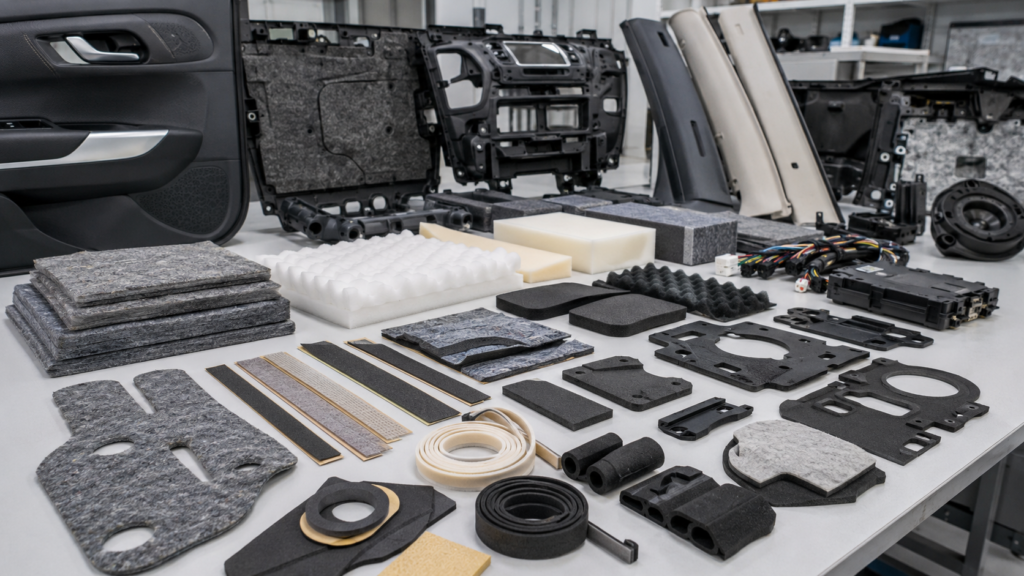
EVA foam can be suitable for automotive use when the application requires lightweight cushioning, anti-rattle performance, vibration reduction, gap filling, surface protection or protective packaging. However, it should be approved based on material grade, density, thickness, compression recovery, adhesive compatibility, odor control, heat resistance and long-term aging behavior.
For sealing applications, buyers should also compare the best foam for die cut sealing gaskets before confirming foam density, compression recovery and adhesive backing.
Automotive environments are demanding. A foam part may face heat, humidity, vibration, compression, adhesive stress and repeated assembly pressure for years. This is why EVA foam should not be selected only because it is soft, lightweight and easy to die cut.
At Sanken Manufacturing, we help automotive OEMs and Tier suppliers convert EVA foam into precision die-cut pads, adhesive-backed foam parts, anti-rattle components, cushioning layers, protective liners, sealing support parts and multilayer assemblies.
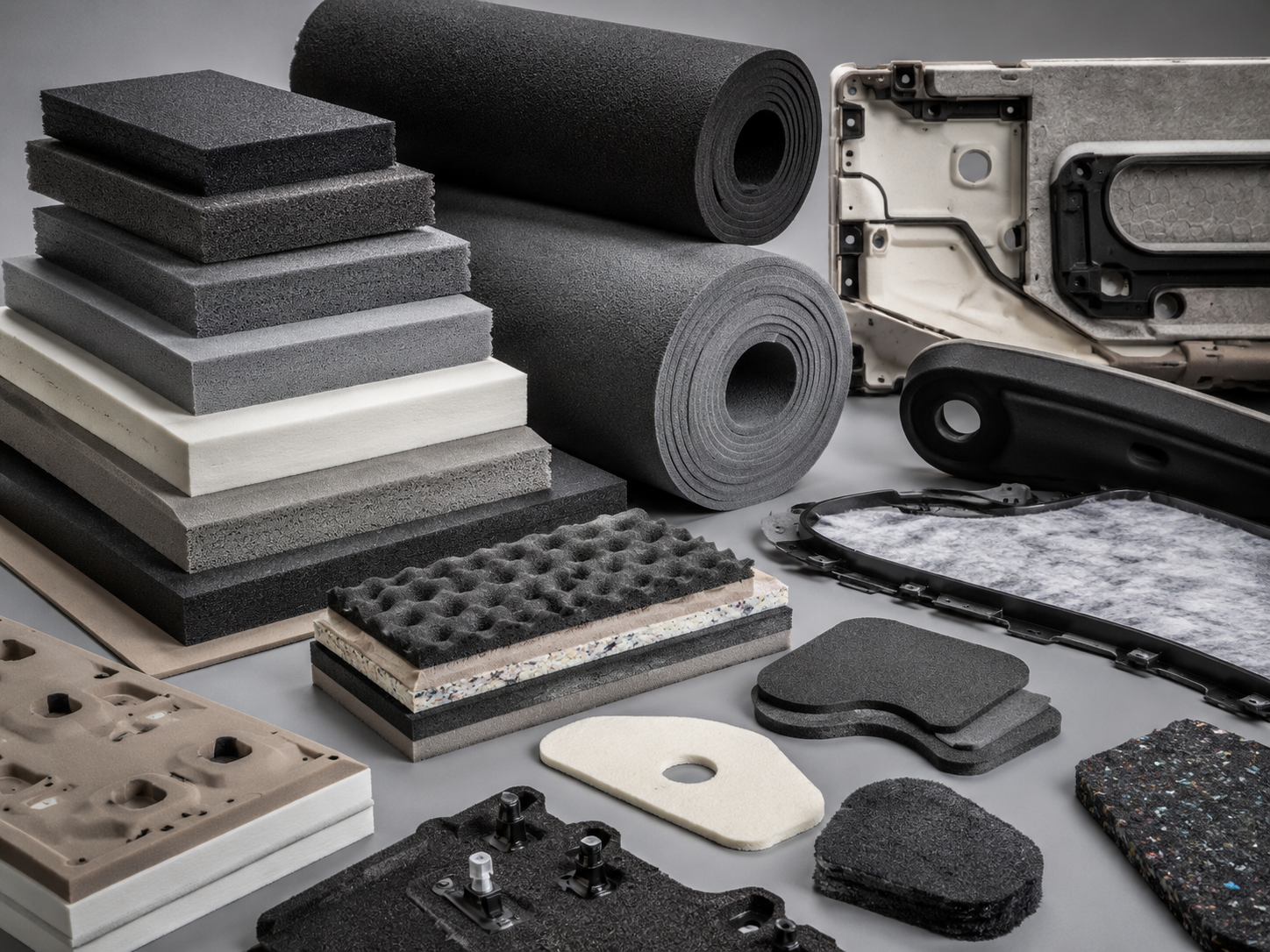
What Is EVA Foam?
EVA stands for ethylene-vinyl acetate.
It is a flexible polymer material commonly produced as foam sheets, rolls, molded parts, and adhesive-backed components.
EVA foam is widely used because it offers:
- Lightweight structure
- Good flexibility
- Shock absorption
- Cushioning performance
- Water resistance
- Easy die cutting
- Easy laminating
- Cost efficiency
For automotive buyers, EVA foam is attractive because it can be customized into many shapes and thicknesses. It can also be combined with adhesive tape, non-woven fabric, film, rubber, or other materials to create functional automotive components.
Where Is EVA Foam Used in Vehicles?
EVA foam is often used in hidden areas of the vehicle.
Common automotive applications include:
| Application Area | Main Function |
|---|---|
| Door trims | Anti-rattle and cushioning |
| Dashboard areas | Vibration reduction |
| Center console | Gap filling and protection |
| Trunk liners | Cushioning and impact protection |
| Wire harness areas | Friction reduction |
| Interior panels | Noise and vibration control |
| Packaging for auto parts | Transportation protection |
In many cases, the driver never sees the EVA foam part.
But the part still affects comfort, assembly quality, and long-term reliability.
A small EVA pad can prevent rattling.
A die-cut EVA spacer can improve fit.
An adhesive-backed EVA strip can reduce friction noise.
Small parts often solve expensive problems.
Why EVA Foam Can Be Good for Automotive Use
1. It Reduces Vibration and Contact Noise
Automotive interiors contain many plastic, metal, and electronic components.
When parts touch, move, or vibrate, they may create:
- Rattling
- Squeaking
- Buzzing
- Friction noise
EVA foam can act as a buffer between surfaces.
This makes it useful for anti-rattle pads, spacer strips, and cushioning components.
2. It Is Lightweight
Weight reduction is important in automotive design.
A lighter vehicle can improve fuel efficiency or EV driving range.
EVA foam provides cushioning and protection without adding much weight.
This makes it useful for interior and packaging applications.
3. It Is Easy to Die Cut
EVA foam can be cut into complex shapes.
That is valuable for automotive parts because components often require:
- Holes
- Slots
- Narrow strips
- Custom contours
- Adhesive-backed shapes
- Multi-layer assemblies
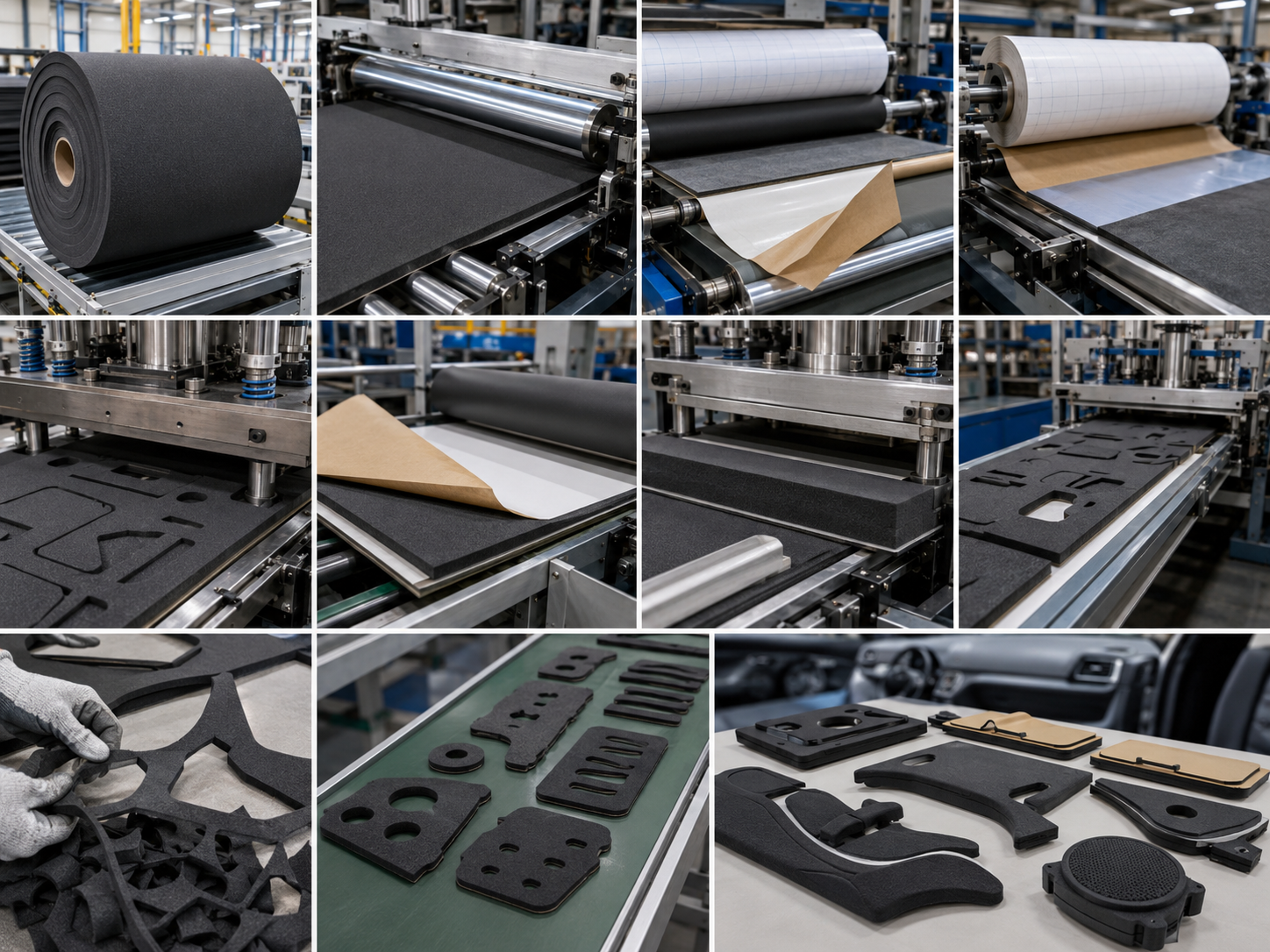
At Sanken, precision die cutting helps customers receive ready-to-assemble EVA foam parts instead of raw foam sheets.
4. It Can Be Laminated With Other Materials
EVA foam is often not used alone.
It can be combined with:
- Adhesive tape
- Release liner
- Non-woven fabric
- Rubber sheet
- PET film
- Aluminum film
- Acoustic felt
This allows customers to create parts that provide cushioning, bonding, insulation, sound control, or surface protection.
Where EVA Foam May Not Be Enough
EVA foam is useful, but it is not suitable for every automotive requirement.
Buyers should be careful in these situations.
High Heat Areas
Some EVA grades may deform, shrink, or create odor under high heat.
If the part is near engine areas, battery modules, or heat sources, higher-performance materials may be required.
Possible alternatives may include:
- EPDM foam
- Silicone foam
- Rubber materials
- High-temperature foam composites
Long-Term Compression
If EVA foam stays compressed for a long time, some grades may lose thickness.
This is called compression set.
When this happens, the part may lose cushioning, sealing, or anti-vibration performance.
For automotive applications, compression recovery must be evaluated carefully.
Strong Sealing Requirements
EVA foam can support light sealing or gap filling.
But for demanding waterproof, airtight, or high-elastic sealing applications, rubber or specialty foam may perform better.
Strict Odor Requirements
Automotive interiors have strict odor expectations.
A foam material may look fine during sampling but produce odor after heat exposure.
For interior applications, buyers should confirm odor, VOC, and aging performance before approval.
Key Automotive Requirements for EVA Foam
Before using EVA foam in a vehicle, buyers should confirm several requirements.
1. Density
Density affects softness, cushioning, recovery, and durability.
Low-density EVA is softer and lighter.
High-density EVA provides better support and may resist compression better.
2. Thickness
Thickness affects performance and assembly fit.
If the part is too thick, it may create assembly stress.
If it is too thin, it may not reduce vibration effectively.
3. Compression Performance
Automotive parts often remain compressed for years.
Buyers should ask:
- Will the foam recover after compression?
- Will it collapse over time?
- Does it maintain function after aging?
4. Adhesive Compatibility
Many EVA foam parts need adhesive backing.
Poor adhesive selection may cause:
- Edge lifting
- Peeling
- Delamination
- Difficult installation
- Assembly failure
At Sanken, we treat the foam and adhesive as one complete structure, not separate materials.
5. Heat and Aging Resistance
Automotive interiors may experience high temperatures during summer parking conditions.
EVA foam should be evaluated for:
- Shrinkage
- Hardness change
- Odor
- Adhesive retention
- Dimensional stability
6. Flame Resistance
Some vehicle applications may require flame-retardant materials.
This depends on the part location and customer specification.
Buyers should confirm this early.
What OEM Buyers Should Confirm Before Approving Automotive EVA Foam
Before approving EVA foam for automotive use, buyers should confirm whether the material can meet the real application environment, not only the sample appearance.
Important points include:
- Foam density and thickness
- Compression recovery after long-term load
- Heat aging and dimensional stability
- Odor and VOC requirements
- Adhesive backing and liner release
- Vibration and anti-rattle performance
- Part tolerance and die-cut edge quality
- Assembly method and delivery format
- Storage and transport conditions
- Whether flame resistance is required
This review helps avoid foam collapse, adhesive lifting, odor complaints, poor fit, edge deformation and delayed assembly problems after mass production.
Common Problems Buyers Face With EVA Foam Parts
EVA foam problems often appear after mass production begins.
Common issues include:
| Problem | Possible Cause |
|---|---|
| Foam collapses | Wrong density or poor compression recovery |
| Adhesive lifts | Poor adhesive compatibility |
| Parts do not fit | Foam deformation during die cutting |
| Odor appears | Low-grade material or poor heat aging |
| Edges are rough | Poor tooling or cutting process |
| Assembly is slow | Part design not optimized |
These problems increase scrap, delay production, and create customer complaints.
The solution is early material review and process validation.
Why Precision Die Cutting Matters for Automotive EVA Foam
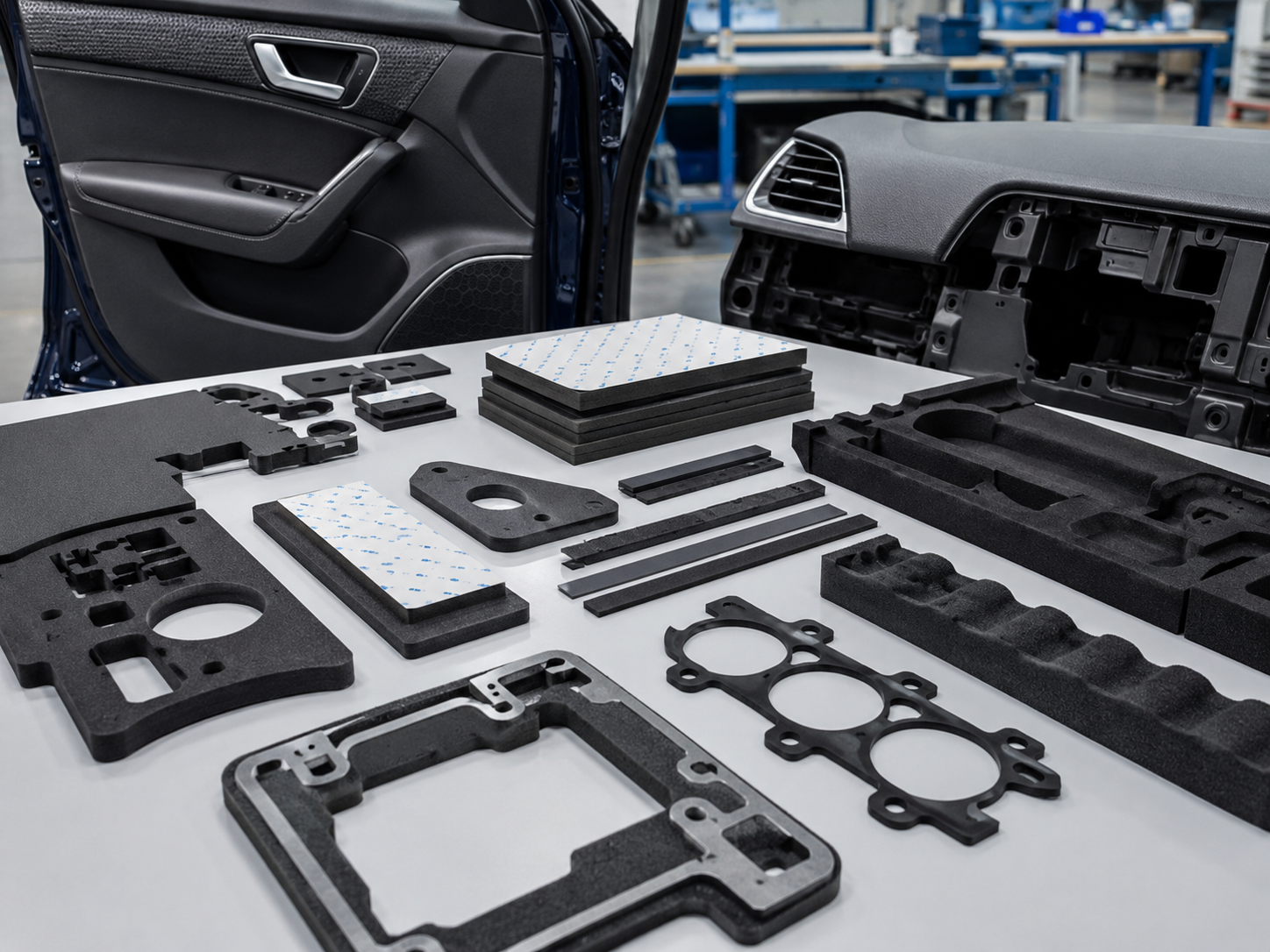
Automotive EVA foam parts are usually not simple rectangles.
They often require accurate shapes, clean edges, and stable dimensions.
Examples include:
- Anti-rattle pads
- Cushioning washers
- Adhesive-backed foam strips
- Custom spacers
- Protective liners
- Foam gaskets
- Multilayer foam assemblies
Poor die cutting may cause dimensional variation, edge tearing, adhesive misalignment, or difficult assembly.
At Sanken, we support EVA foam projects with:
- Precision die cutting
- Adhesive laminating
- Foam converting
- Hot pressing
- Material assembly
- Prototype and mass production support
This helps customers reduce trial-and-error and improve production stability.
When Should Automotive Buyers Use EVA Foam?
EVA foam is a good choice when the application needs:
- Cushioning
- Light vibration reduction
- Anti-rattle performance
- Surface protection
- Gap filling
- Light sealing support
- Protective packaging
- Custom die-cut shapes
It may not be the best choice when the application requires:
- Very high heat resistance
- Strong elastic sealing
- Long-term high compression recovery
- Heavy-duty sound blocking
- Harsh chemical exposure
In those cases, buyers should compare EVA with rubber, EPDM foam, silicone foam, PU foam, non-woven acoustic materials, or multilayer composites.
How Sanken Helps Customers Choose the Right Automotive EVA Foam Solution
At Sanken Manufacturing, we do not recommend EVA foam by material name alone. We review the actual installation location, noise or vibration problem, compression load, heat exposure, humidity, adhesive backing, tolerance requirement, assembly method and production volume.
Then we help customers choose the right EVA foam grade, density, thickness, adhesive structure and converting process.
Our support may include precision die cutting, adhesive laminating, foam converting, hot pressing, material assembly, prototype sampling and mass production. The goal is to help customers reduce assembly problems, improve consistency, shorten development time and achieve stable automotive production.
Conclusion
EVA foam can be suitable for automotive use when the application requires lightweight cushioning, light vibration reduction, anti-rattle performance, surface protection, gap filling, protective packaging or custom die-cut foam parts.
However, EVA foam should be selected carefully based on density, thickness, compression recovery, adhesive compatibility, heat resistance, odor control, flame resistance and long-term aging performance. For demanding sealing, high heat, high compression or heavy-duty acoustic applications, rubber, EPDM foam, silicone foam, PU foam, non-woven acoustic materials or multilayer composites may be better choices.
Sanken supports automotive EVA foam converting, adhesive laminating, precision die cutting, prototyping, inspection and mass production. If your project requires die-cut EVA foam pads, adhesive-backed foam strips, anti-rattle parts, cushioning layers or multilayer automotive foam components, Sanken can help turn material selection into stable production-ready parts.