
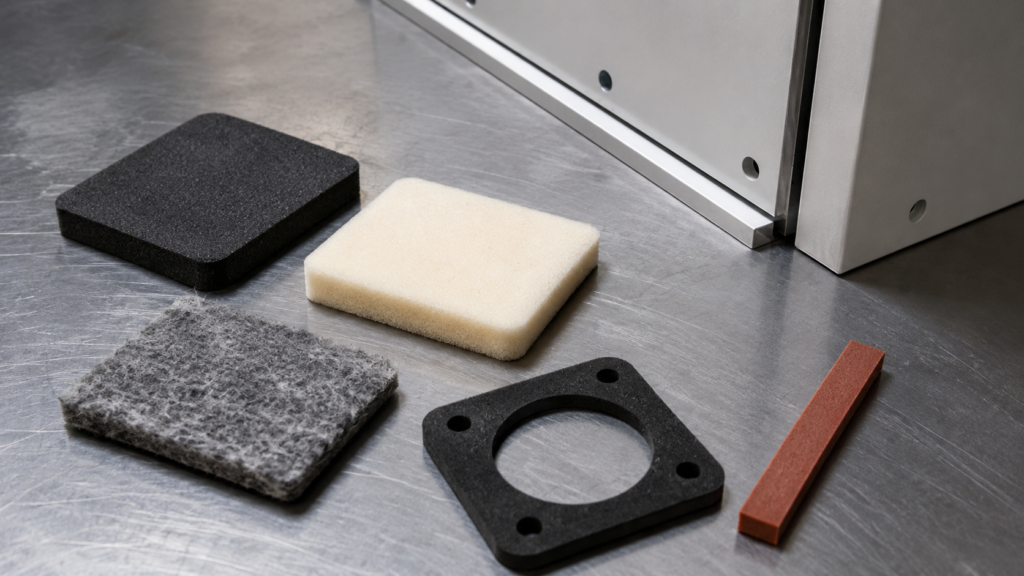
Yes, EVA foam can help reduce vibration, impact and contact noise, but it is generally not the best standalone material for blocking airborne sound.
In OEM products, EVA foam is more commonly used as a cushioning pad, anti-rattle spacer, vibration-isolation layer or sealing support. Its value comes from separating hard surfaces, absorbing impact and reducing the transfer of mechanical vibration.
If the objective is to absorb airborne noise across a wider frequency range, open-cell PU foam or non-woven acoustic felt may be more suitable. For demanding noise-control applications, several materials may need to work together as part of a properly designed structure.
Sanken converts EVA foam, PU foam, EPDM foam, silicone foam, rubber, adhesive tapes and non-woven felt into custom precision die-cut parts based on customer drawings, samples and assembly requirements.
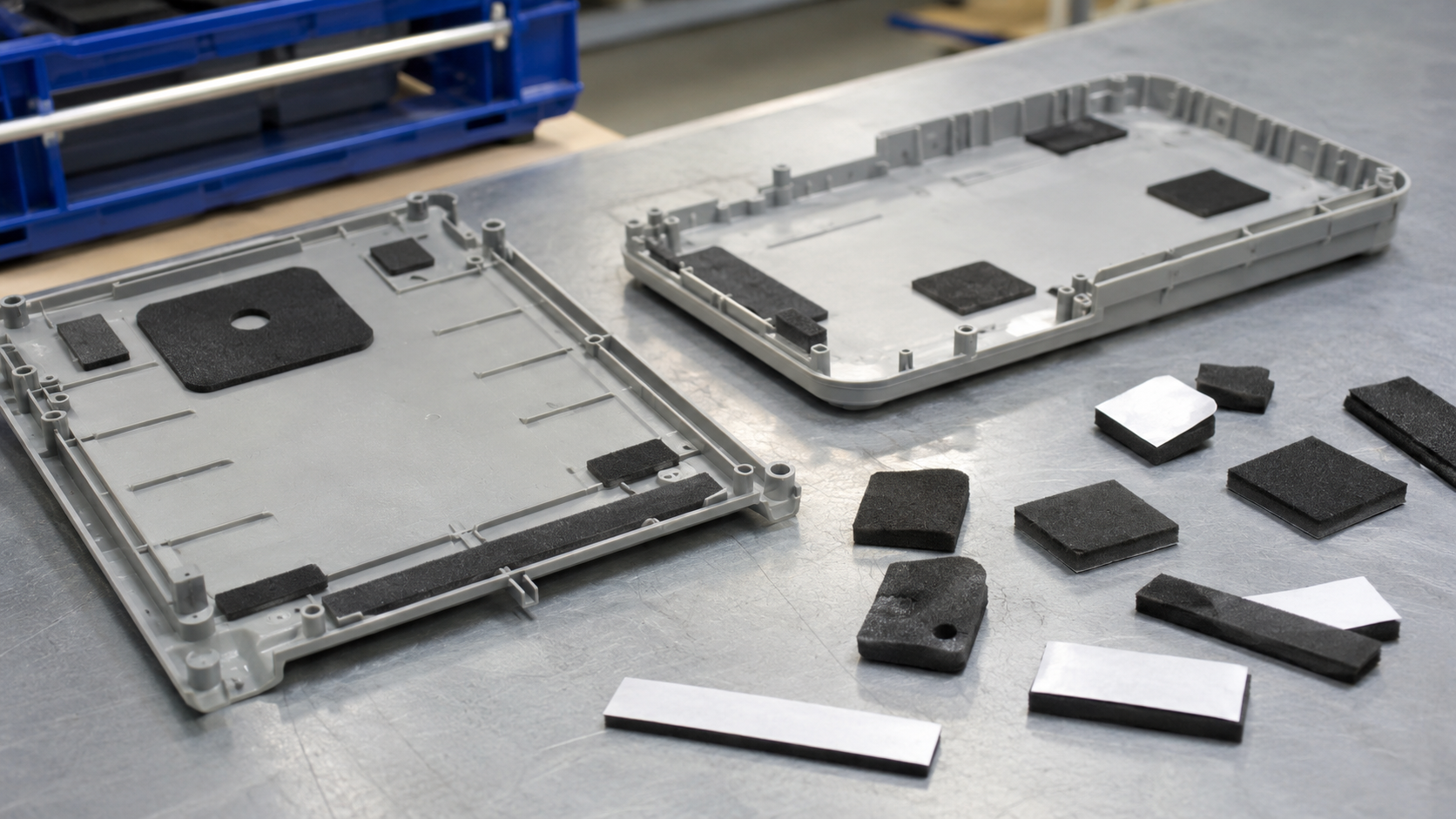
What Type of Noise Can EVA Foam Help Control?
The word “soundproofing” is often used for several different noise-control functions. Before choosing EVA foam, it is important to identify how the noise is being generated.
Structure-Borne Vibration
Structure-borne noise begins when vibration travels through a panel, frame, housing or connected component.
Examples include:
- Motor or fan vibration
- Appliance panel vibration
- Vehicle trim vibration
- Contact between an enclosure and an internal component
- Repeated mechanical movement
A correctly selected EVA pad can separate the vibrating surfaces and reduce direct vibration transfer.
Impact and Contact Noise
Impact noise occurs when components hit, rub or move against each other.
EVA foam can be effective as:
- A cushioning pad
- An anti-rattle spacer
- A protective strip
- A gap-filling component
- A contact buffer
These parts can help reduce clicking, rattling, friction and light impact noise during product operation.
Airborne Sound
Airborne sound travels through the air from sources such as motors, fans, road noise or speakers.
Because EVA is normally a closed-cell, lightweight foam, it generally provides limited absorption of airborne sound when used alone. Effective airborne-noise control often requires a more porous sound-absorbing material or a complete multilayer acoustic design.
Therefore, EVA should not automatically be specified as the primary acoustic absorber without testing the actual noise source and assembly structure.
EVA Foam Is Better for Damping Than Complete Sound Blocking
EVA foam provides a useful balance of cushioning, flexibility, impact resistance and ease of converting.
Depending on the grade, it may support:
- Vibration reduction
- Impact absorption
- Anti-rattle protection
- Gap filling
- Surface separation
- Light sealing support
- Component cushioning
However, blocking strong airborne noise usually requires more than a lightweight foam layer.
The most accurate conclusion is:
EVA foam can support noise reduction when the problem comes from vibration, impact or contact between components, but it should not be treated as a complete soundproofing solution.
Where Die-Cut EVA Foam Can Be Used
Automotive Interiors
Custom EVA foam pads may be positioned between trim parts, panels, brackets and other contact surfaces to reduce movement and local rattling.
Possible part forms include:
- Anti-rattle pads
- Trim cushioning strips
- Spacer pads
- Adhesive-backed foam blocks
- Wire or component protection pads
For applications requiring stronger sound absorption, EVA may be evaluated alongside needle-punched felt or other automotive NVH materials.
Home Appliances
Motors, compressors, fans and moving assemblies can create vibration that travels into appliance housings and panels.
Die-cut EVA components may help:
- Separate contacting surfaces
- Cushion internal components
- Reduce panel contact noise
- Fill controlled assembly gaps
- Protect parts from light impact
The grade must be selected according to temperature, compression, adhesive and service-life requirements.
Electronics and Optical Assemblies
Small EVA pads can provide cushioning and spacing around internal electronic parts, housings and sensitive structures.
In precision assemblies, designers should confirm:
- Available gap
- Compression force
- Part thickness
- Adhesive placement
- Dimensional tolerance
- Risk of particle generation
- Installation method
EVA should not be placed near a sensitive optical surface without evaluating cleanliness, material compatibility and long-term behavior.
Industrial Equipment
EVA pads may be used under covers, panels or internal components where the purpose is to reduce light vibration, impact or contact noise.
For continuous load, high temperature or demanding compression recovery, another foam or rubber material may be more appropriate.
How EVA Compares With Other Noise-Control Materials
No single foam is best for every acoustic problem.
| Material | Primary Strength | Typical Noise-Control Role | Important Limitation |
|---|---|---|---|
| EVA foam | Cushioning and impact resistance | Anti-rattle pads, spacers and vibration buffers | Limited standalone airborne-sound absorption |
| PU foam | Softness and open-cell options | Sound absorption, cushioning and gap filling | Performance varies significantly by grade |
| Non-woven felt | Fibrous, lightweight structure | Sound absorption and anti-rattle protection | Edge and thickness control require suitable converting |
| EPDM foam | Sealing and environmental resistance | Gaskets, vibration isolation and gap sealing | May be less suitable for broad acoustic absorption |
| Silicone foam | Temperature resistance and long-term cushioning | Sealing, cushioning and vibration control | Usually selected for more demanding environments |
| Rubber | Density and elastic isolation | Vibration isolation and sealing support | Weight and compression force may be higher |
The final choice depends on the noise source, available space, temperature, compression, weight target and assembly method.
Sanken can convert foam and rubber into custom gaskets and sealing components when the application requires both vibration control and sealing.
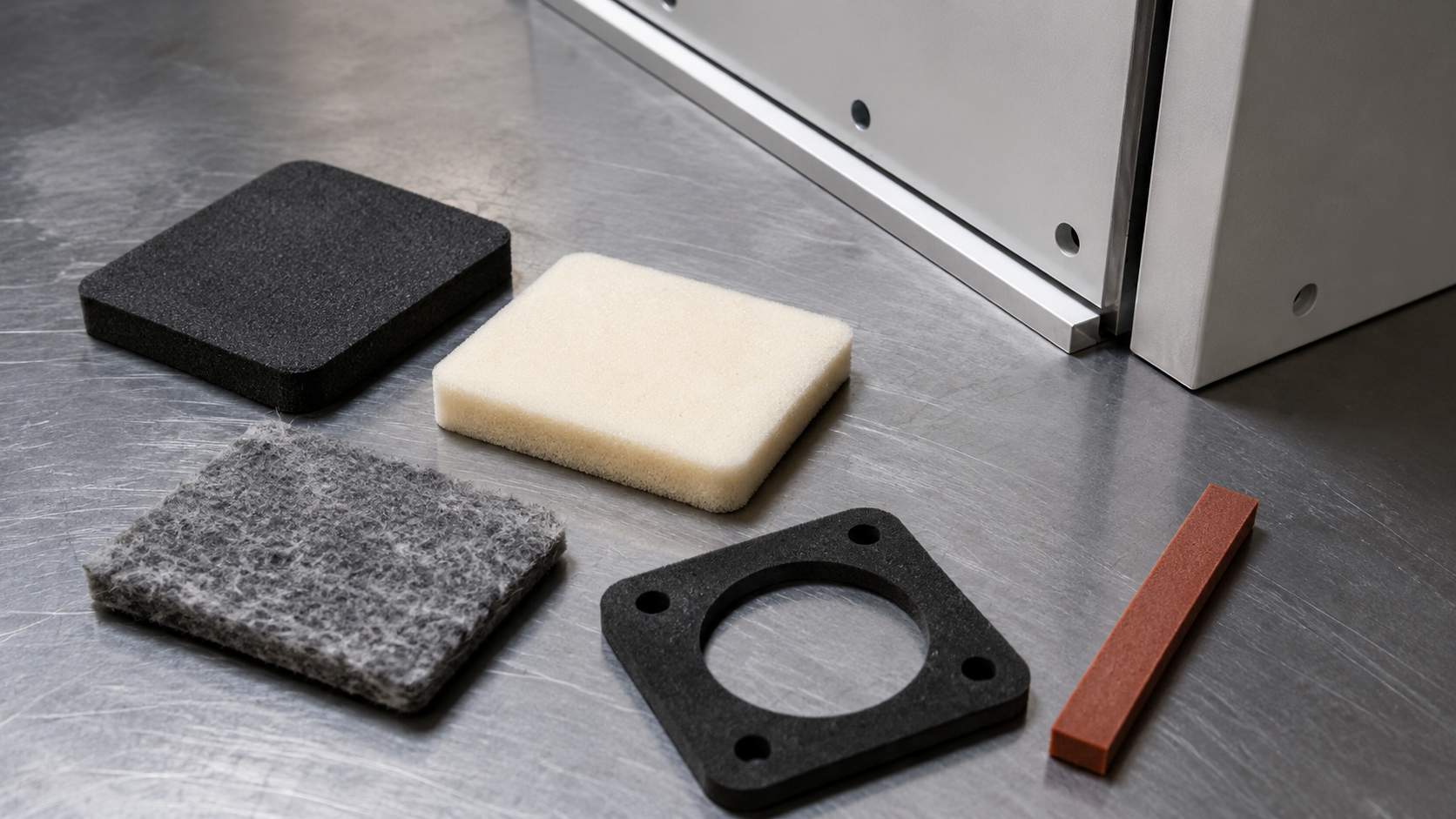
What Determines EVA Foam Performance?
Density and Hardness
Softer EVA may provide better cushioning under light loads, but it may compress too easily in a narrow assembly gap.
A harder or denser grade may support greater loads, but it may transmit more force if it cannot deform sufficiently.
Density and hardness should therefore be reviewed together with the actual compression condition.
Thickness
A thicker pad can provide more deflection and cushioning, but it also requires more installation space.
Using excessive thickness can create:
- Assembly interference
- Excessive closing force
- Uneven panel position
- Foam deformation
- Adhesive stress
The correct thickness should be based on the available gap and required compression, not selected only on the assumption that thicker foam provides better soundproofing.
Compression Recovery
If the foam remains compressed for a long period, poor recovery may reduce its ability to maintain cushioning or vibration isolation.
Prototype testing should reproduce the expected compression and operating temperature whenever possible.
Temperature and Aging
EVA properties can change under prolonged heat, humidity and aging.
Automotive interiors, appliance housings and industrial equipment may require a grade with appropriate:
- Temperature stability
- Odor performance
- Dimensional stability
- Compression behavior
- Material documentation
These properties should be confirmed through the selected material specification rather than assumed for all EVA foam.
Adhesive Compatibility
Many EVA parts require adhesive backing for easier installation.
The adhesive system should match:
- EVA surface characteristics
- Bonding substrate
- Operating temperature
- Humidity exposure
- Peel and shear requirements
- Expected service life
An adhesive may appear stable during initial assembly but lift after heat exposure or repeated vibration.
When Should EVA Foam Be Combined With Other Materials?
EVA may be part of a multilayer component when one material cannot provide every required function.
Examples include:
- EVA foam with double-sided adhesive for positioning
- EVA foam with non-woven felt for cushioning and improved sound absorption
- EVA foam with rubber for additional isolation or sealing support
- EVA foam with PET film for dimensional or assembly support
Each added layer affects thickness, flexibility, cutting method, adhesive behavior and waste removal.
A multilayer design should therefore be reviewed as one complete component rather than as several independent materials.
Sanken supports material laminating, slitting, adhesive backing and precision die cutting for custom foam structures.
Die-Cutting Details That Affect EVA Foam Parts
Even when the correct EVA grade has been selected, poor converting can affect assembly performance.
Important factors include:
- Cutting pressure
- Foam compression during cutting
- Edge deformation
- Inner-hole dimensions
- Adhesive alignment
- Liner stability
- Waste removal
- Part spacing
- Sheet or roll orientation
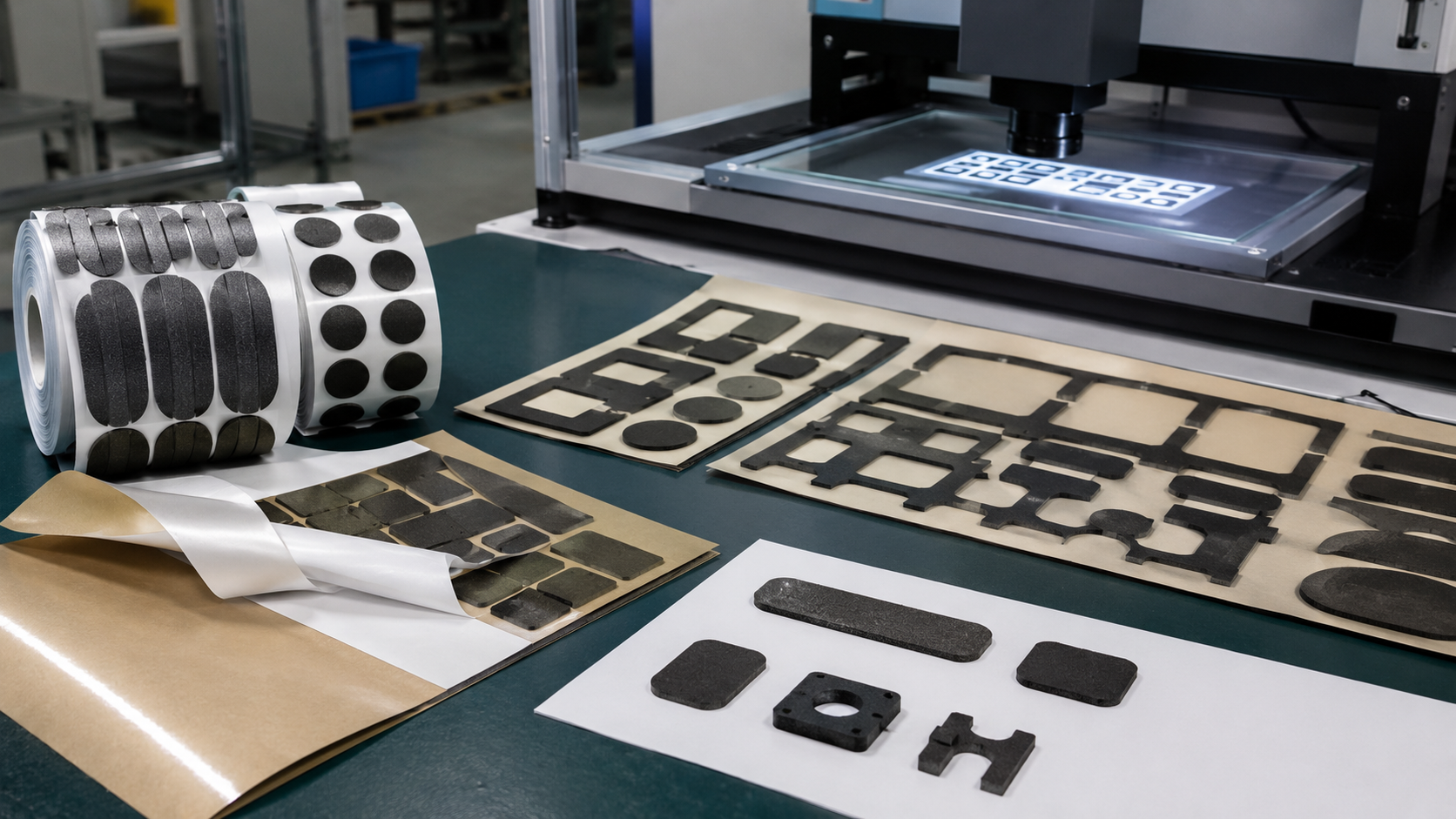
Kiss Cutting
Adhesive-backed EVA parts can be kiss cut while leaving the release liner intact. This can make small pads easier to peel, organize and install.
Through Cutting
Thicker pads or individually supplied parts may require through cutting.
Sheet, Roll or Kit Supply
The best delivery format depends on part size, production volume and installation process.
Parts can be supplied in sheets, rolls, strips or custom kits. More details are available in our guide to die-cut parts supplied in sheets, rolls or kits.
What Should Buyers Provide Before Quotation?
To evaluate an EVA foam component, provide:
- 2D drawing or sample
- Required function
- EVA grade, density or hardness if specified
- Thickness
- Adhesive requirement
- Bonding surface
- Operating temperature
- Expected compression
- Critical tolerances
- Sample quantity
- Estimated annual volume
- Sheet, roll or individual-piece preference
If the material has not been finalized, explain whether the main problem is vibration, impact, rattling, sealing or airborne noise. This helps determine whether EVA is suitable or whether another material should be evaluated.
Conclusion
EVA foam can be useful for reducing vibration, impact and contact noise in automotive, appliance, electronics and industrial assemblies. It is particularly suitable for custom cushioning pads, anti-rattle spacers and adhesive-backed vibration-control parts.
However, EVA is normally not the best standalone material for absorbing or blocking strong airborne sound. The correct solution depends on the noise path, foam grade, density, thickness, compression, adhesive and component structure.
Sanken supports custom EVA foam pads, spacers, strips and multilayer components through material converting, adhesive laminating, precision die cutting, inspection and assembly-ready supply.
Related Articles
https://sankenprecision.com/custom-die-cut-acoustic-foam-pads-for-oem-sound-absorption-applications/
https://sankenprecision.com/how-to-choose-automotive-nvh-materials-for-noise-and-vibration-control/
https://sankenprecision.com/needle-punched-non-woven-felt-for-automotive-noise-reduction/
https://sankenprecision.com/non-woven-vs-foam-materials-which-is-better-for-industrial-gaskets/