
How to Cut Film-Covered Sheet Metals?
Film-covered sheet metals are widely used across industries such as consumer electronics, automotive manufacturing, appliance production, architectural panels, medical equipment, and industrial machinery.
The protective film applied to the metal surface helps prevent scratches, contamination, oxidation, and cosmetic damage during fabrication, transportation, and assembly.
However, cutting film-covered sheet metal presents unique challenges compared to processing bare metal sheets.
Manufacturers must ensure that both the metal substrate and the protective film remain intact throughout the cutting process while maintaining dimensional accuracy and surface quality.
Improper cutting can cause film lifting, edge burrs, scratches, adhesive residue, dimensional inaccuracies, and costly material waste.
At Sanken, we support OEM manufacturers with precision die cutting, material converting, protective film processing, and custom component manufacturing solutions for demanding industrial applications.
So what are the best methods for cutting film-covered sheet metals effectively?
What Is Film-Covered Sheet Metal?
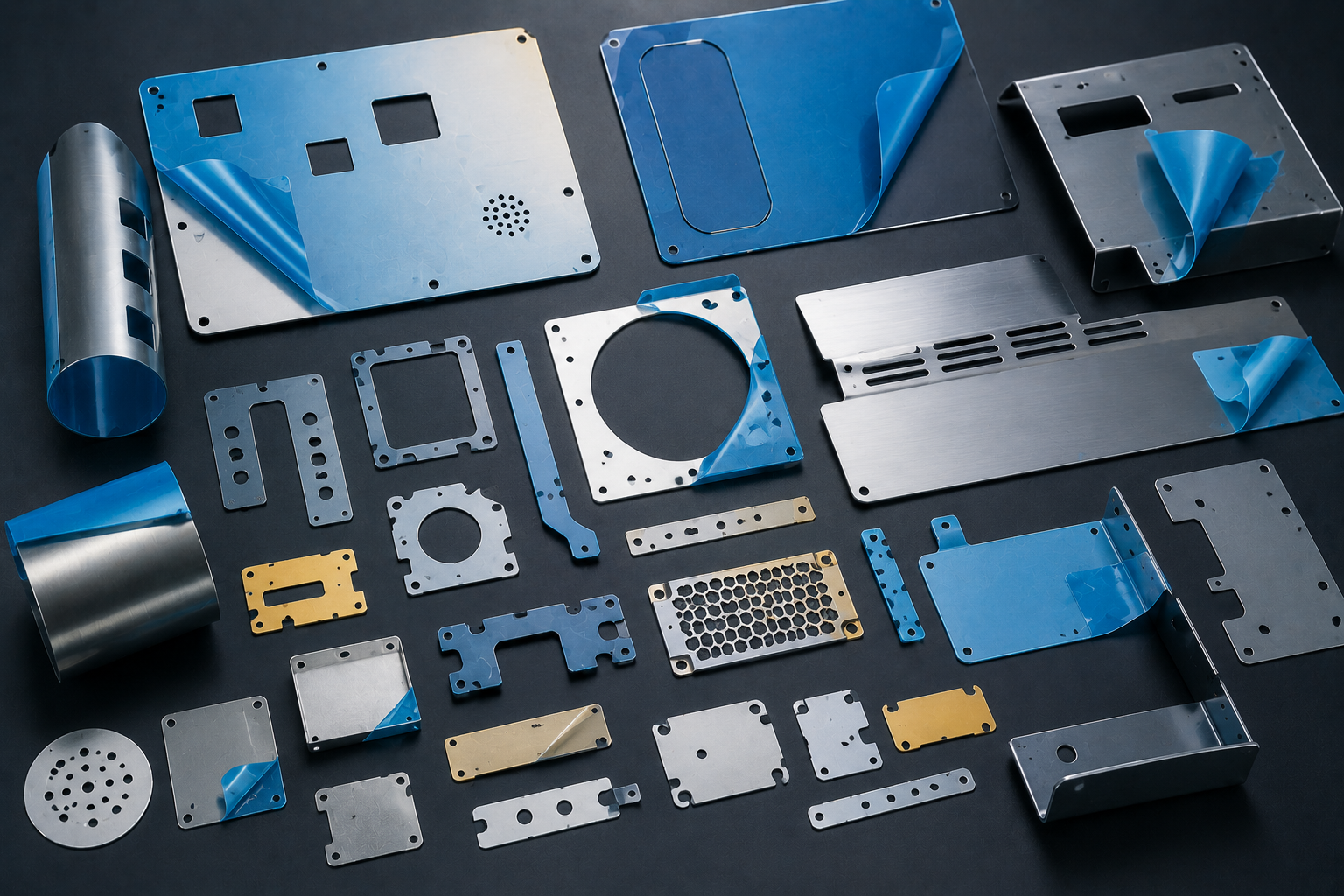
Film-covered sheet metal refers to metal materials protected by a temporary or functional surface film.
Common substrates include:
- Stainless steel
- Aluminum
- Galvanized steel
- Copper
- Brass
- Coated steel
Protective films may be applied to:
- Prevent scratches
- Reduce contamination
- Protect decorative surfaces
- Preserve mirror finishes
- Prevent oxidation
The film often remains on the material until final assembly or installation.
Why Cutting Film-Covered Metal Is Challenging
Unlike bare metal, film-covered materials involve two different layers that behave differently during processing.
Manufacturers must control:
- Metal deformation
- Film adhesion
- Edge quality
- Burr formation
- Surface protection
Common production challenges include:
- Film peeling
- Edge lifting
- Surface scratching
- Adhesive residue
- Inconsistent dimensions
Without proper process control, the protective film may lose its effectiveness.
Choosing the Right Cutting Method
Different applications require different cutting technologies.
The optimal method depends on:
- Material thickness
- Surface finish requirements
- Production volume
- Dimensional tolerance
- Component complexity
The most common cutting methods include:
Mechanical Shearing
Suitable for:
- Straight cuts
- Large panels
- High-volume production
Advantages:
- Fast processing
- Low operating cost
Limitations:
- Limited geometry options
- Potential edge deformation
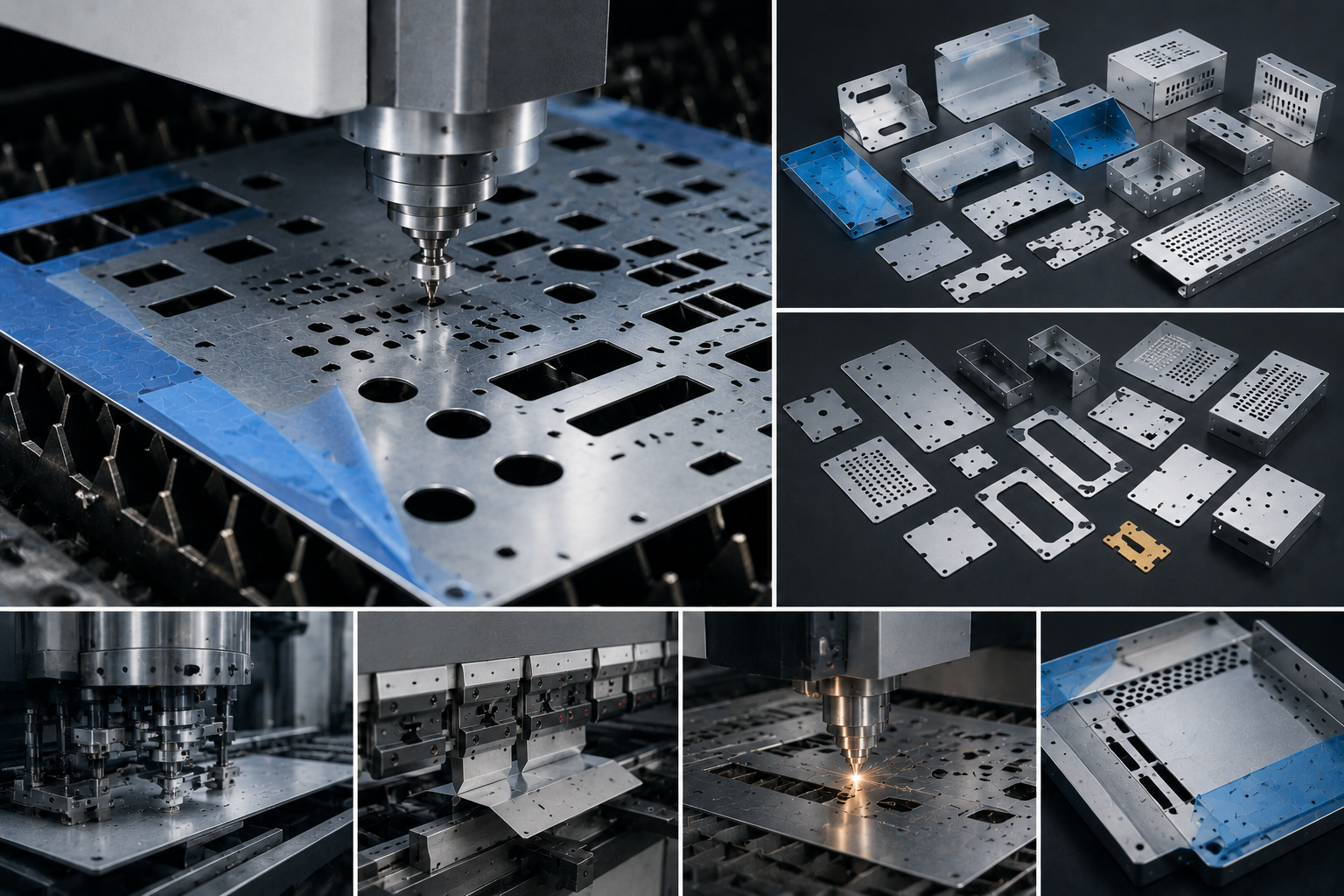
Laser Cutting
Laser cutting is widely used for complex sheet metal components.
Advantages include:
- High precision
- Complex geometries
- Minimal tooling requirements
Applications include:
- Electronic enclosures
- Decorative panels
- Precision assemblies
However, excessive heat may affect certain protective films if process parameters are not optimized.

CNC Punching
CNC punching is suitable for:
- Holes
- Slots
- Repetitive features
Advantages include:
- High productivity
- Consistent dimensions
- Cost-effective production
This method is commonly used in electronics and appliance manufacturing.
Waterjet Cutting
Waterjet technology offers several advantages for film-covered materials.
Benefits include:
- No heat affected zone
- Minimal surface damage
- Excellent edge quality
Applications include:
- Decorative metals
- Sensitive finishes
- Precision components
For highly cosmetic surfaces, waterjet cutting is often preferred.
How Protective Films Affect Cutting Performance
Protective films vary significantly in:
- Thickness
- Adhesion strength
- Material composition
Common film types include:
| Film Type | Typical Application |
|---|---|
| PE Film | Stainless steel protection |
| PVC Film | Decorative panels |
| PET Film | Precision surfaces |
| Specialty Films | High-end electronics |
Film selection directly influences cutting performance.
Poor-quality films may:
- Tear during processing
- Leave residue
- Lift at cut edges
Choosing the correct film is often the first step toward successful manufacturing.
Preventing Film Peeling During Cutting
Film peeling is one of the most common issues.
Causes
- Weak film adhesion
- Excessive cutting force
- Improper blade condition
- Material vibration
Solutions
- Use high-quality protective films
- Optimize cutting speed
- Maintain sharp tooling
- Improve material support
Stable material handling significantly reduces film lifting.
Reducing Surface Scratches
Protective films exist primarily to prevent cosmetic damage.
However, scratches can still occur during fabrication.
Common Sources
- Improper handling
- Dirty equipment
- Material stacking
- Tool contact
Prevention Methods
- Clean production environments
- Protective work surfaces
- Controlled material movement
- Regular equipment maintenance
Surface protection should be considered throughout the entire manufacturing process.
Controlling Burr Formation
Burrs reduce product quality and may interfere with assembly.
Causes
- Worn tooling
- Incorrect cutting parameters
- Material hardness variations
Solutions
- Maintain sharp cutting tools
- Optimize process settings
- Perform regular inspections
High-quality edge finishing improves both appearance and functionality.
Managing Adhesive Residue
Some protective films may leave adhesive residue after processing.
This issue becomes more common when:
- Films remain applied too long
- High temperatures occur
- Incompatible adhesives are used
Solutions
- Use appropriate film systems
- Follow recommended storage conditions
- Remove films within specified timeframes
Material compatibility testing is highly recommended during development.
Achieving Tight Tolerances
Many modern products require precise dimensions.
Examples include:
- Consumer electronics
- Medical equipment
- Automotive assemblies
Dimensional accuracy depends on:
- Stable material positioning
- Proper tooling
- Controlled cutting parameters
- Consistent material quality
Precision manufacturing processes help maintain repeatability across production batches.
Why Film Lamination Quality Matters
The performance of protective film depends heavily on application quality.
Poor lamination may create:
- Air bubbles
- Wrinkles
- Uneven adhesion
- Cutting inconsistencies
Professional lamination processes help ensure:
- Uniform adhesion
- Smooth surfaces
- Stable processing
This becomes especially important for decorative and high-value materials.
How Die Cutting Supports Film-Covered Metal Components
For smaller components and assemblies, die cutting often complements metal fabrication processes.
Die-cut films can provide:
- Surface protection
- Electrical insulation
- Vibration damping
- EMI shielding
- Thermal management
Common applications include:
- Electronic housings
- Battery systems
- Automotive modules
- Industrial equipment
Precision die cutting allows these materials to be integrated efficiently into final assemblies.
How Sanken Supports Film and Metal Component Manufacturing
At Sanken, we help OEM customers develop customized converting and component solutions for demanding applications.
Our capabilities include:
- Precision die cutting
- Protective film converting
- Adhesive tape converting
- Foam processing
- EMI shielding solutions
- Thermal management materials
- Multi-layer lamination
- Prototype development
- High-volume production
We support industries including:
- Consumer electronics
- Automotive
- Medical devices
- Industrial equipment
- Energy storage systems
By combining material expertise with precision converting technologies, we help customers improve product quality, assembly efficiency, and manufacturing reliability.
Conclusion
Cutting film-covered sheet metals requires careful consideration of both the metal substrate and the protective film.
Factors such as cutting technology, film selection, tooling condition, surface protection, burr control, and dimensional accuracy all influence final product quality.
By selecting the appropriate manufacturing process and maintaining proper process control, manufacturers can achieve clean edges, excellent surface finishes, and reliable production performance.
At Sanken, we help OEM customers combine precision converting expertise with advanced material solutions to support high-quality manufacturing across a wide range of industries.