

Why Is Foam Used Instead of Rubber? A Practical Guide for OEM Buyers
Many buyers compare foam and rubber when designing gaskets, pads, seals, cushions, vibration-control parts, and protective components. At first glance, both materials may seem similar because they can be soft, flexible, and easy to shape.
But in real manufacturing, foam and rubber solve different problems.
Foam is often used instead of rubber when the part needs lightweight cushioning, compression softness, sound absorption, vibration reduction, easy die cutting, or lower material cost. Rubber is usually better when the part needs strong sealing force, high elasticity, oil resistance, abrasion resistance, or long-term performance under harsh conditions.
For OEM buyers, the key is not asking “Which material is better?” The better question is: “Which material solves my product problem with the lowest production risk?”
At Sanken Manufacturing, we help customers select, laminate, die cut, and convert foam, rubber, adhesive tapes, non-woven fabrics, and composite materials into functional components for automotive, electronics, medical, packaging, and industrial applications.
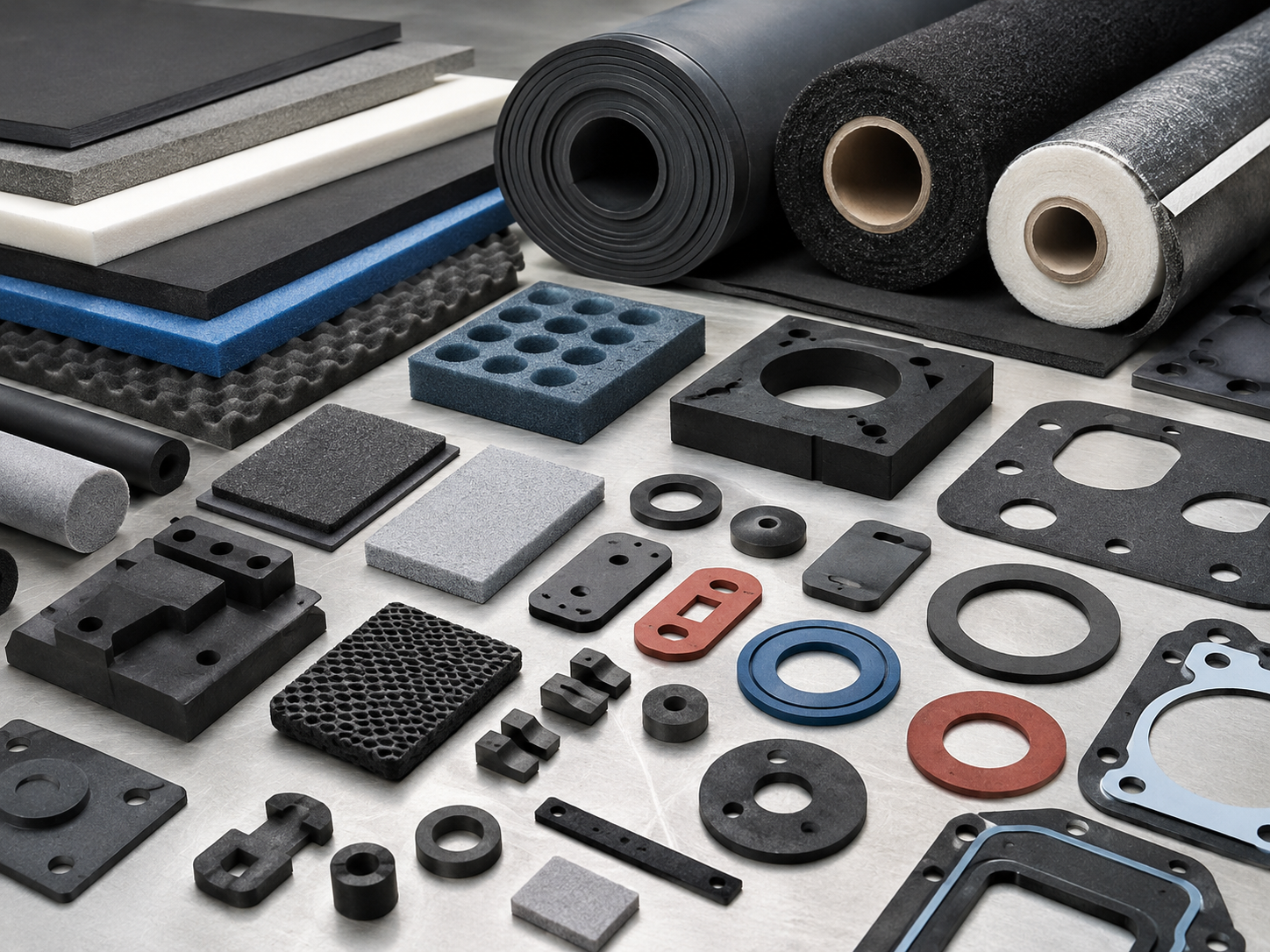
Foam vs Rubber: What Is the Basic Difference?
Foam is a cellular material. It contains many small air pockets inside the structure.
These air pockets make foam:
- Lightweight
- Compressible
- Soft
- Shock absorbing
- Good for cushioning
- Useful for sound absorption
Rubber is a dense elastomer material. It has stronger elasticity, higher mechanical strength, and better sealing force.
Rubber is often used when the product needs:
- Strong sealing
- High rebound
- Oil resistance
- Wear resistance
- Long-term durability
- Higher pressure performance
So the difference is not only material name. It is structure.
Foam uses air cells to absorb pressure and reduce weight. Rubber uses dense elasticity to seal, rebound, and resist harsh conditions.
Why Foam Is Often Chosen Instead of Rubber
1. Foam Is Much Lighter
Weight reduction is one of the biggest reasons manufacturers choose foam.
In automotive, electronics, packaging, and portable equipment, every gram matters.
Foam provides cushioning and protection without adding too much weight.
This is especially useful for:
- Automotive interior pads
- Electronic device cushions
- Protective packaging inserts
- Anti-rattle components
- Lightweight insulation layers
Rubber is usually heavier because it is denser. If the part does not need strong sealing or heavy-duty elasticity, foam may be the more efficient choice.
2. Foam Provides Better Cushioning
Foam is excellent for absorbing shock and impact.
When pressure is applied, the internal air cells compress and help reduce force transfer.
This makes foam suitable for:
- Packaging protection
- Electronic component cushioning
- Tool case inserts
- Medical equipment protection
- Automotive trim support
- Industrial product liners
Rubber can also absorb impact, but it often feels firmer and may transfer more force depending on hardness.
If the customer needs soft cushioning rather than strong rebound, foam is usually preferred.
3. Foam Can Reduce Noise and Vibration
Foam is widely used for noise, vibration, and harshness control.
In automotive interiors, foam can reduce:
- Rattling
- Squeaking
- Buzzing
- Contact noise
- Light vibration transfer
This is why foam is often used in:
- Door panels
- Dashboards
- Center consoles
- Trunk liners
- Wire harness areas
- Interior trim assemblies
Rubber is better for stronger vibration isolation, but foam is often better for lightweight anti-rattle and contact-noise reduction.
For electric vehicles, small foam pads can be very valuable because the cabin is quieter and passengers notice minor noises more easily.
4. Foam Is Easier to Compress in Tight Spaces
Many assemblies have uneven gaps or limited space.
Foam can fill gaps more easily because it compresses under light pressure.
This helps improve:
- Fit
- Contact stability
- Surface protection
- Assembly comfort
- Anti-rattle performance
Rubber may be too firm for some delicate assemblies. If rubber creates too much pressure, it can deform plastic parts, damage thin components, or make assembly difficult.
Foam is often selected when the part needs to adapt gently to the assembly space.
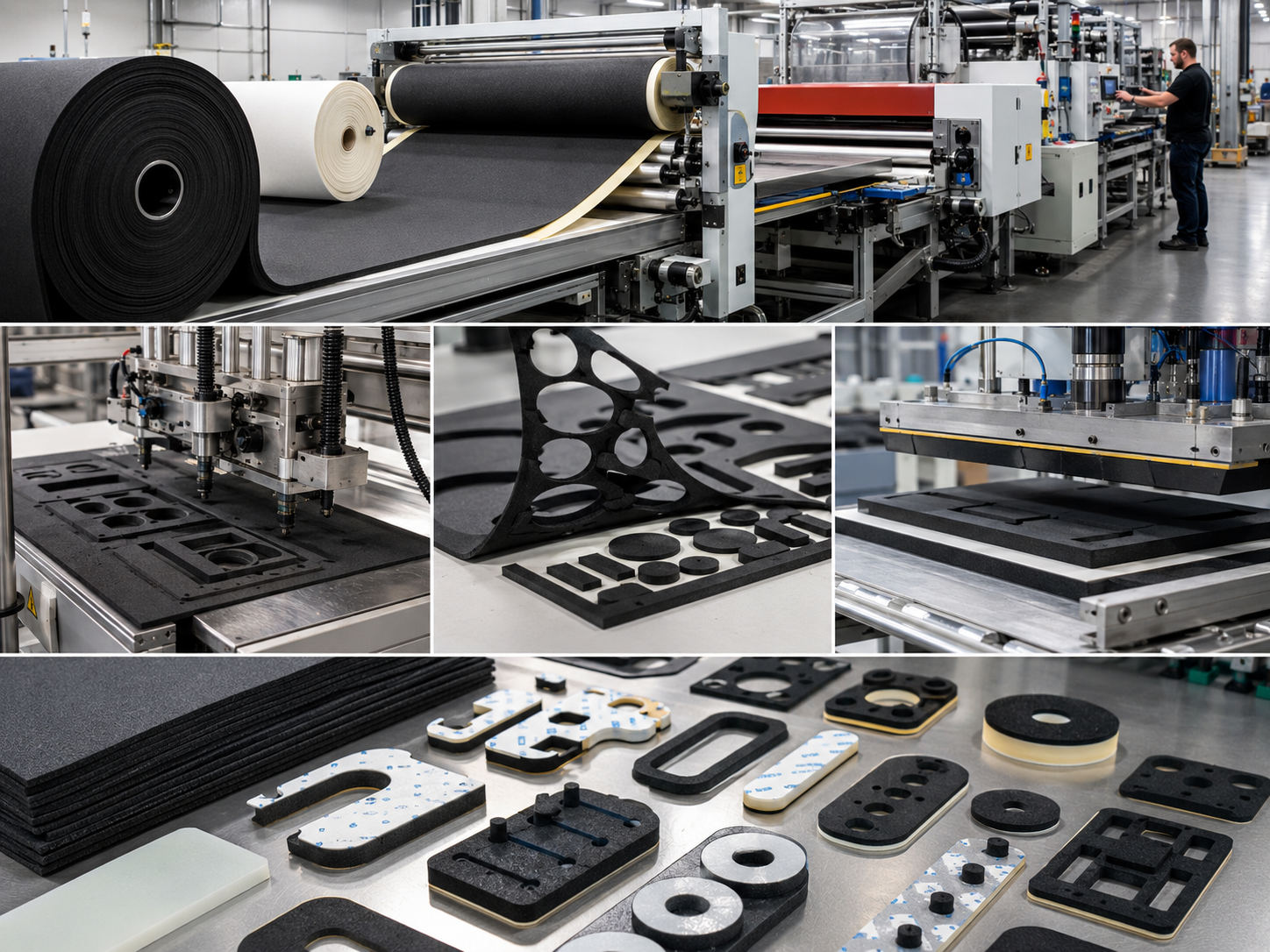
5. Foam Is Usually Easier to Die Cut
Foam is commonly supplied in sheets or rolls, making it suitable for precision die cutting.
It can be converted into:
- Pads
- Strips
- Gaskets
- Washers
- Spacers
- Liners
- Protective inserts
- Adhesive-backed parts
Foam can also be laminated with:
- Adhesive tape
- Release liner
- Non-woven fabric
- Film
- Rubber
- Aluminum foil
This makes foam very flexible for custom OEM components.
At Sanken, many foam parts are not simple rectangles. They may include holes, slots, curves, thin strips, or multilayer structures. Precision die cutting helps customers receive parts that are ready for assembly.
6. Foam Can Lower Total Cost
Foam is often more cost-effective than rubber, especially when the part does not need heavy-duty sealing or high chemical resistance.
Foam may reduce cost through:
- Lower material weight
- Easier cutting
- Faster processing
- Better material utilization
- Simpler assembly
- Adhesive-backed application
However, buyers should not choose foam only because it is cheaper.
A low-cost foam can become expensive if it collapses, peels, shrinks, smells, or fails during assembly.
The best choice is the material that meets the functional requirement with stable production performance.
When Rubber Is Better Than Foam
Foam is not always the right choice.
Rubber is usually better when the application requires stronger mechanical performance.
Choose rubber when the part needs:
- Strong sealing force
- High rebound elasticity
- Oil resistance
- Fuel resistance
- Abrasion resistance
- High tear strength
- Long-term outdoor durability
- High-pressure compression
- Harsh chemical exposure
Common rubber applications include:
- Automotive sealing gaskets
- Industrial seals
- O-rings
- Anti-vibration mounts
- Oil-resistant pads
- Heavy-duty equipment components
If the application involves strong sealing, liquid exposure, or repeated mechanical stress, rubber may be safer than foam.
Foam vs Rubber: Quick Selection Table
| Requirement | Better Choice |
|---|---|
| Lightweight cushioning | Foam |
| Soft compression | Foam |
| Protective packaging | Foam |
| Anti-rattle pads | Foam |
| Sound absorption | Foam |
| Strong sealing | Rubber |
| Oil resistance | Rubber |
| High elasticity | Rubber |
| Heavy-duty vibration isolation | Rubber |
| Harsh environment durability | Rubber |
| Adhesive-backed easy assembly | Foam or foam composite |
| Multi-layer functional part | Foam + rubber composite |
In many real projects, the best answer is not foam or rubber alone.
It may be a composite structure.
Why Foam and Rubber Are Often Combined
Many OEM applications need multiple functions in one component.
For example, a part may need:
- Soft cushioning
- Stronger sealing
- Adhesive installation
- Surface protection
- Vibration control
- Thermal insulation
In these cases, manufacturers may combine foam and rubber.
Common structures include:
- Foam + adhesive tape
- Foam + rubber sheet
- Foam + non-woven fabric
- Foam + PET film
- Rubber + adhesive liner
- Foam + rubber + release liner
This allows buyers to balance softness, sealing, strength, and assembly efficiency.
At Sanken, we often help customers design multilayer material structures when one material alone cannot meet all requirements.
Common Buyer Mistakes When Choosing Foam Instead of Rubber
Choosing Foam Only by Price
Low-cost foam may fail under compression or heat.
Ignoring Compression Set
If foam stays compressed too long, it may not recover.
Using Foam for Strong Sealing
Foam may support light sealing, but rubber is better for demanding sealing.
Choosing the Wrong Adhesive
Many foam parts need adhesive backing. Poor adhesive matching can cause edge lifting or peeling.
Not Testing Real Conditions
A foam sample may look good during inspection but fail under heat, humidity, vibration, or long-term load.
These mistakes can lead to rejected parts, delayed projects, and customer complaints.
What Should Buyers Confirm Before Choosing Foam or Rubber?
Before selecting a material, buyers should ask:
- Does the part need cushioning or sealing?
- Will it face long-term compression?
- Does it need adhesive backing?
- Will it face heat, humidity, oil, or chemicals?
- Is weight reduction important?
- Does the part need sound absorption?
- What tolerance is required?
- Is the part used in automotive, electronics, medical, packaging, or industrial equipment?
- Does the material need flame resistance or odor control?
- Can the supplier support prototypes and mass production?
These questions help reduce wrong material selection.
They also help suppliers recommend a better structure before tooling begins.
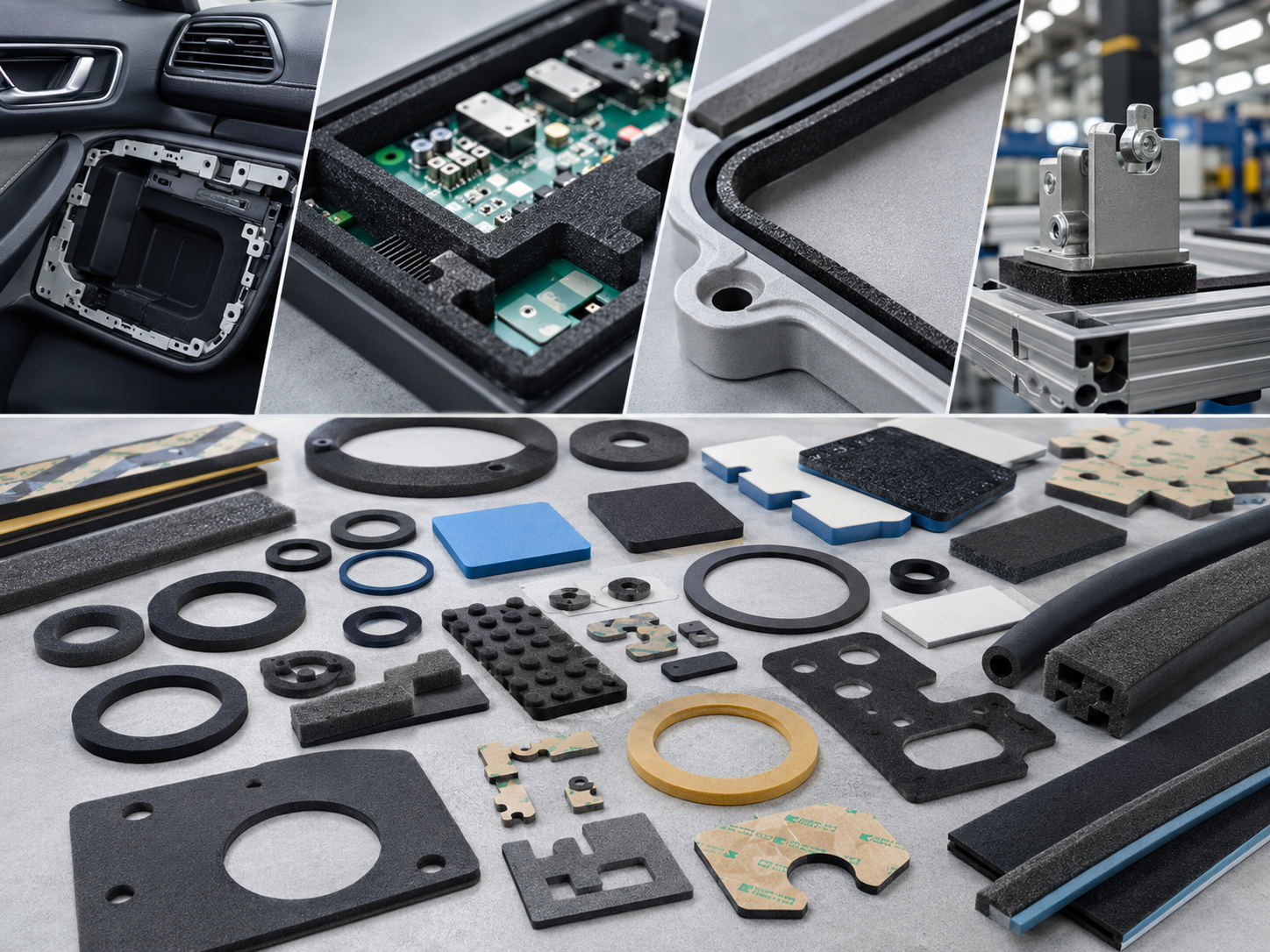
How Sanken Helps Customers Choose Between Foam and Rubber
At Sanken Manufacturing, we do not recommend foam or rubber based only on material name.
We look at the customer’s real problem first.
Is the issue noise?
Is it vibration?
Is it sealing?
Is it protection?
Is it assembly fit?
Is it cost reduction?
Is it long-term durability?
Then we help customers choose the right material and converting process.
Our capabilities include:
- Precision die cutting
- Foam converting
- Rubber processing
- Adhesive lamination
- Non-woven fabric converting
- Hot pressing
- Multilayer material assembly
- Prototype and mass production support
For OEM buyers, this means fewer trial-and-error cycles, better part consistency, and lower production risk.
Conclusion
Foam is often used instead of rubber because it is lighter, softer, easier to compress, better for cushioning, useful for noise reduction, easier to die cut, and often more cost-effective. It is ideal for protective pads, anti-rattle parts, packaging inserts, acoustic layers, spacers, and adhesive-backed components.
Rubber is better when the application requires strong sealing, high elasticity, oil resistance, abrasion resistance, or heavy-duty durability. For many OEM projects, the best solution may be foam, rubber, or a multilayer composite structure.
At Sanken Manufacturing, we help customers select, laminate, die cut, and convert foam and rubber materials into reliable components that solve real production problems and support stable mass production.