
Why Do Smart Wearables Need Professional Film Die Cutting?
Smart wearables have transformed from simple fitness trackers into highly integrated devices that combine health monitoring, wireless communication, biometric sensing, touch interaction, and advanced data processing.
From smartwatches and fitness bands to AR glasses, smart rings, medical wearables, and wireless earbuds, modern wearable technology continues to become smaller, thinner, and more powerful.
However, as wearable devices shrink in size, the complexity of their internal structures increases dramatically.
Every millimeter inside a wearable product matters.
This is why professional film die cutting has become an essential manufacturing process for wearable device manufacturers.
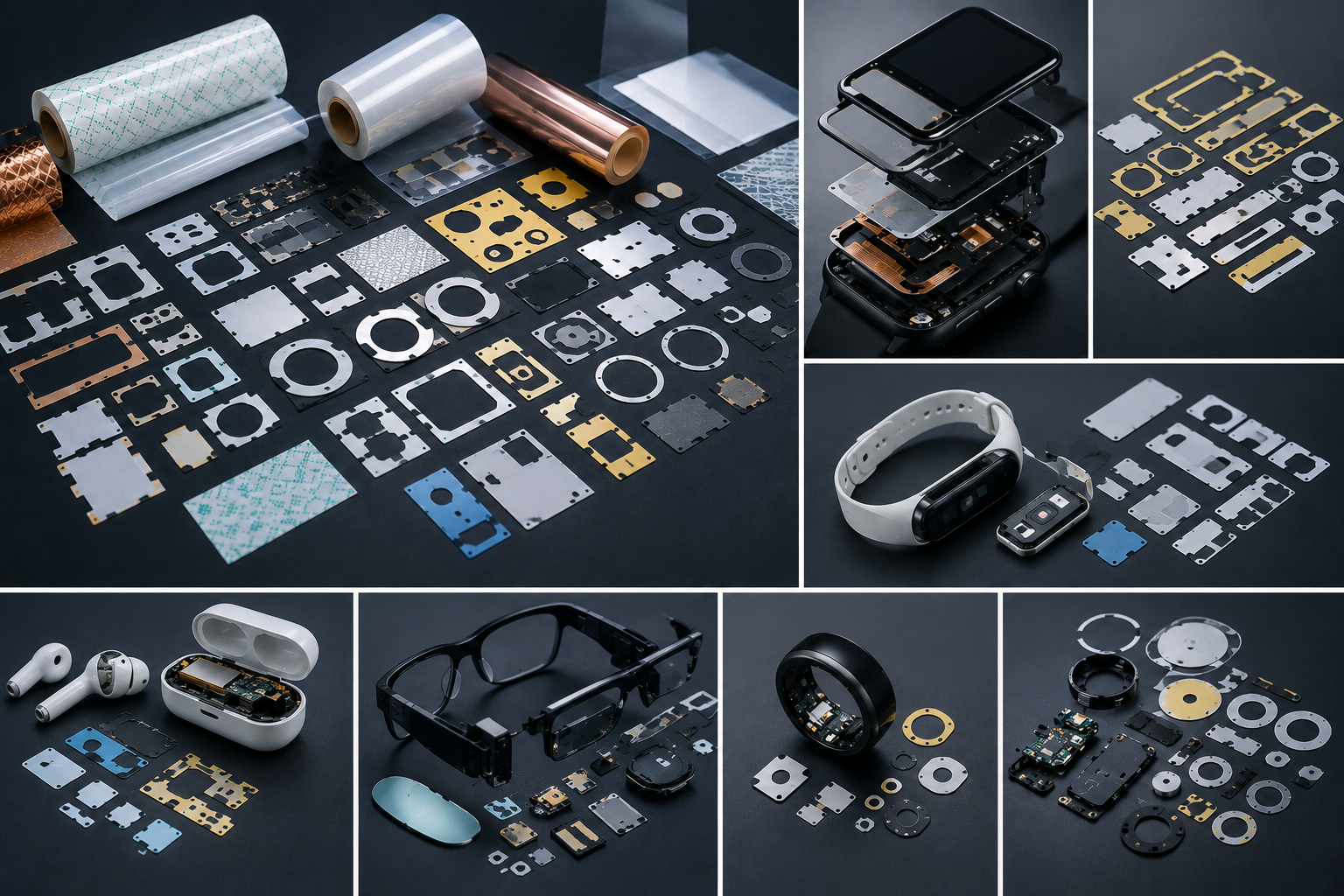
At Sanken, we help OEM and ODM customers convert advanced films, adhesive materials, insulation layers, EMI shielding materials, thermal management materials, and protective films into precision-engineered components that support wearable product performance, reliability, and mass production efficiency.
So why do smart wearables require professional film die cutting solutions?
The Miniaturization Challenge of Smart Wearables
Unlike smartphones or laptops, wearable devices have extremely limited internal space.
A typical smartwatch may contain:
- Display module
- Touch sensor
- Battery
- Main PCB
- Wireless antenna
- Speaker
- Microphone
- Heart rate sensor
- Charging module
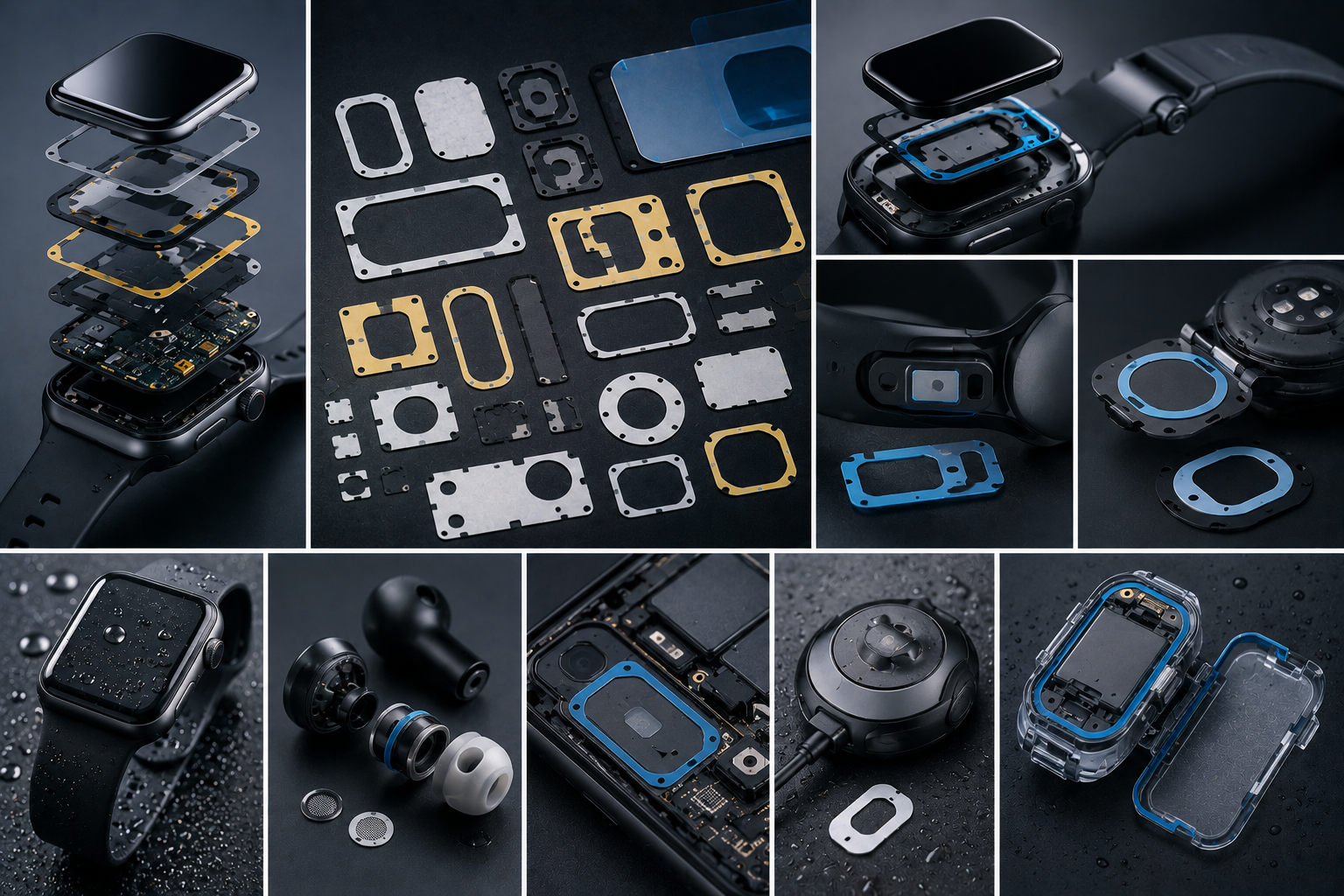
- Waterproof sealing structures
All these components must fit into a compact housing while maintaining comfort and durability.
This creates significant challenges for engineers.
Even a small material positioning error can affect:
- Assembly quality
- Waterproof performance
- Sensor accuracy
- Product reliability
Professional die-cut components help solve these challenges through precise material conversion.
Precision Adhesive Bonding for Compact Assemblies
Wearable devices rely heavily on adhesive bonding.
Mechanical fasteners are often avoided because they:
- Increase thickness
- Add weight
- Consume valuable space
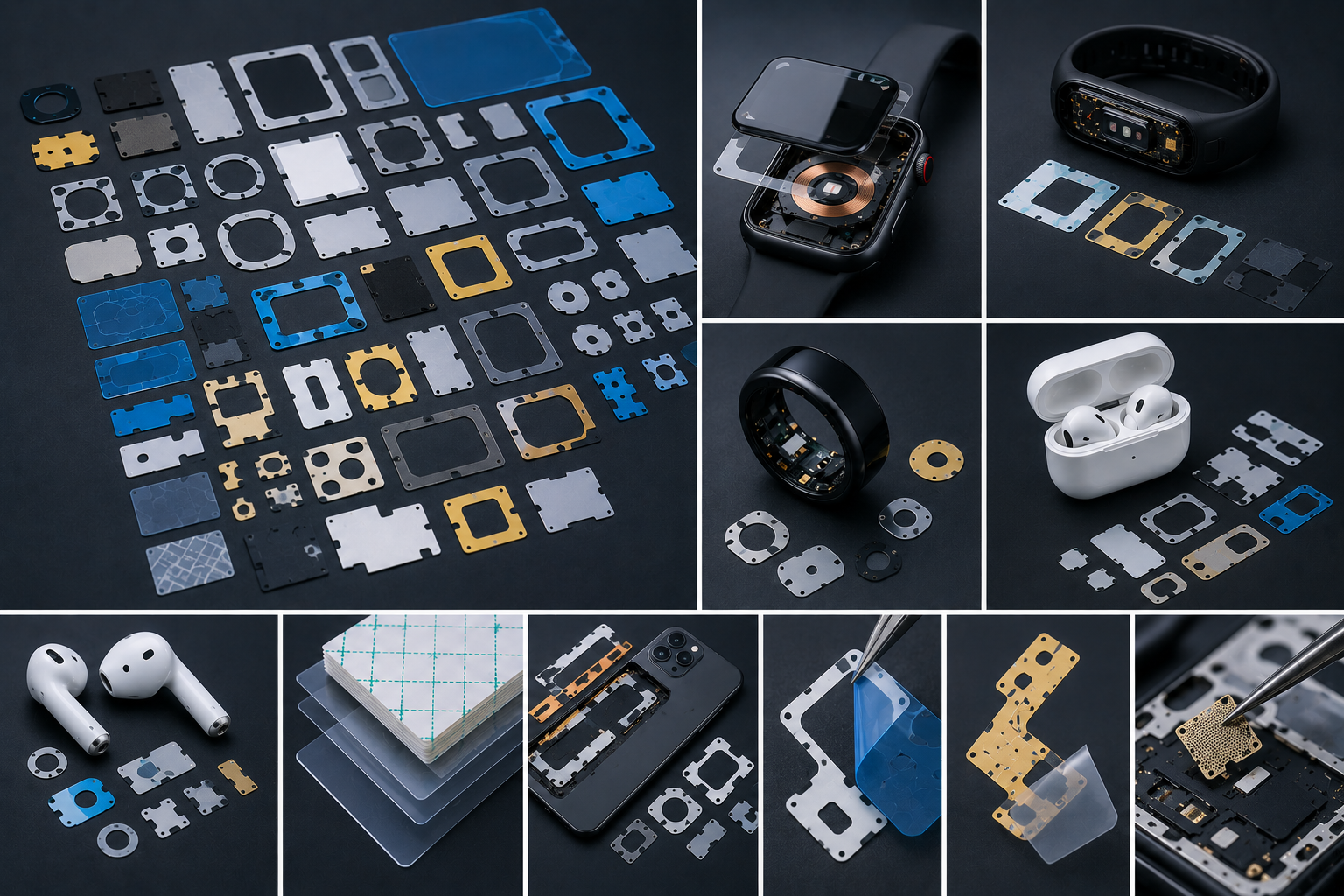
Die-cut adhesive films provide accurate bonding solutions for:
- Display attachment
- Sensor mounting
- Battery fixation
- Housing assembly
- Flexible circuit positioning
Precision die cutting ensures that adhesives are applied only where required.
Benefits include:
- Reduced assembly time
- Improved appearance
- Better structural stability
- Enhanced manufacturing consistency
Without precision die cutting, adhesive placement becomes significantly more difficult.
Supporting Waterproof and Dustproof Designs
Most wearable devices require protection against:
- Sweat
- Moisture
- Rain
- Dust
- Daily environmental exposure
Many products target:
- IP67
- IP68
- Higher waterproof ratings
Die-cut sealing materials help create reliable barriers around:
- Display modules
- Buttons
- Charging ports
- Sensor openings
- Housing joints
Professional converting ensures consistent gasket dimensions and sealing performance.
This is especially important for products used during exercise and outdoor activities.
Improving Sensor Accuracy
Modern wearable devices contain sophisticated sensors such as:
- Heart rate monitors
- Blood oxygen sensors
- Temperature sensors
- Motion sensors
- Optical sensors
These sensors often require specialized die-cut films for:
- Optical isolation
- Light management
- Positioning accuracy
- Environmental protection
Poorly positioned materials may interfere with sensor performance.
Precision die cutting ensures that films align correctly with sensor systems.
This helps maintain measurement accuracy and device reliability.
Thermal Management in Small Devices
As wearable devices become more powerful, heat management becomes increasingly important.
Internal heat sources include:
- Processors
- Wireless chips
- Batteries
- Displays
Thermal interface materials and thermal films are frequently used to:
- Transfer heat
- Spread heat
- Protect sensitive components
Professional die cutting converts thermal materials into complex geometries that fit precisely within compact assemblies.
Effective thermal management improves:
- User comfort
- Device lifespan
- Performance stability
EMI Shielding for Reliable Connectivity
Wearable devices rely on wireless technologies such as:
- Bluetooth
- Wi-Fi
- NFC
- GPS
- Cellular communication
As internal electronics become denser, electromagnetic interference (EMI) becomes a greater concern.
Die-cut EMI shielding materials help:
- Reduce signal interference
- Protect sensitive circuits
- Improve communication stability
Applications include:
- Smartwatches
- Medical wearables
- AR devices
- Wireless earbuds
Precision converting ensures that shielding materials fit exactly where needed.
Flexible Materials Require Precision Converting
Wearable devices often use:
- Flexible circuits
- Thin films
- Foam materials
- Optical films
- Double-sided adhesive tapes
These materials can be difficult to process accurately.
Challenges include:
- Material stretching
- Registration errors
- Dimensional variation
- Waste removal difficulties
Professional die cutting equipment helps maintain tight tolerances and consistent quality.
This becomes increasingly important as wearable designs become more complex.
Supporting Lightweight Product Designs
Consumers expect wearable devices to be:
- Lightweight
- Comfortable
- Slim
- Durable
Film-based components support these goals by replacing heavier alternatives.
Common die-cut materials include:
- PET films
- Polycarbonate films
- Foam tapes
- Optical films
- EMI shielding films
These materials provide functionality without adding unnecessary weight.
Precision converting allows manufacturers to optimize material usage while maintaining performance.
Enhancing Product Appearance
Wearable devices are not only electronic products.
They are also consumer lifestyle products.
Customers expect:
- Premium appearance
- Precise fit
- Consistent quality
Die-cut films help create:
- Clean display edges
- Invisible bonding structures
- Uniform assembly gaps
- Professional finishing
Even minor cosmetic defects can negatively affect user perception.
Precision converting helps maintain high aesthetic standards.
Accelerating Mass Production
Wearable products often launch in highly competitive markets.
Speed matters.
Die-cut components arrive ready for assembly and help reduce:
- Manual labor
- Positioning errors
- Production variability
Benefits include:
- Faster assembly
- Improved yields
- Higher throughput
- Reduced manufacturing costs
For large-scale OEM programs, these advantages become increasingly significant.
Why Smart Wearables Require Tight Tolerances
Many wearable components feature:
- Narrow adhesive zones
- Micro openings
- Complex contours
- Multi-layer constructions
Typical requirements may involve:
- Precise alignment
- Stable dimensions
- Consistent registration
Professional film die cutting ensures that every component meets these requirements consistently.
As device dimensions continue shrinking, tolerance control becomes even more critical.
Why OEM Brands Choose Professional Film Converters
Film converting involves more than simply cutting materials.
Successful wearable projects require expertise in:
- Material selection
- Adhesive technology
- Lamination processes
- Optical films
- EMI shielding materials
- Thermal management solutions
Experienced converting partners help reduce development risks and improve manufacturing efficiency.
This is why leading wearable brands often work closely with specialized die-cutting suppliers.
How Sanken Supports Smart Wearable Manufacturers
At Sanken, we provide precision converting solutions for wearable electronics manufacturers worldwide.
Our capabilities include:
- Precision film die cutting
- Multi-layer lamination
- Optical film converting
- EMI shielding die cutting
- Thermal material converting
- Foam converting
- Adhesive integration
- Rapid prototyping
- High-volume manufacturing
We support applications in:
- Smartwatches
- Fitness trackers
- AR/VR devices
- Medical wearables
- Smart rings
- Wireless earbuds
By combining advanced converting technologies with extensive material expertise, we help customers improve product performance while simplifying manufacturing processes.
Conclusion
As smart wearables become smaller, lighter, and more feature-rich, professional film die cutting plays an increasingly important role in product design and manufacturing.
From adhesive bonding and waterproof sealing to EMI shielding, thermal management, and sensor optimization, precision-converted film components help wearable devices achieve superior performance and reliability.
At Sanken, we help wearable OEMs transform advanced materials into precision-engineered components that support innovation, efficient assembly, and large-scale production success.