

How to Cut Foam Straight? A Practical Guide for Clean, Accurate Foam Parts
Cutting foam straight sounds simple, but many buyers and production teams know the real problem: the edge bends, the surface tears, the thickness compresses, the adhesive shifts, or the final part does not fit during assembly.
For DIY projects, a slightly uneven foam edge may be acceptable. For automotive, electronics, packaging, medical equipment, or industrial components, it is different. A poor cut can create assembly gaps, weak sealing, unstable cushioning, noise problems, and higher rejection rates.
So the better question is not only “How to cut foam straight?” The better question is: “How can foam be cut straight, consistently, and accurately for the final application?”
At Sanken Manufacturing, we help OEM customers convert EVA foam, PE foam, PU foam, EPDM foam, rubber foam, adhesive-backed foam, and multilayer foam materials into precision die-cut components for mass production.
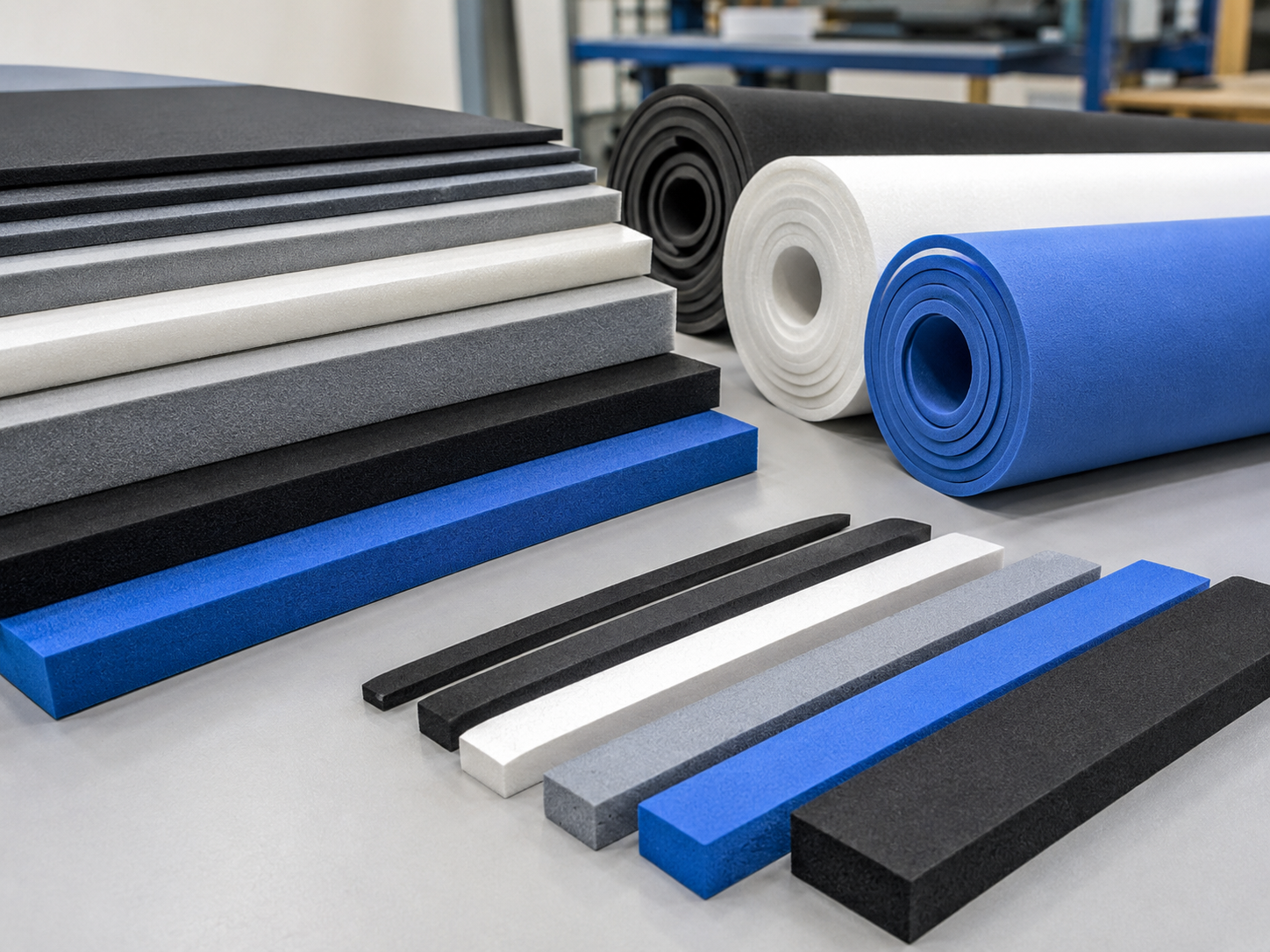
Why Foam Is Difficult to Cut Straight
Foam is not like paper, metal, or hard plastic.
Foam is soft, compressible, and sometimes elastic. When pressure is applied during cutting, the material may move before the blade passes through it.
This can cause:
- Slanted edges
- Rough cutting lines
- Compressed surfaces
- Torn cells
- Uneven thickness
- Adhesive layer shifting
- Poor dimensional accuracy
The softer and thicker the foam, the harder it is to cut straight by hand.
Common foam materials include:
| Foam Type | Cutting Challenge |
|---|---|
| EVA foam | Can compress during cutting |
| PE foam | May deform if pressure is uneven |
| PU foam | Soft structure may tear |
| EPDM foam | Elastic recovery may affect edge accuracy |
| Adhesive-backed foam | Adhesive may drag or lift |
| Multilayer foam | Different layers may cut differently |
This is why professional foam cutting depends on the right tool, support, pressure, and process.
How to Cut Foam Straight by Hand
For small samples, packaging prototypes, or simple internal use, foam can be cut manually.
1. Use a Sharp Blade
A dull blade is the most common reason for bad foam edges.
A sharp utility knife, craft knife, or long foam blade can reduce tearing and dragging.
For thicker foam, use multiple light passes instead of forcing one deep cut.
Forcing the blade can compress the foam and create a slanted edge.
2. Use a Straightedge Guide
A metal ruler or cutting guide helps maintain a straight line.
Do not use a soft plastic ruler because the blade may cut into it.
Hold the guide firmly and keep the blade angle consistent.
3. Support the Foam Fully
Foam should lie flat on a stable cutting surface.
If part of the foam hangs over the table edge, it may bend during cutting.
This creates uneven edges.
A full cutting mat or flat table support helps improve accuracy.
4. Cut Slowly
Fast cutting often causes the blade to drift.
Slow, steady movement gives better control.
This is especially important for thick EVA foam, PE foam, and adhesive-backed foam.
5. Avoid Excessive Pressure
Too much pressure compresses the foam before cutting.
This can make the edge look straight while cutting, but uneven after the foam rebounds.
Light pressure and repeated passes are usually better.
Best Tools for Straight Foam Cutting
The best tool depends on foam thickness, density, and production volume.
Utility Knife
Good for thin foam sheets and small samples.
Advantages:
- Low cost
- Easy to use
- Suitable for simple straight cuts
Limitations:
- Not ideal for thick foam
- Hard to maintain repeatability
- Edge quality depends heavily on operator skill
Hot Wire Cutter
A hot wire cutter melts through certain foam materials.
It can create clean straight cuts for compatible foam types.
However, it is not suitable for all materials, especially foam with adhesive, rubber content, or heat-sensitive layers.
Buyers should also consider fumes and material safety.
Band Knife Cutting
Band knife cutting is common for thicker foam blocks or sheets.
It can produce straight cuts with better control than manual blades.
It is useful for foam preparation before die cutting or lamination.
CNC Cutting
CNC cutting is useful for prototypes, thick foam, and complex shapes.
It provides better accuracy than hand cutting, especially for small-batch development.
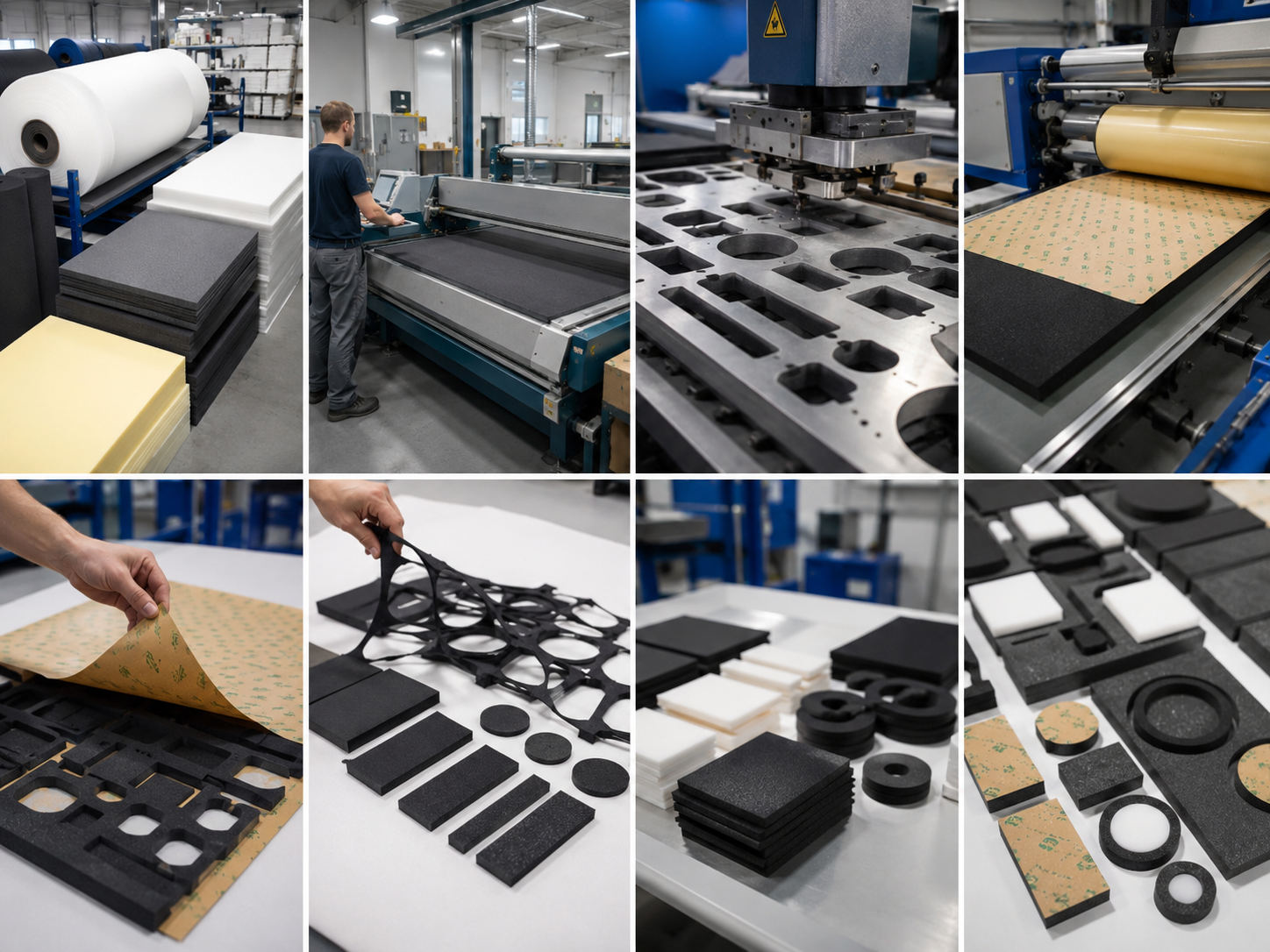
Die Cutting
For mass production, die cutting is often the best solution.
It allows foam to be cut into consistent shapes with repeatable dimensions.
This is especially important when foam parts need holes, slots, curves, adhesive backing, or tight assembly fit.
Why Straight Cutting Matters in OEM Applications
A straight foam edge is not only about appearance.
In OEM manufacturing, edge quality affects product function.
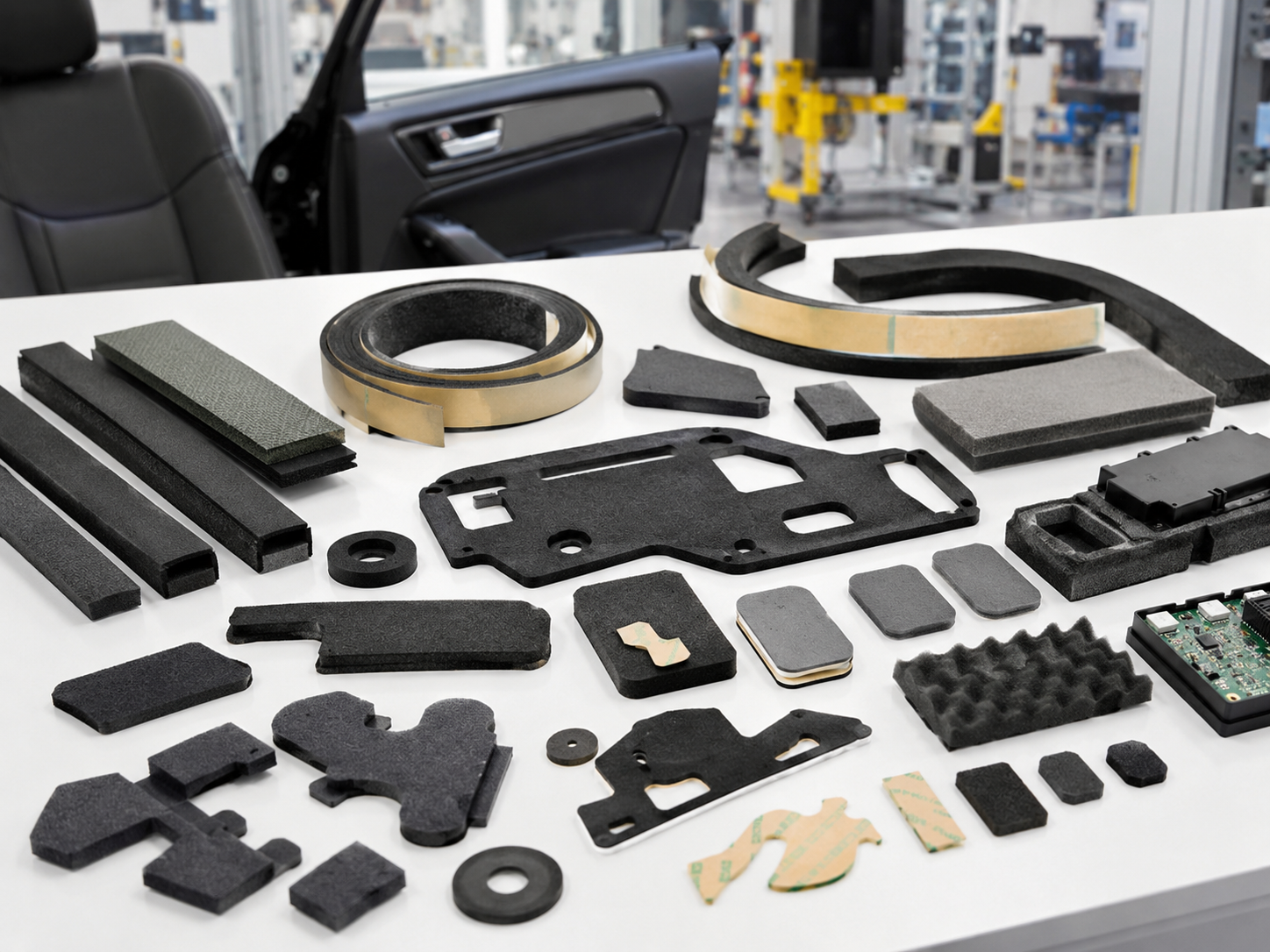
Automotive Applications
In automotive interiors, foam parts may be used for:
- Anti-rattle pads
- Door trim cushions
- Dashboard spacers
- Wire harness protection
- Acoustic support layers
- Sealing support strips
If the edge is uneven, the foam may not fit correctly. This can cause squeaks, gaps, poor bonding, or inconsistent pressure.
For electric vehicles, this becomes even more important because passengers can hear small interior noises more easily.
Electronics Applications
Electronics products often have limited space.
Foam is used for:
- Battery cushioning
- Speaker damping
- Dust protection
- Display protection
- Shock absorption
- Internal spacers
A small dimensional error can create pressure on sensitive components.
Straight and accurate cutting helps improve assembly reliability.
Packaging Applications
Foam packaging needs clean and accurate edges to hold the product securely.
If the foam insert is cut poorly, the product may move inside the package.
This reduces protection and damages customer experience.
Industrial Applications
Industrial foam parts may be used as gaskets, pads, spacers, or vibration-control components.
Straight cuts help improve sealing support, contact stability, and installation efficiency.
Common Mistakes When Cutting Foam Straight
Many cutting problems come from simple mistakes.
Using the Wrong Blade
A blade that works for paper may not work for foam.
Foam needs a sharp, clean edge to avoid tearing.
Cutting Too Fast
Fast movement increases blade drift.
This causes wavy edges.
Cutting Thick Foam in One Pass
Thick foam should usually be cut in several passes.
One heavy cut compresses the material and reduces accuracy.
Ignoring Foam Density
Soft foam and dense foam behave differently.
A process that works for low-density EVA may not work for high-density EPDM foam.
Cutting Adhesive-Backed Foam Without Testing
Adhesive layers can stick to the blade or shift during cutting.
This may cause rough edges, adhesive overflow, or liner damage.
How to Get Better Foam Cutting Quality
To improve cutting quality, buyers should control both material and process.
Important factors include:
- Foam density
- Foam thickness
- Blade sharpness
- Cutting pressure
- Cutting speed
- Material support
- Adhesive structure
- Release liner strength
- Tooling design
- Tolerance requirement
For mass production, manual cutting is usually not enough.
The process must be stable and repeatable.
When Should You Use Precision Die Cutting?
Precision die cutting is recommended when foam parts require:
- Repeated production
- Clean edges
- Custom shapes
- Tight tolerance
- Adhesive backing
- Holes or slots
- Multi-layer lamination
- Fast assembly
- Automotive or electronics use
Die cutting is especially useful when customers need thousands or millions of identical foam parts.
It reduces manual variation and improves production efficiency.
At Sanken, we often combine die cutting with adhesive laminating, foam converting, hot pressing, kiss cutting, and custom assembly to create ready-to-use foam components.
Foam Cutting Tolerance: What Buyers Should Know
Foam tolerance depends on material behavior.
Soft foam can deform more easily than dense rubber or plastic.
This means tolerance should be realistic.
For example, a very soft thick foam may not hold the same tolerance as a thin PET film.
Before confirming a drawing, buyers should discuss:
- Material type
- Thickness
- Density
- Part size
- Hole diameter
- Adhesive backing
- Assembly method
- Function of the part
A good supplier will review whether the required tolerance is practical before production begins.
This avoids unnecessary cost and quality disputes later.
How Sanken Helps Customers Cut Foam Accurately
At Sanken Manufacturing, we help customers solve real foam cutting problems, not just cut material into shape.
Our foam converting capabilities include:
- EVA foam die cutting
- PE foam cutting
- PU foam converting
- EPDM foam processing
- Adhesive lamination
- Kiss cutting
- Foam slitting
- Hot pressing
- Multilayer assembly
- Prototype and mass production support
We help customers choose the right foam, adhesive, cutting process, and tolerance based on the final application.
For OEM buyers, this means fewer rejected parts, better assembly fit, lower production risk, and more stable mass production.
What Should Buyers Confirm Before Ordering Foam Parts?
Before ordering cut foam parts, buyers should ask:
- What type of foam is required?
- What thickness and density are needed?
- Does the edge need to be perfectly clean?
- Does the part need adhesive backing?
- Will the foam stay under compression?
- What tolerance is required?
- Will the part be applied manually or automatically?
- Does the foam need flame resistance, odor control, or aging resistance?
- Is this for prototype testing or mass production?
- Can the supplier support laminating and die cutting together?
These questions help prevent wrong material selection and poor cutting results.
Conclusion
Foam can be cut straight with a sharp blade, stable support, a straightedge guide, light pressure, and controlled cutting speed. For simple samples, manual cutting may be enough. However, for OEM production, straight cutting must be repeatable, clean, and dimensionally stable.
For automotive, electronics, packaging, medical, and industrial applications, precision die cutting is often the better solution. At Sanken Manufacturing, we help customers convert foam into accurate, adhesive-backed, laminated, and ready-to-assemble components that solve real production problems and support stable mass production.