
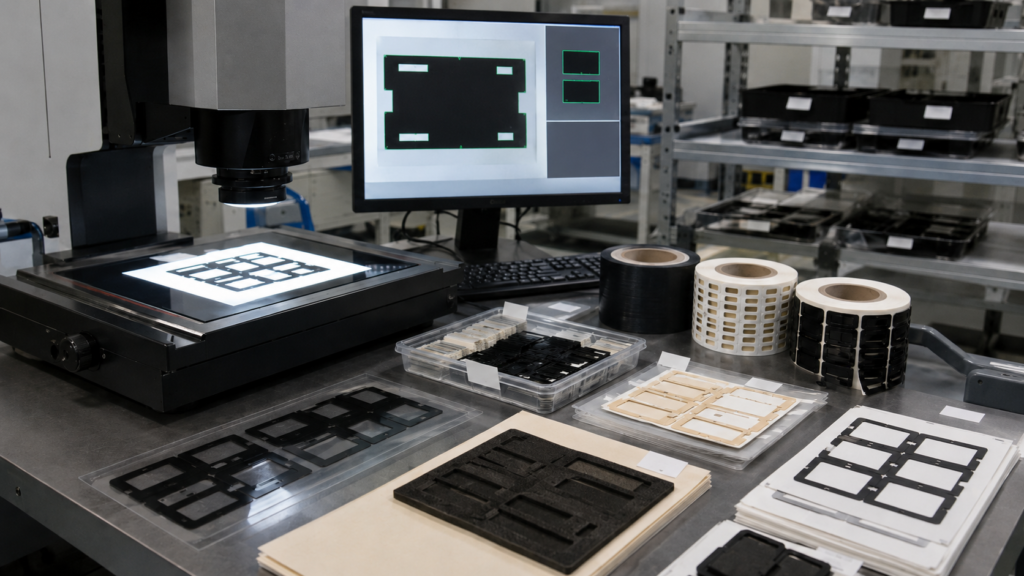
Selecting a precision die-cut part involves more than choosing a material and sending a drawing to a converter. The part must match the operating environment, assembly process, dimensional requirements and expected production volume.
Material thickness, compression behavior, adhesive compatibility, liner design, cutting depth and delivery format can all affect whether a component performs consistently during assembly and mass production.
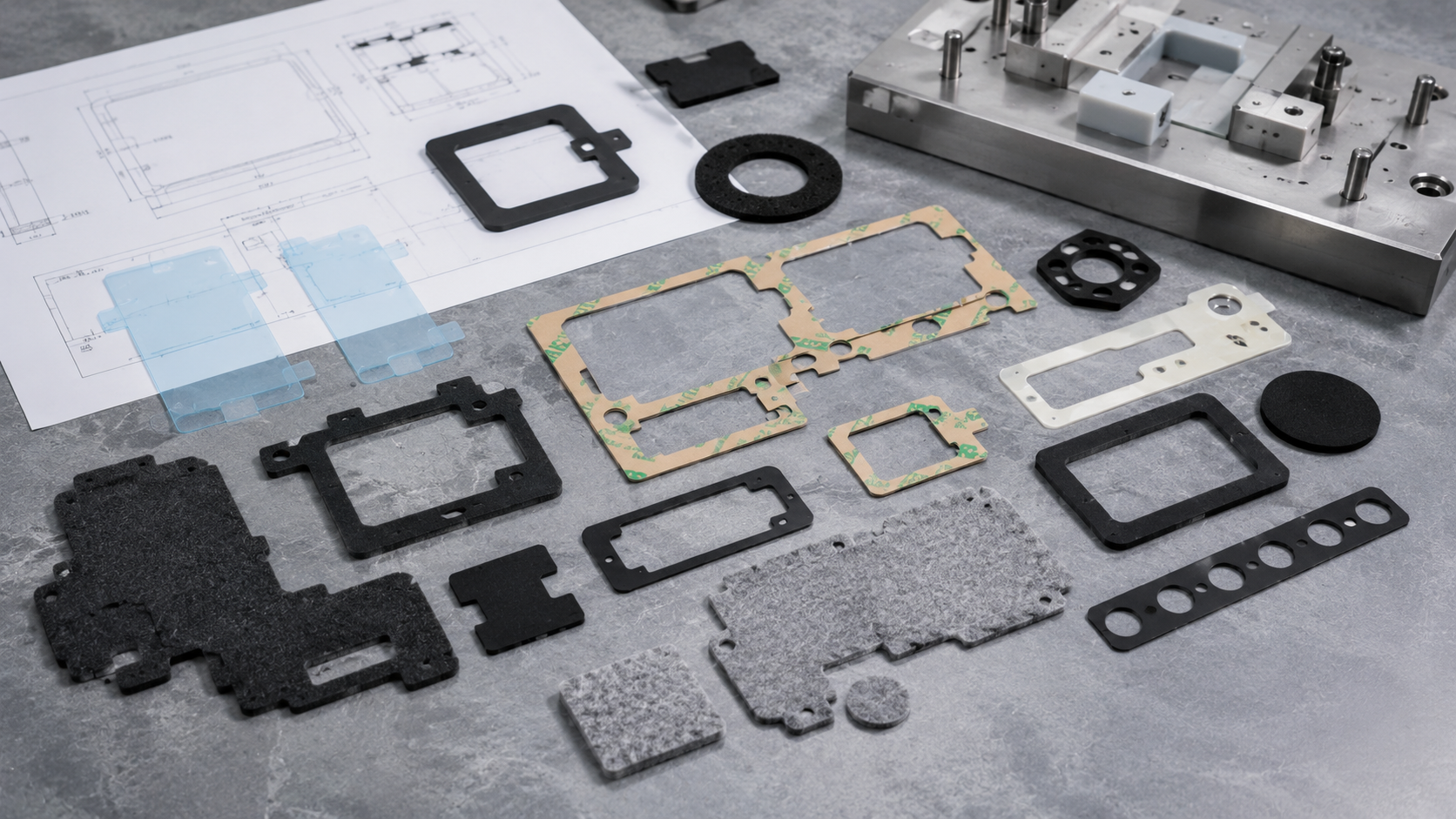
Sanken supports custom precision die-cut parts made from foam, rubber, adhesive tape, PET film, protective film, non-woven felt and conductive foam for automotive, optical, electronic, appliance, medical equipment and energy-related OEM applications.
Start With the Function of the Part
The first question should not be “Which material is cheapest?” It should be:
What must this component do after it is installed?
A custom die-cut part may provide one or several functions:
- Sealing against dust or moisture
- Bonding two surfaces
- Filling a controlled gap
- Reducing vibration or rattling
- Cushioning a sensitive component
- Blocking unwanted light
- Providing electrical insulation
- Protecting a surface during assembly
- Supporting grounding or EMI control with conductive foam
The required function determines the material family, thickness, adhesive structure and acceptable dimensional variation.
A foam pad used for cushioning does not have the same requirements as a black PET light-blocking frame, an adhesive mounting part or an EPDM sealing gasket.
Review the Operating and Assembly Environment
A material that performs well during initial sampling may fail after temperature cycling, compression, vibration or long-term exposure.
Before material selection, confirm:
| Requirement | Questions to Review |
|---|---|
| Temperature | What are the minimum and maximum operating temperatures? |
| Moisture | Will the part face humidity, splash water or condensation? |
| Compression | Is the part compressed once or repeatedly? |
| Vibration | Will the component experience continuous movement or shock? |
| Surface | Will it bond to plastic, coated metal, glass, rubber or another film? |
| Cleanliness | Are particles, residue or fingerprints critical? |
| Assembly | Will the part be installed manually or automatically? |
| Service life | Is the component temporary or permanent? |
For example, automotive interior parts may require vibration control and long-term adhesive stability. Optical components may require clean edges, controlled light blocking and careful liner handling. Appliance components may need cushioning, sealing and resistance to repeated operating vibration.
Select the Material by Performance, Not Appearance
Materials that look similar may behave very differently during converting and assembly.
Adhesive Tapes
Double-sided tapes, foam tapes and transfer adhesive structures are used for bonding, positioning and assembly support.
Selection should consider:
- Surface energy of the bonded materials
- Peel and shear requirements
- Temperature and humidity exposure
- Adhesive thickness
- Initial tack and long-term bonding
- Residue or removability requirements
- Release liner type
Adhesive selection should be confirmed together with the substrate and assembly conditions, not evaluated as a separate layer.
Foam
PE, EVA, PU, EPDM and silicone foam can provide cushioning, sealing, gap filling and vibration control.
Important variables include:
- Density
- Thickness
- Cell structure
- Compression force
- Compression recovery
- Water resistance
- Temperature performance
- Adhesive compatibility
Soft foam may deform during cutting, while thicker or higher-density foam may require a different tool and cutting method.
Rubber
EPDM, silicone and other rubber materials may be selected for sealing, protection and vibration isolation.
Buyers should confirm hardness, thickness, compression requirements and environmental exposure before finalizing the part design.
For additional sealing information, see Sanken’s custom gaskets and seals.
Non-Woven Felt
Needle-punched felt and other non-woven materials are used for automotive NVH control, anti-rattle protection, cushioning and surface separation.
The fiber structure, density, thickness, edge quality and forming requirements influence both material selection and converting stability.
PET and Protective Films
PET films can support electrical insulation, light blocking, internal separation and dimensional stability. Protective films are usually used to reduce scratching, dust and contamination during manufacturing or transport.
Film parts may require:
- Precise inner windows
- Clean edges
- Low-distortion cutting
- Pull tabs
- Split liners
- Controlled adhesive levels
- Clean packaging
These requirements are especially important for optical and display applications.
Define the Complete Part Structure
A drawing should identify more than the outer dimensions.
The converter may also need to understand:
- Material name or required performance
- Material thickness
- Adhesive type and adhesive side
- Release liner material
- Single-layer or multilayer construction
- Inner holes and window dimensions
- Critical dimensions and reference points
- Pull tabs or extended liners
- Split-liner position
- Part orientation
- Sheet or roll direction
- Packaging requirements
For multilayer parts, the drawing should distinguish between the cut lines for each layer.
One layer may require through cutting, while another layer or liner must remain intact. Without this information, a sample may appear correct but still be difficult to peel, position or install.
Specify Tolerances Only Where They Matter
Applying very tight tolerances to every dimension can increase tooling difficulty, inspection time and production cost without improving part performance.
Instead, identify:
- Critical outer dimensions
- Inner-window position
- Hole-to-hole spacing
- Adhesive-free areas
- Alignment features
- Thickness requirements
- Compression-sensitive areas
- Dimensions that affect mating components
Tolerance feasibility depends on the material.
Thin PET film, soft PU foam, elastic rubber and fibrous non-woven felt do not respond to cutting pressure in the same way. The converter should review material behavior before confirming a production tolerance.
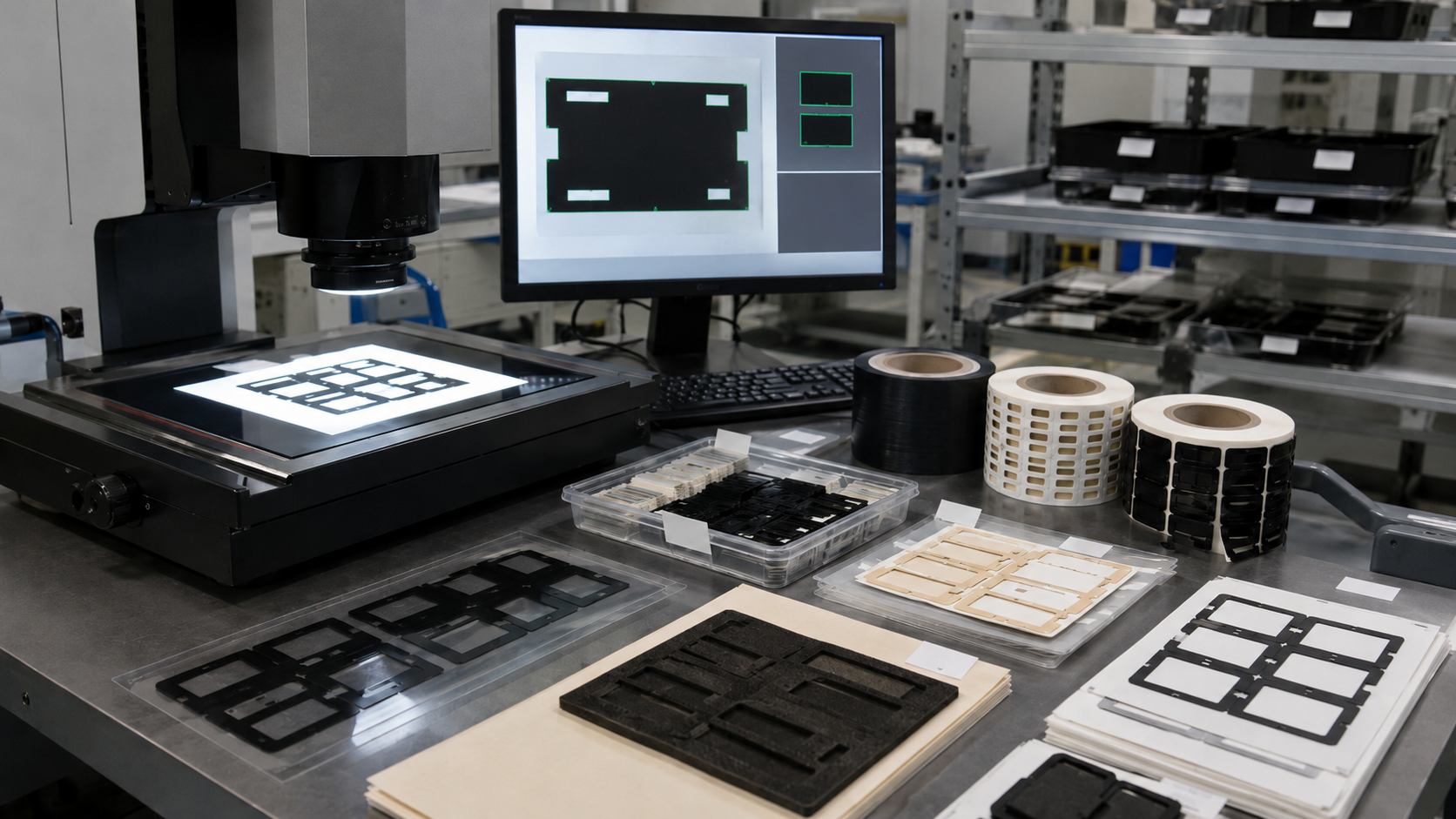
Sanken’s precision die-cutting services include drawing review, material preparation, tooling, laminating, cutting, waste removal and dimensional inspection.
Choose the Appropriate Cutting Method
The process should match the material, construction, tolerance and production volume.
Kiss Cutting
Kiss cutting cuts the component while leaving the release liner intact. It is commonly used for adhesive tape, protective film and thin foam parts that need organized peeling and placement.
Through Cutting
Through cutting cuts through the material and supporting layers to create individual parts or fully separated shapes.
Rotary Die Cutting
Rotary die cutting is generally suitable for roll-fed materials and repeat production where part spacing, liner control and waste removal can be stabilized.
Flatbed Die Cutting
Flatbed die cutting can be suitable for sheets, thicker foam, rubber, felt and lower-volume production.
The decision should not be based only on machine speed. Material thickness, compressibility, liner structure, tooling cost and production quantity all affect process selection.
For a more detailed comparison, see rotary vs. flatbed die cutting.
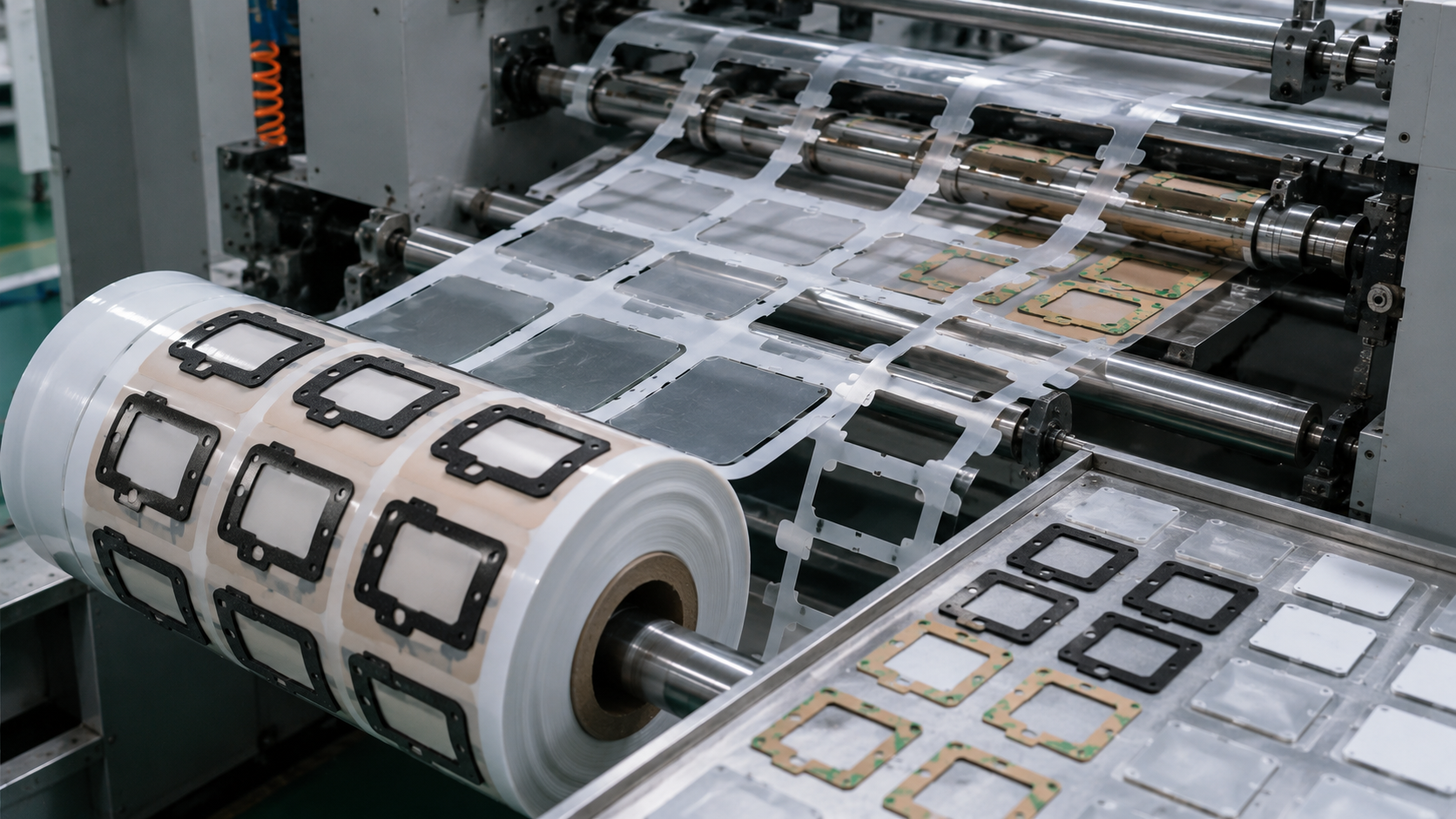
Design the Liner and Supply Format for Assembly
A dimensionally correct component can still slow production if operators cannot peel, orient or position it efficiently.
Before mass production, confirm whether the parts should be supplied as:
- Individual pieces
- Kiss-cut parts on sheets
- Parts on rolls
- Strips
- Matched sets
- Assembly-ready kits
For roll supply, buyers should also specify:
- Part orientation
- Number of parts across the web
- Pitch and spacing
- Roll direction
- Core size
- Maximum roll diameter
- Splice requirements
- Quantity per roll
Pull tabs, extended liners and split liners can improve handling, particularly for thin films and small adhesive parts.
Learn more about die-cut parts supplied in sheets, rolls or kits.
Validate the Part Before Mass Production
Prototype approval should evaluate both the component and the assembly process.
A useful validation review may include:
- Dimensional inspection
- Material thickness confirmation
- Adhesive and liner evaluation
- Trial installation
- Peeling and placement checks
- Compression or fit assessment
- Visual inspection of edges
- Packaging and transport review
Whenever possible, sample parts should use a material structure and converting method representative of the planned production process.
Changing the material, adhesive, liner or tool after approval may alter part behavior and should trigger another review.
Evaluate the Supplier’s Manufacturing System
Buyers should assess more than whether a supplier owns a die-cutting machine.
A capable converting partner should be able to review:
- Material availability and consistency
- Drawing completeness
- Tooling method
- Lamination sequence
- Cutting depth
- Waste-removal stability
- Inspection method
- Packaging format
- Prototype-to-production scalability
- Batch traceability
Marian emphasizes matching geometry, adhesive interaction and tolerance requirements with the correct converting process. Strouse places particular importance on early material testing and complete drawings. These principles are equally important for stable OEM production.
Sanken supports material converting, slitting, laminating, precision die cutting, prototype development, inspection and mass-production supply across China and Vietnam.
Information to Provide for a Quotation
To improve quotation accuracy, buyers should provide as much of the following information as possible:
- 2D drawing or CAD file
- Material specification or required function
- Thickness
- Adhesive and liner requirements
- Critical tolerances
- Application surface
- Operating environment
- Sample quantity
- Estimated annual volume
- Supply format
- Quality or inspection requirements
If the material has not been finalized, provide the application requirements and assembly conditions so suitable options can be reviewed.
Conclusion
Reliable precision die-cut parts are developed by matching material behavior, part geometry, adhesive structure, cutting method and delivery format with the actual OEM assembly process.
The best result is not simply a component that matches the drawing. It is a part that can be peeled, positioned, installed and produced consistently from prototype through mass production.
Sanken supports custom foam, rubber, adhesive tape, PET film, protective film, non-woven felt and conductive foam components through material review, laminating, precision die cutting, inspection and assembly-ready supply.
Related Articles
https://sankenprecision.com/which-is-better-a-rotary-or-a-flatbed-die-cutting-2/
https://sankenprecision.com/from-foam-rolls-to-finished-parts-how-die-cutting-works/
https://sankenprecision.com/how-die-cut-parts-are-supplied-in-sheets-rolls-or-kits/
https://sankenprecision.com/how-to-choose-the-right-die-cutting-manufacturer-for-your-oem-project/
https://sankenprecision.com/what-is-die-cut-definition-meaning-and-applications/