
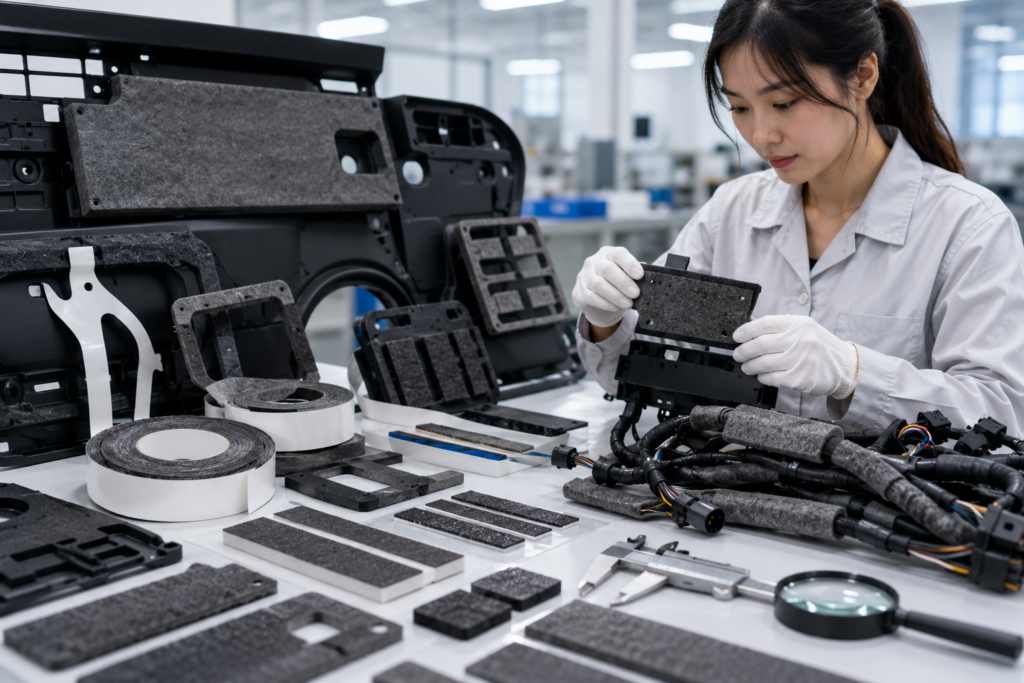
As vehicles become quieter and more technologically advanced, even minor noises inside the cabin become more noticeable. Squeaks between plastic parts, vibration from wiring harnesses, and rattling trim panels can significantly affect the driver's perception of quality. To eliminate these issues without adding unnecessary weight, automotive manufacturers widely use die cut non-woven felt pads.
Unlike rubber or foam components, non-woven felt provides an excellent combination of noise absorption, cushioning, wear resistance, and anti-rattle performance. It can be precisely die cut into custom shapes and applied exactly where contact, movement, or vibration occurs.
Sanken manufactures custom die cut non-woven felt pads for automotive interior, electronic, and appliance applications, helping OEM manufacturers improve product quality, simplify assembly, and reduce unwanted noise.
Why Non-Woven Felt Is Widely Used for Automotive NVH
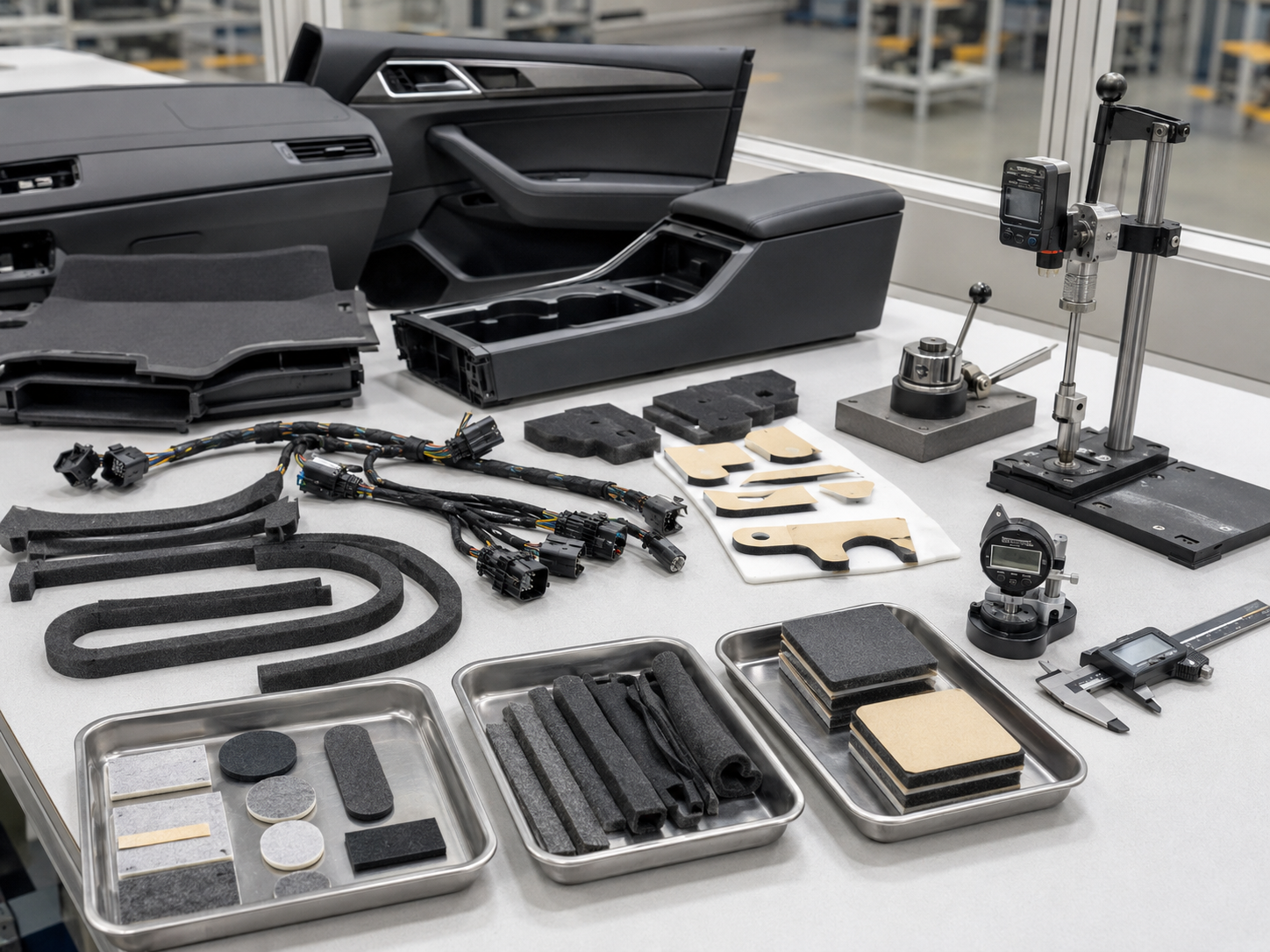
NVH (Noise, Vibration, and Harshness) has become a major focus in modern vehicle development. Even when mechanical systems perform well, small friction points between plastic, metal, and electronic components can generate unwanted sounds over time.
Non-woven felt provides a soft, durable interface that separates contacting parts and absorbs vibration before noise is generated.
Compared with rigid materials, felt offers several advantages:
- Excellent anti-rattle performance
- Lightweight construction
- Good abrasion resistance
- Stable compression
- Easy adhesive lamination
- Flexible die cutting into complex shapes
These characteristics allow engineers to improve cabin comfort without increasing component complexity.
| Function | Benefit |
|---|---|
| Noise reduction | Absorbs friction noise and vibration |
| Cushioning | Protects contacting components |
| Anti-rattle | Prevents plastic-to-plastic contact |
| Surface protection | Reduces wear and scratches |
| Gap compensation | Improves assembly consistency |
Typical Applications Inside Modern Vehicles
Die cut felt pads appear throughout today's vehicles, although most drivers never notice them.
Common applications include:
- Door trim panels
- Dashboard assemblies
- Center consoles
- Instrument panels
- Pillar trim
- Headliners
- HVAC ducts
- Wire harness routing
- Glove boxes
- Storage compartments
- Battery covers
- Seat structures
In these locations, felt pads reduce vibration, eliminate squeaking, and prevent long-term wear caused by repeated movement between adjacent parts.
Many automotive manufacturers also combine felt with adhesive backing, allowing faster installation during assembly while maintaining accurate positioning.
Material Properties That Influence NVH Performance
Not all non-woven felt materials perform the same.
Material selection depends on several engineering factors, including fiber composition, density, thickness, compression behavior, and surface finish.
| Property | Engineering Importance |
|---|---|
| Thickness | Controls cushioning distance |
| Density | Influences stiffness and acoustic absorption |
| Compression recovery | Maintains long-term performance |
| Abrasion resistance | Extends service life |
| Fiber stability | Reduces loose fibers |
| Adhesive compatibility | Supports reliable installation |
Selecting a thicker material does not always improve noise reduction. In confined assemblies, excessive thickness may increase installation force or interfere with adjacent components. Engineers usually balance acoustic performance with dimensional limitations to achieve the best overall result.
Adhesive-Backed Felt Simplifies OEM Assembly
Many automotive felt pads are supplied with pressure-sensitive adhesive already laminated to the material.
The adhesive does not provide the NVH function itself. Instead, it keeps the felt accurately positioned throughout assembly and vehicle operation.
Benefits of adhesive-backed felt include:
- Faster installation
- Improved positioning accuracy
- Reduced assembly variation
- Better compatibility with automated production
- Elimination of additional clips or fasteners in selected applications
Depending on the project, felt pads may be supplied as individual pieces, kiss-cut sheets, or roll formats for continuous production.
Sanken converts adhesive-backed felt through our Precision Die Cutting Services, producing assembly-ready components that fit directly into OEM manufacturing processes.
Precision Die Cutting Improves Part Quality
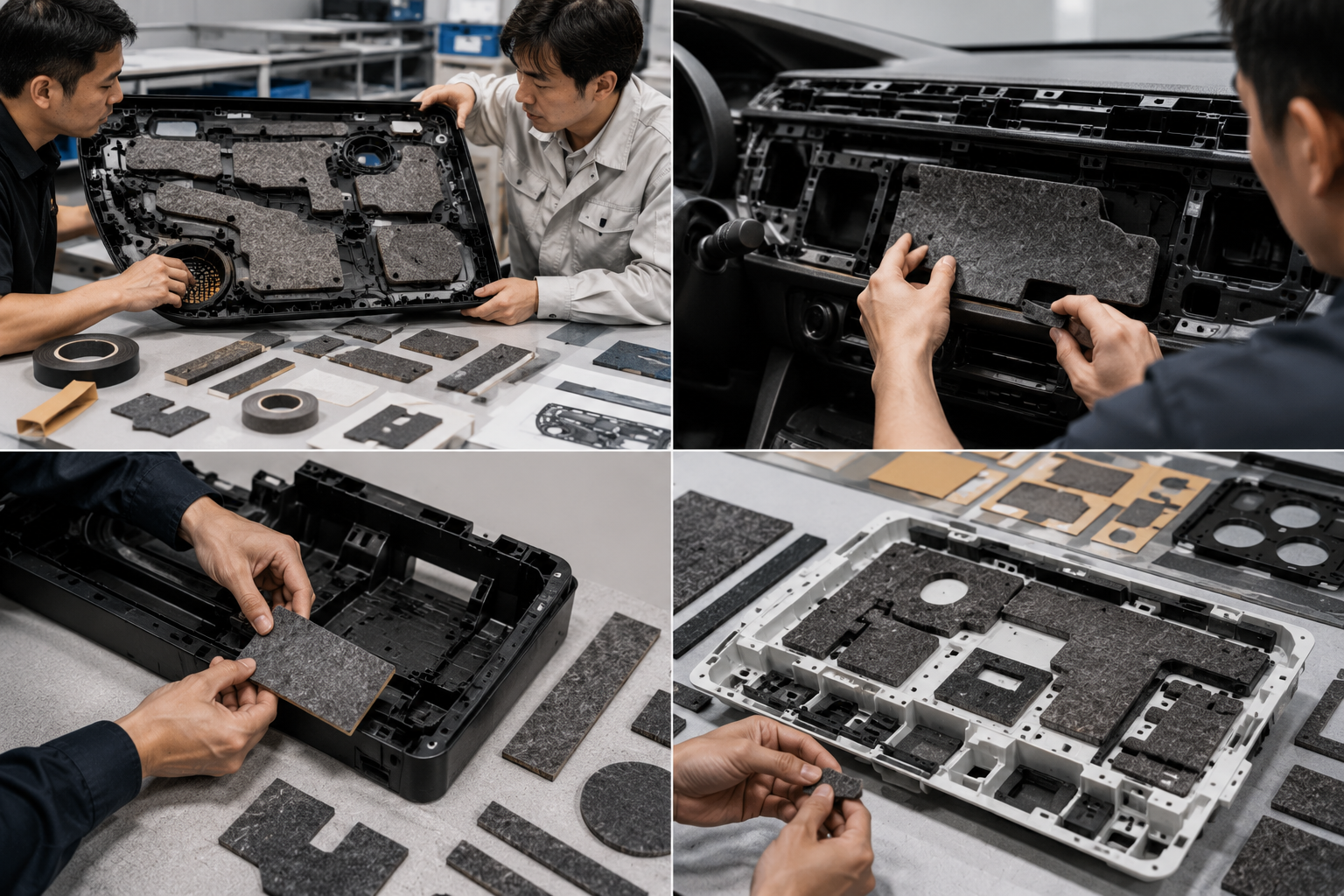
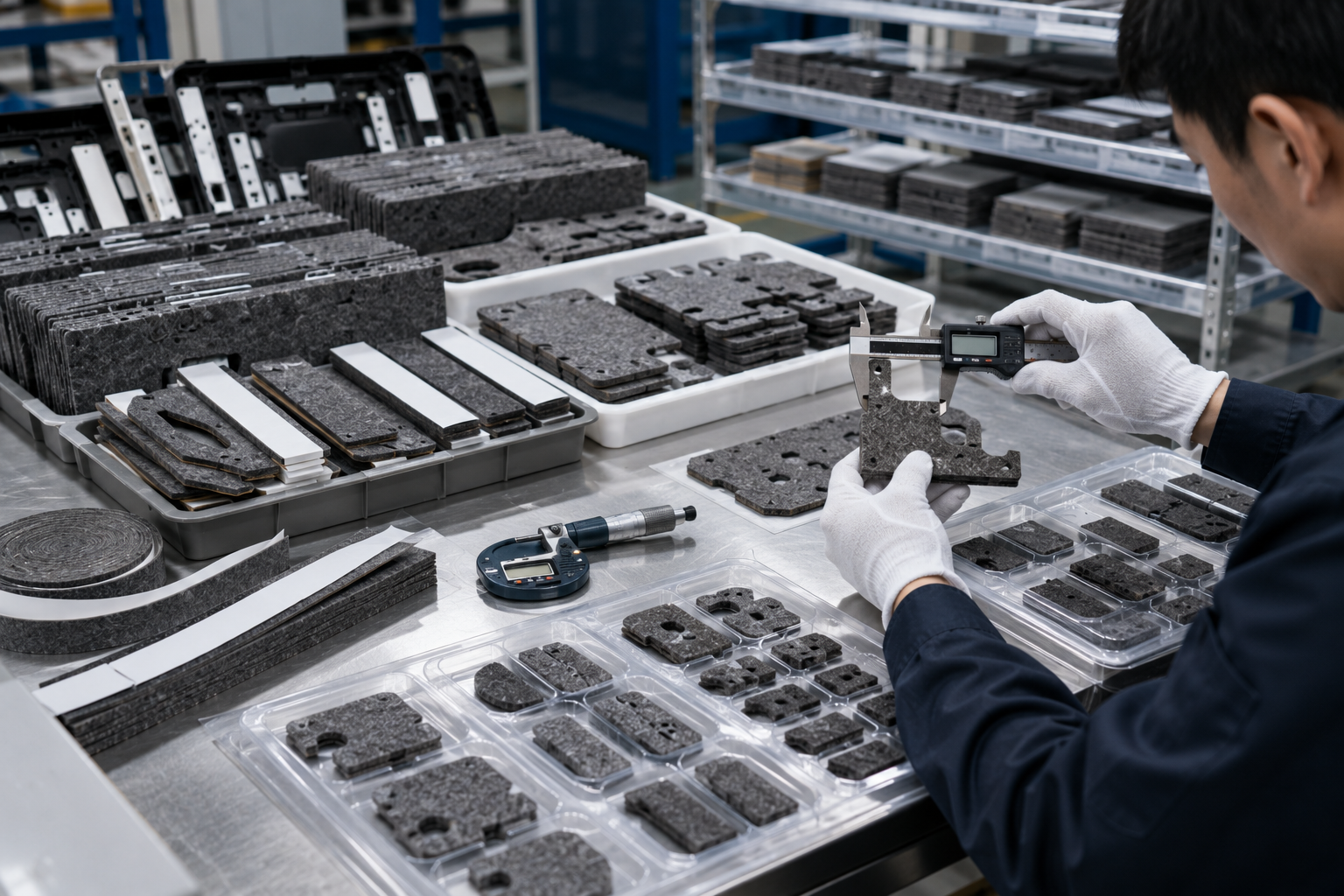
The effectiveness of a felt pad depends not only on the material but also on how accurately it is converted.
Precision die cutting ensures:
- Consistent dimensions
- Clean edges
- Accurate hole locations
- Stable adhesive alignment
- Repeatable production quality
Complex automotive parts often include narrow strips, curved outlines, mounting holes, or irregular profiles that must fit precisely around clips, ribs, or fasteners.
Inaccurate cutting may create installation problems, reduce contact area, or allow components to move during vehicle operation.
Custom die cutting also enables felt pads to be laminated with PET films, protective films, or adhesive tapes when additional functions are required.
Common Design Mistakes That Reduce NVH Performance
Many NVH issues originate during product design rather than manufacturing.
Common mistakes include:
- Selecting material based only on thickness
- Ignoring long-term compression recovery
- Using insufficient contact area
- Choosing unsuitable adhesive
- Installing felt where compression is excessive
- Overlooking wear caused by repeated movement
Another common issue is placing a felt pad too late in the development process. Once tooling has been finalized, available installation space may become too limited to achieve the desired acoustic performance.
Early collaboration between product designers and converting specialists usually produces better long-term results while reducing redesign costs.
How Sanken Supports Automotive Felt Projects
Sanken develops custom die cut non-woven felt components for automotive OEMs and Tier suppliers. We support projects from prototype development through mass production, helping customers optimize material selection, part geometry, adhesive structures, and manufacturing processes to improve assembly efficiency and long-term NVH performance.
You May Also Be Interested In
- What Are Non-Woven Fabrics Used For?
- The Importance of Non-Woven Materials in Modern OEM Manufacturing
- How Precision Die Cutting Is Used in Modern Household Appliances
- How Die Cut Gaskets Improve Vehicle Waterproof and Dustproof Performance
- How to Choose Automotive NVH Materials for Noise and Vibration Control
Conclusion
Die cut non-woven felt pads play an essential role in improving automotive NVH performance by reducing noise, absorbing vibration, protecting surfaces, and preventing unwanted movement between components. Their lightweight structure, excellent wear resistance, and compatibility with precision die cutting make them a practical solution for modern vehicle manufacturing.
By selecting the appropriate felt material, adhesive structure, and component design early in development, OEM manufacturers can improve cabin comfort, reduce warranty issues, and simplify production. Working with an experienced converting partner also helps ensure every felt component delivers consistent performance from prototype validation through high-volume manufacturing.