
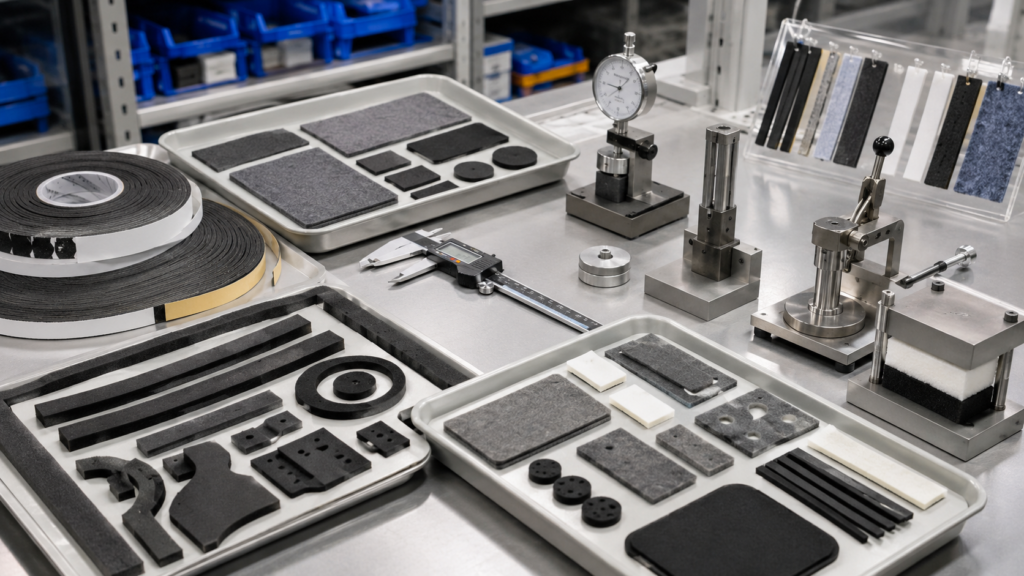
Electric vehicle interiors are quieter, cleaner, and more electronics-heavy than traditional vehicle cabins.
That creates a new challenge for OEM engineers.
When the cabin is quiet, small rattles become obvious.
When displays become larger, bonding and surface protection become more important.
When more sensors, switches, lighting modules, and wire harnesses are used, insulation and dust protection matter more.
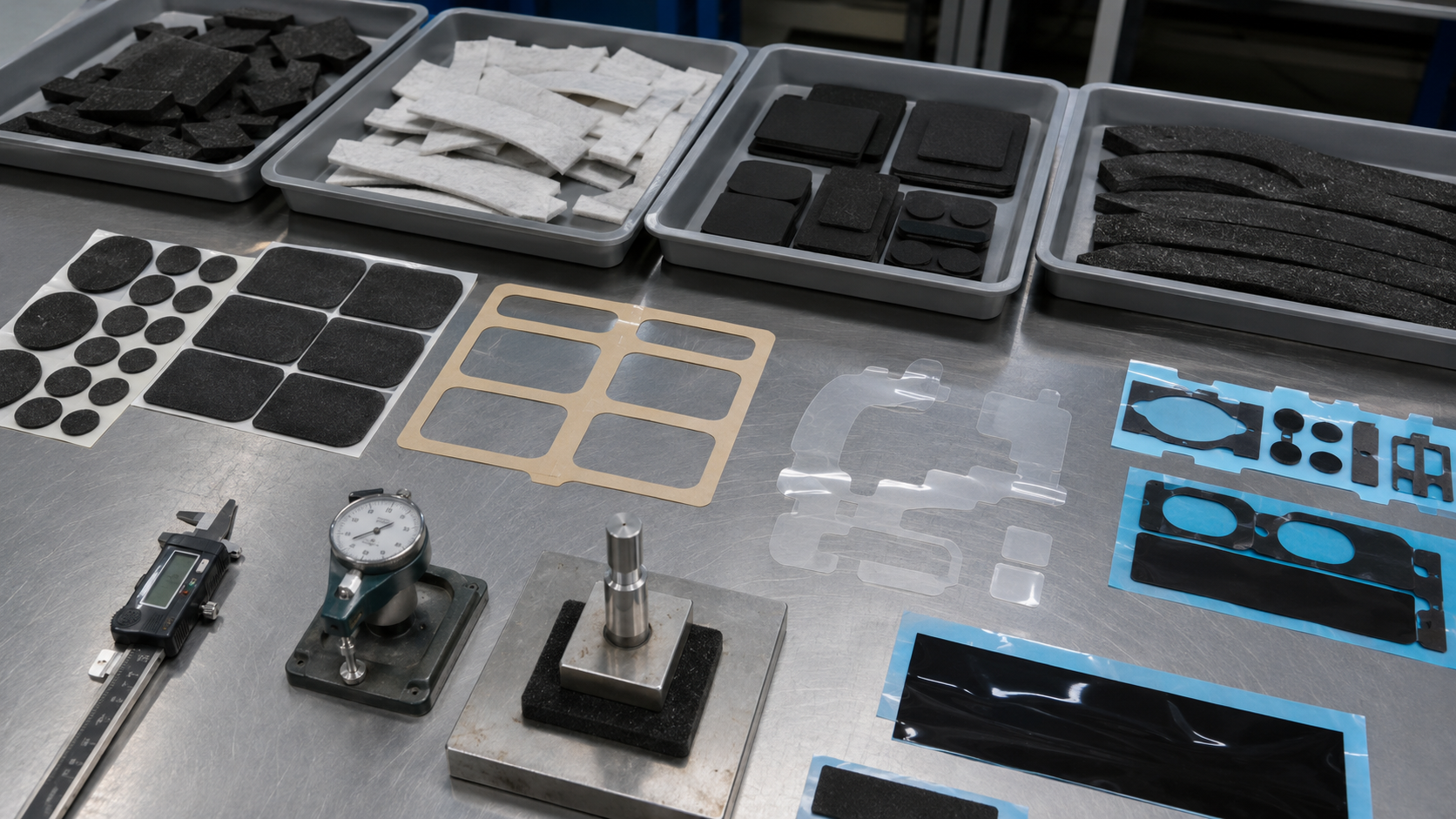
At Sanken, we use precision die cutting to convert foam, non-woven felt, rubber, adhesive tape, PET insulation film, protective film, black light-blocking film, and laminated materials into custom EV interior components.
These parts are usually hidden after assembly.
But they help decide whether the cabin feels quiet, stable, clean, and premium.
Why EV Interiors Need Die Cut Components
EV interiors contain many plastic trim parts, electronic modules, display structures, decorative panels, wire harnesses, lighting parts, sensors, and HVAC ducts.
Each area may need a different hidden functional part.
For automotive die cut components, the goal is not only to cut a material into shape.
The goal is to solve a real assembly problem.
| Interior Need | Common Die Cut Component |
|---|---|
| NVH control | Foam pads, non-woven felt strips, rubber damping pads |
| Sealing | Foam gaskets, adhesive-backed foam seals |
| Bonding | Double-sided tape frames, foam tape parts, adhesive films |
| Protection | Protective films, PET films, cushioning pads |
| Electrical insulation | PET insulation films |
| Light control | Black PET films, foam spacers |
| Surface protection | Protective films with pull tabs |
| Assembly support | Kiss-cut parts on release liner, sheets, rolls, kits |
A single EV interior module may use several of these materials together.
That is why material selection, lamination, die cutting, packaging, and assembly format must be reviewed as one complete process.
NVH Control: Reducing Rattles, Squeaks, and Vibration
NVH means noise, vibration, and harshness.
In EV cabins, NVH control is especially important because there is less engine noise to hide small interior sounds.
Common EV interior NVH issues include:
- Plastic trim rattle
- Door panel vibration
- Center console buzz
- Wire harness movement
- Dashboard squeak
- HVAC duct contact noise
- Display frame contact noise
- Speaker area vibration
Die cut foam, felt, and rubber parts help reduce these problems.
| Material | Best Used For |
|---|---|
| Foam | Gap filling, cushioning, anti-rattle control |
| Non-woven felt | Anti-squeak, friction reduction, surface cushioning |
| Rubber | Stronger vibration damping and impact protection |
| Adhesive-backed foam | Fast placement and stable positioning |
| Laminated NVH materials | Combined cushioning, bonding, and protection |
Foam fills gaps.
Felt reduces friction.
Rubber controls stronger vibration.
Together, these materials help the cabin feel more solid and comfortable.
Small hidden part.
Big cabin difference.
Sealing: Dust, Air, Gaps, and Contact Protection
EV interior sealing is not only about waterproofing.
Many interior sealing parts are used for dust prevention, air control, gap filling, and contact protection.
Common sealing applications include:
| EV Interior Area | Die Cut Sealing Component |
|---|---|
| HVAC ducts | Foam seals and adhesive-backed foam strips |
| Door panels | Foam strips, felt pads, rubber cushions |
| Display housings | Foam gaskets, black films, adhesive frames |
| Sensor areas | Dustproof foam gaskets and PET films |
| Control panels | Adhesive foam seals and protective films |
| Interior electronics | Foam gaskets and PET insulation films |
| Lighting areas | Black PET films and foam spacers |
For sealing and cushioning applications, foam gaskets and sealing components are often used because foam can compress into gaps and support easier assembly.
But the foam must be selected correctly.
If it is too thin, it may not seal.
If it is too thick, the trim may not fit.
If the compression recovery is poor, the sealing function may disappear over time.
Foam should compress.
It should not surrender.
Bonding: Adhesive Tape Frames and Foam Tape Parts
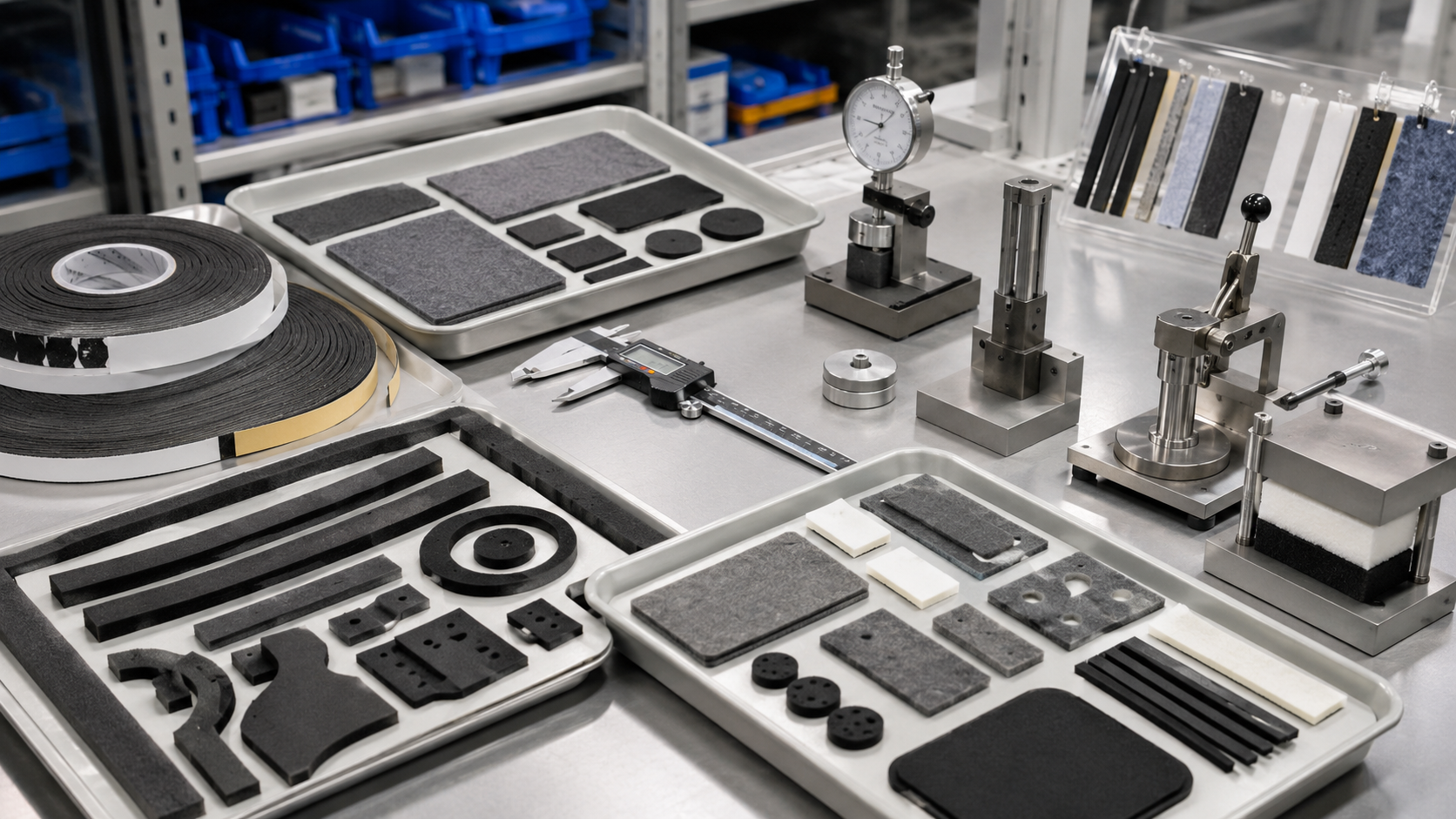
Adhesive die cut parts are widely used in EV interior assembly.
They help bond trim parts, position foam pads, mount protective films, attach felt strips, and simplify production.
Common adhesive die cut components include:
- Double-sided tape frames
- Foam tape gaskets
- PET-backed adhesive parts
- Transfer adhesive parts
- Adhesive-backed felt pads
- Protective films with pull tabs
- Black adhesive films for light control
- Laminated foam and adhesive structures
Adhesive selection must match the bonding surface.
EV interiors may include plastic, glass, metal, rubber, foam, fabric, painted surfaces, and textured decorative panels.
These surfaces do not bond the same way.
A good adhesive part should peel smoothly, stay flat, bond accurately, and resist lifting after heat, vibration, or long-term use.
For high-volume adhesive-backed parts, roll-to-roll die cutting can improve part spacing, liner control, waste removal, and production consistency.
Protection: Films, Pads, and Surface-Safe Materials
EV interiors include many visible and sensitive surfaces.
Displays, glossy panels, decorative trim, sensor windows, touch controls, and lighting areas may need protective films or cushioning pads during production and assembly.
Common protective die cut parts include:
| Protective Part | Function |
|---|---|
| PET protective films | Prevent scratches and surface damage |
| Protective films with pull tabs | Easier removal after assembly |
| Foam cushioning pads | Prevent hard contact damage |
| Rubber pads | Impact and vibration protection |
| PET insulation films | Electrical separation and protection |
| Black PET films | Light blocking and appearance control |
For display and control panel areas, optical film die cut components may include protective films, black light-blocking films, adhesive frames, foam spacers, and PET films.
Cleanliness matters in these areas.
Dust, scratches, adhesive residue, curling, or poor liner release can create visible defects or slow down assembly.
A protective film should protect the part.
Not become the defect.
PET Insulation Films for Interior Electronics
EV interiors include control panels, switches, lighting modules, sensors, displays, wire harness areas, and electronic housings.
These areas may need thin insulation parts.
PET insulation films are commonly used because they are thin, stable, and suitable for custom die cutting.
Common PET film applications include:
- Wire harness protection films
- Control panel insulation films
- Sensor area protection pieces
- Display module PET films
- Adhesive-backed PET insulation parts
- Black PET light-blocking parts
- PET spacers and separators
PET films must be cut cleanly and packaged carefully.
Burrs, scratches, particles, curling, or hole misalignment can affect assembly quality.
For EV interior electronics, a thin PET film can support electrical separation without adding bulky material.
Design Tips for EV Interior Die Cut Components
Good design improves both performance and manufacturability.
Before mass production, engineers should review the part shape, material, adhesive, liner, tolerance, and delivery format.
| Design Point | Why It Matters |
|---|---|
| Minimum width | Prevents tearing and deformation |
| Corner radius | Reduces edge lifting and stress concentration |
| Thickness | Controls fit, compression, and spacing |
| Adhesive area | Supports stable bonding |
| Pull tab design | Improves peeling and manual assembly |
| Hole position | Supports accurate installation |
| Liner release | Improves handling and placement |
| Packaging method | Prevents deformation before use |
For foam and adhesive parts, sharp corners can create lifting or tearing risks.
For felt pads, small handling areas can slow assembly.
For PET films, poor flatness can make placement difficult.
A good die cut part must be designed for cutting, peeling, placing, and long-term use.
Manufacturing Process for EV Interior Die Cut Parts
Most EV interior die cut components are made through material converting, lamination, die cutting, kiss cutting, waste removal, inspection, and packaging.
A typical process includes:
| Step | Purpose |
|---|---|
| Application review | Confirm NVH, sealing, bonding, or protection need |
| Material selection | Choose foam, felt, rubber, tape, PET film, or protective film |
| Lamination | Add adhesive, liner, film, or backing layer if needed |
| Tooling design | Prepare die cutting tool based on drawing |
| Die cutting | Cut pads, strips, frames, gaskets, films, or custom shapes |
| Kiss cutting | Keep adhesive-backed parts on release liner |
| Waste removal | Remove unused material cleanly |
| Inspection | Check dimensions, thickness, edge, adhesive, and liner release |
| Packaging | Prevent dust, deformation, scratches, and missing parts |
For foam-related processing, buyers can review how die cutting works from foam rolls to finished parts.
For assembly planning, this guide on die cut parts supplied in sheets, rolls, or kits explains how delivery format affects handling and production efficiency.
Quality Checks Before Mass Production
A successful sample does not automatically mean stable mass production.
EV interior die cut components must remain consistent across batches.
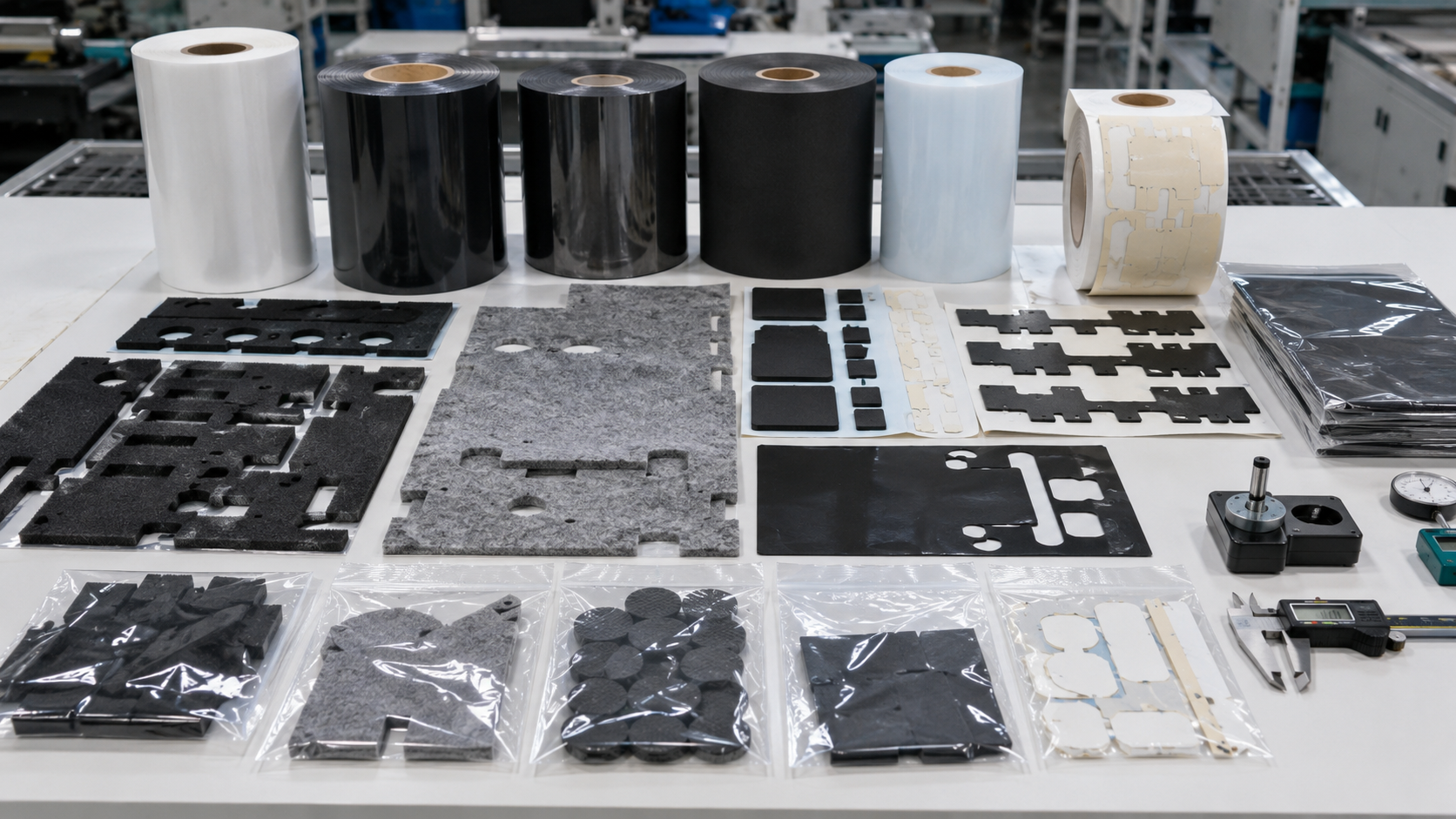
Important quality checks include:
| Inspection Item | Why It Matters |
|---|---|
| Dimensions | Ensures correct fit |
| Thickness | Controls compression and stack height |
| Density or hardness | Affects cushioning and vibration control |
| Compression recovery | Supports long-term sealing and NVH performance |
| Edge quality | Reduces particles and poor fitting |
| Adhesive position | Prevents lifting or shifting |
| Liner release | Improves assembly speed |
| Surface cleanliness | Protects visible and electronic areas |
| Packaging condition | Prevents deformation before use |
For EV interior parts, consistency is part of performance.
One perfect sample is not enough.
The production batch must behave the same way.
What Buyers Should Provide Before Quotation
To recommend the right die cut interior component, we usually need clear project details.
Helpful information includes:
- Drawing or sample
- EV interior application area
- Main function
- Material preference
- Thickness and tolerance
- Adhesive requirement
- Bonding surface
- Compression gap
- Noise or vibration issue
- Sealing requirement
- Surface protection requirement
- Electrical insulation requirement
- Cleanliness requirement
- Annual volume
- Delivery format
- Packaging preference
If the material is not confirmed, Sanken can help compare foam, non-woven felt, rubber, adhesive tape, PET film, protective film, black PET film, and laminated structures.
For supplier selection, buyers can also review how to choose the right die cutting manufacturer before moving from sampling to mass production.
Need Die Cut Interior Components for Electric Vehicles?
Die cut interior components help EV cabins improve NVH control, sealing, bonding, protection, insulation, light control, and assembly stability.
But the final result depends on material selection, adhesive backing, compression design, die cutting accuracy, inspection, packaging, and delivery format.
If you need custom die cut parts for OEM assembly, send us your drawing, sample, EV interior location, material requirement, adhesive structure, tolerance, annual volume, and packaging preference.
Sanken can help review material selection, lamination structure, die cutting method, quality control points, and delivery format before mass production.
Related Articles
You may also find these articles helpful:
- Where Are Die Cut Parts Used in Automotive Manufacturing?
- What Is Die Cutting in Automotive OEM Manufacturing? Materials, Process, and Applications
- How Automation Improves Precision Die Cutting for Automotive OEM Parts
- Custom Die Cut Foam Gaskets for Automotive Electronics
- Adhesive Backed Die Cut Components for OEM Assembly
- How Die Cutting Transforms Raw Materials Into Precision Components
- From Foam Rolls to Finished Parts: How Die Cutting Works
Conclusion
Die cut interior components are important in electric vehicles because they solve hidden cabin problems. Foam, felt, rubber, adhesive tape, PET films, protective films, black films, and laminated materials help improve NVH control, sealing, bonding, protection, insulation, and assembly efficiency. The best result comes from matching each material to the real interior function.