
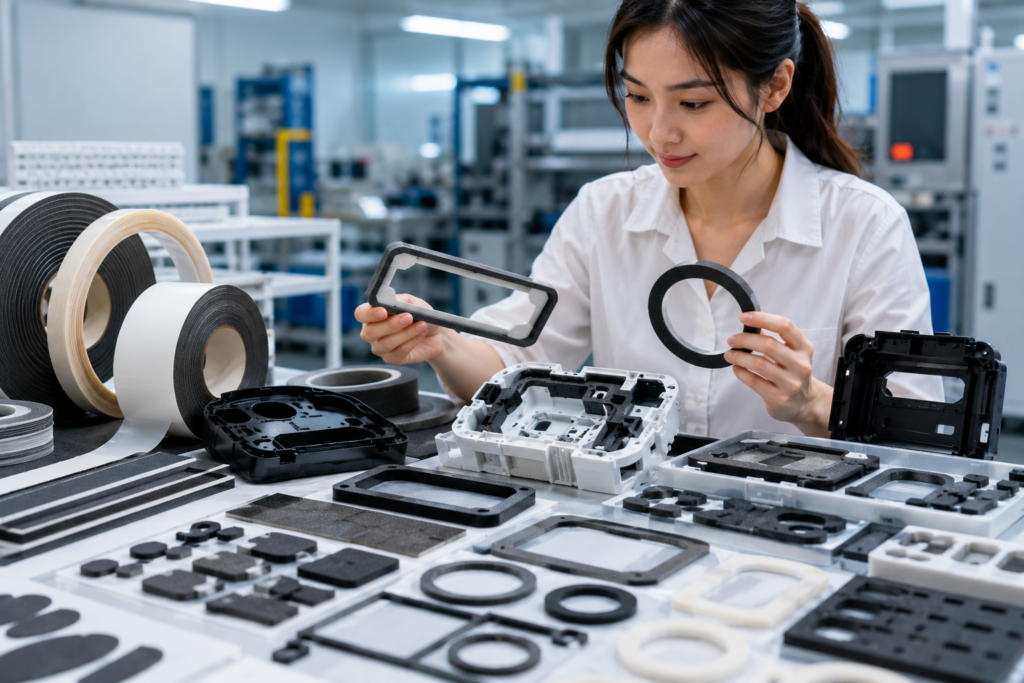
Foam tape and foam gaskets are often made from similar foam materials, but they are designed to solve different engineering problems. Foam tape is primarily used for bonding and positioning, while foam gaskets are developed to seal gaps, absorb vibration, and protect assemblies from dust, moisture, and noise.
For OEM engineers and purchasing teams, understanding these differences is important. Selecting the wrong solution can lead to bonding failures, water leakage, poor compression, or unnecessary production costs.
Sanken manufactures custom die cut foam tapes and foam gaskets for automotive, electronics, appliances, and industrial OEM applications, helping customers optimize material selection, part design, and assembly efficiency.
Foam Tape and Foam Gaskets Solve Different Problems
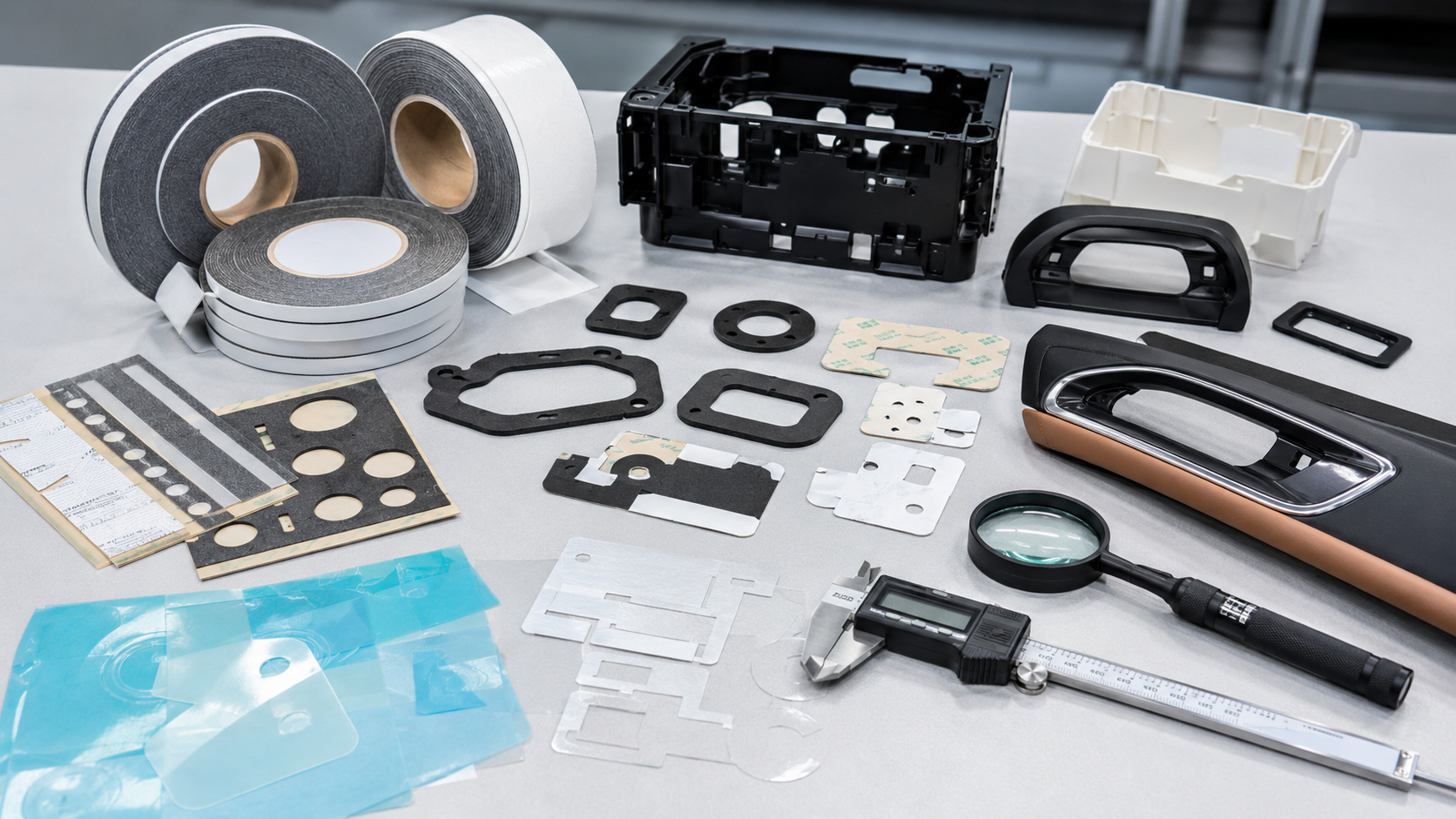
Although they are both manufactured from foam materials, foam tape and foam gaskets perform different functions during assembly.
Foam tape combines foam with pressure-sensitive adhesive, allowing it to bond two surfaces while also absorbing vibration and compensating for small dimensional variations. It is commonly used to replace screws, clips, or liquid adhesives in lightweight assemblies.
Foam gaskets, however, are designed to create a compressed seal between two mating surfaces. Instead of focusing on bonding strength, they are engineered to maintain compression, prevent dust or water ingress, reduce vibration, and compensate for manufacturing tolerances.
| Product | Primary Function | Typical Applications |
|---|---|---|
| Foam Tape | Bonding and positioning | Trim, displays, brackets, decorative panels |
| Foam Gasket | Sealing and cushioning | Enclosures, lighting, HVAC, electronic housings |
| Adhesive Foam Gasket | Positioning plus sealing | Electronics, appliances, automotive modules |
In some products, the two solutions work together. For example, an adhesive-backed foam gasket uses the adhesive only to hold the gasket in position before assembly, while the compressed foam provides the actual sealing performance.
Foam Material Selection Depends on the Application
The foam material itself often determines product performance more than the component shape.
Several materials are commonly converted into foam tapes and foam gaskets, each offering different characteristics.
| Foam Material | Advantages | Typical OEM Applications |
|---|---|---|
| EVA Foam | Flexible, economical, good cushioning | Appliances, general industrial products |
| PE Foam | Lightweight, moisture resistant | Electronics, packaging, insulation |
| EPDM Foam | Excellent weather resistance | Automotive sealing, outdoor equipment |
| PU Foam | Soft with good recovery | Cushioning and vibration control |
| Silicone Foam | High-temperature stability | Specialized electronic and industrial sealing |
For automotive exterior applications, EPDM foam is frequently selected because it withstands heat, UV exposure, and moisture. Thin PE or EVA foam is often preferred for electronic assemblies where space is limited and dimensional accuracy is critical.
Rather than selecting materials based only on price, engineers should evaluate compression, durability, operating temperature, environmental exposure, and assembly conditions together.
Typical OEM Applications
Foam tape and foam gaskets are used across many industries, but their applications are not always interchangeable.
In automotive manufacturing, foam tape is widely used to mount trim panels, decorative parts, displays, and sensors. Foam gaskets are more commonly installed in lighting systems, electronic control units, HVAC modules, and battery enclosures where sealing performance is essential.
In electronics, foam tape helps secure displays, batteries, speakers, and housings, while foam gaskets reduce dust intrusion, cushion delicate components, and improve assembly reliability.
Household appliances also rely on both solutions. Foam tapes simplify the installation of decorative panels and internal components, while foam gaskets reduce operating noise, prevent air leakage, and isolate vibration.
Our Precision Die Cutting Services allow these materials to be converted into custom shapes that match each product's design and assembly requirements.
Design Considerations for Better Assembly Performance
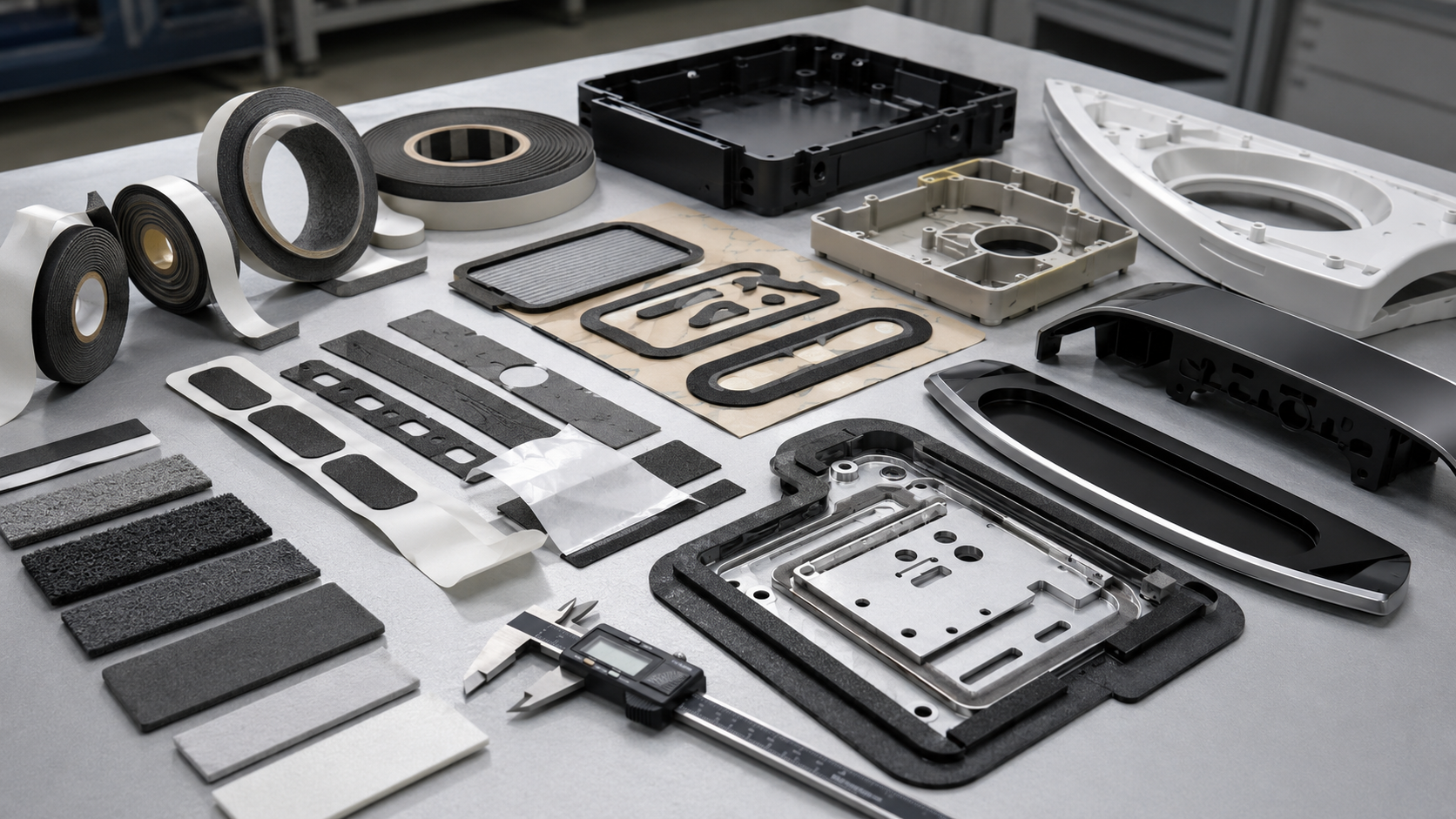
Selecting the right foam solution involves more than choosing a material. Several design factors directly affect manufacturing efficiency and long-term reliability.
For foam tape, engineers should consider adhesive compatibility with the bonding surface, tape thickness, long-term adhesion, and environmental conditions.
For foam gaskets, attention should focus on compression ratio, recovery after repeated compression, sealing pressure, and dimensional consistency.
Other important considerations include:
- Required sealing performance
- Assembly tolerance
- Installation method
- Temperature and humidity
- Chemical exposure
- Production volume
- Manual or automated assembly
Early design review often prevents production issues that appear only after mass manufacturing begins.
Precision Die Cutting Improves Product Consistency
Even high-quality foam materials cannot perform well if they are converted inaccurately.
Precision die cutting ensures consistent dimensions, clean edges, accurate hole positions, and reliable adhesive alignment. This becomes especially important for thin gasket frames, complex outlines, and components used in automated assembly.
Many OEM projects also require laminated structures combining foam with adhesive tapes, PET films, protective films, or release liners. Manufacturing accuracy ensures these layers remain properly aligned throughout production.
Sanken provides precision converting for custom foam components, producing parts in sheets, rolls, or assembly-ready formats according to customer requirements.
Common Mistakes When Selecting Foam Components
Several common mistakes can reduce product performance even when quality materials are used.
One is selecting foam tape where a compressed gasket is actually required. Although the adhesive may hold the part in place, it cannot replace the sealing function of a properly designed gasket.
Another mistake is focusing only on foam thickness. Compression characteristics, density, recovery, and adhesive compatibility often have a greater impact on long-term performance than thickness alone.
Engineers should also avoid underestimating packaging and installation methods. Components designed for manual assembly may not perform efficiently in automated production if liner structure, part spacing, or delivery format are not considered early in the project.
How Sanken Supports Foam Converting Projects
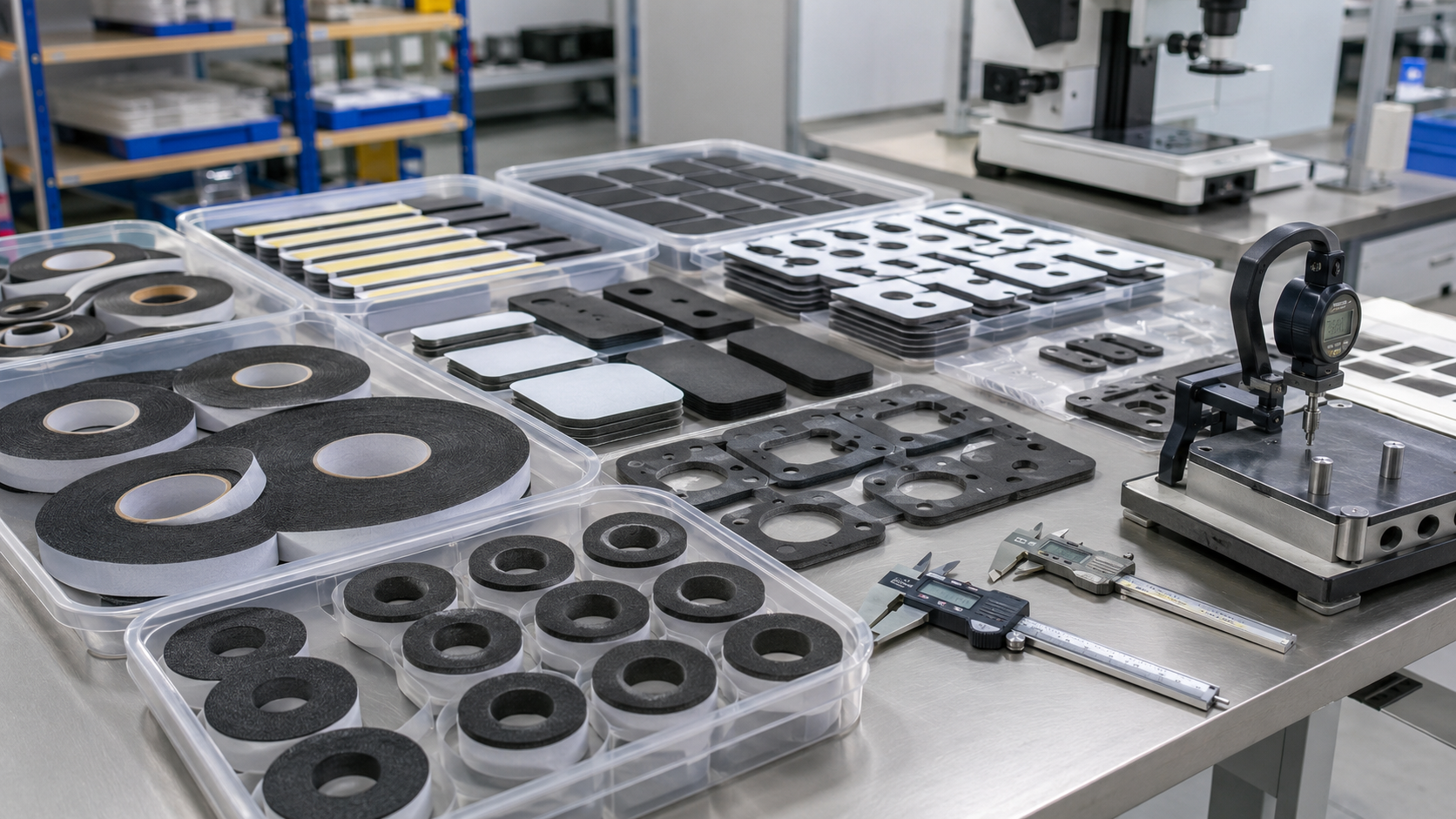
Sanken develops custom die cut foam tapes and foam gaskets for OEM manufacturers across the automotive, electronics, appliance, and industrial sectors. From prototype development through mass production, we help customers optimize materials, component structures, and manufacturing methods to improve assembly efficiency and long-term product reliability.
You May Also Be Interested In
- From Foam Rolls to Finished Parts: How Die Cutting Works
- How Long Does EVA Foam Last?
- How Is EVA Foam Used in Die Cut and Converted Products?
- Where Is EVA Foam Used in Industrial Manufacturing?
- How to Choose the Right Die Cutting Manufacturer for Your OEM Project
Conclusion
Foam tape and foam gaskets may be manufactured from similar materials, but they are designed for different purposes. Foam tape provides reliable bonding and positioning, while foam gaskets deliver sealing, cushioning, and environmental protection. Selecting the correct solution requires understanding the application's mechanical, environmental, and assembly requirements rather than simply choosing a foam material.
Working with an experienced converting partner early in the design stage helps optimize material selection, improve assembly efficiency, and reduce long-term production risks.