
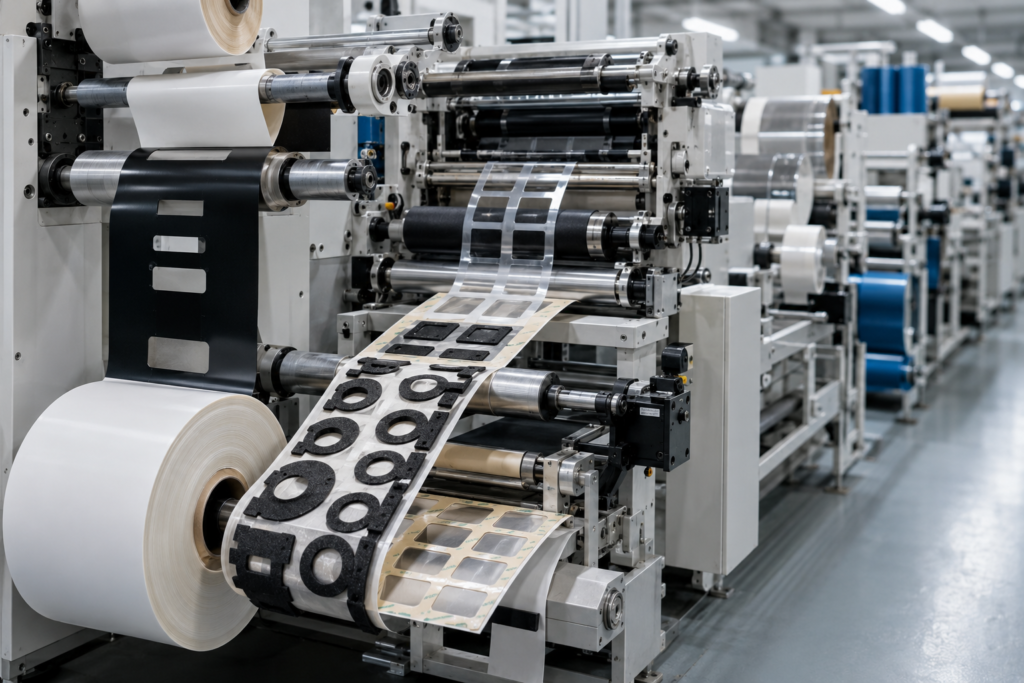
Roll-to-roll die cutting has become one of the most efficient manufacturing methods for producing high-volume adhesive tape, foam, and protective film components. Compared with sheet-fed processing, continuous roll converting allows manufacturers to improve production speed, reduce material waste, and deliver components in formats that integrate directly into automated assembly lines.
For OEM manufacturers, roll-to-roll die cutting is more than a production method—it is a way to improve assembly efficiency, maintain consistent part quality, and reduce overall manufacturing costs. Whether producing adhesive tape frames, foam gaskets, protective films, or multilayer laminated parts, selecting the appropriate converting process has a direct impact on product performance.
Sanken manufactures custom roll-to-roll die cut components for automotive, electronics, appliances, and industrial OEM applications, supplying parts in roll, sheet, or custom packaging formats according to customer assembly requirements.
Why Roll-to-Roll Die Cutting Is Preferred for High-Volume Production
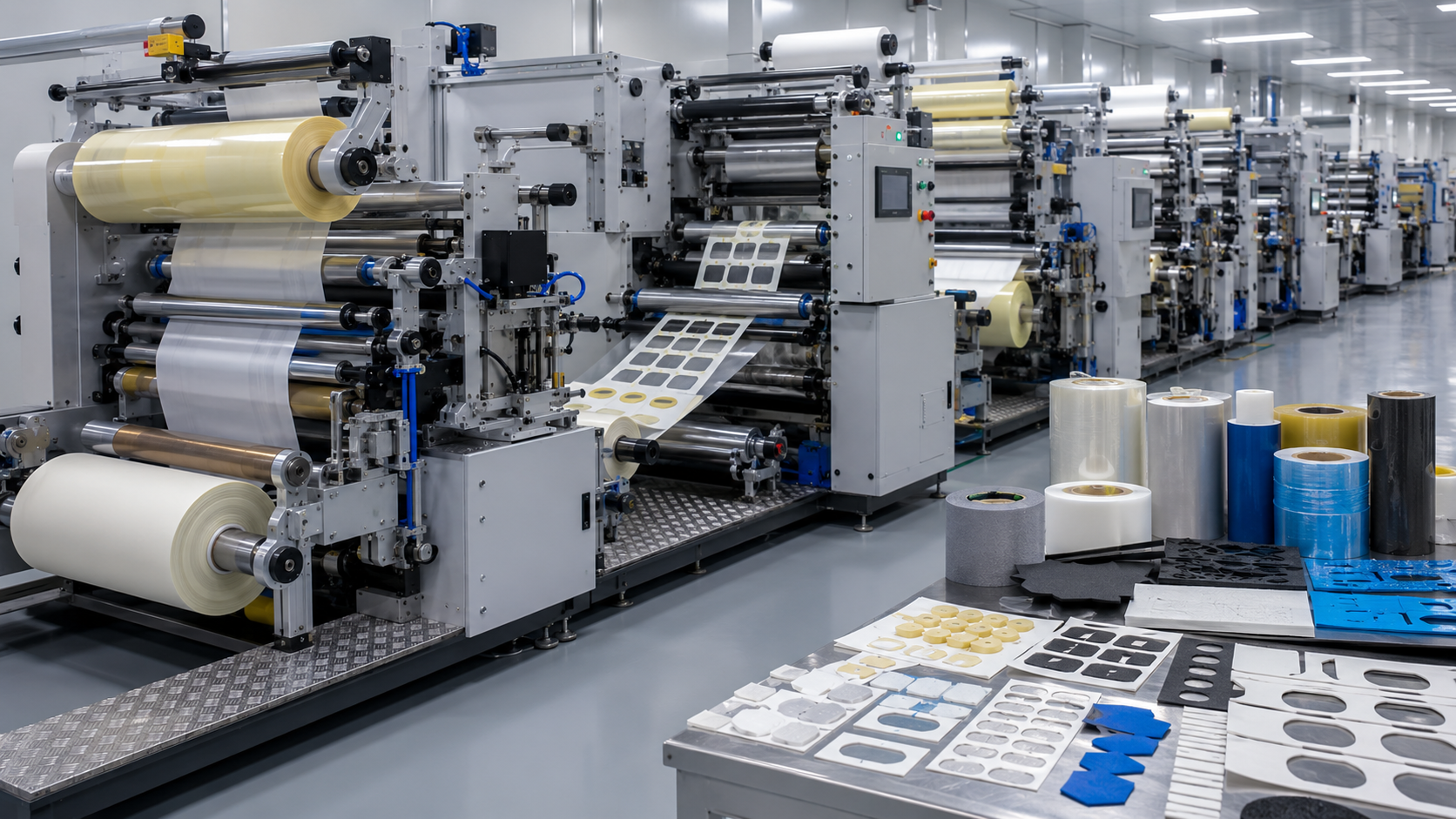
Unlike sheet processing, roll-to-roll die cutting continuously feeds material through multiple converting stations. Cutting, laminating, kiss cutting, waste removal, inspection, and rewinding are completed in one production flow.
This continuous process offers several advantages:
- Higher production efficiency
- Better dimensional consistency
- Reduced material handling
- Stable registration accuracy
- Lower labor costs
- Better compatibility with automated assembly
The process is particularly suitable for flexible materials that are supplied in roll form before converting.
| Production Method | Best Suited For |
|---|---|
| Roll-to-roll die cutting | High-volume continuous production |
| Sheet-fed die cutting | Medium and low-volume production |
| Flatbed die cutting | Thick materials and prototypes |
For large OEM programs, continuous converting often provides lower production costs while improving overall manufacturing stability.
Materials Commonly Processed by Roll-to-Roll Die Cutting
Many flexible materials used in OEM manufacturing are supplied in rolls, making them ideal for continuous converting.
Common materials include:
- Double-sided adhesive tape
- Transfer adhesive
- Acrylic foam tape
- PE foam
- EVA foam
- PET insulation film
- Protective films
- Black light-blocking film
- Non-woven materials
- Release liners
These materials can be processed individually or laminated together before die cutting to create multifunctional components.
For example, an adhesive-backed foam gasket may combine foam, double-sided tape, and a release liner into a single assembly-ready part.
Our Precision Die Cutting Services support multilayer converting for a wide range of flexible materials used in OEM manufacturing.
Typical OEM Applications
Roll-to-roll die cut components are widely used across multiple industries because they can be supplied directly to automated assembly lines.
| Industry | Typical Components |
|---|---|
| Automotive | Foam gaskets, adhesive tapes, protective films, anti-rattle pads |
| Electronics | Display tape frames, insulation films, protective films |
| Appliances | Foam seals, mounting tapes, vibration pads |
| Industrial Equipment | Dust seals, adhesive strips, protective pads |
Many of these components require narrow tolerances, clean edges, and consistent adhesive positioning, all of which benefit from continuous converting.
Automotive manufacturers frequently use roll-form components because they simplify repetitive assembly operations while reducing operator handling.
Kiss Cutting Plays an Important Role
Most adhesive tape and protective film components are produced using kiss cutting rather than through cutting.
During kiss cutting, the cutting tool passes through the functional material while leaving the release liner intact. This allows finished parts to remain accurately positioned on the liner until they are peeled off during assembly.
Common kiss-cut components include:
- Adhesive tape frames
- Foam tape gaskets
- Protective films
- PET-backed adhesive parts
- Pull-tab films
- Black light-blocking frames
Keeping components on the liner improves handling, protects adhesive surfaces, and supports automated placement systems.
For a detailed comparison, readers may also find this article helpful:
Lamination Expands Component Functionality
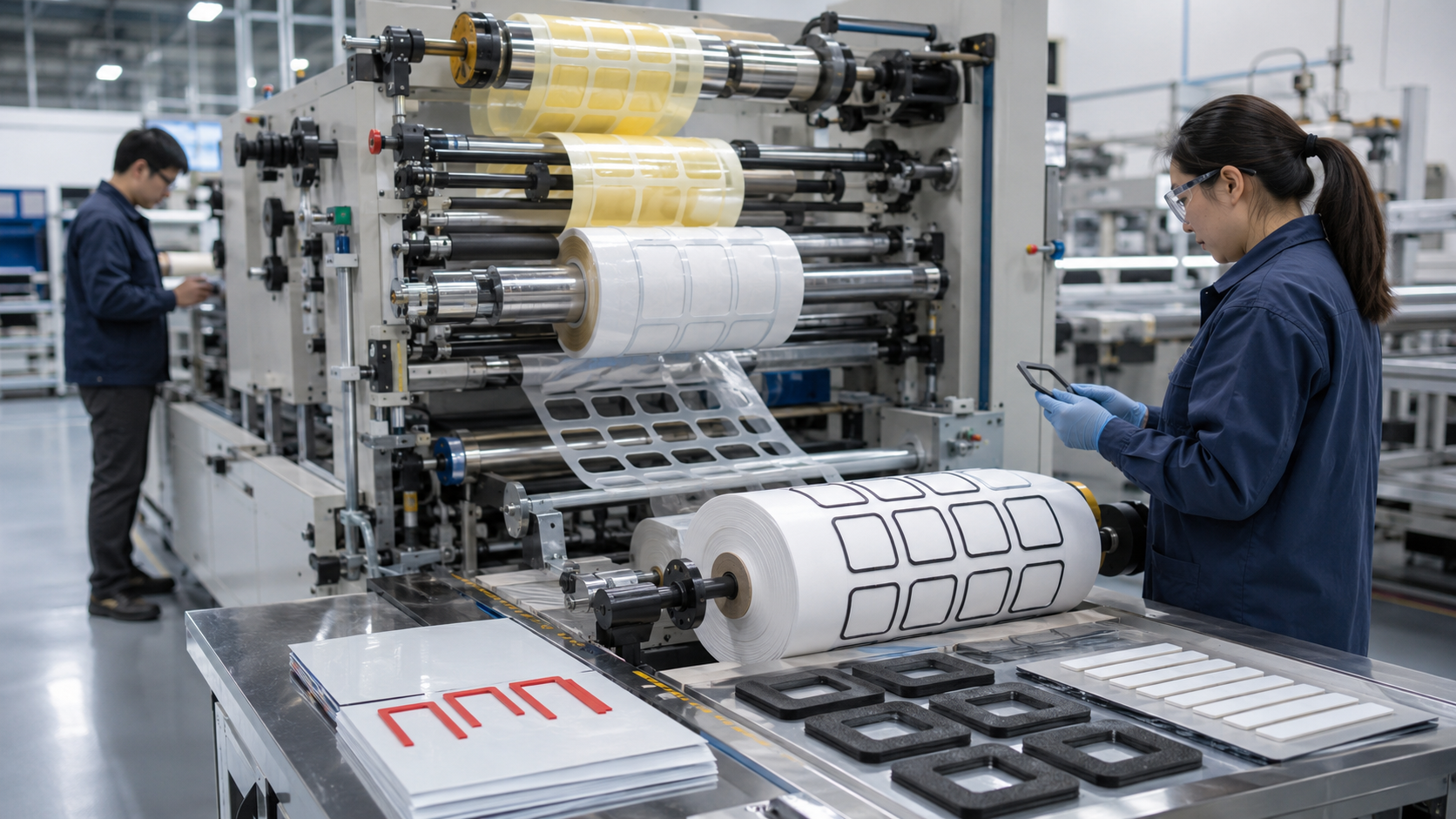
Roll-to-roll production is particularly effective when multiple materials must be combined before die cutting.
Common laminated structures include:
| Material Structure | Primary Function |
|---|---|
| Foam + Adhesive | Cushioning and mounting |
| PET Film + Adhesive | Insulation and positioning |
| Protective Film + Pull Tab | Surface protection |
| Foam + PET + Adhesive | Sealing and insulation |
| Non-Woven + Adhesive | Anti-rattle and cushioning |
By laminating materials before converting, manufacturers reduce assembly steps while improving dimensional consistency.
Accurate registration during lamination is essential because even small alignment errors can affect holes, windows, adhesive position, and final assembly.
Manufacturing Considerations for Roll-to-Roll Production
Successful roll-to-roll converting depends on more than cutting accuracy.
Engineers must also consider:
- Material thickness variation
- Web tension
- Adhesive flow
- Registration accuracy
- Release liner stability
- Cutting depth
- Waste removal
- Roll winding quality
Improper tension may stretch thin films. Incorrect cutting pressure may damage release liners. Poor waste removal can distort narrow adhesive frames.
These factors become increasingly important when producing high-volume components with complex geometries.
Quality Control Throughout Production
Continuous production requires continuous inspection.
Typical quality checks include:
| Inspection Item | Purpose |
|---|---|
| Material verification | Confirms approved specification |
| Registration accuracy | Maintains dimensional consistency |
| Cutting depth | Protects release liner |
| Adhesive position | Ensures proper assembly |
| Edge quality | Reduces defects |
| Roll winding | Prevents deformation during shipment |
| Packaging | Protects finished components |
Consistent inspection throughout production reduces variation between batches and improves long-term manufacturing stability.
How Sanken Supports Roll-to-Roll Converting Projects
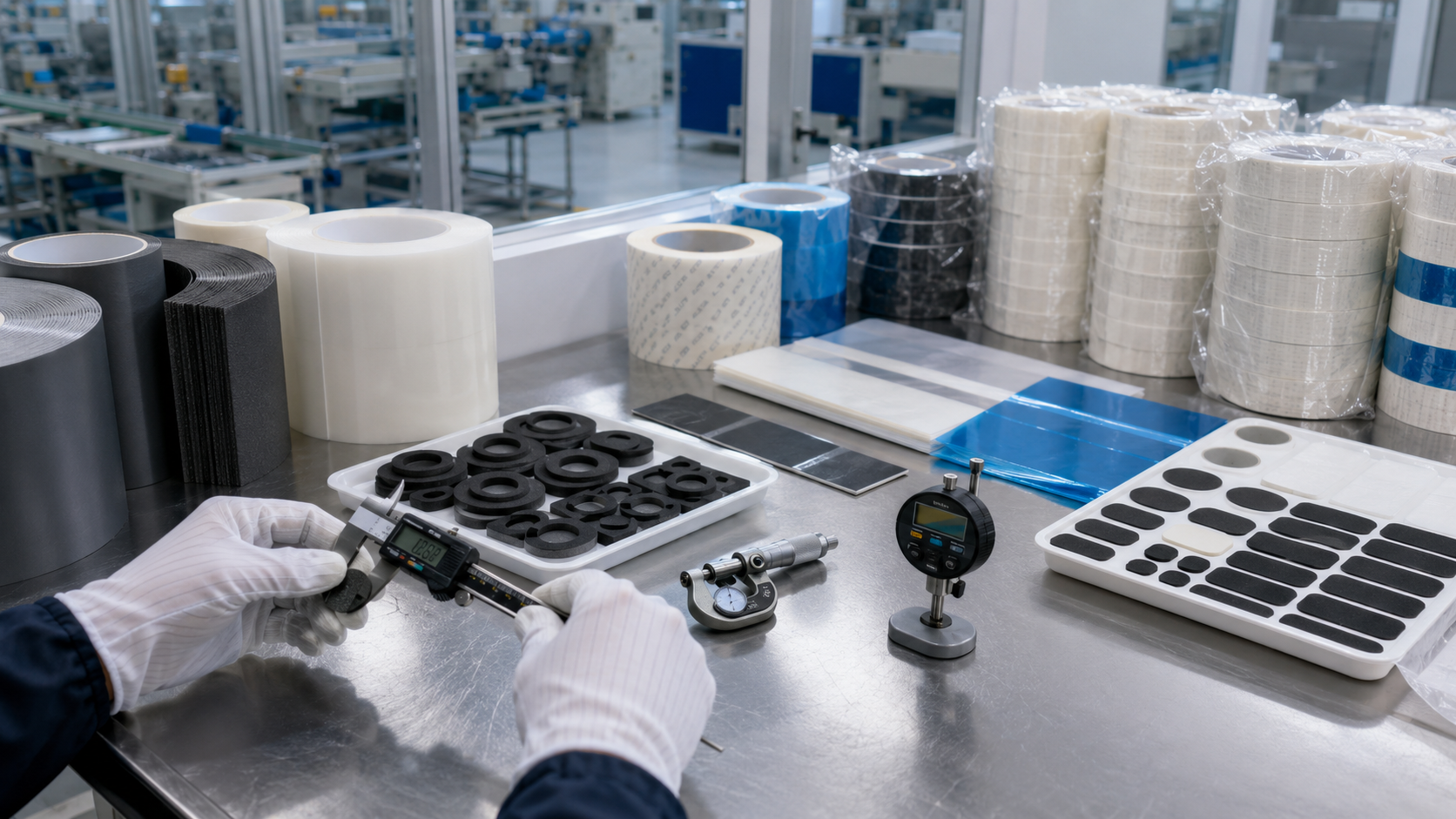
Sanken supplies custom roll-to-roll die cut components for OEM manufacturers requiring high-volume production of adhesive tapes, foam parts, protective films, insulation films, and multilayer converted materials. We work closely with customers to optimize material selection, converting methods, packaging formats, and assembly processes, helping improve production efficiency while maintaining consistent product quality.
You May Also Be Interested In
- What Is Adhesive Tape Converting and How Does It Support OEM Manufacturing?
- Die Cut vs Kiss Cut: What OEM Buyers Should Know for Adhesive Parts and Protective Films
- How Are Die Cut Parts Supplied in Sheets, Rolls or Kits?
- Pressure Sensitive Adhesive Tape and OEM Assembly Applications
- From Foam Rolls to Finished Parts: How Die Cutting Works
Conclusion
Roll-to-roll die cutting is one of the most efficient manufacturing methods for producing adhesive tape, foam, and protective film components used in OEM assembly. Its continuous production process improves efficiency, maintains dimensional consistency, supports automated manufacturing, and reduces material waste.
By combining precision die cutting, lamination, kiss cutting, and continuous quality inspection, manufacturers can produce high-volume components that meet demanding OEM requirements. Selecting the appropriate materials, converting process, and delivery format early in product development helps improve assembly performance while reducing long-term manufacturing costs.