
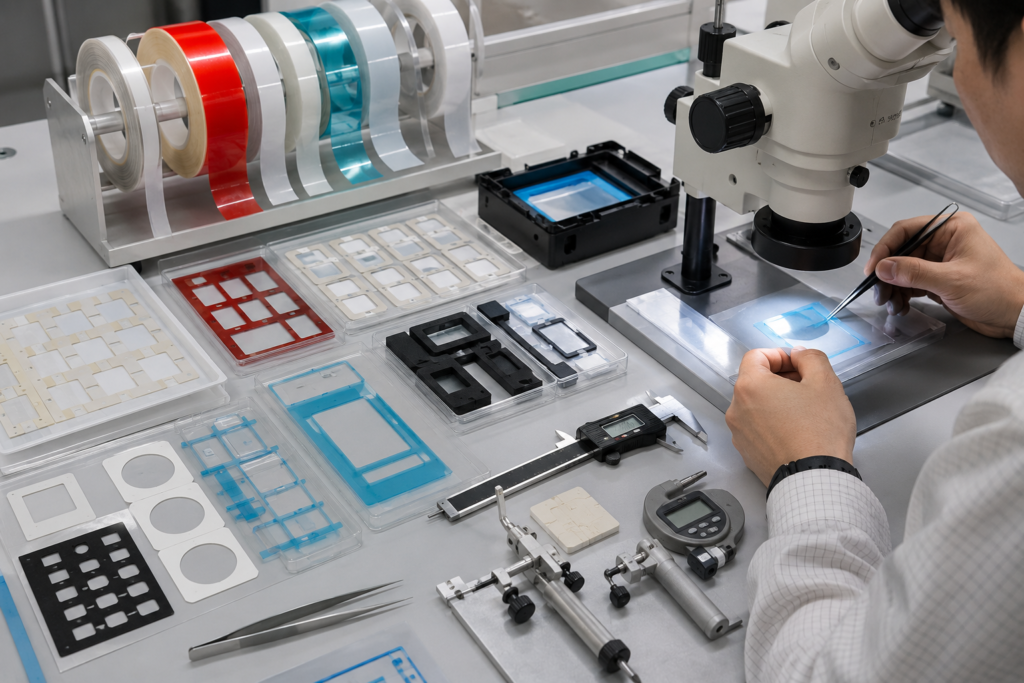
Adhesive tape converting is the process of turning raw adhesive tape materials into custom parts for OEM assembly.
That may sound simple.
But in real production, adhesive tape converting can include lamination, slitting, kiss cutting, die cutting, liner control, waste removal, pull-tab design, sheet supply, roll supply, and packaging.
At Sanken, we use precision die cutting and material converting to process adhesive tapes, foam tapes, PET-backed tapes, protective films, and multilayer adhesive structures for automotive, electronics, optical, appliance, medical, and industrial OEM projects.
The goal is not just to make tape sticky.
The goal is to make tape parts that are accurate, clean, easy to peel, easy to apply, and stable in mass production.
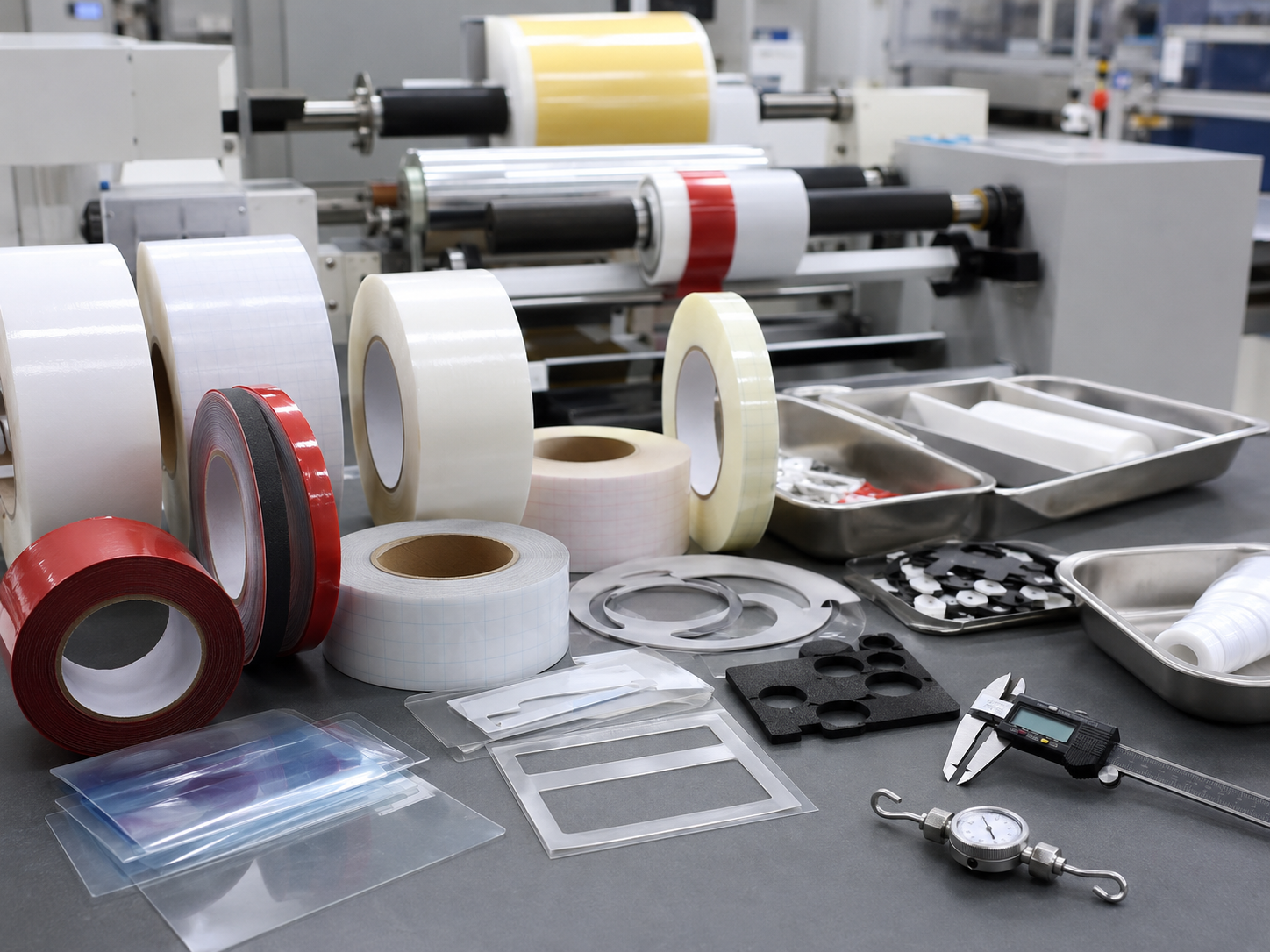
What Is Adhesive Tape Converting?
Adhesive tape converting means modifying adhesive tape into a usable production part.
Raw tape may come in large rolls.
OEM customers usually do not want a large roll of tape and a pair of scissors.
They need custom shapes, controlled thickness, clean edges, stable liner release, and packaging that fits their assembly process.
Common adhesive tape converting processes include:
| Process | Purpose |
|---|---|
| Slitting | Cuts wide rolls into narrower rolls |
| Lamination | Combines tape with foam, film, liner, or protective layer |
| Die cutting | Cuts custom shapes, holes, frames, pads, or strips |
| Kiss cutting | Cuts tape while keeping the release liner intact |
| Waste removal | Removes unwanted adhesive areas |
| Pull-tab design | Makes parts easier to peel and apply |
| Sheet or roll supply | Matches customer assembly method |
| Packaging | Prevents dust, curling, shifting, and deformation |
When adhesive tape is converted into custom die cut parts, it becomes much easier for OEM customers to use on the production line.
Why OEM Manufacturers Use Adhesive Tape Converting
OEM manufacturers use adhesive tape converting because it improves assembly efficiency.
It also helps reduce manual work.
Instead of applying liquid glue, cutting tape by hand, or positioning material manually, customers can use ready-to-assemble tape components.
Converted adhesive tape parts can support:
- Bonding
- Mounting
- Sealing
- Cushioning
- Insulation
- Surface protection
- Gap filling
- Vibration control
- Temporary fixing
- Assembly positioning
In automotive, electronics, appliances, and optical products, many adhesive tape parts are hidden after assembly.
But they still affect product quality.
A tape frame may hold a display module.
A foam tape gasket may seal a housing.
A PET-backed adhesive part may support insulation.
A protective film may prevent scratches during assembly.
Small tape part.
Very real responsibility.
Common Materials Used in Adhesive Tape Converting
Different adhesive tapes solve different OEM problems.
The tape structure should match the surface, function, environment, and assembly method.
| Material Type | Common OEM Use |
|---|---|
| Double-sided tape | Bonding panels, housings, displays, and trims |
| Transfer adhesive | Thin bonding and lamination |
| Acrylic foam tape | Strong bonding, vibration resistance, and gap filling |
| Foam tape | Sealing, cushioning, and anti-rattle protection |
| PET-backed tape | Positioning, insulation, and dimensional stability |
| Protective film | Temporary surface protection |
| Conductive adhesive tape | EMI shielding and grounding support |
| High-temperature tape | Heat-resistant masking or insulation support |
For sealing applications, foam gaskets and sealing components often use adhesive-backed foam tape to combine bonding, sealing, cushioning, and assembly convenience.
The right material is not always the strongest material.
It is the material that performs correctly in the final product.
How Adhesive Tape Converting Supports Automotive OEM Parts
Automotive OEM parts need stable bonding, sealing, vibration control, and long-term reliability.
Adhesive tape converting helps produce parts for:
- Interior trim bonding
- Display module bonding
- ECU foam seals
- Camera and sensor mounting
- Lighting module sealing
- EV battery insulation support
- Wire harness protection
- HVAC foam seals
- NVH cushioning pads
For automotive die cut components, adhesive tape parts may face heat, vibration, compression, dust, and aging requirements.
That is why we review the real application before recommending the tape.
If the tape is used on plastic, we check surface energy.
If it is used near heat, we check temperature resistance.
If it is used for sealing, we check compression behavior.
If it is used for assembly, we check peeling and handling.
The tape must work in the vehicle, not only in a sample room.
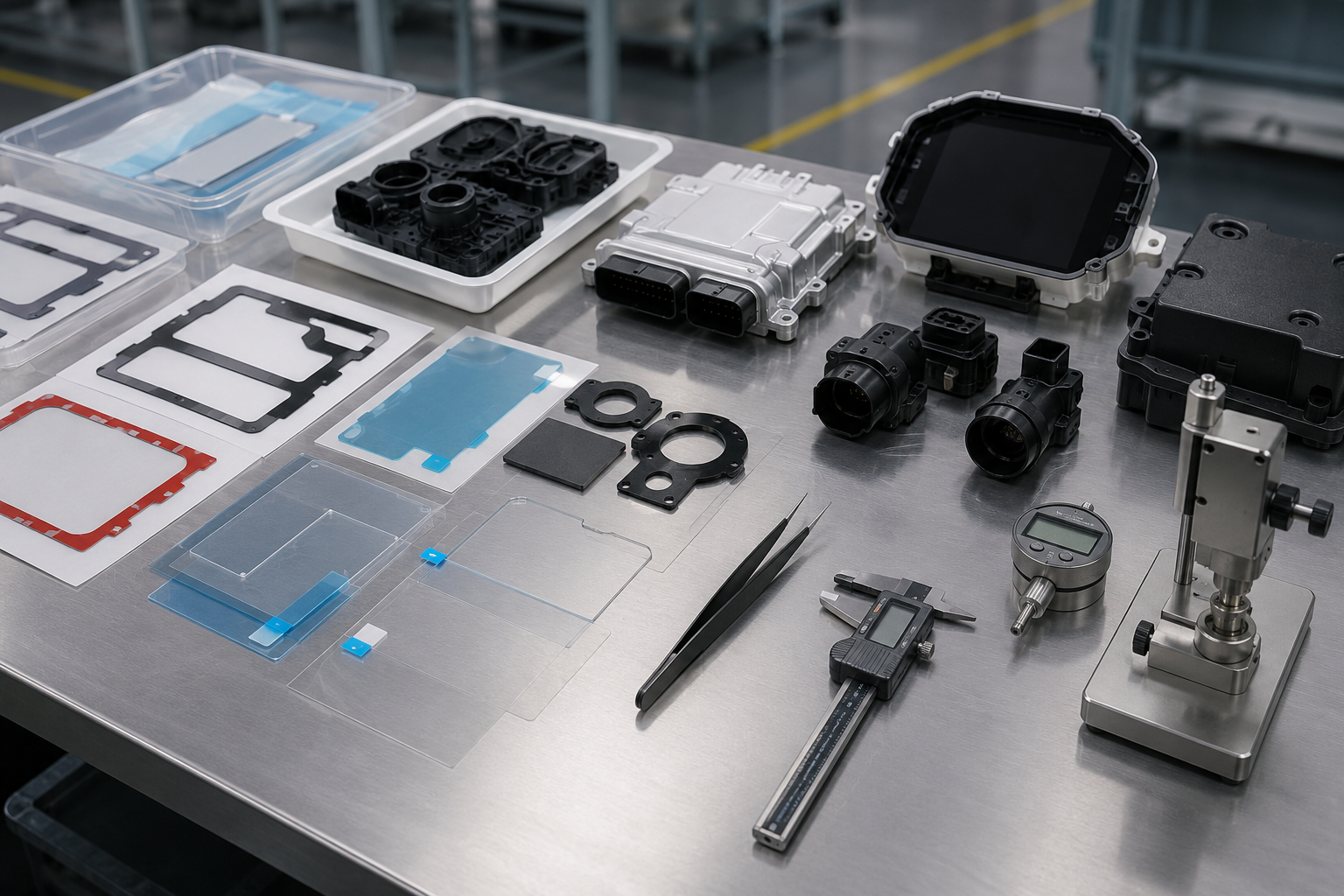
How Adhesive Tape Converting Supports Electronics and Optical Products
Electronics and optical products often need thin, clean, and precise adhesive parts.
These parts may be used in displays, sensors, camera modules, control panels, PCB housings, touch modules, and protective film applications.
Common converted tape parts include:
| Application | Converted Tape Part |
|---|---|
| Display bonding | Thin adhesive frames |
| Protective film assembly | Pull-tab protective films |
| Sensor modules | Small adhesive pads and spacers |
| PCB protection | PET-backed adhesive insulation parts |
| Optical films | Clean adhesive film components |
| Camera modules | Dust sealing and light-blocking adhesive structures |
For optical film die cut components, dust, bubbles, scratches, adhesive residue, and liner release problems can create visible defects.
So the tape converting process must control cleanliness, flatness, cut quality, and packaging.
A part can have the correct shape but still fail if it curls, shifts, or leaves residue.
This is why converting quality matters as much as adhesive performance.
Kiss Cutting and Liner Control
Kiss cutting is one of the most important processes in adhesive tape converting.
It cuts the adhesive tape layer but keeps the release liner intact.
This allows the customer to peel the finished part from the liner during assembly.
Kiss cutting is used for:
- Adhesive tape frames
- Foam tape gaskets
- Protective films
- Pull-tab films
- PET-backed adhesive parts
- Thin transfer adhesive parts
- Multilayer tape structures
Good kiss cutting requires accurate cut depth.
If the cut is too shallow, the part may not separate cleanly.
If the cut is too deep, the liner may tear.
If the liner release is wrong, operators may struggle to peel the part.
For a deeper process comparison, buyers can review Die Cut vs Kiss Cut: What OEM Buyers Should Know for Adhesive Parts and Protective Films.
Sheet, Roll, or Kit Supply
Converted adhesive tape parts can be supplied in different formats.
The best format depends on the customer’s assembly line.
| Supply Format | Best For |
|---|---|
| Sheets | Manual picking and organized assembly |
| Rolls | Automated application and high-volume production |
| Kiss-cut on liner | Adhesive parts and protective films |
| Individual pieces | Simple assembly or low-volume use |
| Kits | Multi-part OEM assembly |
| Trays or bags | Parts needing deformation protection |
For manual assembly, die cut parts supplied in sheets may make picking and placement easier.
For automation, roll-to-roll die cutting can improve speed and spacing consistency.
For more details, buyers can review how die cut parts are supplied in sheets, rolls, or kits for different OEM assembly processes.
Delivery format is not just packaging.
It affects labor cost, assembly speed, peeling behavior, and defect risk.
Common Problems Adhesive Tape Converting Helps Prevent
Good converting can prevent many common tape problems before mass production.
| Problem | Possible Cause |
|---|---|
| Tape lifting | Wrong adhesive or poor surface match |
| Tape shifting | Weak positioning or poor liner design |
| Adhesive overflow | Wrong tape thickness or cutting method |
| Difficult peeling | Poor liner release or missing pull tab |
| Curling | Material tension or poor packaging |
| Residue | Adhesive mismatch or aging issue |
| Torn parts | Poor waste removal or narrow design |
| Slow assembly | Wrong supply format |
Many adhesive failures are not caused by adhesive alone.
They come from material structure, die cutting method, liner control, handling, and packaging.
That is why we review the full converting process, not only the tape brand.
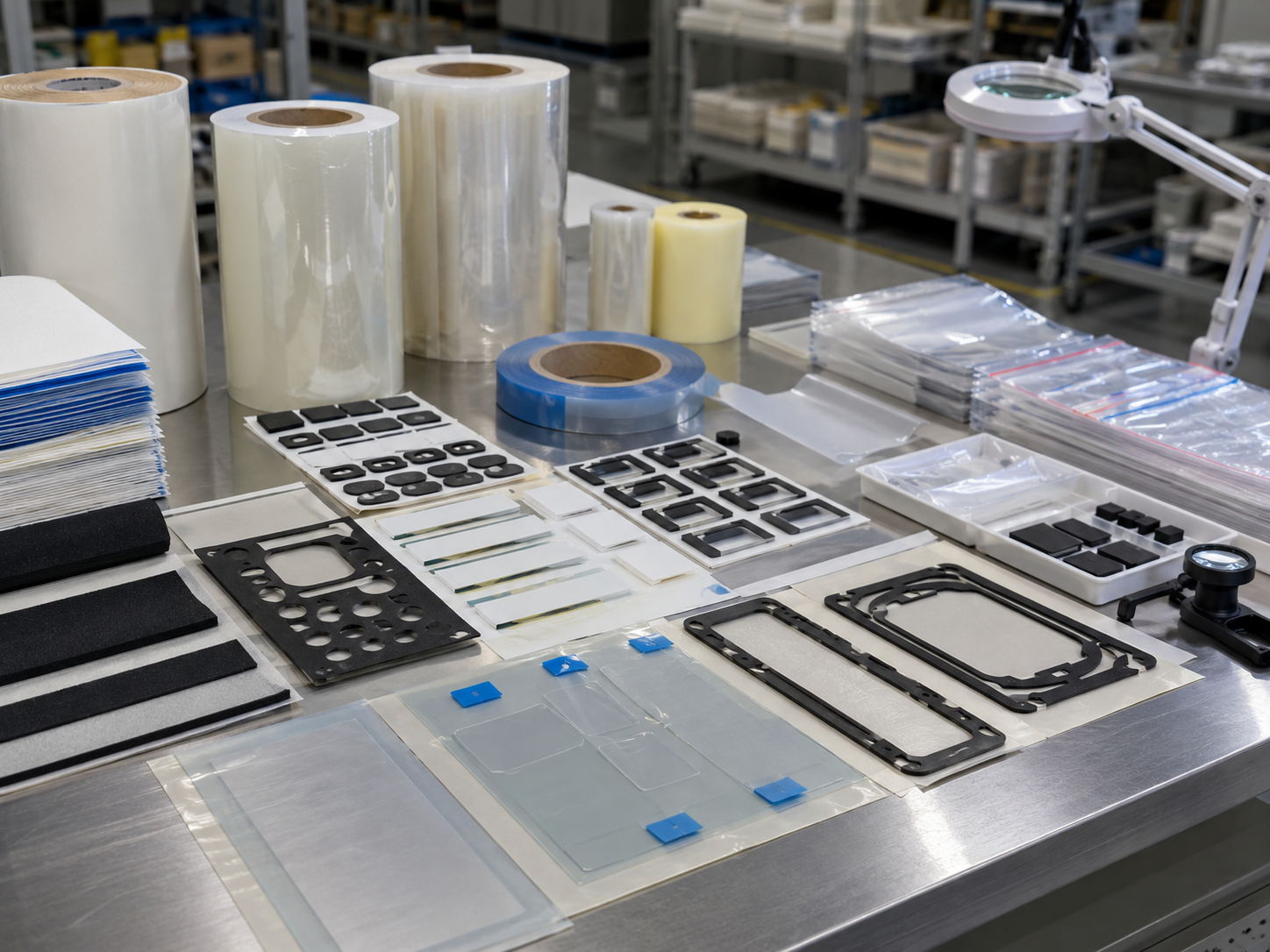
Quality Checks for Converted Adhesive Tape Parts
For OEM projects, converted tape parts must be stable from sample to mass production.
Important inspection points include:
| Inspection Item | Purpose |
|---|---|
| Dimensions | Ensures correct fit |
| Thickness | Controls spacing, sealing, and bonding |
| Adhesive position | Prevents bonding failure |
| Edge quality | Reduces glue residue and particles |
| Liner release | Improves peeling and assembly |
| Flatness | Supports accurate placement |
| Surface cleanliness | Reduces contamination risk |
| Packaging condition | Prevents curling, shifting, and deformation |
The approved sample is only the beginning.
The real goal is repeatable parts that work the same way in every production batch.
What Buyers Should Provide Before Quotation
To recommend the right adhesive tape converting solution, we usually need more than a drawing.
Helpful information includes:
- Drawing or sample
- Bonding surface
- Tape function
- Tape thickness
- Adhesive strength requirement
- Temperature range
- Indoor or outdoor use
- Compression or cushioning need
- Liner preference
- Pull-tab requirement
- Tolerance
- Assembly method
- Annual volume
- Delivery format
- Packaging preference
- Validation requirement
If the tape structure is not confirmed, we can help compare adhesive, carrier, liner, foam, film, and lamination options before sampling.
For new OEM projects, buyers can also review how to choose the right die cutting manufacturer before moving from sample approval to mass production.
Need Adhesive Tape Converting for OEM Manufacturing?
Adhesive tape converting supports OEM manufacturing by turning tape rolls into clean, accurate, assembly-ready components.
It helps improve bonding, sealing, protection, insulation, cushioning, and production efficiency.
If you need custom die cut parts for OEM assembly, send us your drawing, sample, material requirement, adhesive structure, bonding surface, tolerance, application location, annual volume, and packaging preference.
Sanken can help review tape selection, lamination structure, die cutting method, liner design, inspection points, and delivery format before mass production.
Related Articles
You may also find these articles helpful:
- Adhesive Backed Die Cut Components for OEM Assembly
- Why Do Die Cut Adhesive Parts Fail After Assembly?
- Why Your Die Cut Tape Parts Lift, Shift or Peel Off
- How to Prevent Adhesive Overflow in Custom Die Cut Tape Parts
- How to Prevent Adhesive Lifting in Die Cut Tape Components
- What Is the Best Adhesive for Die Cut Tape Parts?
- Die Cut vs Kiss Cut: What OEM Buyers Should Know for Adhesive Parts and Protective Films
Conclusion
Adhesive tape converting helps OEM manufacturers turn tape materials into production-ready bonding, sealing, cushioning, insulation, and protection parts. The best results come from matching tape selection, lamination, die cutting, liner release, inspection, and delivery format to the real assembly process.