
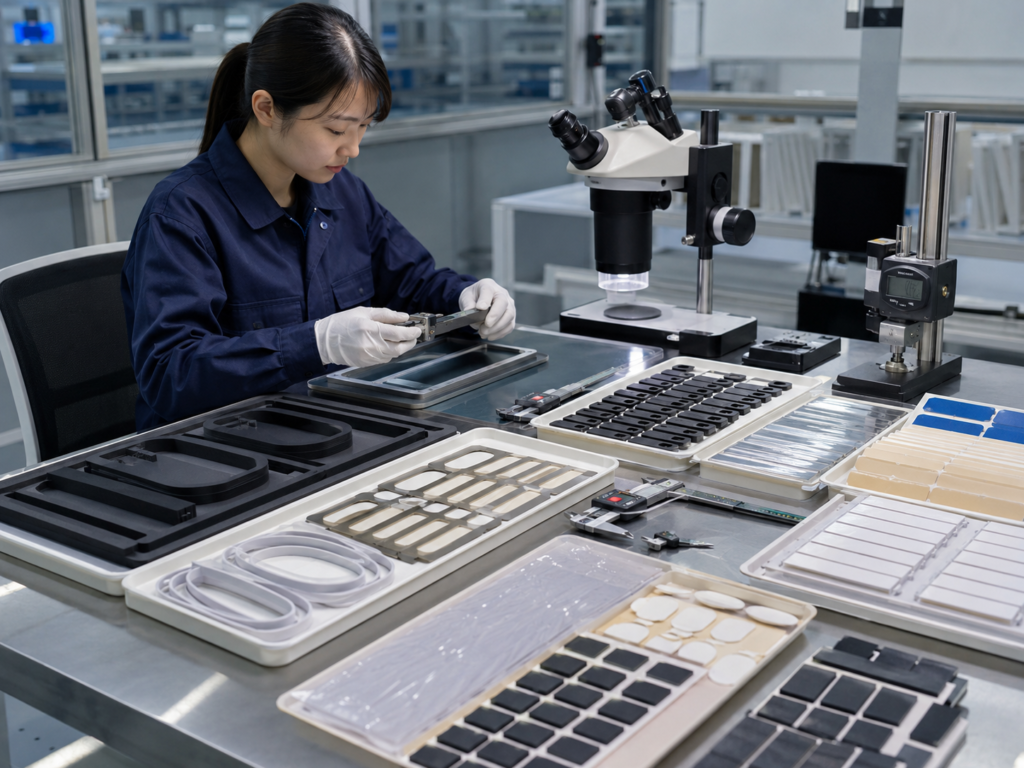
High-performance EV battery packs require more than electrical insulation. Their enclosures and internal assemblies must also resist moisture, dust, vibration, dimensional variation, and repeated temperature changes throughout the vehicle’s service life.
Sealing and gasketing materials are therefore selected according to their position and function. Enclosure interfaces, access covers, internal supports, cable areas, and local protection points may each require different foam, rubber, or adhesive-backed components. The correct material must compress predictably, recover after loading, remain stable in the operating environment, and support repeatable mass-production assembly.
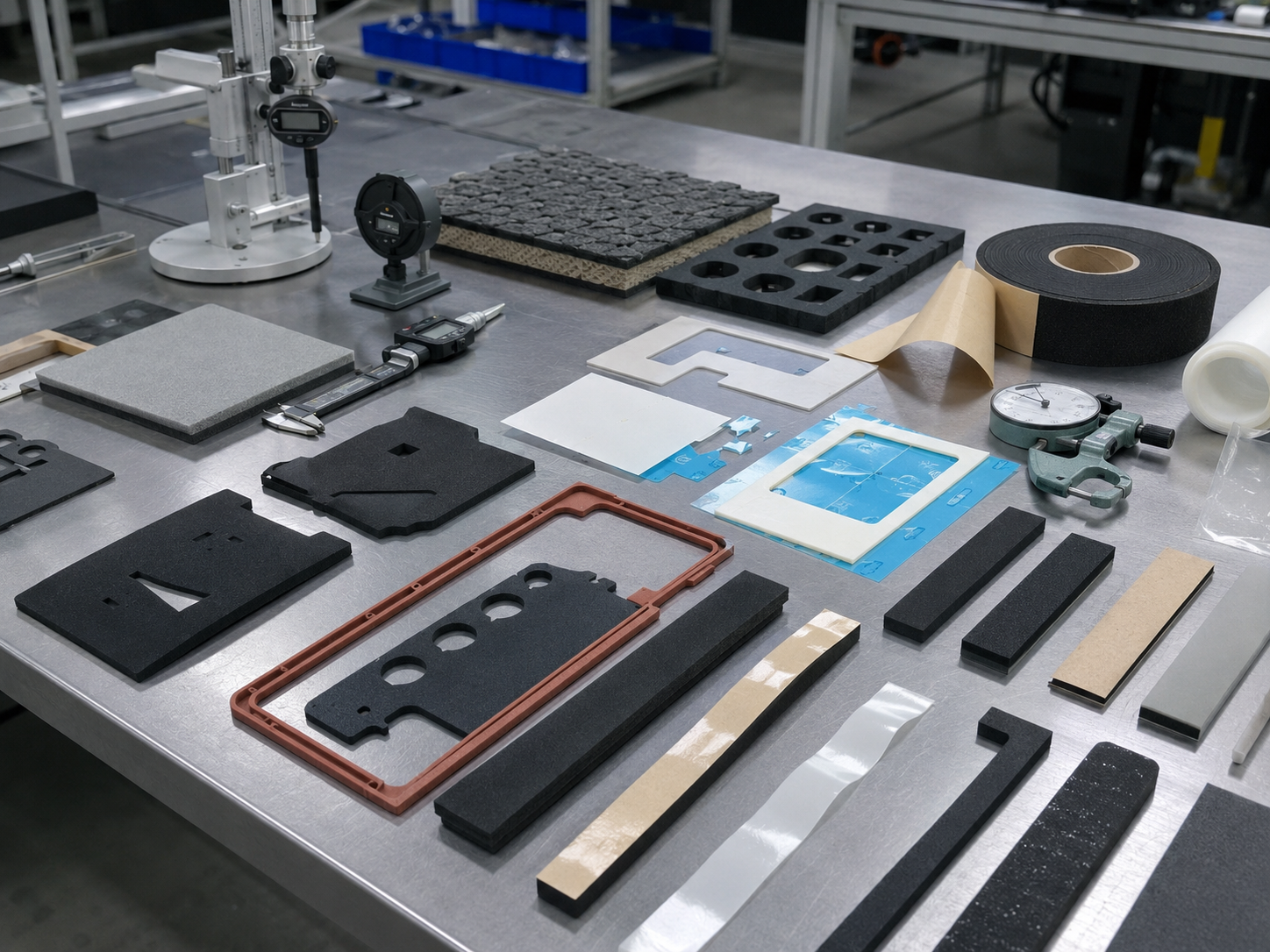
Battery Pack Sealing Involves Several Different Functions
A battery gasket may be described simply as a seal, but different components perform very different jobs.
Some gaskets close the interface between an enclosure and its cover. Others protect local contact areas, reduce vibration, control spacing, or prevent flexible components from moving during assembly.
| Function | Typical Requirement |
|---|---|
| Environmental sealing | Resistance to moisture, dust, and external contamination |
| Gap compensation | Conformity across dimensional variation and uneven surfaces |
| Cushioning | Controlled compression around sensitive components |
| Vibration isolation | Reduced movement, impact, and mechanical noise |
| Surface protection | Prevention of abrasion between contacting parts |
| Assembly positioning | Stable placement before final fastening |
| Local protection | Sealing or cushioning around openings and contact points |
Because these functions are different, one material should not automatically be used throughout the entire battery pack. An enclosure gasket may need excellent compression recovery, while an internal pad may prioritize cushioning and dimensional stability.
The first sourcing step is therefore to define what each part must do before selecting its material.
EPDM Foam for Durable Environmental Sealing
EPDM foam is commonly considered for automotive sealing because it provides flexibility, compression, weather resistance, and long-term durability.
In EV battery pack assemblies, die cut EPDM foam can be considered for:
- Enclosure sealing frames
- Cover interface gaskets
- Access-panel seals
- Cable-area sealing pads
- Local vibration-control components
- Protective strips around structural contact areas
Its closed-cell or semi-closed-cell structure can help limit moisture penetration while conforming to moderate surface variation. It is also suitable for irregular gasket outlines that must follow an enclosure perimeter or fit around holes and fasteners.
However, the term “EPDM foam” covers many different grades. OEM buyers should evaluate density, cell structure, hardness, thickness tolerance, compression force, compression set, and adhesive compatibility.
A low-density grade may compress easily but provide insufficient support. A denser grade may resist deformation but require greater clamping force. The selected material must match the enclosure stiffness and fastening design rather than being chosen by thickness alone.
Custom foam gaskets and seals can be die cut with holes, joints, adhesive backing, and release liners based on the battery assembly.
Silicone Foam for Higher-Temperature Sealing Areas
Silicone foam is often considered where temperature resistance and long-term flexibility are more demanding.
It can retain useful sealing and cushioning properties across a broader temperature range than many general-purpose foam materials. This makes it relevant for selected areas exposed to higher operating temperatures or repeated thermal cycling.
Potential applications include:
- Sealing around heat-affected interfaces
- Cushioning near temperature-sensitive assemblies
- Local protective pads
- High-performance enclosure gaskets
- Adhesive-backed sealing strips
Silicone foam is available in different densities and compression-force ranges. Its performance should be evaluated under the actual clamp load and gap conditions of the battery pack.
A thicker silicone foam is not automatically a better seal. If it is over-compressed, it may place excessive force on the surrounding structure. If it is under-compressed, it may not maintain continuous contact across the sealing surface.
The gasket design should establish a controlled compression range and consider the dimensional tolerance of both the gasket and the enclosure.
PE, EVA, and PU Foams for Cushioning and Gap Management
Not every foam component inside a battery pack is an environmental seal. PE, EVA, and PU foams can be useful for internal cushioning, protective spacing, and gap management where the requirements are less severe than those of an enclosure gasket.
| Foam Material | Main Characteristics | Potential Use |
|---|---|---|
| PE foam | Lightweight, moisture resistant, dimensionally stable | Protective pads and controlled spacing |
| EVA foam | Flexible, economical, easy to convert | General cushioning and assembly protection |
| PU foam | Soft and conformable | Low-pressure cushioning and local gap filling |
| EPDM foam | Durable and weather resistant | Environmental sealing and vibration control |
| Silicone foam | Temperature resistant and resilient | More demanding sealing or cushioning locations |
PE foam is often selected when a lightweight, relatively stable pad is needed. EVA offers practical cushioning for general applications, while softer PU foam can conform to irregular gaps under lower pressure.
These materials should not automatically be used as electrical insulation barriers. Their primary role is normally mechanical: cushioning, spacing, contact protection, or vibration reduction.
Where electrical separation is also required, a separate PET insulation film or a designed multilayer structure may be needed.
Solid Rubber for Contact Protection and Durable Sealing
Solid EPDM and silicone rubber behave differently from foam. They are less compressible and can provide stronger mechanical protection, durable contact surfaces, and controlled sealing at specific interfaces.
Die cut rubber components may be used as:
- Protective pads
- Durable spacers
- Vibration-damping pieces
- Local sealing rings
- Contact buffers
- Support parts around openings or covers
Solid EPDM rubber offers good resistance to environmental aging, while silicone rubber may be considered where temperature resistance and long-term flexibility are important.
Rubber thickness, hardness, and compression behavior must be matched to the application. A solid rubber pad that is too hard may transfer rather than absorb vibration. A part that is too soft may deform or move under repeated loading.
The design should also consider whether the rubber is supplied with adhesive backing. Adhesive can simplify positioning, but it should normally support assembly rather than carry the entire mechanical load.
Pressure-Sensitive Adhesives Support Gasket Installation
Many EV battery gaskets and pads are laminated with pressure-sensitive adhesive to keep them in place before the enclosure is closed or the assembly is fastened.
Adhesive-backed components can improve:
- Installation speed
- Positioning consistency
- Manual assembly accuracy
- Automated placement
- Stability during transportation between stations
- Repeatability across production shifts
Adhesive selection depends on the bonding surface. Aluminum, coated metal, painted surfaces, plastics, rubber, and PET film may require different adhesive systems.
OEM buyers should define the substrate, surface texture, cleaning process, operating temperature, and expected aging conditions. Initial tack alone is not enough to determine long-term suitability.
Release-liner design also affects production. A large gasket may be difficult to install if the liner must be removed in one step. Split liners, extended tabs, or staged-release designs can help operators position the part without stretching or folding it.
Sanken manufactures adhesive-backed die cut components using foam, rubber, PET film, and pressure-sensitive adhesive structures.
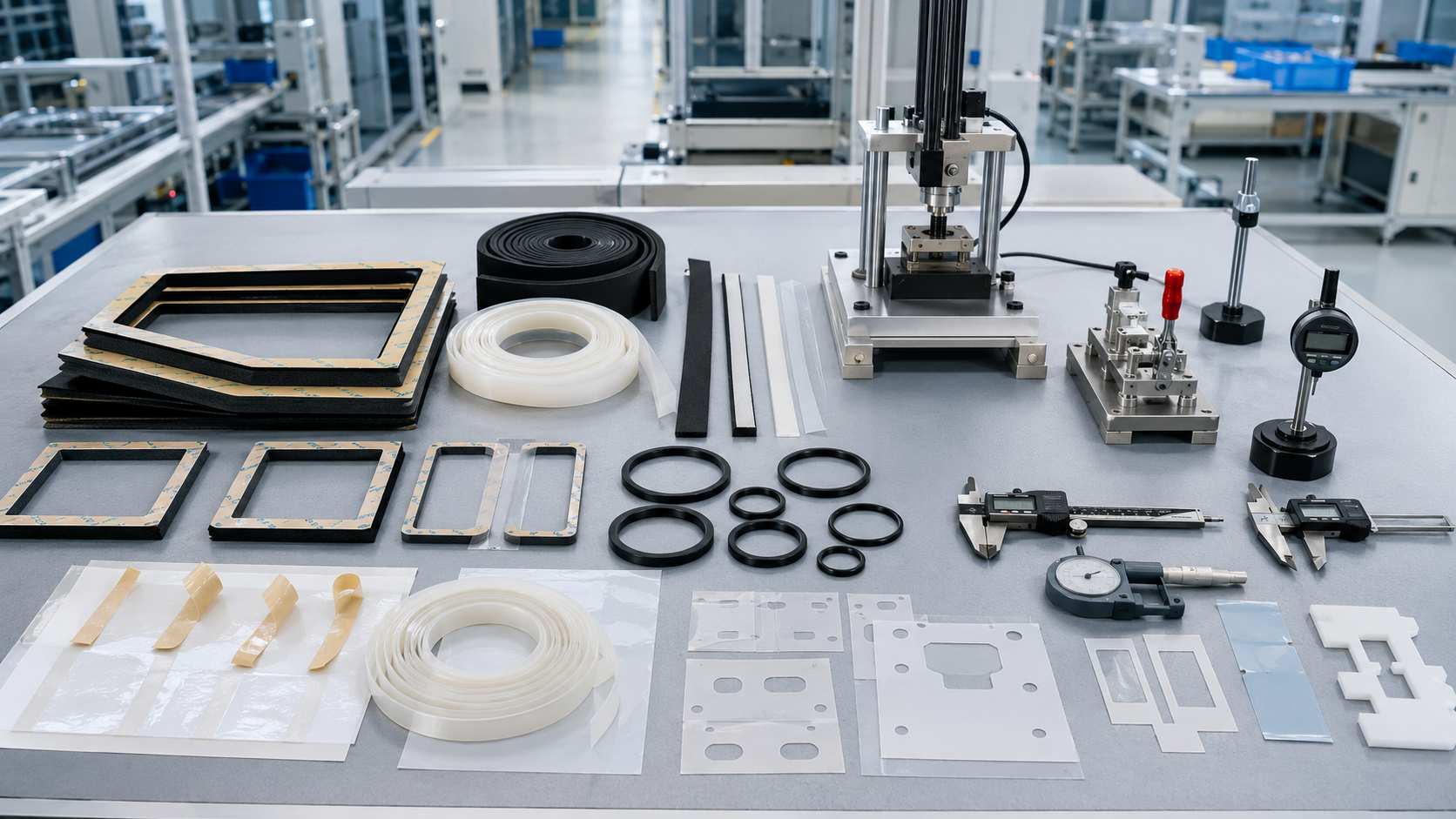
Compression Performance Is Central to Gasket Selection
A sealing gasket must remain in contact with both mating surfaces. Its performance depends on how it behaves when compressed and how much it recovers after the load is reduced.
Important properties include:
- Compression force
- Recommended compression percentage
- Compression set
- Recovery after aging
- Thickness tolerance
- Density or hardness
- Resistance to temperature cycling
- Resistance to moisture and environmental exposure
Compression force should be compatible with the enclosure structure and fastening pattern. A gasket requiring excessive force can contribute to cover deformation or inconsistent closure. A gasket with insufficient force may not compensate for gaps.
Compression set is also critical. When a foam remains permanently compressed, it may gradually lose contact pressure and reduce sealing effectiveness.
Prototype testing should reproduce the intended gap, fastener spacing, surface condition, and temperature exposure. Testing a loose sample by hand cannot accurately predict performance in the final battery enclosure.
Gasket Geometry Influences Sealing Reliability
Material performance can be undermined by poor part design. Width, corners, joints, holes, adhesive position, and tolerance all affect how a gasket behaves during installation and compression.
Engineers should review:
| Design Feature | Potential Risk |
|---|---|
| Narrow gasket walls | Stretching, tearing, or inconsistent compression |
| Sharp internal corners | Local stress and difficult matrix removal |
| Poorly located joints | Leakage paths or compression variation |
| Holes near the edge | Weak sections and dimensional distortion |
| Adhesive at the edge | Contamination and adhesive overflow |
| Excessively tight tolerance | Higher cost without added sealing benefit |
| Unsupported long sections | Stretching during liner removal and placement |
Rounded corners can improve cutting stability and reduce stress concentration. Sufficient gasket width helps maintain continuous compression around openings and fasteners.
For large perimeter gaskets, the supplier should also evaluate how the part is packaged and applied. A gasket may be dimensionally correct when inspected flat but stretch during removal from the liner.
Precision die cutting services help control the gasket outline, holes, liner depth, adhesive alignment, and multilayer registration.
Multilayer Gaskets Can Combine Several Functions
Some battery pack components require a combination of sealing, cushioning, positioning, and insulation support.
Possible constructions include:
- EPDM foam with double-sided adhesive
- Silicone foam with a PET carrier
- Rubber pads with positioning adhesive
- Foam laminated to PET insulation film
- Protective film with removable tabs
- Gasket frames supplied on a release liner
Combining layers can reduce assembly steps, but it also increases manufacturing complexity.
The converter must control lamination pressure, adhesive placement, layer alignment, cutting depth, air entrapment, liner integrity, and part flatness. Adhesive should not extend beyond the gasket edge, and one layer should not shrink or distort the others.
Kiss cutting is often used for adhesive-backed gaskets because the finished parts remain organized on the liner. Through cutting may be appropriate for individual rubber pads or components supplied in trays and kits.
The delivery format should be selected according to the customer’s assembly process rather than the converter’s convenience.
OEM Buyers Should Provide Complete Application Requirements
A meaningful material recommendation requires more than a two-dimensional drawing.
Battery OEMs and Tier 1 suppliers should provide information about:
- Gasket location
- Required sealing function
- Mating-surface materials
- Surface flatness
- Minimum and maximum gap
- Target compression
- Operating and storage temperatures
- Moisture and environmental exposure
- Vibration and mechanical loads
- Adhesive requirements
- Installation method
- Annual production volume
- Required supply format
Without these details, a supplier may quote a technically processable part that is unsuitable for the final assembly.
The sample stage should evaluate fit, compression, liner removal, placement time, surface adhesion, dimensional stability, and packaging. These checks help identify risks before tooling and volume production are finalized.
The article on what can go wrong before mass production explains why early reviews of geometry, material structure, and assembly handling are important.
How Sanken Supports EV Battery Sealing Components
Sanken converts EPDM foam, silicone foam, PE foam, EVA foam, PU foam, EPDM rubber, silicone rubber, PET insulation films, pressure-sensitive adhesives, and protective films into custom components for automotive and energy-related assemblies.
We support drawing review, material conversion, laminating, kiss cutting, through cutting, adhesive application, prototype production, inspection, and sheet, roll, or kit delivery. Each component is developed around its actual function, installation method, dimensional requirements, and mass-production conditions.
You May Also Be Interested In
Custom Die-Cut PET Insulation Films for Electronics Assembly
Custom Die Cut Parts: What Can Go Wrong Before Mass Production?
Conclusion
High-performance EV battery packs may use EPDM foam, silicone foam, PE, EVA, and PU foam, solid EPDM or silicone rubber, pressure-sensitive adhesives, PET insulation film, and temporary protective films. Each material serves a different sealing, cushioning, spacing, protection, or assembly function.
The best gasket material is not determined by material name alone. OEM buyers should review compression behavior, environmental resistance, temperature, surface compatibility, geometry, adhesive structure, and installation conditions together.
Early prototype validation and precision converting help ensure that the finished gasket fits correctly, remains easy to install, and maintains consistent performance during mass production and long-term vehicle operation.