
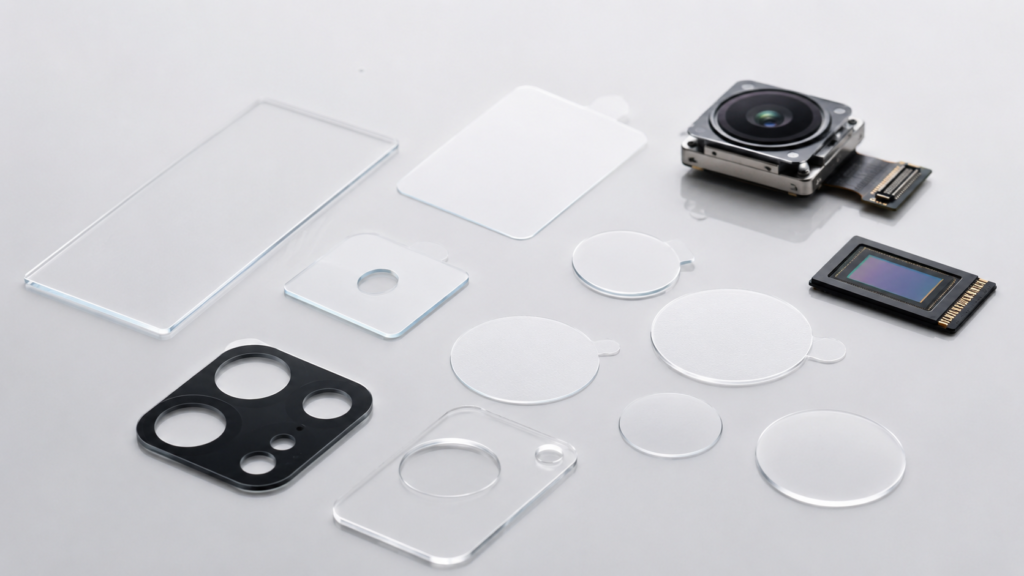
A customer once told us:
"The lens was perfect when it left production. It was scratched when the customer opened the package."
The culprit was not poor manufacturing.
It was the packaging foam.
As cameras, optical sensors, LiDAR modules, medical lenses, and precision optical components become more sophisticated, manufacturers are discovering a hidden risk: protective foam can sometimes damage the very product it is supposed to protect.
Foam particles, surface friction, static electricity, and repeated vibration during shipping can all lead to micro-scratches on sensitive lens surfaces.
This is why many OEMs are replacing direct foam contact with custom die-cut liner solutions specifically designed for optical protection.
At Sanken, we help customers design die-cut liner systems that separate delicate lenses from abrasive packaging materials while maintaining reliable shock protection.
So what custom die-cut liners actually work?
Common Die-Cut Liners for Lens Scratch Protection
| Die-Cut Liner Type | Main Function | Suitable Application |
|---|---|---|
| PET protective film liner | Smooth barrier and scratch prevention | Camera modules, optical sensors, consumer electronics |
| Optical-grade protective film liner | High cleanliness and residue-free surface protection | AR-coated lenses, medical optics, display-related optics |
| Nonwoven protective liner | Soft contact layer and cushioning support | Precision optics, imaging equipment, laboratory devices |
| Silicone-free liner | Lower contamination risk | Automotive cameras, medical devices, display assembly |
| Anti-static die-cut liner | Reduces dust attraction and particle contamination | Electronics, LiDAR modules, optical sensors |
| Multilayer liner system | Combines scratch protection and shock absorption | Premium optical products and high-value modules |
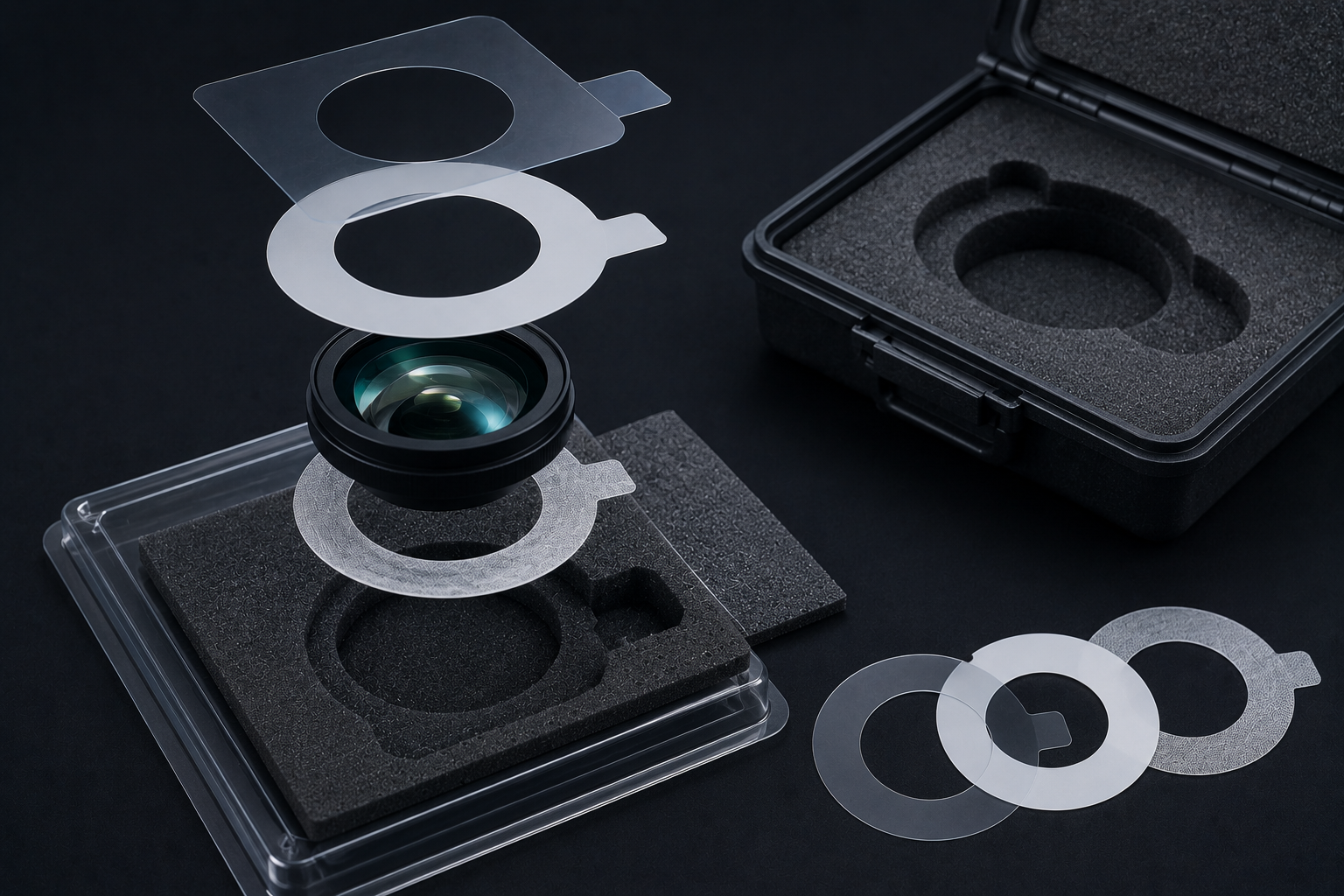
Why Can Packaging Foam Scratch Optical Lenses?
Many buyers assume soft foam cannot damage glass.
Unfortunately, the reality is different.
During transportation, products experience:
- Vibration
- Repeated movement
- Temperature changes
- Compression cycles
- Long shipping durations
If a lens continuously rubs against foam, several problems can occur:
- Micro-abrasion
- Surface haze
- Coating damage
- Particle contamination
- Static attraction
Even premium foam materials can become problematic when directly contacting sensitive optical surfaces.
The risk increases dramatically for:
- AR-coated lenses
- Camera modules
- Automotive optical sensors
- Medical imaging components
- Laser optics
Why Direct Foam Contact Is No Longer Recommended
Modern optical products use increasingly sophisticated surface treatments.
Examples include:
- Anti-reflective coatings
- Anti-fingerprint coatings
- UV protective layers
- Optical enhancement coatings
These coatings improve performance but are often more sensitive than the glass itself.
As a result, many OEM packaging specifications now prohibit direct foam-to-lens contact.
Instead, they require an intermediate protection layer.
This is where die-cut liners become essential.
Solution #1: PET Protective Film Liners
One of the most widely used solutions is precision die-cut PET film.
PET liners provide:
- Smooth surface protection
- Excellent optical cleanliness
- Low particle generation
- Dimensional stability
Advantages include:
- Thin profile
- Low cost
- High consistency
- Easy die cutting
For many consumer electronics applications, PET liners serve as the first protective barrier between foam packaging and optical components.
Solution #2: Optical-Grade Protective Film Liners
When lenses have highly sensitive coatings, optical-grade protective films are often preferred.
These films provide:
- Ultra-clean surfaces
- Controlled adhesion
- Residue-free removal
- Excellent transparency
Applications include:
- Smartphone camera lenses
- Automotive camera systems
- AR/VR optical modules
- Medical optics
Because they are specifically designed for optical applications, these films reduce the risk of coating damage.
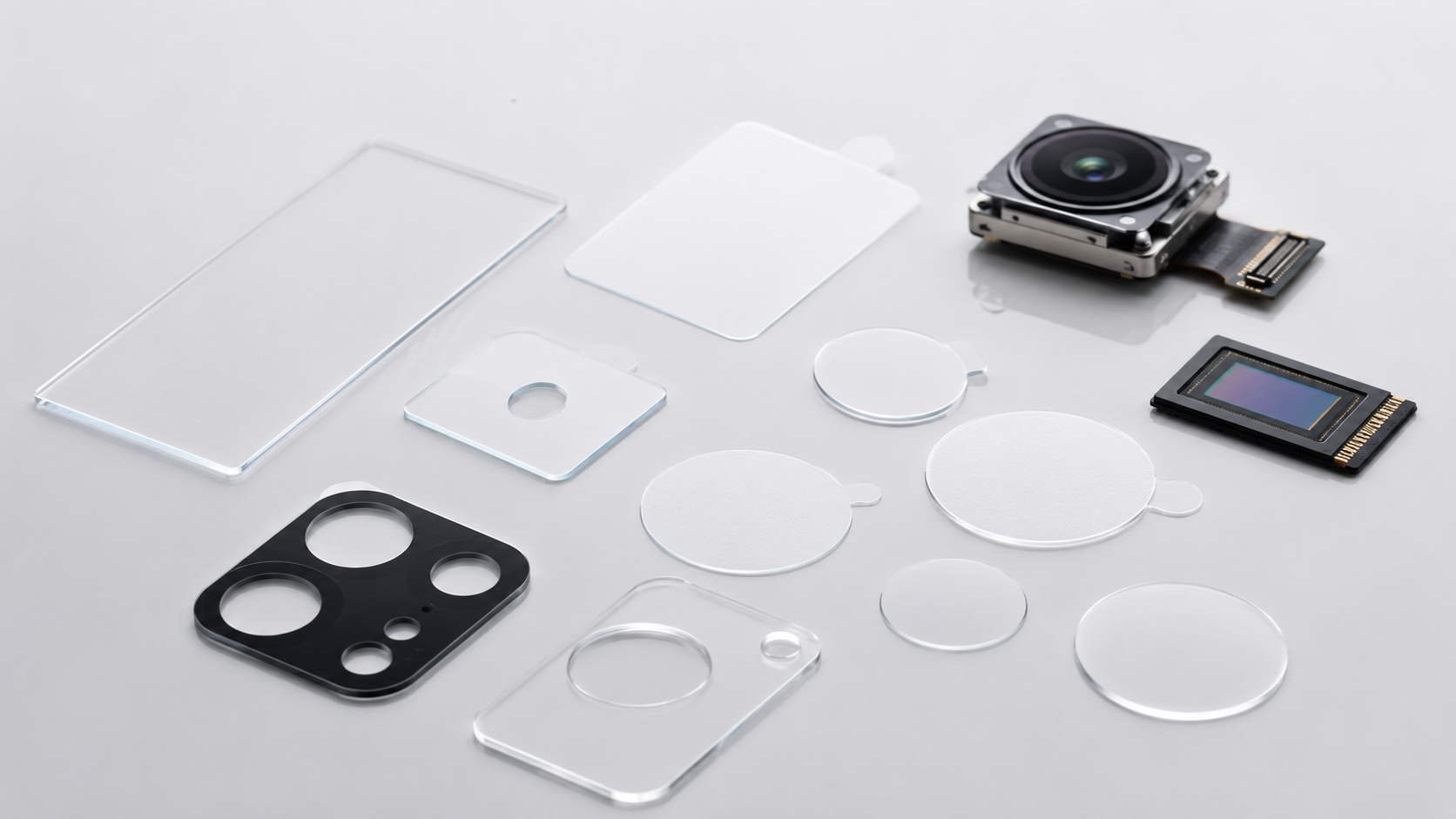
Solution #3: Nonwoven Protective Liners
In some packaging systems, soft nonwoven liners offer an excellent alternative.
Compared with traditional foam surfaces, engineered nonwoven materials provide:
- Lower friction
- Better particle control
- Improved cushioning
High-quality nonwoven liners are commonly used for:
- Precision optics
- Laboratory equipment
- Imaging systems
However, material selection is critical.
Not all nonwoven materials are suitable for optical contact.
Solution #4: Silicone-Free Protective Liners
Many optical manufacturers prohibit silicone contamination.
Certain silicone compounds can affect:
- Optical coatings
- Bonding processes
- Display assembly
For these applications, silicone-free die-cut liners are often required.
Benefits include:
- Cleaner surfaces
- Better compatibility
- Reduced contamination risk
Automotive and medical customers frequently specify silicone-free packaging components.
Solution #5: Anti-Static Die-Cut Liners
Static electricity is another hidden cause of lens damage.
Electrostatic charges attract:
- Dust particles
- Fibers
- Microscopic debris
These particles can become trapped between the lens and protective materials.
During transportation, they may create scratches.
Anti-static liners help minimize this risk by reducing particle attraction.
Common options include:
- Anti-static PET films
- ESD-safe liners
- Conductive packaging materials
These solutions are particularly important for electronics and automotive optical systems.
Why Custom Die Cutting Matters
Using the correct material is only half the solution.
The liner must also fit correctly.
Poorly designed protection can create:
- Pressure points
- Edge contact
- Material shifting
- Uneven support
Custom die cutting allows manufacturers to create liners that:
- Match lens geometry
- Avoid critical optical zones
- Maintain proper spacing
- Improve packaging efficiency
A properly designed die-cut liner protects the lens without interfering with assembly or packaging.
Designing A Multi-Layer Protection System
Many high-end manufacturers no longer rely on a single protective material.
Instead, they use layered systems.
A typical configuration may include:
| Layer | Function |
|---|---|
| Optical Film | Surface Protection |
| Die-Cut PET Liner | Scratch Prevention |
| Cushioning Foam | Impact Protection |
| Outer Packaging | Transportation Protection |
This approach separates optical protection from shock absorption.
The result is a more reliable packaging system.
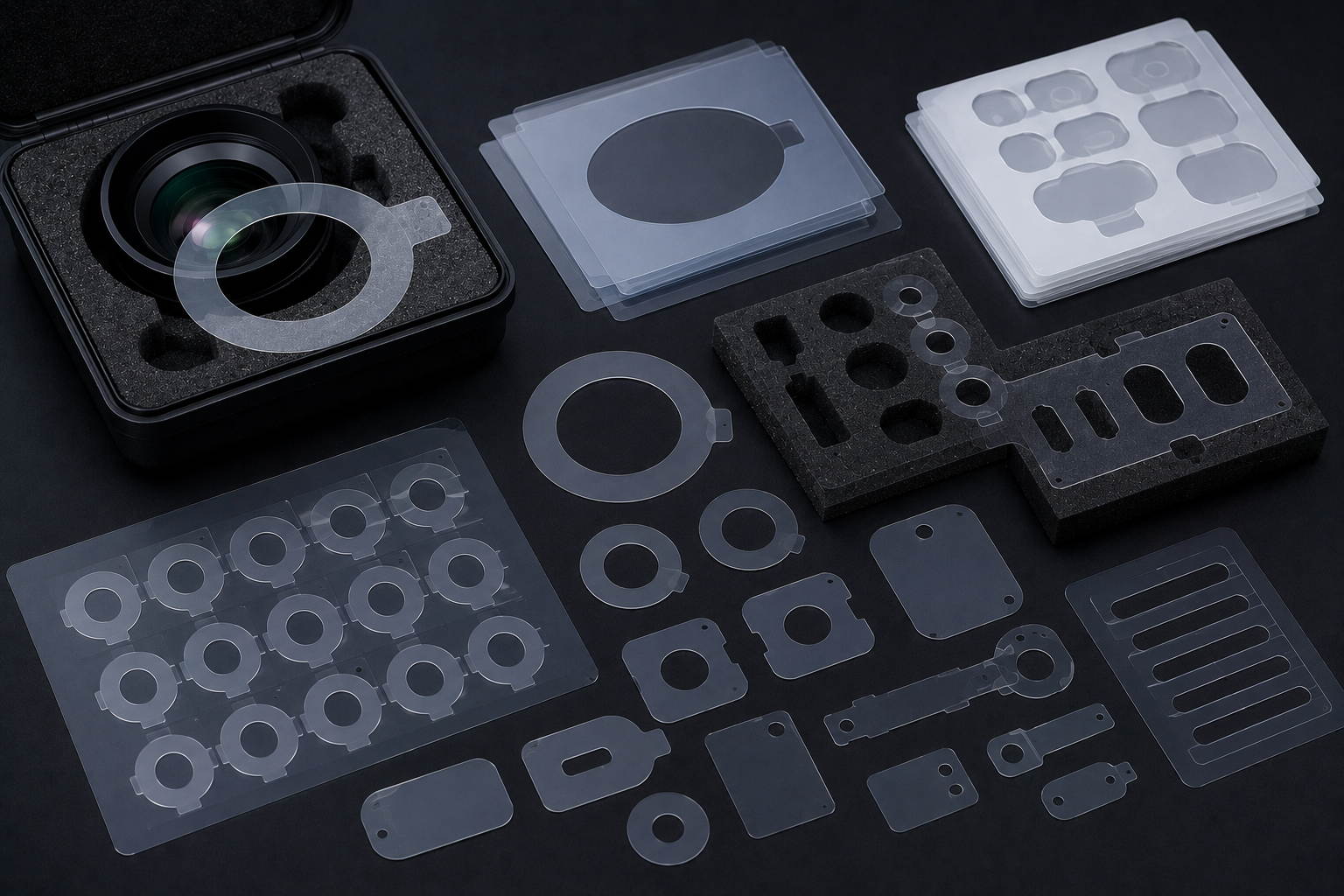
Industries Using Custom Lens Protection Liners
Custom die-cut liners are now widely used across multiple industries.
Consumer Electronics
- Smartphone cameras
- Tablet cameras
- Wearable devices
Automotive
- ADAS cameras
- Driver monitoring systems
- LiDAR modules
- Optical sensors
Medical Devices
- Endoscopes
- Imaging equipment
- Diagnostic systems
Industrial Optics
- Laser systems
- Inspection equipment
- Machine vision cameras
As optical components become more valuable, protection requirements continue increasing.
Common Mistakes When Selecting Lens Protection Materials
Many companies make the same mistakes.
Choosing The Softest Material
Softer does not always mean safer.
Certain soft materials generate particles or create friction.
Ignoring Static Control
Dust attraction is often overlooked until defects appear.
Using Generic Packaging Materials
Materials designed for industrial parts may not be suitable for optical components.
Focusing Only On Shock Protection
A package can survive shipping while still damaging the lens surface.
Protection strategies should address both impact and surface integrity.
How Sanken Helps Protect Optical Components
Sanken supports OEM customers with custom die-cut protection systems for sensitive optical products. Our capabilities include PET protective film die cutting, optical film converting, nonwoven liner converting, anti-static material integration, silicone-free material selection, lamination and multilayer packaging component development.
We help customers review lens sensitivity, foam contact risk, liner material, die-cut shape, pull-tab design, cleanliness requirement, anti-static requirement and delivery format.
These solutions are used for camera modules, LiDAR modules, automotive optical sensors, medical imaging components, AR/VR optics, machine vision cameras and other high-value optical assemblies.
Conclusion
Custom die-cut liners help prevent lens scratches from foam packaging by separating sensitive optical surfaces from direct foam contact. PET protective film liners, optical-grade protective films, nonwoven liners, silicone-free liners, anti-static materials and multilayer protection systems can all be used depending on the lens, coating and packaging requirement.
For OEM buyers, the best solution is not simply the softest material. It is the material system that controls friction, particles, static electricity, coating compatibility, cushioning and removal performance.
Sanken supports custom die-cut optical protection liners, PET protective films, nonwoven liners, anti-static liners and multilayer packaging components for automotive, electronics, medical and industrial optical applications. From material selection and prototyping to precision die cutting, inspection and mass production, Sanken helps protect sensitive lenses from production to final delivery.