

What Is Die Cutting? A Practical Guide for OEM Buyers and Engineers
Die cutting is a manufacturing process that cuts materials into precise shapes using a custom cutting tool called a die. It is widely used to produce foam pads, rubber gaskets, adhesive tape parts, non-woven components, insulation films, protective liners, and multilayer assemblies.
For OEM buyers and engineers, die cutting is not just a cutting method. It is a way to make components more consistent, easier to assemble, and more reliable in mass production.
A die-cut part may be hidden inside a car door, electronic device, medical product, packaging insert, or industrial machine. Even though the part may look simple, it often plays an important role in sealing, cushioning, noise reduction, insulation, protection, bonding, or spacing.
The real question is not only “What is die cutting?” The better question is: “Can die cutting help my product reduce assembly problems, improve consistency, and lower production risk?”
At Sanken Manufacturing, we help OEM customers convert foam, rubber, non-woven fabric, adhesive tape, PET film, insulation materials, and composite materials into precision die-cut components for automotive, electronics, medical, packaging, and industrial applications.
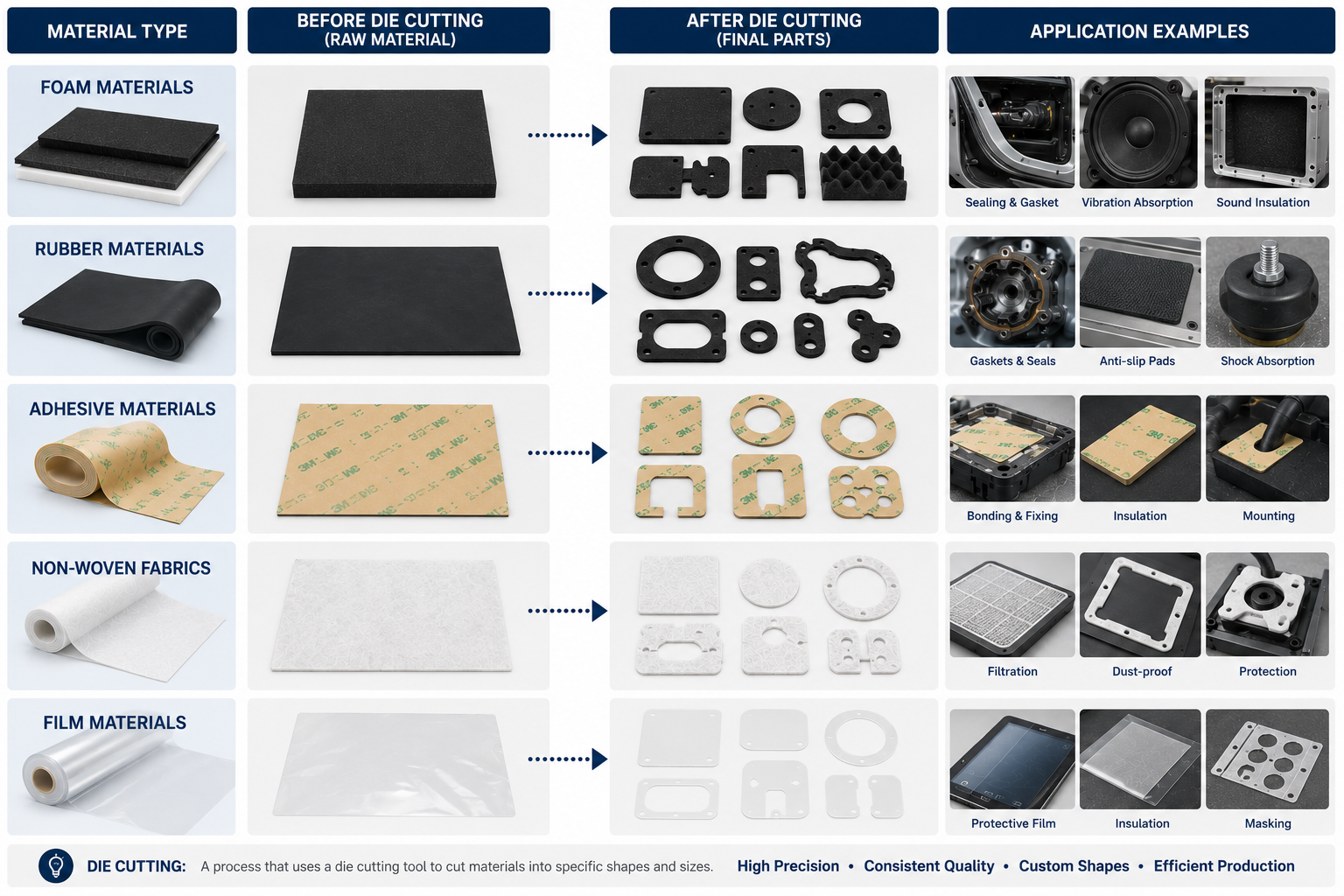
What Does Die Cutting Mean?
Die cutting means using a shaped cutting tool to cut material into a specific form.
The cutting tool is called a die.
The die can create:
- Outer shapes
- Holes
- Slots
- Windows
- Gaskets
- Pads
- Strips
- Spacers
- Custom contours
Instead of cutting parts manually one by one, die cutting allows the same shape to be produced repeatedly with controlled dimensions.
This is important for mass production.
If a customer needs 100 pieces, hand cutting may be possible. If a customer needs 100,000 parts with stable dimensions, die cutting becomes the better solution.
How Does Die Cutting Work?
The die cutting process usually follows several steps.
First, the material is selected based on the final application. This may include foam, rubber, adhesive tape, non-woven fabric, film, paper, plastic sheet, or a laminated composite.
Second, the drawing or sample is reviewed. The supplier checks the part shape, material thickness, tolerance, adhesive structure, holes, waste removal, and assembly method.
Third, a die or cutting tool is made according to the part design.
Fourth, the material is placed under the die and cut by pressure, rotary movement, or another controlled cutting process.
Finally, the waste material is removed, and the finished die-cut parts are inspected and packed for customer use.
For simple products, this process may be straightforward. For more complex OEM parts, die cutting may include lamination, adhesive backing, kiss cutting, waste stripping, liner control, and multilayer assembly.
What Materials Can Be Die Cut?
Die cutting is valuable because it works with many flexible and semi-rigid materials.
| Material | Common Die-Cut Use |
|---|---|
| EVA foam | Cushioning pads, packaging inserts, anti-rattle parts |
| PE foam | Protective liners, spacers, insulation pads |
| PU foam | Acoustic pads, cushioning layers, soft protection |
| Rubber | Gaskets, seals, vibration damping parts |
| Non-woven fabric | Acoustic insulation, filters, dust barriers |
| Adhesive tape | Mounting parts, bonding strips, assembly aids |
| PET film | Insulation, protection, electronic components |
| Composite materials | Multilayer sealing, cushioning, and acoustic parts |
For buyers, material selection is as important as cutting accuracy.
A part that is cut accurately but made from the wrong material may still fail in assembly or use.
For example, a foam gasket may need compression recovery. A non-woven part may need low fiber shedding. An adhesive tape part may need strong bonding after heat aging. A rubber seal may need oil resistance or long-term elasticity.
Main Types of Die Cutting
Different die cutting methods are used depending on material type, part structure, and production volume.
Flatbed Die Cutting
Flatbed die cutting uses a flat cutting tool and pressure to cut sheet materials.
It is commonly used for:
- Foam pads
- Rubber gaskets
- Non-woven insulation parts
- Thick materials
- Prototype and medium-volume production
Flatbed die cutting is suitable for custom shapes and thicker materials.
Rotary Die Cutting
Rotary die cutting uses a cylindrical die to cut materials continuously in roll form.
It is commonly used for:
- Adhesive tapes
- Films
- Thin foam materials
- Labels
- High-volume roll-to-roll parts
Rotary die cutting is efficient for large production runs and continuous materials.
Kiss Cutting
Kiss cutting cuts only the top material layer while leaving the release liner intact.
It is useful for adhesive-backed parts.
For example, an adhesive foam pad can be kiss cut on a liner so the operator can peel and apply it easily during assembly.
Steel Rule Die Cutting
Steel rule die cutting uses sharp steel blades formed into a custom shape.
It is often used for foam, rubber, paper, non-woven fabric, and packaging materials.
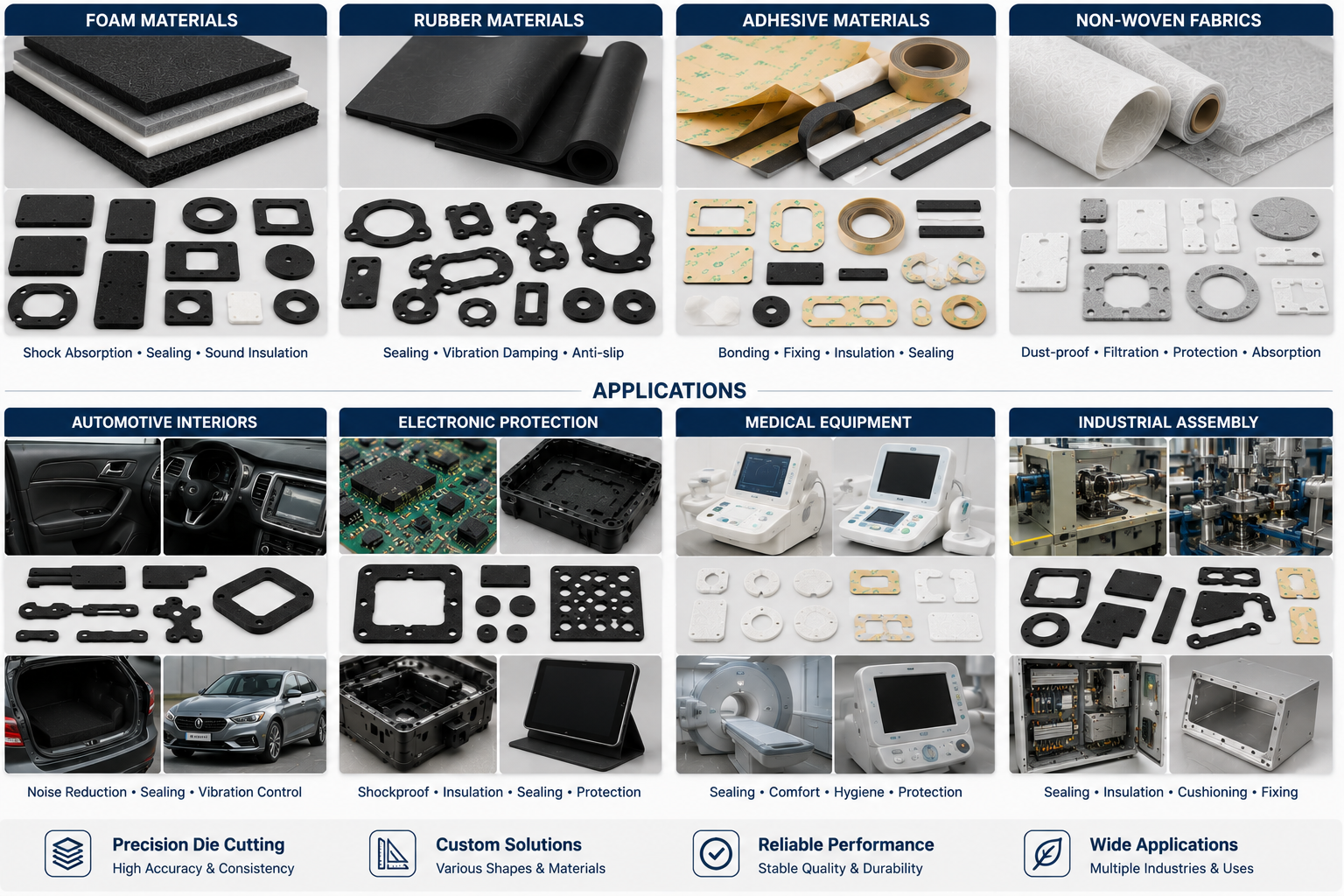
Why Do OEM Buyers Use Die Cutting?
OEM buyers use die cutting because it improves repeatability, efficiency, and production stability.
Consistent Part Shape
Die cutting helps produce the same part shape repeatedly.
This reduces variation and improves assembly fit.
Faster Assembly
Die-cut parts can be supplied as ready-to-use components.
Adhesive-backed parts can be delivered on release liners for fast application.
This saves labor and reduces assembly mistakes.
Better Material Utilization
A good die-cut layout can reduce material waste.
This matters when the material is expensive, laminated, adhesive-backed, or used in large quantities.
Lower Production Risk
Die cutting reduces manual cutting variation.
For buyers, this means fewer rejected parts, fewer delays, and more predictable mass production.
Common Applications of Die Cutting
Die cutting is used in many industries because many products need custom-shaped functional materials.
Automotive Applications
Automotive die-cut parts may include:
- Foam anti-rattle pads
- Door trim cushioning
- Rubber seals
- Non-woven acoustic insulation
- Adhesive-backed spacers
- Dashboard foam strips
- EV battery insulation layers
- Trunk liner support pads
These parts help reduce noise, improve fit, protect components, and support long-term reliability.
Electronics Applications
Electronics products often require small, accurate parts.
Common examples include:
- Battery insulation films
- Speaker damping pads
- Display cushioning
- Protective foam liners
- Adhesive tape parts
- Dust-proof non-woven layers
- Thermal management materials
In electronics, even small dimensional errors can affect assembly quality.
Medical and Industrial Applications
Medical and industrial products may use die-cut parts for:
- Device pads
- Protective liners
- Filter layers
- Sealing gaskets
- Cushioning components
- Adhesive-backed assemblies
- Equipment vibration pads
For these industries, clean edges, stable dimensions, and material reliability are important.
Why Die-Cut Tolerance Matters
Tolerance means the acceptable variation in part dimensions.
Die-cut tolerance depends on:
- Material type
- Thickness
- Density
- Adhesive backing
- Part size
- Hole size
- Shape complexity
- Cutting method
- Tooling design
- Production volume
Soft materials behave differently from metal or hard plastic.
Foam can compress.
Rubber can rebound.
Adhesive can flow.
Non-woven fabric can fray or shed fibers.
This is why tolerance should be discussed early.
If a buyer requests very tight tolerance without considering material behavior, the project may become more expensive or harder to produce.
A good supplier should review both the drawing and the material before confirming tolerance.
Common Problems in Die-Cut Parts
Poor die cutting can create real production issues.
Common problems include:
- Rough edges
- Loose fibers
- Inconsistent dimensions
- Adhesive lifting
- Poor hole quality
- Material deformation
- Difficult waste removal
- Liner release problems
- Assembly misalignment
These problems often appear when the material and process are not matched correctly.
For example, a non-woven material may shed fibers after cutting. A foam material may deform under pressure. An adhesive-backed part may fail if the adhesive is not compatible with the surface.
This is why early sample testing is important before mass production.
What Should Buyers Confirm Before Ordering Die-Cut Parts?
Before ordering die-cut components, buyers should confirm:
- What is the final application?
- What material should be used?
- Does the part need adhesive backing?
- What tolerance is truly required?
- Will the part face heat, humidity, compression, or vibration?
- Will it be applied manually or automatically?
- Does it need clean edges or low fiber shedding?
- Is it for prototype testing or mass production?
- Does it need lamination before cutting?
- Can the supplier support material selection and die cutting together?
These questions help reduce wrong material selection, tooling changes, and production delays.
How Sanken Helps Customers With Die Cutting
At Sanken Manufacturing, we do not treat die cutting as simple shape cutting.
We first look at the customer’s real problem.
Is the part used for sealing?
Is it used for cushioning?
Does it reduce vibration or noise?
Does it protect electronics?
Does it need adhesive backing?
Does it need clean edges?
Does it need to survive heat, compression, or long-term aging?
Then we help customers choose the right material structure and converting process.
Our capabilities include:
- Precision die cutting
- Kiss cutting
- Foam converting
- Rubber processing
- Non-woven fabric converting
- Adhesive tape lamination
- Film converting
- Hot pressing
- Injection molding support
- Custom assembly
For OEM buyers, this means fewer suppliers, fewer communication gaps, better part consistency, and more stable production.
Conclusion
Die cutting is a manufacturing process that cuts materials into specific shapes using a custom die. It is widely used for foam pads, rubber gaskets, adhesive parts, non-woven components, films, liners, and multilayer assemblies.
For OEM buyers, die cutting is valuable because it improves assembly efficiency, part consistency, material utilization, and production stability. At Sanken Manufacturing, we help customers convert raw materials into precision die-cut components that solve real problems in automotive, electronics, medical, packaging, and industrial applications.