

What Is Meant by EVA Foam? A Practical Guide for OEM Buyers
Many buyers see “EVA foam” on a drawing, quote sheet, or material list and assume it is a simple cushioning material. In reality, EVA foam can perform very different functions depending on its density, thickness, hardness, cell structure, adhesive backing, and converting process.
For OEM buyers, the key question is not only “What is EVA foam?” The better question is: “Which EVA foam structure will solve my product problem without creating quality risk during mass production?”
EVA foam is widely used in automotive, electronics, packaging, medical equipment, consumer products, and industrial applications. It can cushion, protect, seal, reduce vibration, improve assembly fit, and support lightweight product design.
At Sanken Manufacturing, we help customers convert EVA foam into precision die-cut pads, adhesive-backed foam parts, protective liners, cushioning components, sealing parts, and custom assemblies that are ready for production.
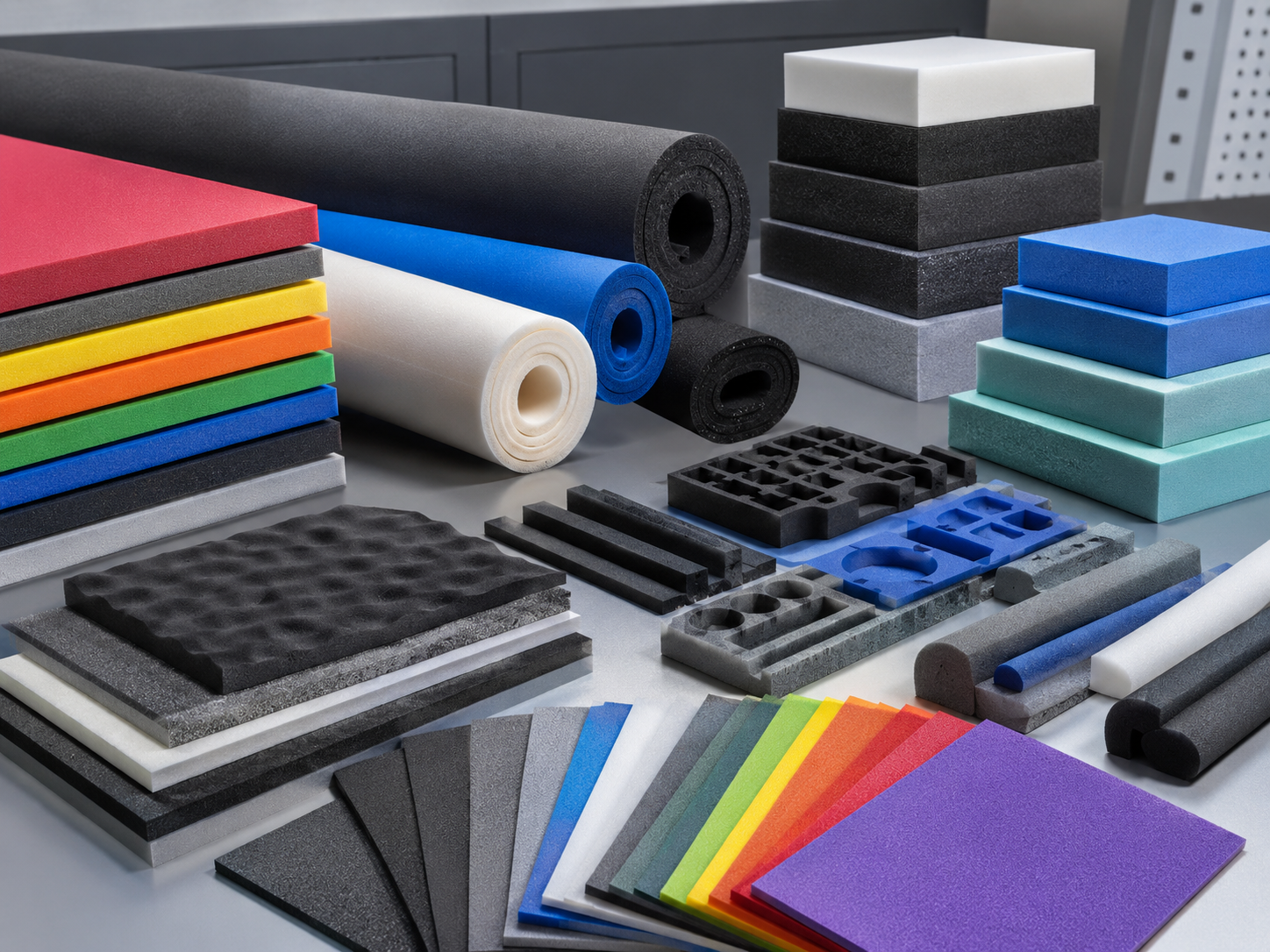
What Is EVA Foam?
EVA foam means ethylene-vinyl acetate foam.
It is a flexible foam material made from EVA polymer. EVA is created by combining ethylene and vinyl acetate. By adjusting the vinyl acetate content, manufacturers can change the softness, flexibility, elasticity, and performance of the final material.
In simple terms:
EVA foam is a lightweight, flexible, shock-absorbing foam used for cushioning, protection, sealing, insulation, and comfort.
It is commonly supplied as:
- Foam sheets
- Foam rolls
- Molded foam parts
- Adhesive-backed foam pads
- Die-cut foam components
- Laminated foam assemblies
For industrial buyers, EVA foam is attractive because it is easy to process and can be customized into many shapes.
Why Is EVA Foam So Popular?
EVA foam is popular because it offers a strong balance between performance and cost.
It is not as heavy as rubber.
It is softer than many plastics.
It is easier to die cut than many dense elastomers.
It can be laminated with adhesive, film, non-woven fabric, rubber, or other materials.
Common advantages include:
| EVA Foam Property | Customer Value |
|---|---|
| Lightweight | Helps reduce product weight |
| Soft and flexible | Improves cushioning and comfort |
| Shock absorbing | Protects parts from impact |
| Water resistant | Suitable for moisture-prone uses |
| Easy to die cut | Supports custom shapes |
| Adhesive compatible | Improves assembly efficiency |
| Cost-effective | Helps control project cost |
This makes EVA foam useful for both simple products and more complex OEM assemblies.
What Is EVA Foam Used For?
EVA foam is used when a product needs cushioning, vibration reduction, surface protection, light sealing, or shock absorption.
Automotive Applications
Automotive manufacturers use EVA foam in many hidden locations.
Common uses include:
- Door trim cushioning pads
- Anti-rattle foam parts
- Dashboard spacer pads
- Interior panel support strips
- Wire harness protection
- Trunk liner cushioning
- Packaging for automotive parts
- Light sealing and gap filling components
For automotive buyers, the main concerns are usually heat resistance, compression recovery, odor, adhesive stability, and dimensional consistency.
A foam part may look acceptable during sampling but fail after heat exposure or long-term compression. This is why proper material validation is important before mass production.
Electronics Applications
Electronics products often need soft protection inside compact assemblies.
EVA foam may be used for:
- Battery protection pads
- Speaker cushioning parts
- Shock-absorbing inserts
- Dust protection pads
- Packaging liners
- Device assembly spacers
In electronics, dimensions are often tight. If the foam part is too thick, too soft, or poorly cut, it can affect assembly fit and product reliability.
Packaging Applications
EVA foam is widely used for protective packaging because it can absorb impact and improve product presentation.
Common packaging uses include:
- Tool case inserts
- Instrument protection
- Medical equipment packaging
- Consumer electronics packaging
- Luxury product inserts
Compared with low-cost packaging foam, EVA often provides better appearance, cleaner edges, and stronger cushioning performance.
Industrial Applications
Industrial products use EVA foam for:
- Protective pads
- Anti-slip layers
- Vibration reduction parts
- Equipment liners
- Cushioning strips
- Light sealing components
- Assembly spacers
Many of these parts need adhesive backing or custom die-cut shapes.
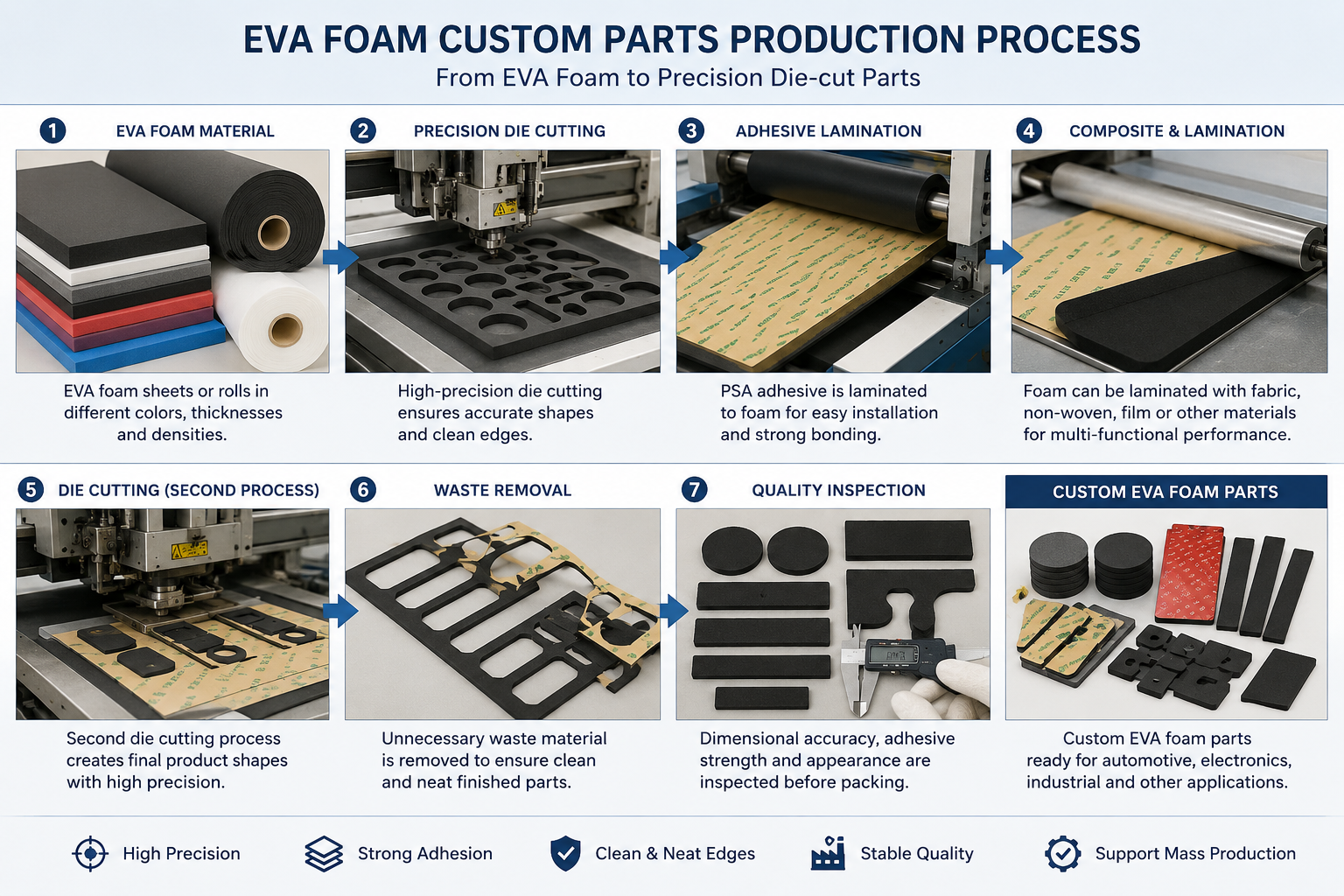
Is EVA Foam Waterproof?
EVA foam has good water resistance, especially compared with many open-cell foam materials.
However, buyers should be careful with wording.
EVA foam is often water resistant, but the final waterproof performance depends on:
- Foam cell structure
- Density
- Surface skin
- Lamination
- Adhesive layer
- Application pressure
- Exposure time
If the part must provide true waterproof sealing, buyers should confirm test requirements early.
For demanding sealing applications, rubber, EPDM foam, silicone foam, or a multilayer structure may be better.
Is EVA Foam Good for Soundproofing?
EVA foam can help reduce vibration, impact noise, and contact noise.
It is useful for:
- Anti-rattle pads
- Cushioning strips
- Panel spacer parts
- Contact noise reduction
- Light vibration damping
But EVA foam is usually not the best material for full soundproofing by itself.
Soundproofing often requires mass, density, or multilayer acoustic design. For stronger acoustic control, EVA foam may be combined with:
- Non-woven fabric
- Acoustic felt
- Rubber
- Adhesive layers
- Barrier films
- Foam composites
For automotive interiors, EVA foam often works best as part of a complete NVH solution.
NVH means:
- Noise
- Vibration
- Harshness
EVA Foam vs Rubber vs PE Foam
Buyers often compare EVA foam with rubber and PE foam.
Each material has its own strengths.
| Material | Main Strength | Common Limitation |
|---|---|---|
| EVA Foam | Soft, flexible, shock absorbing | May compress under long-term load |
| PE Foam | Lightweight and stable | Usually less soft than EVA |
| Rubber | Strong sealing and elasticity | Heavier and often higher cost |
EVA foam is often selected when the project needs cushioning, comfort, easy processing, and moderate cost.
Rubber is better when the application requires strong elastic sealing, high durability, or harsh environmental resistance.
PE foam may be better when the product needs lightweight structure and lower-cost packaging support.
Common Problems Buyers Face With EVA Foam
EVA foam is easy to use, but it can still create quality problems if the wrong grade or process is selected.
Compression Collapse
Some EVA grades may flatten after long-term pressure.
This can reduce cushioning, sealing, and vibration reduction performance.
Adhesive Lifting
Many EVA parts need adhesive backing.
If the adhesive does not match the EVA surface, the part may peel, lift, or shift during assembly.
Odor After Heat Exposure
This is especially important for automotive interiors and consumer products.
Low-quality foam may create odor after high-temperature exposure.
Poor Cutting Accuracy
Soft foam can deform during cutting.
If the die-cutting process is not controlled, the final part may have rough edges, wrong dimensions, or inconsistent shape.
Wrong Material Density
If the foam is too soft, it may collapse.
If it is too hard, it may not cushion properly.
That is why buyers should not choose EVA foam by appearance alone.
How to Choose the Right EVA Foam
Before approving EVA foam, buyers should confirm several details:
- What density is required?
- What thickness is needed?
- Does the part need adhesive backing?
- Will it face heat, humidity, or compression?
- Does it need odor control?
- Does it require flame resistance?
- What die-cut tolerance is required?
- Will it be used in automotive, electronics, packaging, or industrial equipment?
- Does it need cushioning, sealing, vibration reduction, or surface protection?
- Will it be produced as a sample only or for mass production?
These questions help avoid material mismatch.
They also help suppliers recommend a more reliable structure.
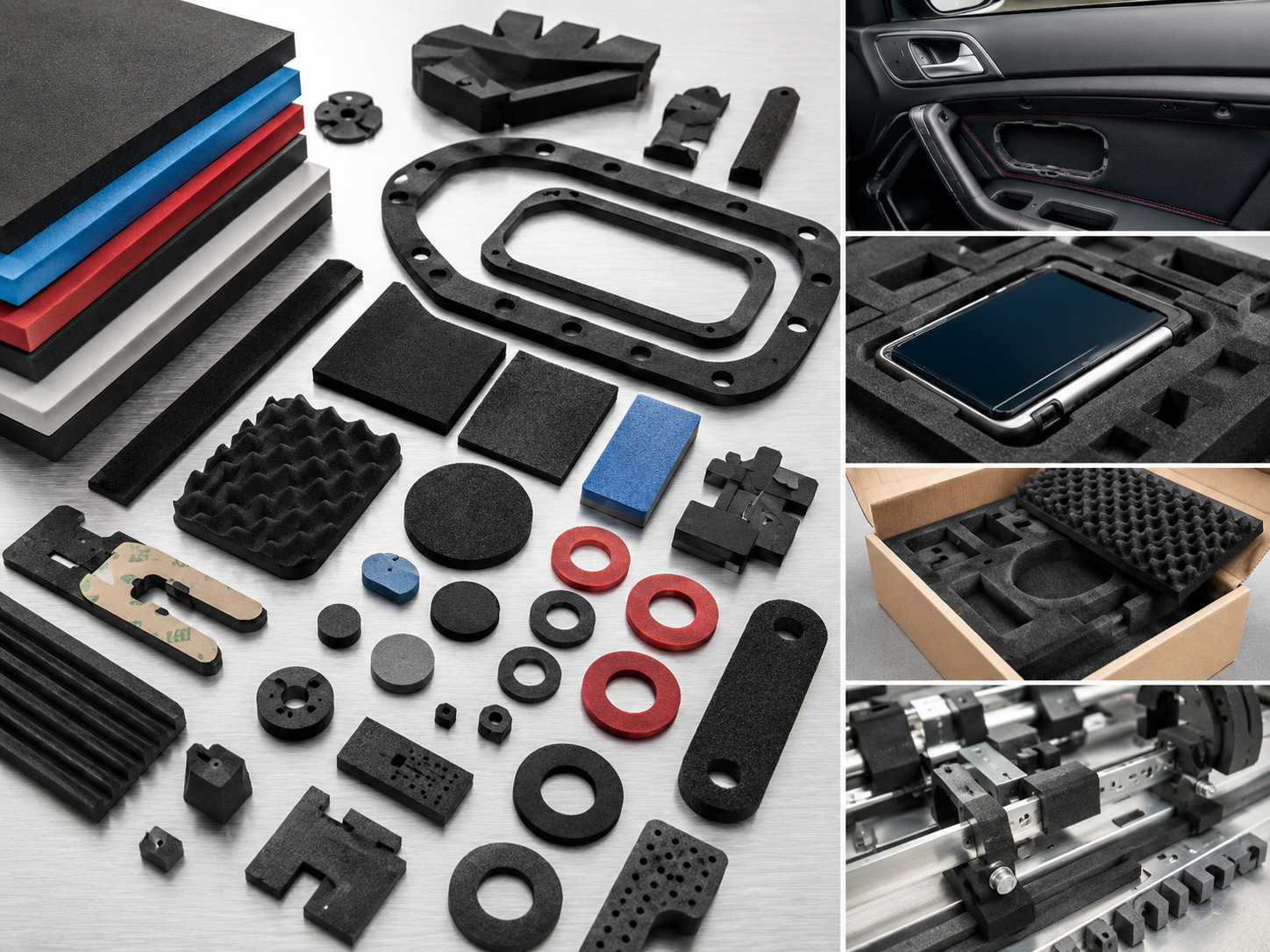
Why Precision Die Cutting Matters for EVA Foam
Raw EVA foam sheets are only the beginning.
Most OEM customers need finished parts that can go directly into assembly.
Examples include:
- Die-cut EVA foam pads
- Adhesive-backed EVA strips
- EVA cushioning washers
- EVA protective liners
- EVA spacer parts
- EVA sealing supports
- Multilayer EVA assemblies
Poor converting can create:
- Rough edges
- Adhesive misalignment
- Uneven compression
- Dimensional variation
- Difficult assembly
- Higher rejection rates
At Sanken Manufacturing, we support EVA projects with precision die cutting, adhesive laminating, foam converting, hot pressing, and custom assembly.
This helps customers reduce trial-and-error and improve production stability.
How Sanken Helps Customers With EVA Foam Projects
At Sanken, we do not treat EVA foam as only a raw material.
We look at the customer’s real application first.
We ask:
- What problem should the foam solve?
- Is the issue impact, vibration, sealing, protection, or assembly fit?
- Will the part be exposed to heat or compression?
- Does the part need adhesive backing?
- What tolerance does the assembly require?
- Will the customer need prototype support and mass production?
Then we help customers select the right EVA grade, thickness, density, adhesive structure, and converting process.
Our goal is simple:
Help customers receive stable, ready-to-assemble foam components that reduce production risk and support reliable mass production.
Conclusion
EVA foam means ethylene-vinyl acetate foam. It is a lightweight, flexible, shock-absorbing material used for cushioning, protection, sealing support, vibration reduction, insulation, and custom die-cut components.
For OEM buyers, EVA foam can be an excellent material choice, but only when the density, thickness, compression behavior, adhesive compatibility, heat resistance, and converting process match the final application. At Sanken Manufacturing, we help customers turn EVA foam into precision die-cut, laminated, and ready-to-assemble components that solve real production problems and improve manufacturing reliability.