

What Is the Best Non-Woven Material for Medical Device Manufacturing?
The best non-woven material for medical device manufacturing is not a single universal material. It depends on the device function, patient contact level, cleanliness requirement, fluid barrier needs, breathability, strength, sterilization method, converting process, and regulatory expectations.
For OEM buyers, the better question is not only “Which non-woven fabric is best?” The real question is: “Which non-woven material can meet my performance, safety, converting, and documentation requirements without creating production risk?”
This matters because medical device components often face strict expectations for biocompatibility, cleanliness, traceability, process control, and quality consistency. FDA guidance on ISO 10993-1 supports a risk-based biological evaluation approach for medical devices, while ISO 13485 is widely recognized for quality management systems in medical device design and manufacturing. :contentReference[oaicite:0]{index=0}
At Sanken Manufacturing, we help customers convert non-woven fabrics, foam materials, adhesive tapes, films, rubber materials, and composite structures into precision die-cut components for medical device, electronics, automotive, and industrial applications. For medical device projects, our focus is not simply cutting material into shape. It is helping customers reduce material mismatch, edge defects, adhesive failure, contamination risk, and assembly instability.
Why Non-Woven Materials Are Used in Medical Devices
Non-woven fabrics are widely used in medical device manufacturing because they can be engineered for softness, filtration, liquid management, barrier performance, absorbency, breathability, and clean converting.
Common medical-related uses include:
- Wound care components
- Absorbent pads
- Medical device liners
- Protective barriers
- Diagnostic device components
- Filtration layers
- Skin-contact pads
- Packaging support materials
- Adhesive-backed medical components
- Disposable healthcare products
Non-woven materials are especially useful when the component must be lightweight, flexible, breathable, or disposable.
However, not every non-woven material is suitable for medical applications. A material that works well in packaging or industrial protection may not meet medical device requirements for safety, cleanliness, consistency, and documentation.
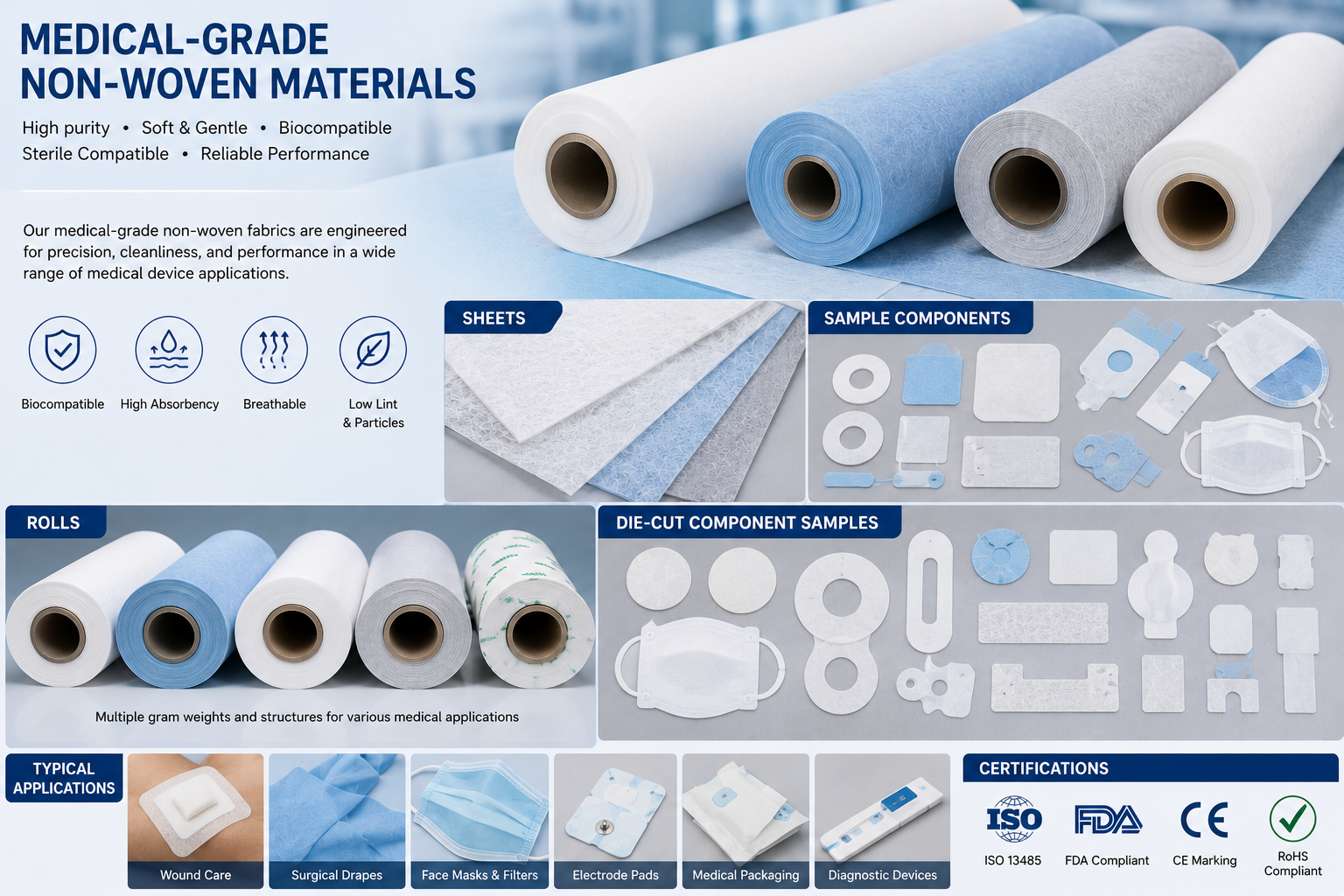
Main Non-Woven Materials Used in Medical Device Manufacturing
Different non-woven materials solve different problems.
| Material Type | Main Strength | Typical Medical-Related Use |
|---|---|---|
| Polypropylene non-woven | Lightweight, cost-effective, moisture resistant | Disposable barriers, protective layers |
| Polyester non-woven | Durable, dimensionally stable, stronger structure | Device liners, filtration support, die-cut parts |
| Spunlace non-woven | Soft, absorbent, comfortable | Wipes, wound care, skin-contact layers |
| Meltblown non-woven | Fine fiber structure, filtration performance | Filter media and barrier layers |
| Needle-punched non-woven | Thick, cushioning, absorbent or acoustic structure | Pads, liners, support layers |
| Laminated non-woven | Multi-function performance | Adhesive-backed or barrier composite components |
The best material depends on how the final device will be used.
If the component needs filtration, meltblown or composite non-woven may be appropriate. If it needs softness and absorbency, spunlace may be better. If it needs dimensional stability for die cutting, polyester non-woven may be a stronger option. If it needs a disposable barrier layer, polypropylene non-woven may be cost-effective.
Start With the Device Function
Before selecting a non-woven material, buyers should define the part’s function.
A medical device component may need to:
- Absorb fluid
- Block fluid
- Filter air or liquid
- Protect skin
- Cushion a device surface
- Support adhesive bonding
- Separate internal layers
- Provide a disposable barrier
- Improve handling during assembly
- Maintain shape after die cutting
Each function leads to a different material choice.
For example, a skin-contact absorbent pad needs softness and fluid management. A filtration component needs controlled pore structure. A die-cut internal liner needs dimensional stability and clean edges. A disposable protective barrier may need low cost and reliable coverage.
Choosing only by thickness or price can create problems later.
Consider Patient Contact and Biocompatibility
Medical device material selection must consider whether the material contacts the body, how long it contacts the body, and what type of tissue it contacts.
This is where biocompatibility becomes important.
FDA describes biocompatibility as the ability of a device material to perform with an appropriate host response in a specific situation, and ISO 10993-1 is used to guide biological evaluation of medical devices within a risk management process. :contentReference[oaicite:1]{index=1}
For buyers, this means material approval should not be based only on supplier claims.
Important questions include:
- Does the non-woven material contact skin, tissue, fluid, or only packaging?
- Is contact short-term, long-term, or repeated?
- Does the material include adhesives, coatings, binders, or additives?
- Is the material sterilized?
- Can the supplier provide documentation and traceability?
- Has the full finished component been evaluated, not only the raw fabric?
This is important because a die-cut part may include non-woven fabric, adhesive, release liner, film, foam, or coating. The complete component structure may need review, not just the base material.
Cleanliness and Fiber Shedding Matter
For medical device manufacturing, cleanliness is a major concern.
Some non-woven fabrics can release fibers during cutting, handling, or assembly. This may not matter in simple packaging, but it can be a serious issue in medical devices, diagnostics, electronics, and clean assembly environments.
Common risks include:
- Loose fibers
- Particles on cut edges
- Dust contamination
- Weak bonding surfaces
- Poor product appearance
- Assembly rejection
Material bonding strength and cutting method both affect cleanliness.
A tightly bonded non-woven may cut more cleanly. A loose fiber structure may need special tooling, lamination, edge control, or alternative material selection.
At Sanken, we evaluate the material’s cutting behavior during sampling so customers can identify fiber shedding risks before mass production.
Fluid Barrier, Absorbency, or Breathability?
Medical device buyers often need one or more of these functions:
- Fluid barrier
- Fluid absorption
- Breathability
These functions are different.
A material that absorbs fluid may not block fluid.
A material that blocks fluid may not breathe well.
A breathable material may not provide enough barrier performance.
Common solutions include:
| Requirement | Possible Material Direction |
|---|---|
| Absorbency | Spunlace, viscose blend, absorbent non-woven |
| Barrier protection | Laminated non-woven, coated non-woven, film composite |
| Breathability | PP or PET non-woven with controlled structure |
| Filtration | Meltblown or multilayer non-woven |
| Cushioning | Needle-punched or thicker non-woven |
| Die-cut stability | PET non-woven or laminated structure |
For more demanding applications, a multilayer material may be better than a single non-woven layer.
Sterilization Compatibility
Some medical device components must withstand sterilization.
Common sterilization methods may include ethylene oxide, gamma irradiation, electron beam, or steam, depending on the device and material system.
Not all non-woven materials respond the same way.
Sterilization may affect:
- Strength
- Color
- Odor
- Shrinkage
- Adhesive performance
- Surface feel
- Barrier properties
- Material aging
If the part includes adhesive, foam, film, coating, or rubber, the entire structure should be evaluated.
Buyers should confirm sterilization compatibility early, not after tooling and sampling are complete.
Adhesive-Backed Non-Woven Components
Many medical device components use adhesive-backed non-woven materials.
Examples include:
- Skin-contact pads
- Device mounting components
- Disposable assembly layers
- Protective covers
- Cushioning parts
- Diagnostic device layers
Adhesive selection is critical.
Poor adhesive matching may cause:
- Edge lifting
- Delamination
- Residue
- Skin irritation risk
- Liner separation
- Difficult application
- Assembly failure
For medical applications, buyers should evaluate the full adhesive system, including adhesive type, coating weight, release liner, skin or device contact surface, sterilization exposure, and storage conditions.
Precision Die Cutting Requirements
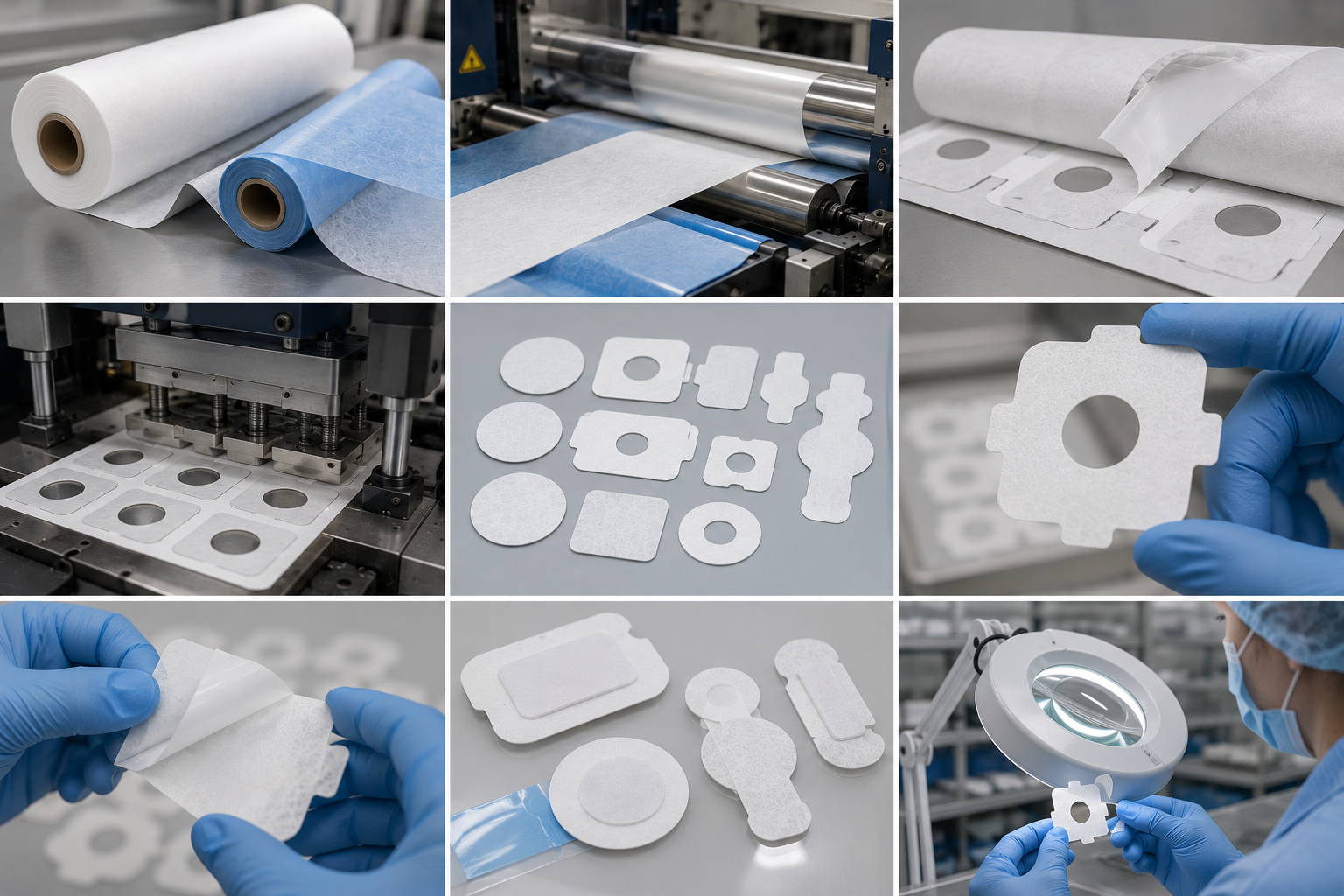
Medical device non-woven components often require accurate shapes, clean edges, and repeatable quality.
Precision die cutting can produce:
- Pads
- Liners
- Filters
- Barriers
- Spacers
- Absorbent layers
- Adhesive-backed components
- Multilayer assemblies
However, non-woven fabric is softer and more flexible than hard plastic or metal. It may stretch, compress, fray, or shift during processing.
Die-cut quality depends on:
- Fiber bonding strength
- Thickness
- Density
- Adhesive backing
- Tooling design
- Cutting pressure
- Waste stripping method
- Part geometry
- Packaging method
A design with small holes, narrow strips, or fine features may be harder to process cleanly.
This is why design-for-converting review is important before production.
Quality Management and Documentation
Medical device manufacturing requires strong process control and documentation.
ISO 13485 outlines quality management system requirements for medical devices, and FDA’s Quality Management System Regulation has been modernized to incorporate ISO 13485:2016 by reference. :contentReference[oaicite:2]{index=2}
For buyers, documentation can be just as important as the material itself.
Depending on the project, customers may need:
- Material specification
- Lot traceability
- Certificate of analysis
- Biocompatibility documentation
- Sterilization compatibility data
- Change control
- Inspection records
- Dimensional reports
- Packaging controls
- Process validation support
A supplier that cannot support documentation may create regulatory and production risk, even if the sample looks good.
Common Buyer Mistakes
Choosing by Price Alone
Low-cost non-woven fabric may create fiber shedding, weak bonding, poor consistency, or documentation gaps.
Ignoring the Finished Component
A raw non-woven material may be acceptable, but the final die-cut component may include adhesive, film, coating, or foam. The complete structure must be reviewed.
Testing Too Late
If testing happens only after tooling, failures become more expensive.
Ignoring Edge Cleanliness
Medical device parts often require clean, stable edges. Cutting behavior should be tested early.
Overlooking Supply Stability
Medical device production depends on consistent material lots and controlled changes.
What Buyers Should Confirm Before Approval
Before choosing a non-woven material for medical device manufacturing, buyers should confirm:
- What is the device function?
- Does the part contact the body?
- What contact duration applies?
- Does the material need absorbency, barrier protection, or breathability?
- Does the component require adhesive backing?
- Will the part be sterilized?
- What dimensional tolerance is required?
- Is fiber shedding acceptable?
- What documentation is needed?
- Can the supplier support prototypes and mass production?
These questions help reduce material risk and avoid late-stage redesign.
How Sanken Helps Medical Device Manufacturers
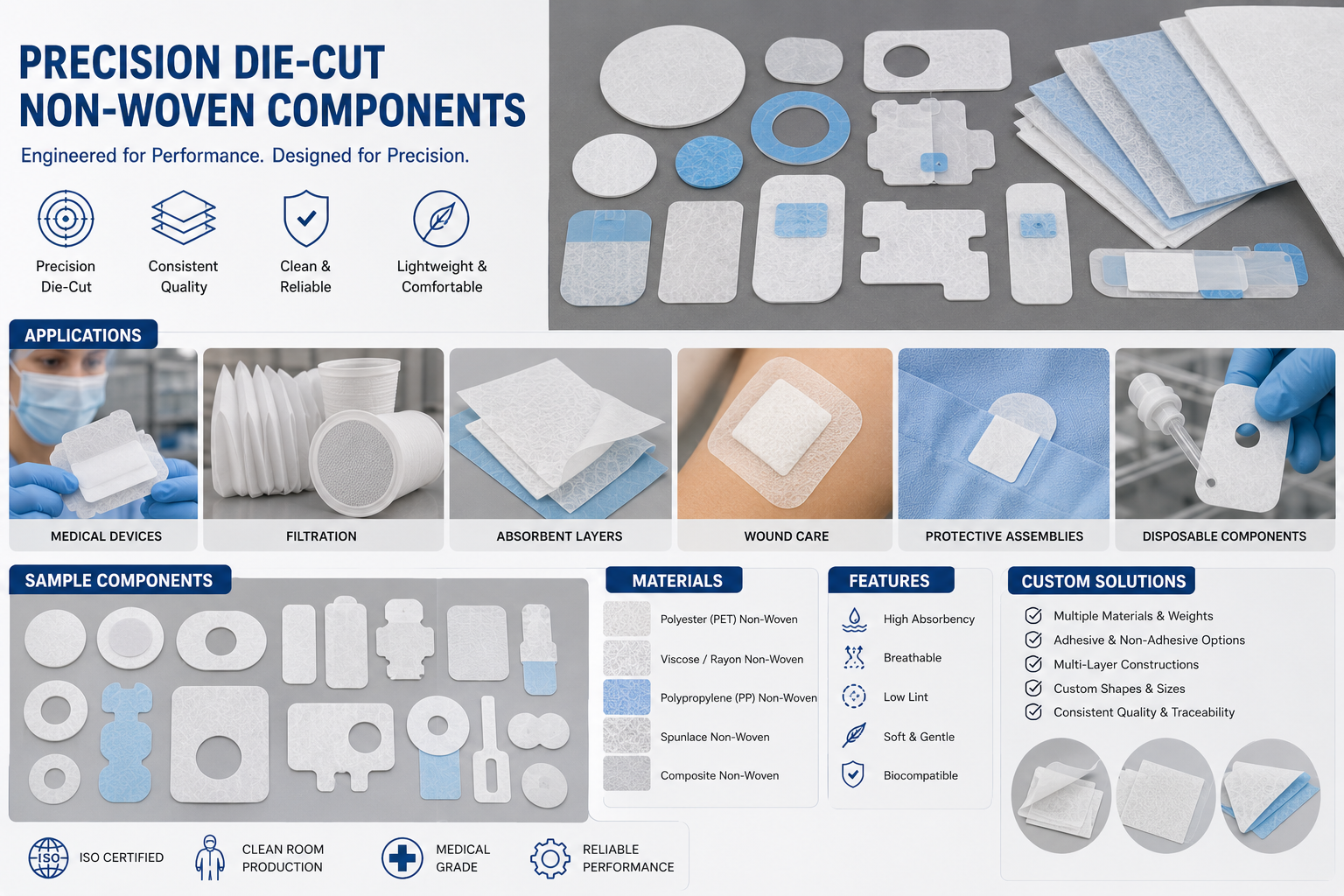
At Sanken Manufacturing, we help customers convert non-woven materials into reliable components that support production needs.
Our capabilities include:
- Precision die cutting
- Non-woven fabric converting
- Adhesive lamination
- Foam bonding
- Film lamination
- Rubber processing
- Kiss cutting
- Slitting
- Hot pressing
- Custom assembly
- Prototype and mass production support
Our value is not only material processing. We help customers identify potential problems before mass production, including fiber shedding, adhesive lifting, edge quality, tolerance difficulty, material mismatch, and supplier complexity.
For OEM customers, this means fewer development delays, better part consistency, and more stable production.
Conclusion
The best non-woven material for medical device manufacturing depends on the device function, patient contact level, cleanliness requirements, fluid management needs, sterilization compatibility, adhesive structure, die-cut tolerance, and documentation requirements.
Polypropylene, polyester, spunlace, meltblown, needle-punched, and laminated non-woven materials can all be useful in different medical device applications. The best choice is the one that performs reliably in the final component, not only in raw roll form.
At Sanken Manufacturing, we help customers select, laminate, die cut, and convert non-woven materials into stable medical device components that support cleaner assembly, better performance, and reliable production.