
What Sound Absorbing Materials Fit Sunroof Shade Panels? A Practical NVH Guide for Automotive Engineers
Sunroof systems are no longer just a styling feature.
They are a comfort feature—and in many cases, a noise gateway.
At high speed, the area around the sunroof shade panel becomes one of the most sensitive acoustic zones in a vehicle. Wind turbulence, roof vibration, and cavity resonance all combine into one problem: unwanted cabin noise.
And here is the real challenge:
The space is thin, curved, and structurally complex—so material choice is everything.
At Sanken (Dongguan Sanken Electronics Co., Ltd.), we often receive the same engineering question from OEM teams:
“What sound absorbing materials actually work in sunroof shade panels without causing thickness, weight, or assembly issues?”
Let’s break it down in a practical, engineering-first way.
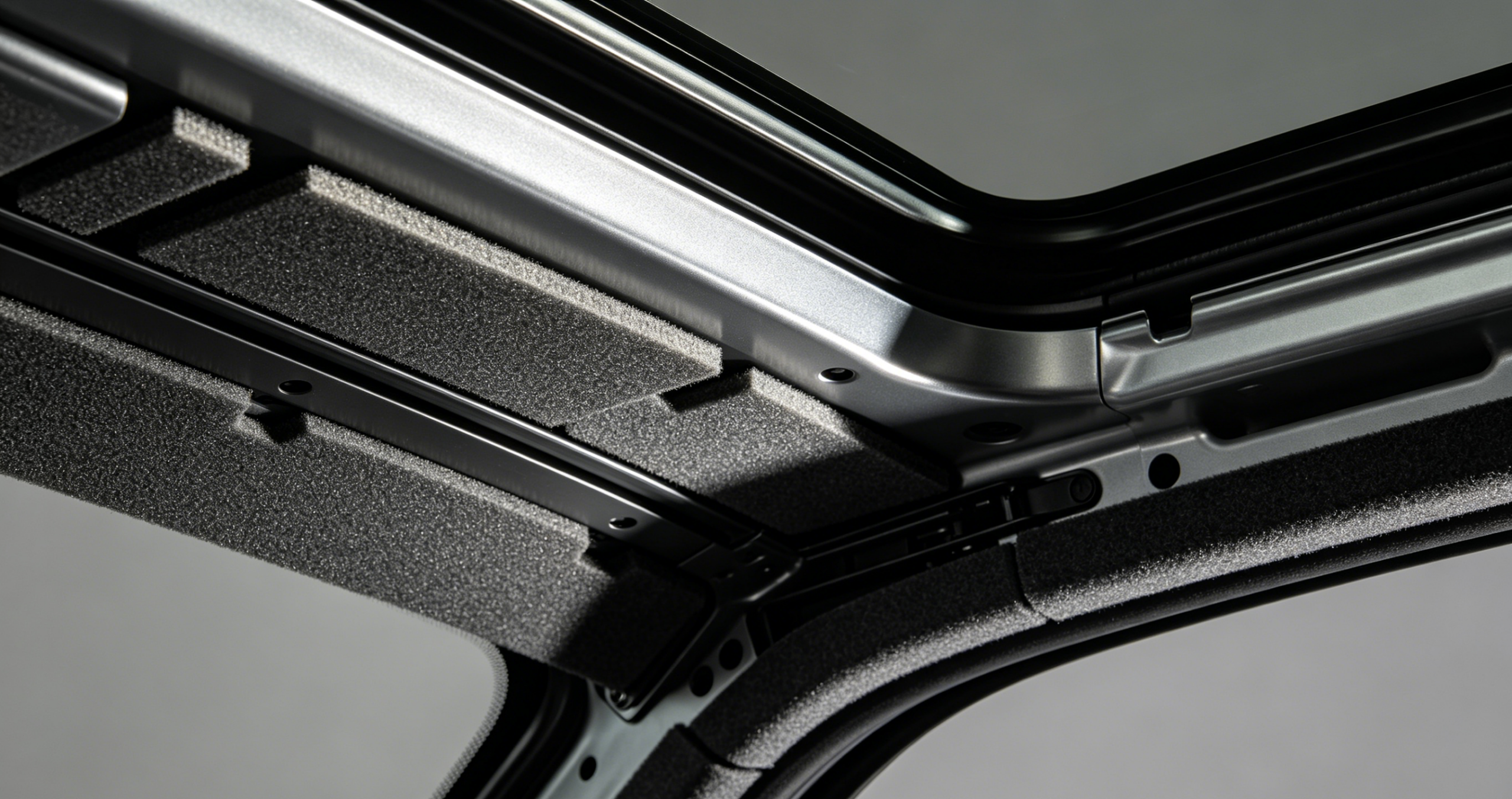
Sunroof systems create a natural weak point in vehicle roof acoustics.
Unlike solid roof structures, sunroof assemblies introduce:
- air gaps
- structural discontinuities
- cavity resonance zones
- flexible panel movement
At highway speed, this leads to:
- wind noise intrusion
- low-frequency booming
- vibration transfer into the cabin ceiling
- inconsistent acoustic comfort depending on speed
Many OEMs focus on door and floor insulation, but overlook the roof system until late-stage testing.
That is when problems become expensive.
Because once the vehicle structure is fixed, only material optimization remains.
What sound absorbing materials actually work in sunroof shade panels?
Not every acoustic material can survive the constraints of a sunroof system.
The material must handle:
- very limited thickness space
- curved installation geometry
- long-term compression
- humidity and temperature cycling
- lightweight vehicle requirements
So in real automotive applications, only a few material families are widely used.
1. Needle-punched acoustic felt systems
This is one of the most stable and widely adopted solutions.
It works by using dense fiber entanglement to trap and dissipate sound energy.
Key advantages:
- excellent broadband sound absorption
- stable performance under compression
- easy adaptation to curved shapes
- cost-efficient for mass production
In sunroof applications, it is often used as a primary acoustic layer behind the shade panel.
What makes it effective is not just the material—but how it is die-cut and fitted into the limited roof cavity.
Poor fit = acoustic leakage.
Precision fit = stable NVH performance.
2. PET fiber acoustic insulation layers
PET-based acoustic materials are becoming increasingly important in modern vehicle platforms, especially EVs.
Why?
Because they combine:
- lightweight structure
- consistent acoustic behavior
- moisture resistance
- recyclability
In sunroof systems, PET materials are particularly effective at:
- reducing wind-induced high-frequency noise
- stabilizing long-term acoustic performance
- maintaining shape under repeated thermal cycles
Compared to traditional fiber systems, PET solutions are more predictable in mass production environments.
That predictability matters more than people think.
3. PU foam-based acoustic layers
PU foam is often used when comfort becomes a priority.
It provides:
- strong mid-to-high frequency absorption
- soft energy dissipation behavior
- good compatibility with laminated structures
- improved perceived cabin quietness
In sunroof systems, PU foam is usually not used alone.
Instead, it is combined with:
- non woven layers
- surface fabrics
- adhesive bonding systems
This creates a multi-layer acoustic structure that balances performance and feel.
However, PU foam must be carefully selected, because long-term compression can affect performance if not properly engineered.
4. Multi-layer hybrid acoustic structures
In higher-end vehicle platforms, the most effective solution is often not a single material—but a system.
Typical structure:
- acoustic felt layer
- foam damping layer
- adhesive bonding layer
- surface protective layer
This hybrid system allows engineers to tune:
- frequency absorption range
- stiffness and flexibility
- thickness control
- installation stability
It is especially useful in vehicles with strict NVH targets and premium cabin expectations.
The key advantage is control.
Not just absorption—but balanced acoustic tuning.
Why material choice alone is not enough
One common mistake in sunroof acoustic design is focusing only on material selection.
In reality, performance depends on three layers:
1. Material structure
Fiber density, foam cell structure, PET composition.
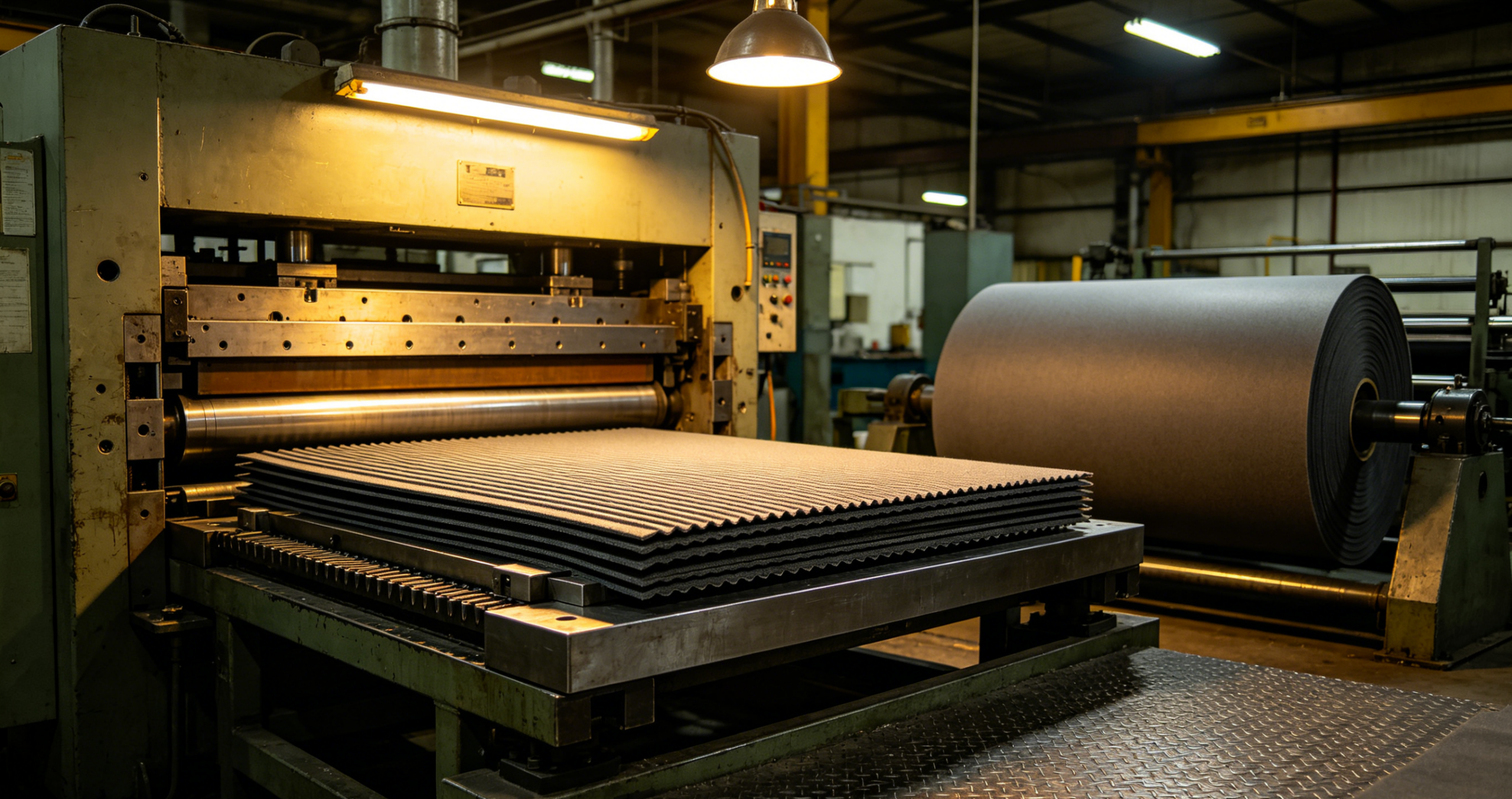
2. Conversion accuracy
How the material is cut, shaped, and layered.
3. Installation consistency
Fit accuracy inside the sunroof cavity.
Even the best acoustic material can fail if:
- edges are misaligned
- compression is uneven
- gaps are not sealed properly
This is why OEMs increasingly evaluate suppliers not just on material specs—but on conversion capability.
Where Sanken fits into sunroof acoustic solutions
At Sanken, we do not treat sunroof acoustic materials as raw input materials.
We treat them as precision functional components inside a vehicle NVH system.
Our role focuses on three key areas:
1. Precision die-cutting for complex roof geometries
Sunroof structures are curved and space-limited.
We ensure:
- tight tolerance control
- repeatable geometry accuracy
- stable batch-to-batch consistency
2. Multi-material integration
We combine:
- non woven acoustic layers
- foam systems
- adhesive bonding structures
into one stable functional component.
3. Automotive-grade reliability control
We focus on:
- compression stability over time
- temperature and humidity resistance
- long-term acoustic consistency
Because in real vehicles, performance must last years—not just pass lab tests.
The real engineering insight: sunroof noise is a system problem
Sunroof acoustic performance is not solved by one material.
It is solved by system thinking:
- material selection
- structural design
- die-cut precision
- assembly integration
When these align, cabin noise drops significantly, and driving comfort improves noticeably.
When they don’t, even premium vehicles can suffer from unexpected wind noise complaints.
Conclusion
Sunroof shade panels require carefully engineered sound absorbing materials that can perform under tight spatial, thermal, and mechanical constraints.
The most effective solutions today include:
- needle-punched acoustic felt
- PET fiber insulation layers
- PU foam systems
- multi-layer hybrid structures
But material alone is not enough.
True performance comes from precision conversion, stable integration, and system-level engineering.
At Sanken, we help OEMs turn acoustic materials into reliable, die-cut functional components that reduce road noise and improve real-world driving comfort—without compromising design constraints.