
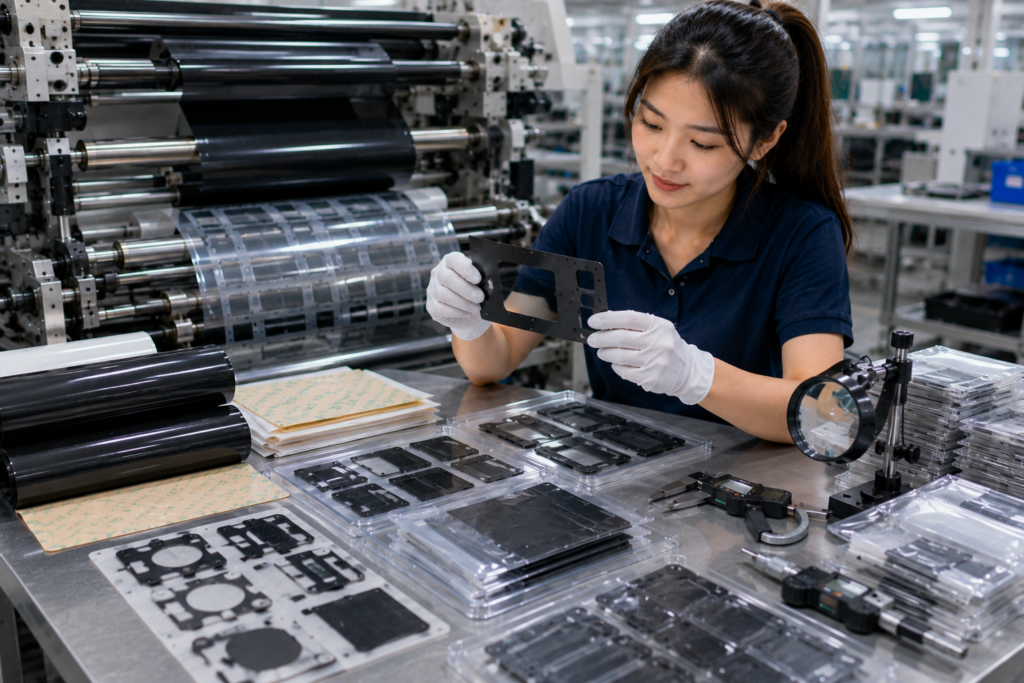
Battery insulation materials must provide the required electrical or mechanical protection, but they must also be practical to laminate, cut, remove from waste, inspect, package, and install. A technically suitable material can still create production problems if it curls, stretches, tears, compresses unevenly, or leaves adhesive residue on the cutting tool.
PET insulation film and pressure-sensitive adhesive constructions are generally among the easiest materials to convert into thin, accurate custom parts. Foam, rubber, and protective films can also be die cut effectively, but their convertibility depends more strongly on density, thickness, elasticity, surface condition, and part geometry.
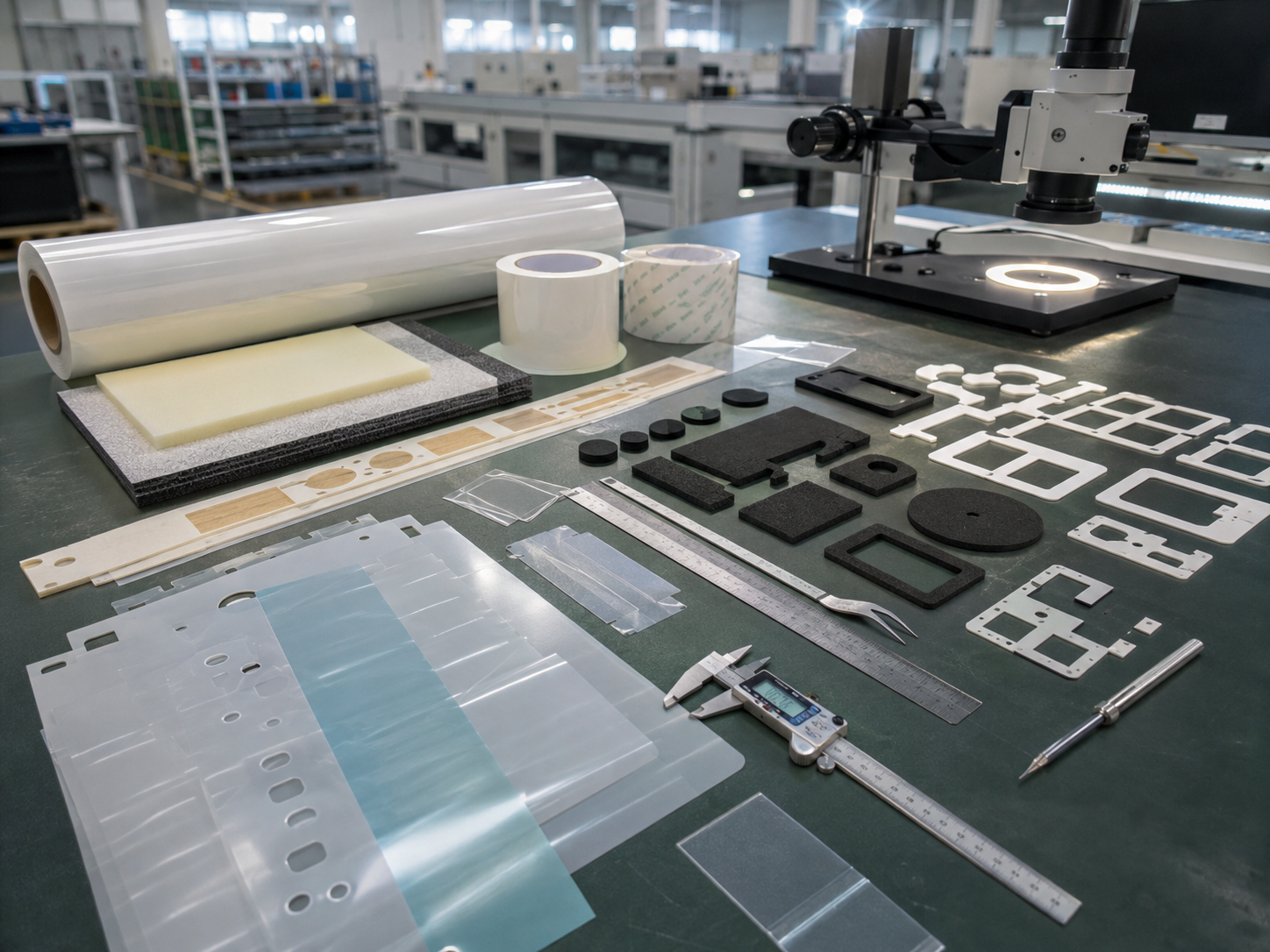
Convertibility Depends on More Than Material Type
A material is easier to convert when it remains dimensionally stable during feeding, lamination, cutting, waste removal, and packaging. It should separate cleanly under the blade without stretching or leaving rough edges.
The same material may be easy or difficult to process depending on its thickness, backing, adhesive, release liner, and required shape.
| Converting Factor | Why It Matters |
|---|---|
| Dimensional stability | Helps maintain part size and registration |
| Material stiffness | Supports clean feeding and waste removal |
| Compression behavior | Affects cut depth and dimensional accuracy |
| Elastic recovery | Can cause rubber or foam parts to change shape |
| Surface condition | Influences adhesive bonding and machine feeding |
| Thickness tolerance | Affects kiss-cut depth and final part height |
| Part geometry | Determines whether narrow walls and holes remain stable |
| Release-liner quality | Supports cutting, peeling, and delivery |
OEM buyers should therefore evaluate the complete material construction rather than selecting a material only by its general name.
PET Insulation Film Is Highly Suitable for Precision Die Cutting
PET film is one of the most practical materials for custom battery insulation components. It combines low thickness, mechanical strength, dimensional stability, and good compatibility with precision converting processes.
PET film can be converted into:
- Flat electrical insulation barriers
- Adhesive-backed insulation pads
- Frames around openings
- Connector-area covers
- Narrow insulation strips
- Parts with holes, slots, and positioning tabs
- Components supplied on sheets or rolls
Because PET does not compress significantly under the cutting tool, it is easier to control dimensionally than soft foam. Clean, consistent material also supports accurate registration in roll-to-roll production.
PET film is particularly suitable for parts that require precise hole locations or consistent edge coverage. It can remain stable while the surrounding waste matrix is removed, provided that the design avoids excessively narrow sections and sharp internal corners.
However, thin PET film can still develop burrs, white stress marks, cracked corners, or curling when tooling and pressure are not controlled. Sharp blades, balanced cutting pressure, suitable material support, and stable web tension are essential.
Sanken’s precision die cutting services support custom PET insulation components in kiss-cut, through-cut, sheet, and roll formats.
Adhesive-Backed PET Is Efficient but Requires Layer Control
Laminating PET film with pressure-sensitive adhesive creates an assembly-ready insulation component. The adhesive helps keep the part correctly positioned before the surrounding battery structure is fully assembled.
From an OEM assembly perspective, adhesive-backed PET is often easier to use than separate film and tape materials. From a converting perspective, however, the complete stack requires tighter process control.
A typical construction may include:
| Layer | Main Function |
|---|---|
| PET film | Electrical insulation and structural stability |
| Pressure-sensitive adhesive | Positioning and bonding |
| Release liner | Protects adhesive before installation |
| Optional pull tab | Simplifies liner removal |
The adhesive should cut cleanly without squeezing beyond the PET edge. A soft or thick adhesive can transfer to tooling, create sticky edges, or make waste removal more difficult.
The release liner must also be compatible with kiss cutting. The blade must pass through the PET and adhesive while leaving the liner intact. Uneven liner thickness or excessive pressure can damage the carrier and cause parts to detach prematurely.
Despite these challenges, adhesive-backed PET remains highly convertible when the material stack is properly matched. It can be supplied as organized parts on a liner, helping OEM manufacturers improve placement speed and reduce installation errors.
Double-Sided and Transfer Tapes Are Well Suited to Kiss Cutting
Pressure-sensitive adhesive tapes are widely converted into custom shapes for positioning, joining, and supporting insulation components.
Double-sided tapes usually contain a carrier with adhesive on both sides, while transfer tapes consist primarily of adhesive supported by a removable liner. Both can be kiss cut into rings, frames, strips, pads, and irregular shapes.
Their converting advantages include:
- Compatibility with roll-to-roll processing
- Easy integration with PET film or foam
- Efficient sheet or roll delivery
- Accurate adhesive placement
- Reduced manual adhesive application
- Support for extended liners and pull tabs
Tape convertibility depends heavily on adhesive softness and liner quality. A very aggressive adhesive may make waste removal difficult, while an unstable liner can create registration and cutting-depth problems.
Part spacing also matters. If adhesive parts are placed too closely on the liner, the waste matrix may break during removal. If the adhesive reaches the cut edge, it may attract dust or interfere with neighboring components.
Sanken converts adhesive-backed die cut components using PET film, foam, rubber, and pressure-sensitive adhesive constructions.
PE and EVA Foams Are Generally Easy to Cut into Protective Pads
PE and EVA foams are commonly used for cushioning, spacing, surface protection, and controlled gap filling. They are usually easier to die cut than highly elastic rubber because they maintain their shape reasonably well after cutting.
PE foam offers relatively stable thickness and good moisture resistance. EVA foam is flexible and economical, making it practical for general protective pads and spacers.
| Foam Material | Converting Characteristics | Typical Converted Part |
|---|---|---|
| PE foam | Lightweight and relatively stable | Cushioning pads and spacers |
| EVA foam | Flexible and easy to shape | Protective pads and support parts |
| PU foam | Soft and compressible | Conforming gap-filling components |
| EPDM foam | Resilient and durable | Sealing and vibration-control gaskets |
| Silicone foam | Flexible and temperature resistant | Specialized sealing components |
Foam density affects cutting quality. A foam that is too soft may compress under the blade, causing dimensional variation or angled edges. A denser foam often produces a cleaner outline but may require greater cutting force.
Adhesive-backed PE and EVA foams are also straightforward to convert when the liner and adhesive are compatible. They can be supplied as kiss-cut pads or through-cut components according to the customer’s assembly process.
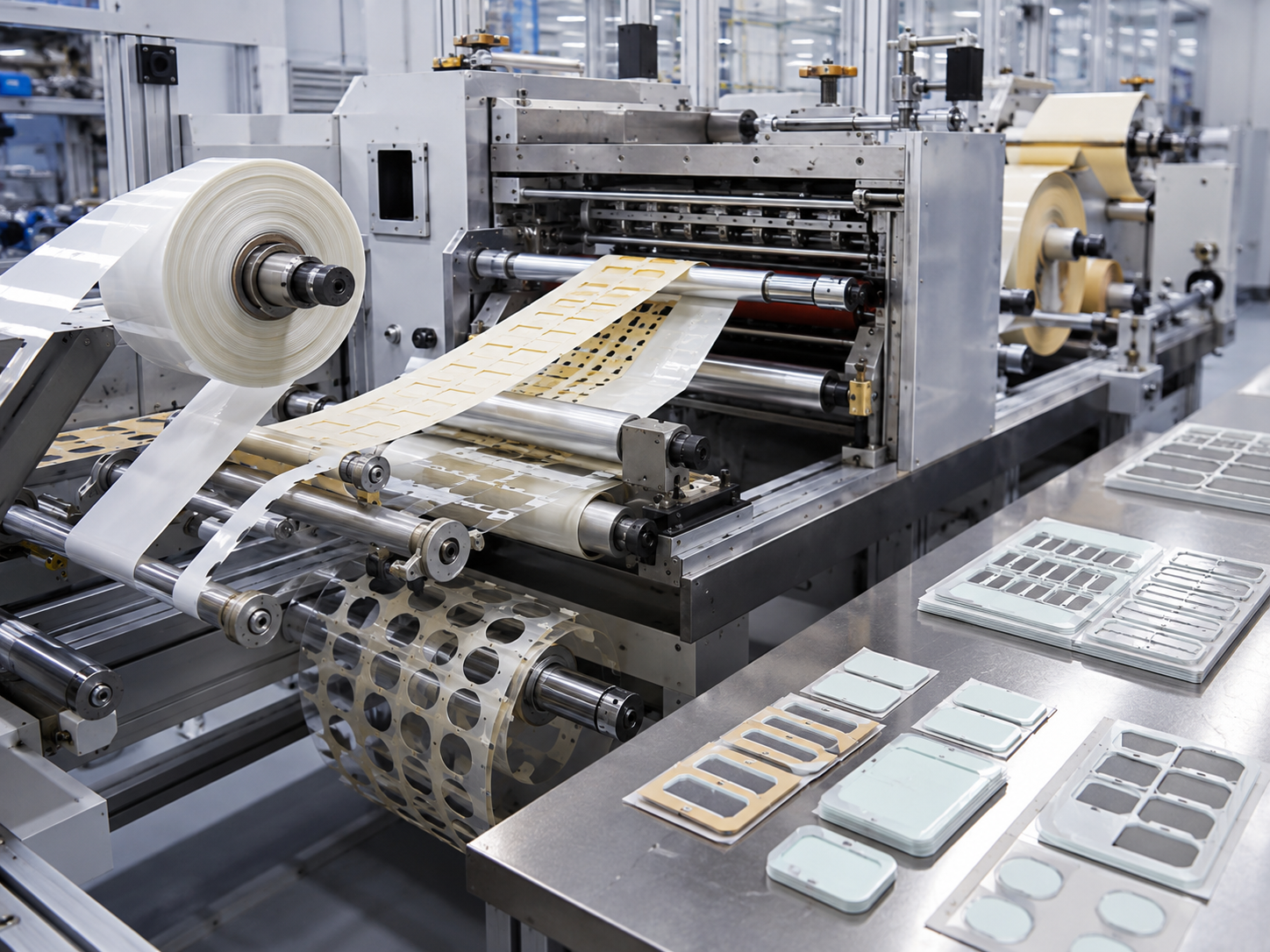
Soft PU and Highly Compressible Foams Need Additional Control
Soft PU foam can conform well to irregular spaces, but its compressibility makes accurate cutting more difficult.
When the cutting tool contacts the material, the foam may collapse before it is fully separated. After the blade is removed, the material expands again. This can produce tapered edges, dimensional variation, or inconsistent hole shapes.
Common process considerations include:
- Supporting the foam during cutting
- Selecting suitable cutting pressure
- Allowing material recovery before measurement
- Avoiding extremely narrow walls
- Controlling adhesive lamination pressure
- Protecting finished parts from compression during packaging
OEM engineers should avoid applying unnecessarily tight tolerances to soft foam components. The functional requirement may be compression and gap filling rather than exact edge alignment.
When narrow tolerances are essential, a more dimensionally stable foam grade or a laminated construction with a PET carrier may be easier to manufacture consistently.
EPDM and Silicone Rubber Can Be Converted but May Recover After Cutting
Solid EPDM and silicone rubber can be die cut into durable pads, rings, spacers, and protective components. They provide better mechanical durability than many lightweight foams but are generally more challenging to convert accurately.
Rubber materials can stretch as they feed through production equipment and recover after cutting. This elastic behavior may affect:
- Outer dimensions
- Hole diameter
- Slot position
- Part flatness
- Registration with adhesive layers
- Waste-removal stability
Hardness and thickness influence the process. Thin, firm rubber sheets are usually easier to control than thick, soft materials. Tool sharpness is especially important because a dull blade may drag the rubber instead of producing a clean cut.
Parts with narrow walls or holes close to the edge may distort during waste removal. Practical corner radii, sufficient material around holes, and stable carrier liners help reduce these risks.
Rubber remains a useful material where durable contact protection, damping, or sealing is required, but buyers should expect more tolerance consideration than with thin PET film.
Protective Films Are Easy to Cut but Sensitive to Tension and Adhesion
Temporary protective films can be converted into custom covers, masking parts, and surface-protection pieces for production and handling.
Their low thickness makes them easy to cut, but also sensitive to web tension, static, wrinkles, and liner behavior. Excessive tension may stretch the film and cause size drift after cutting.
The adhesive must hold the film during production but remove cleanly from the protected surface. It should not leave residue, damage the finish, or lift prematurely.
Protective films are often supplied as kiss-cut parts with tabs that help operators remove them after assembly. The tab design, liner cut, and part orientation should be reviewed together to ensure easy handling.
Multilayer Materials Require Registration and Lamination Control
Combining PET film, adhesive tape, foam, or rubber into one component can reduce assembly steps. However, every additional layer introduces another possible source of movement or dimensional variation.
Typical multilayer constructions include:
- PET film with pressure-sensitive adhesive
- PET film laminated to foam
- Foam with double-sided tape
- Rubber with positioning adhesive
- Protective film with an extended removal tab
The converter must control layer alignment, adhesive overflow, lamination pressure, cutting depth, and material relaxation.
Materials with different stiffness or thermal behavior may shift after lamination. For example, a rigid PET layer and a soft foam layer may react differently under pressure. If the construction is cut immediately after lamination, the finished part may change shape as the adhesive relaxes.
Prototype validation should therefore include dimensional checks after the material has stabilized, not only immediately after cutting.
Part Geometry Can Make an Easy Material Difficult to Convert
Even PET film can become difficult to process when the drawing contains weak or unstable features.
| Geometry Issue | Converting Risk |
|---|---|
| Sharp internal corners | Cracking and stress whitening |
| Narrow bridges | Stretching during waste removal |
| Small holes near edges | Tearing and distortion |
| Closely spaced parts | Weak waste matrix |
| Large unsupported frames | Curling and difficult handling |
| Excessive tolerance requirements | Higher cost and unstable yield |
Rounded internal corners, practical minimum widths, adequate spacing, and clearly identified critical dimensions improve production stability.
Supply format should also be considered during design. Large adhesive-backed frames may be easier to install with split liners, while small repeated parts may be better supplied in rolls.
The guide to how die cut parts are supplied in sheets, rolls, or kits explains how delivery format can affect handling and assembly efficiency.
How Sanken Supports Battery Insulation Converting
Sanken converts PET insulation film, pressure-sensitive adhesive tapes, protective films, PE and EVA foam, EPDM foam, silicone foam, EPDM rubber, and silicone rubber into custom flexible components for automotive and energy-related assemblies.
We review the material stack, part geometry, adhesive and liner structure, critical tolerances, cutting method, waste-removal requirements, and supply format before mass production. Prototypes help confirm edge quality, dimensional stability, liner performance, and ease of installation under the customer’s actual assembly conditions.
You May Also Be Interested In
- How to Avoid Burrs, Size Drift, and Edge Defects in PET Insulation Film Die Cutting
- How Do PET Films and Adhesive Tapes Support EV Battery Electrical Insulation?
- What Makes Multi-Layer Die Cut Parts Difficult to Produce?
- How Die Cut Parts Are Supplied in Sheets, Rolls, or Kits
- How to Choose the Right Die Cutting Manufacturer for Your OEM Project
Conclusion
PET insulation film is generally the easiest battery insulation material to convert into thin, accurate custom parts because it provides good dimensional stability and clean cutting performance. Adhesive-backed PET and pressure-sensitive tapes are also highly suitable when the adhesive, liner, and kiss-cut depth are properly controlled.
PE and EVA foams are practical for cushioning and spacing components, while soft PU foam, EPDM foam, silicone foam, and solid rubber require more attention to compression, elastic recovery, and tolerance. Protective films are easy to cut but sensitive to tension, wrinkles, and adhesive behavior.
The most convertible material is not always the material with the best electrical or mechanical performance. OEM buyers should balance functional requirements with part geometry, adhesive structure, installation method, tolerances, and production volume. Early design review and prototype testing help turn the selected material into a stable, assembly-ready die-cut component.