
Which Cushion Foams Suit Miniature Camera Module Inner Padding?
When protecting miniature camera modules inside products such as smartphones, drones, automotive cameras, medical endoscopes, and industrial vision sensors, the wrong foam can lead to image distortion, vibration blur, moisture ingress, assembly misalignment, or long‑term fatigue problems.
The best cushion foams for camera module inner padding are those that balance shock absorption, vibration damping, dimensional stability, low outgassing, compression set resistance, and clean die‑cut edge quality. Materials like closed‑cell EVA foam, PE foam, PU foam with controlled density, and specialty anti‑static foams are commonly used in precision die‑cut inner padding for optical and electronics assemblies.
For OEM engineers and procurement teams, the right choice is not just about softness. The better question is:
“Which foam provides stable protection and clean die‑cut performance for sensitive optical components throughout assembly, operation, and life‑cycle conditions?”
At Sanken Manufacturing, we support customers with precision foam converting, clean die cutting, adhesive lamination, multilayer foam composites, and dimensional inspection to ensure miniature camera modules are protected and aligned without visual artifacts or assembly issues.
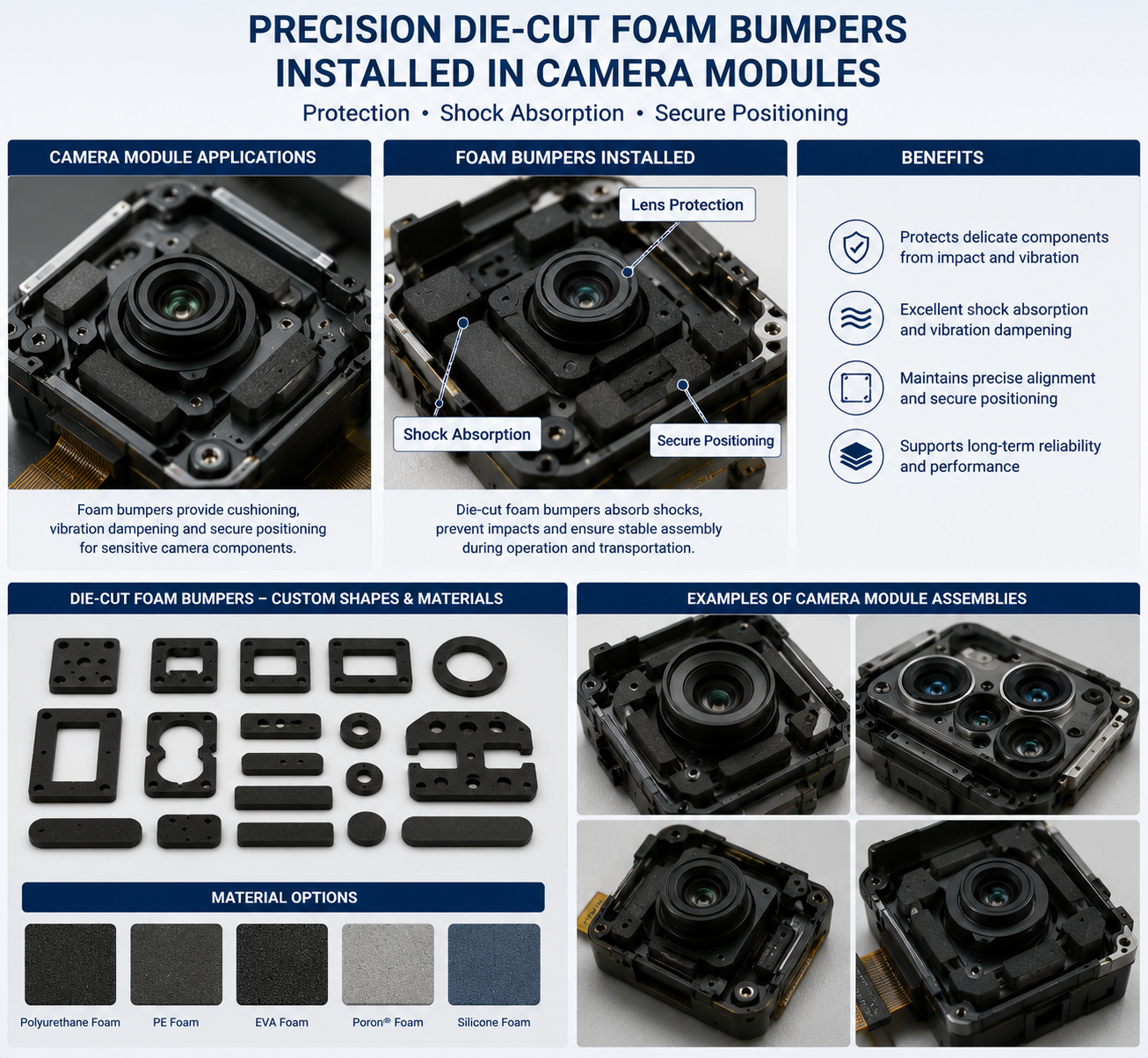
Why Camera Modules Need Proper Foam Padding
Miniature camera modules are sensitive to:
- Vibration and shock during transport and operation
- Micro‑gap movement inside housings
- Dust and particle intrusion
- Temperature and humidity change
- Optical alignment drift
- Assembly pressure variability
A poorly selected foam can:
- Compress permanently (high compression set)
- Transmit vibration instead of damping it
- Lose thickness over time
- Introduce particles or bubbles in optical path
- Affect adhesive reliability
Choosing the right foam ensures long‑term reliability and performance.
Key Foam Properties to Consider
When selecting foam for miniature camera module padding, the most important properties include:
Shock Absorption
The foam must cushion impacts and mechanical shock without transmitting excessive force to the lens or sensor.
Vibration Damping
Minimizing resonance and vibration prevents blurry images, especially in drones, automotive ADAS cameras, or industrial vision systems.
Compression Set Resistance
The foam must recover after compression to maintain constant thickness and protective spacing.
Clean Cut and Low Particle Shedding
For precision assemblies, the foam should die cut cleanly with minimal fiber or particle release.
Dimensional Stability
Foam must retain shape and thickness consistently across temperature and humidity changes.
Die‑Cutting Precision
Accurate cutting preserves assembly tolerances and prevents misalignment or uneven pressure on modules.
Recommended Foam Types for Inner Padding
EVA Foam (Ethylene Vinyl Acetate)
- Advantages:
- Closed‑cell structure resists moisture
- Good shock absorption and moderate vibration damping
- Clean die‑cut edges
- Low particle shedding
- Best For: Protective padding around compact camera housings, lightweight modules, where waterproofing and stable compression matter.
PE Foam (Polyethylene)
- Advantages:
- Excellent vibration and impact damping
- Closed‑cell structure with low compression set
- Moisture resistance
- Best For: High‑frequency vibration environments like drones and industrial vision systems.
PU Foam (Polyurethane)
- Advantages:
- Softer cushioning
- Effective energy absorption
- Flexible compression behavior
- Considerations:
- Open‑cell PU may shed particles; select high‑quality industrial PU with controlled cell structure.
- Best For: Low‑impact protective layers where soft cushion and comfort‑fit are priorities.
Specialty Anti‑Static Foam
For camera modules used in sensitive electronics where static discharge is a concern, anti‑static foam (often PE or conductive EVA variants) helps protect circuitry during assembly and in operation.
What Foam Density Works Best?
Foam density affects how the material performs dynamically:
| Density Range | Cushioning | Vibration Damping | Compression Set |
|---|---|---|---|
| Low (e.g., 25–80 kg/m³) | Soft cushioning | Moderate | Higher set |
| Medium (80–150 kg/m³) | Balanced protection | Good | Lower set |
| High (>150 kg/m³) | Firm support | Excellent | Excellent |
For miniature camera padding, medium‑density EVA or PE foam often provides the best balance between shock absorption and vibration damping without permanent flattening.
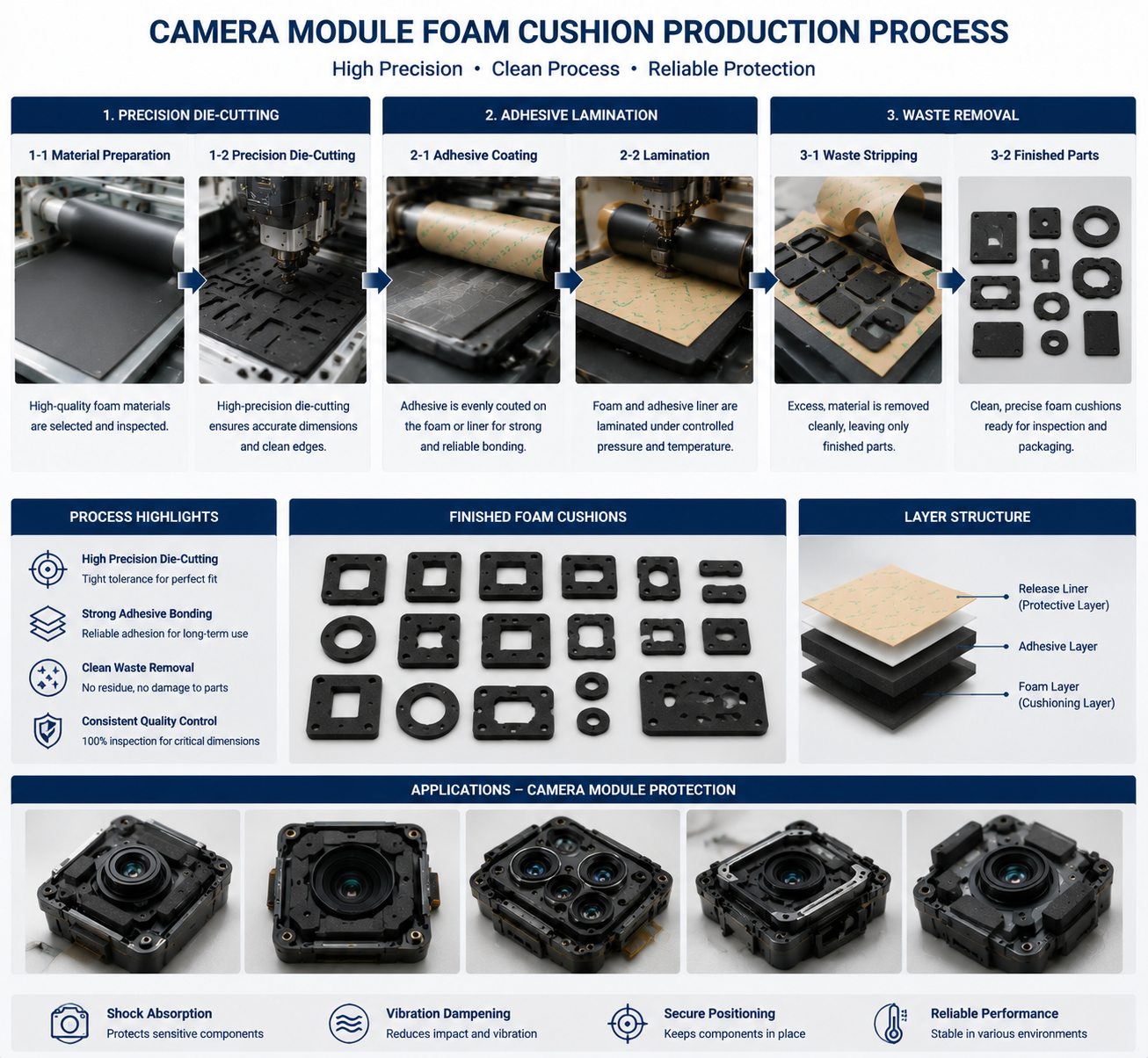
How Die Cutting Improves Foam Padding Performance
Precision die cutting matters because:
- Die‑cut edges are clean and consistent
- Parts fit precisely in tight cavity geometries
- Adhesive backing can be applied accurately
- Waste removal and part shape design aid assembly speed
- Tolerances align with lens optical axis and mounting frames
Poor cutting can lead to uneven compression, assembly misalignment, and acoustic vibration issues.
Design Tips for Camera Module Foam Inserts
Avoid Too Soft Foam Near Optics
Too soft foam may compress under assembly pressure, causing the module to shift. Choose medium‑density materials that resist compression set.
Use Closed‑Cell Foam Near Electronics
Closed‑cell foams like EVA or PE reduce moisture and particle build‑up around sensitive sensors.
Include Adhesive Backing Carefully
Adhesive backing can simplify installation but must be evaluated for:
- Long‑term bonding stability
- Aging resistance
- Compatibility with housing surfaces
Consider Multi‑Layer Structures
Combining foam with films, non‑woven layers, or thin rubber can improve vibration control and sealing.
Common Mistakes to Avoid
- Choosing foam only by softness: Too soft means permanent deformation.
- Ignoring compression set: Some foams never recover fully.
- Overlooking particle shedding: Important for optical clarity.
- Using the wrong adhesive: Edge lifting or outgassing can cause bubbles or separation.
- Neglecting environmental conditions: Temperature and humidity affect foam behavior.
What Buyers Should Confirm Before Ordering
Before placing a bulk order for foam padding, confirm:
- What type of device and operating environment?
- Does the module require shock, vibration, or dust protection?
- What density and thickness optimize cushioning without deformation?
- Is adhesive backing needed?
- Does the foam need anti‑static properties?
- What tolerance is acceptable for die‑cut parts?
- Does the supplier provide cleanroom or low‑particle converting?
- Will the part face heat or humidity over time?
- Is compression set resistance important for long‑term reliability?
- Does the supplier offer testing and validation support?
Why Sanken’s Foam Solutions Work
At Sanken Manufacturing, we help customers:
- Select the right foam type, density, and structure
- Provide precision die cutting with tight tolerances
- Laminate adhesive backing when required
- Control particle cleanliness
- Support prototype testing and mass production
- Optimize assembly fit and vibration control
Our goal is to help OEMs reduce defects, improve product reliability, and shorten development cycles.
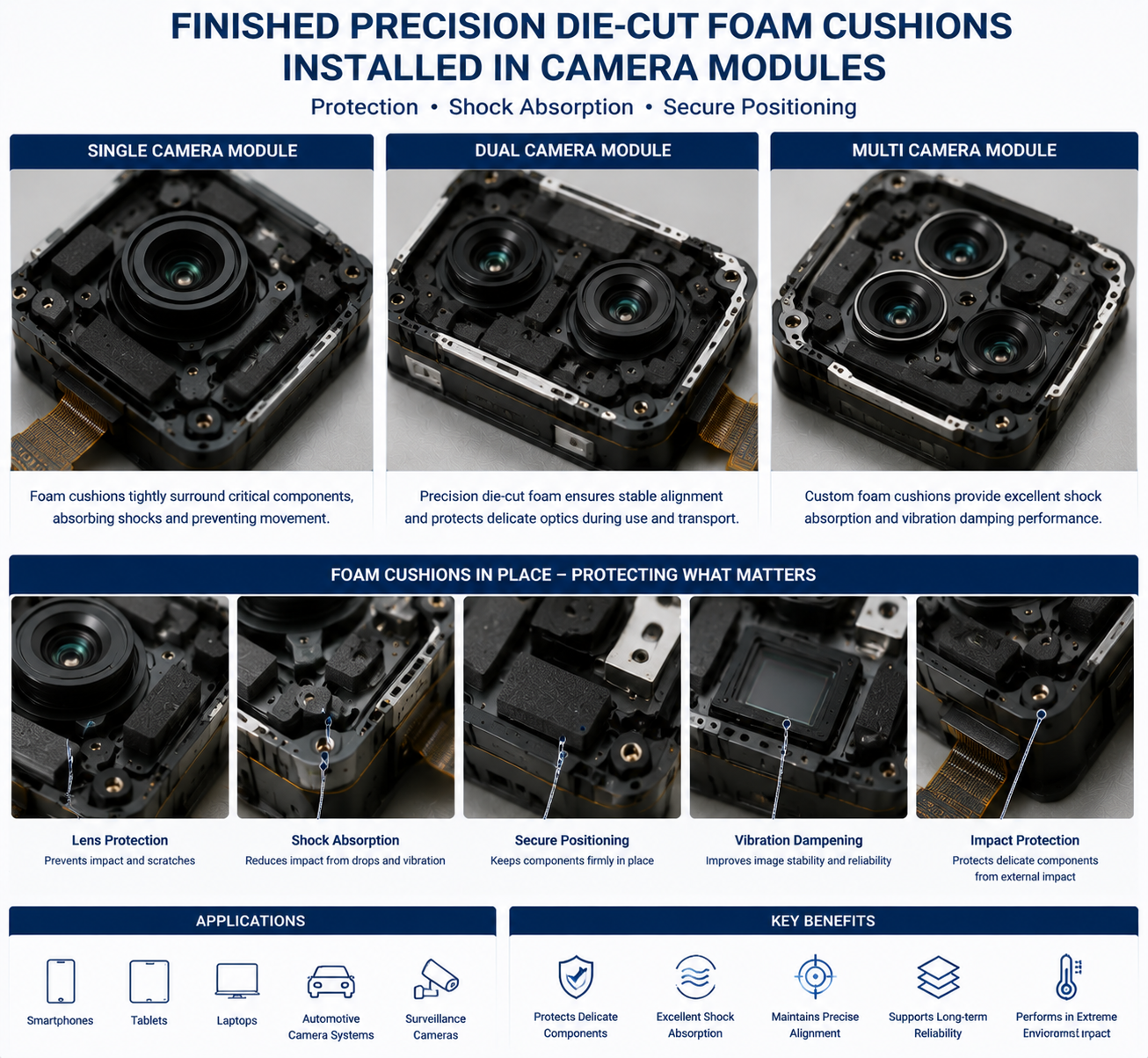
Conclusion
The best cushion foams for miniature camera module inner padding are closed‑cell EVA, PE foam, controlled‑cell PU, and specialty anti‑static foam, selected based on shock absorption, vibration damping, compression set resistance, clean die‑cut quality, and environmental resilience. Precision material selection and converting improve part performance and reduce assembly risk—especially for sensitive optical assemblies.
Choose the right foam and manufacturing partner to ensure stable, reliable camera module performance throughout product life.