
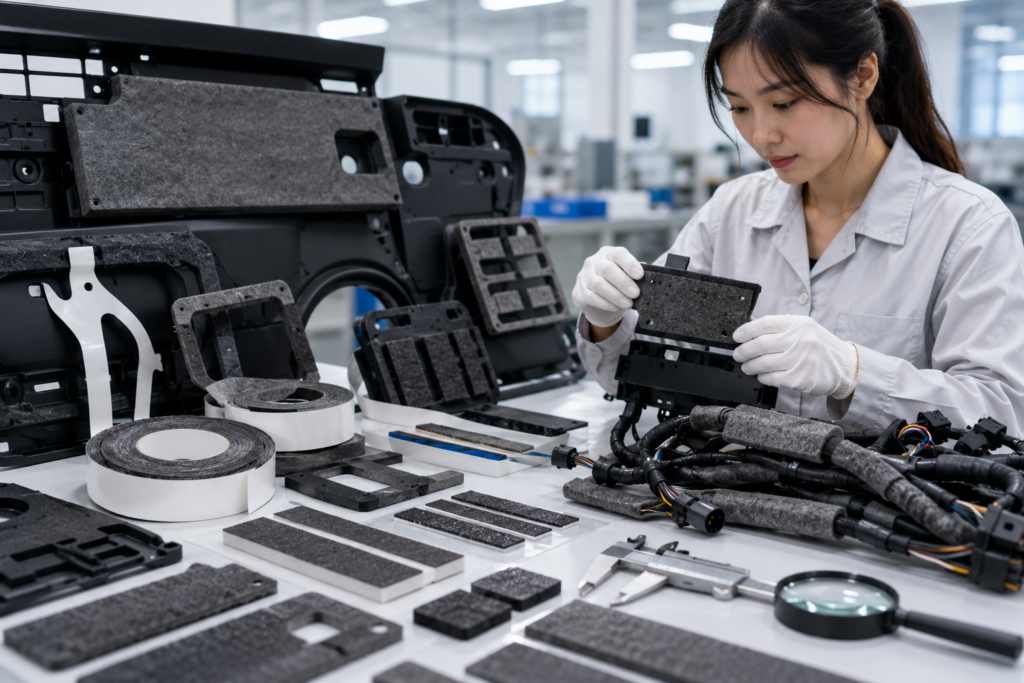
Before a die-cut component enters mass production, it must first prove that its design, material, and manufacturing process meet the requirements of the final application. A well-executed prototype helps engineers verify dimensions, assembly fit, material performance, and manufacturing feasibility before investing in production tooling.
For OEM manufacturers, prototype development is more than producing a sample. It is an opportunity to identify design issues early, reduce engineering changes, and shorten product development cycles.
Sanken supports OEM customers by transforming CAD drawings into functional die-cut prototypes for automotive, electronics, appliances, and industrial applications, helping validate designs before production begins.
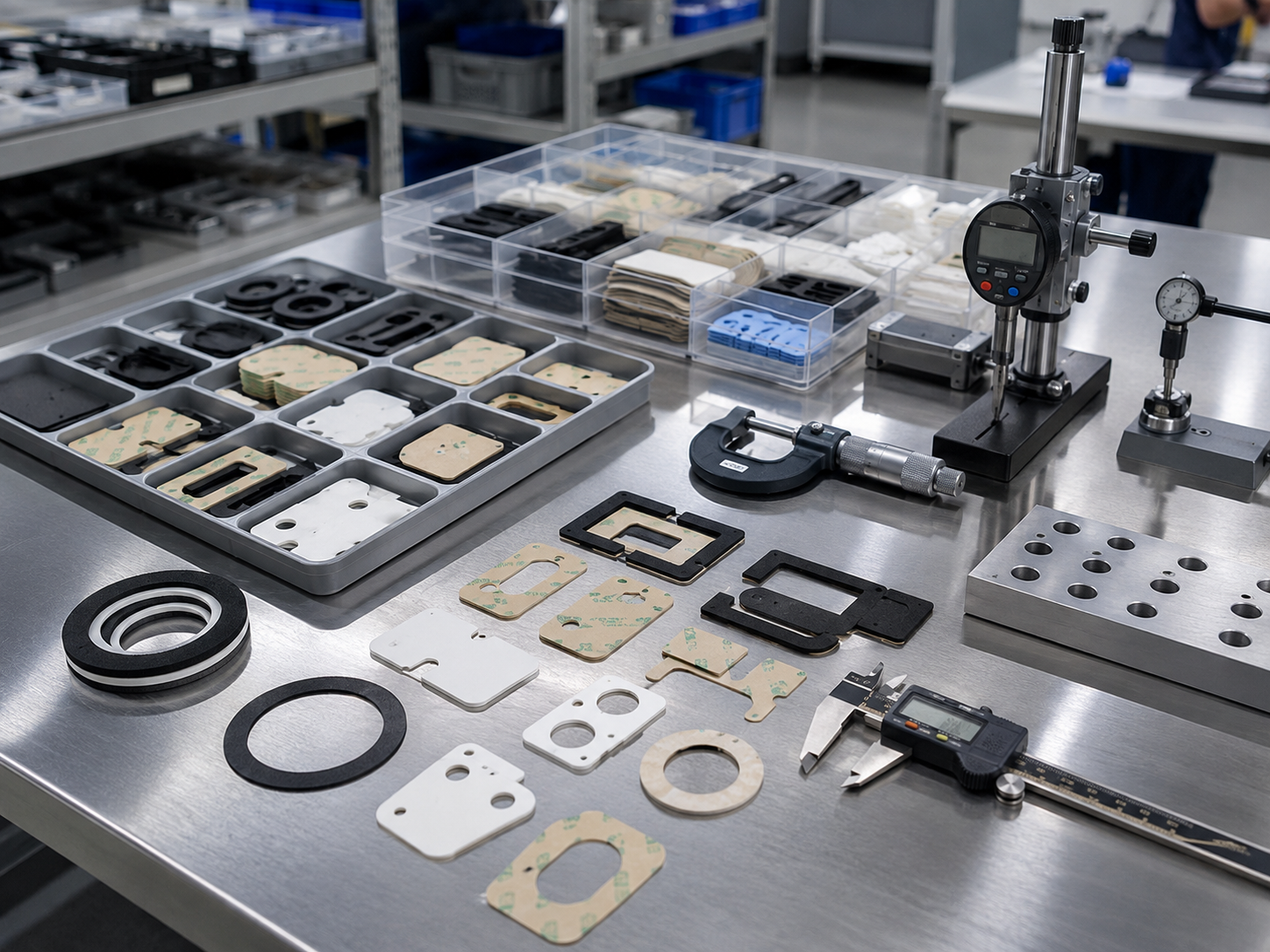
Prototyping Begins with Engineering Drawings
Every prototype starts with a drawing, but a drawing alone does not guarantee a successful component. Engineers must evaluate whether the design can be manufactured efficiently while meeting functional requirements.
During the initial review, several factors are typically considered:
- Material specification
- Part dimensions
- Tolerance requirements
- Hole and slot locations
- Corner radius
- Adhesive structure
- Assembly direction
- Production volume
Some features that appear acceptable in CAD may become difficult to manufacture or assemble. Extremely narrow bridges, sharp internal corners, or unnecessary cutouts can increase tooling complexity and reduce production stability.
Early engineering review often identifies opportunities to simplify the design without affecting product performance.
Material Selection Determines Prototype Performance
Choosing the correct material is one of the most important steps in prototype development.
A prototype should use the same—or a functionally equivalent—material intended for production whenever possible. This allows engineers to evaluate compression, adhesion, flexibility, and durability under realistic conditions.
Common materials include:
| Material | Typical Applications |
|---|---|
| EVA Foam | Cushioning, sealing, vibration reduction |
| PE Foam | Electronics, insulation, packaging |
| EPDM Foam | Automotive sealing |
| Double-sided Adhesive Tape | Bonding and positioning |
| PET Film | Electrical insulation |
| Protective Film | Surface protection |
| Non-Woven Felt | NVH and anti-rattle applications |
Material selection should also consider environmental conditions such as temperature, humidity, UV exposure, and chemical resistance.
Prototype Manufacturing Methods
Not every prototype requires production tooling.
Depending on project requirements, prototypes may be produced using different manufacturing methods before steel-rule dies or rotary tooling are developed.
| Method | Best For |
|---|---|
| Sample cutting | Early design verification |
| Prototype die cutting | Functional testing |
| Pilot tooling | Small production runs |
| Production tooling | High-volume manufacturing |
The chosen method depends on project timing, required accuracy, expected quantity, and customer validation needs.
Prototype manufacturing focuses on confirming the design quickly while providing parts that closely represent future production components.
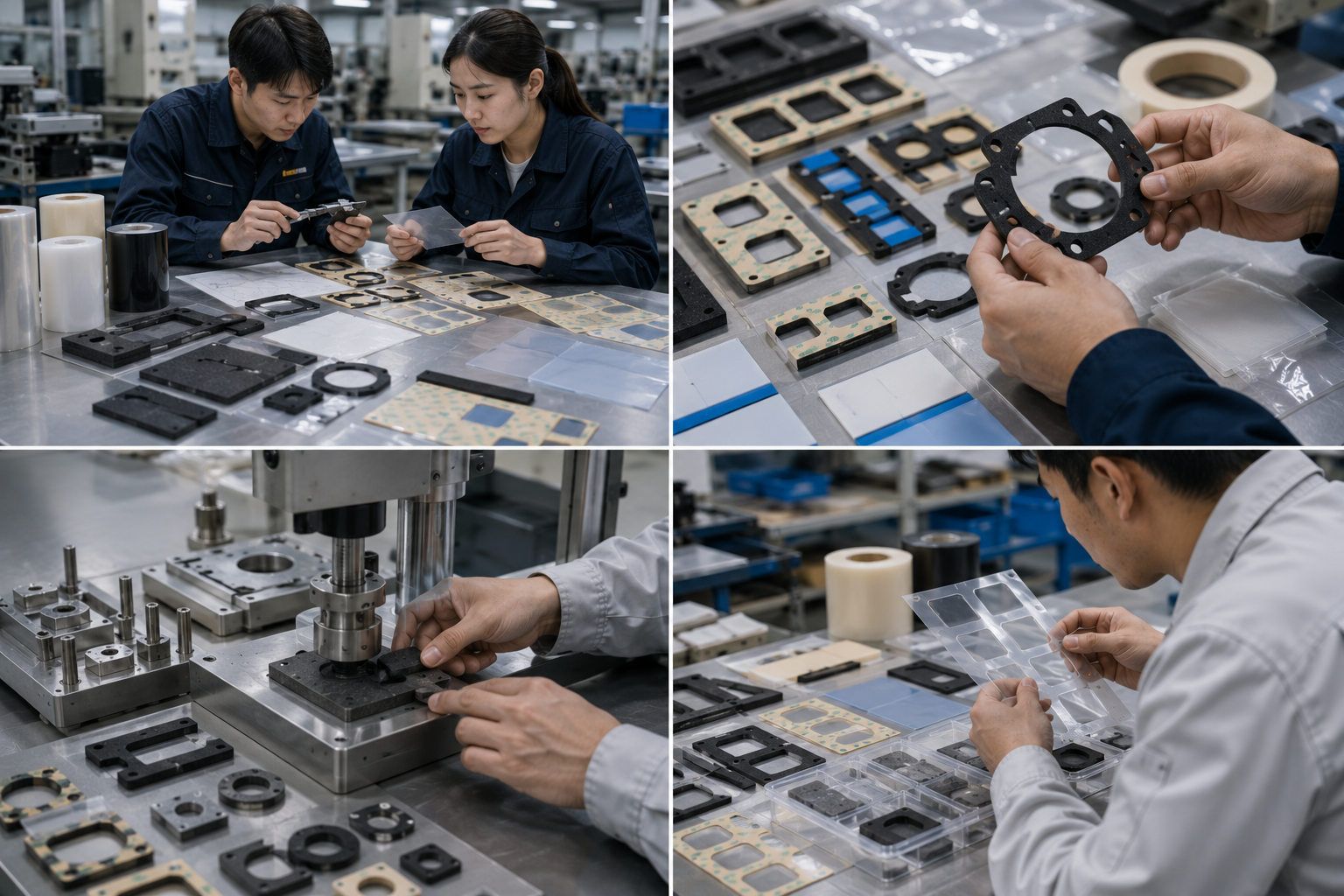
Prototype Evaluation Before Production
Producing a sample is only part of the prototyping process. The prototype must also be evaluated in its intended application.
Typical validation includes:
- Dimensional inspection
- Assembly fit
- Compression performance
- Adhesive positioning
- Peeling performance
- Gap coverage
- Hole alignment
- Surface appearance
For sealing applications, engineers often verify compression and contact pressure. For adhesive components, peel strength and positioning accuracy are checked before production approval.
Testing prototypes under actual operating conditions helps reduce the risk of unexpected issues during mass production.
Optimizing the Design Before Tooling
Prototype feedback frequently leads to design improvements.
Small adjustments made during this stage can significantly improve manufacturability and assembly efficiency.
Examples include:
- Increasing narrow bridge widths
- Adding corner radii
- Simplifying internal cutouts
- Adjusting adhesive areas
- Optimizing gasket compression
- Improving liner design
These changes may appear minor but often reduce production scrap, improve dimensional stability, and simplify installation.
Because tooling has not yet been finalized, modifications are generally faster and less expensive during prototyping than after production begins.
Preparing for Mass Production
Once the prototype has been approved, the project moves into production preparation.
At this stage, manufacturers confirm:
| Production Item | Purpose |
|---|---|
| Final material | Consistent product performance |
| Production tooling | Stable repeatability |
| Manufacturing process | Efficient production |
| Inspection standards | Quality consistency |
| Packaging method | Safe transportation |
| Delivery format | Supports customer assembly |
Many OEM customers also determine whether components should be supplied in sheets, rolls, or custom kits based on their assembly process.
Our Precision Die Cutting Services support the transition from prototype validation to stable mass production while maintaining dimensional consistency and production efficiency.
How Sanken Supports Prototype Development
Sanken works with OEM manufacturers from the earliest stages of product development, converting customer drawings into functional die-cut samples for evaluation and testing. By combining material selection, engineering review, prototype manufacturing, and production planning, we help customers reduce development time and improve the success of mass production projects.
You May Also Be Interested In
- How to Choose the Right Die Cutting Manufacturer for Your OEM Project
- From Foam Rolls to Finished Parts: How Die Cutting Works
- What Is Die Cut Definition, Meaning and Applications?
- How Are Die Cut Parts Supplied in Sheets, Rolls or Kits?
- Why OEM Manufacturers Rely on Die Cutting Every Day
Conclusion
Successful die-cut part prototyping involves much more than producing a sample. It validates material selection, confirms assembly performance, identifies design improvements, and reduces manufacturing risks before production tooling is released. By reviewing drawings early and testing prototypes under realistic conditions, OEM manufacturers can shorten development cycles, reduce engineering changes, and move into mass production with greater confidence.