
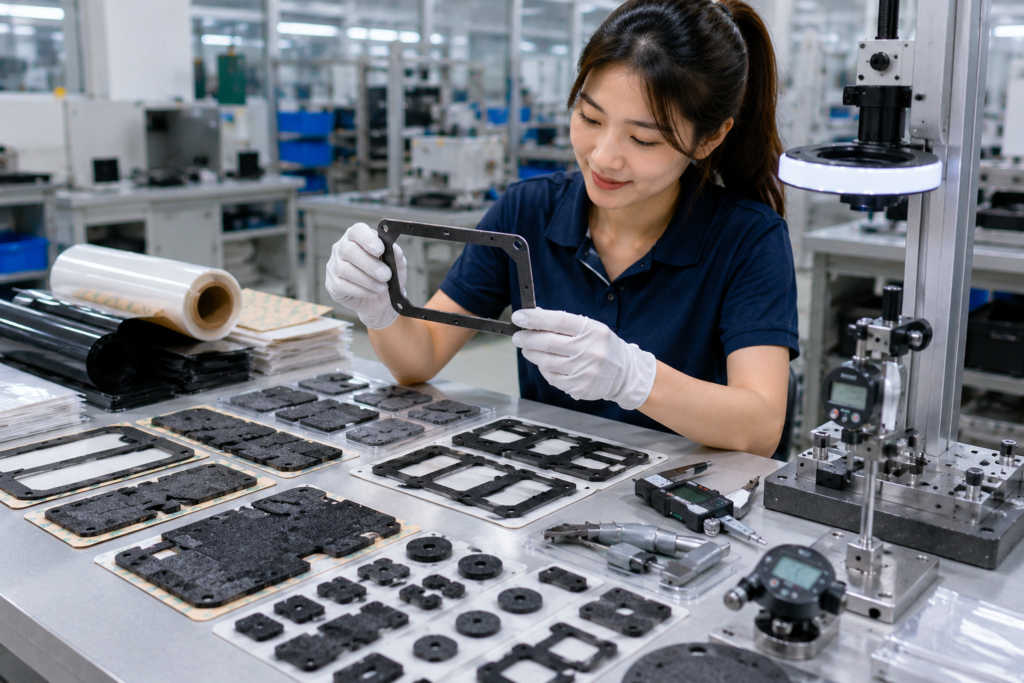
Electric vehicle interiors are becoming quieter, more electronic, and more tightly integrated than conventional vehicle cabins. Displays, sensors, control panels, lighting systems, air ducts, wiring, trim assemblies, and acoustic structures must fit into limited spaces while meeting strict requirements for comfort, appearance, and production efficiency.
Precision die cutting supports these assemblies by converting flexible materials into accurate foam pads, rubber seals, adhesive frames, PET insulation parts, protective films, and non-woven felt components. Although many of these parts remain hidden after assembly, they influence noise control, vibration reduction, sealing, electrical protection, component positioning, and long-term interior quality.
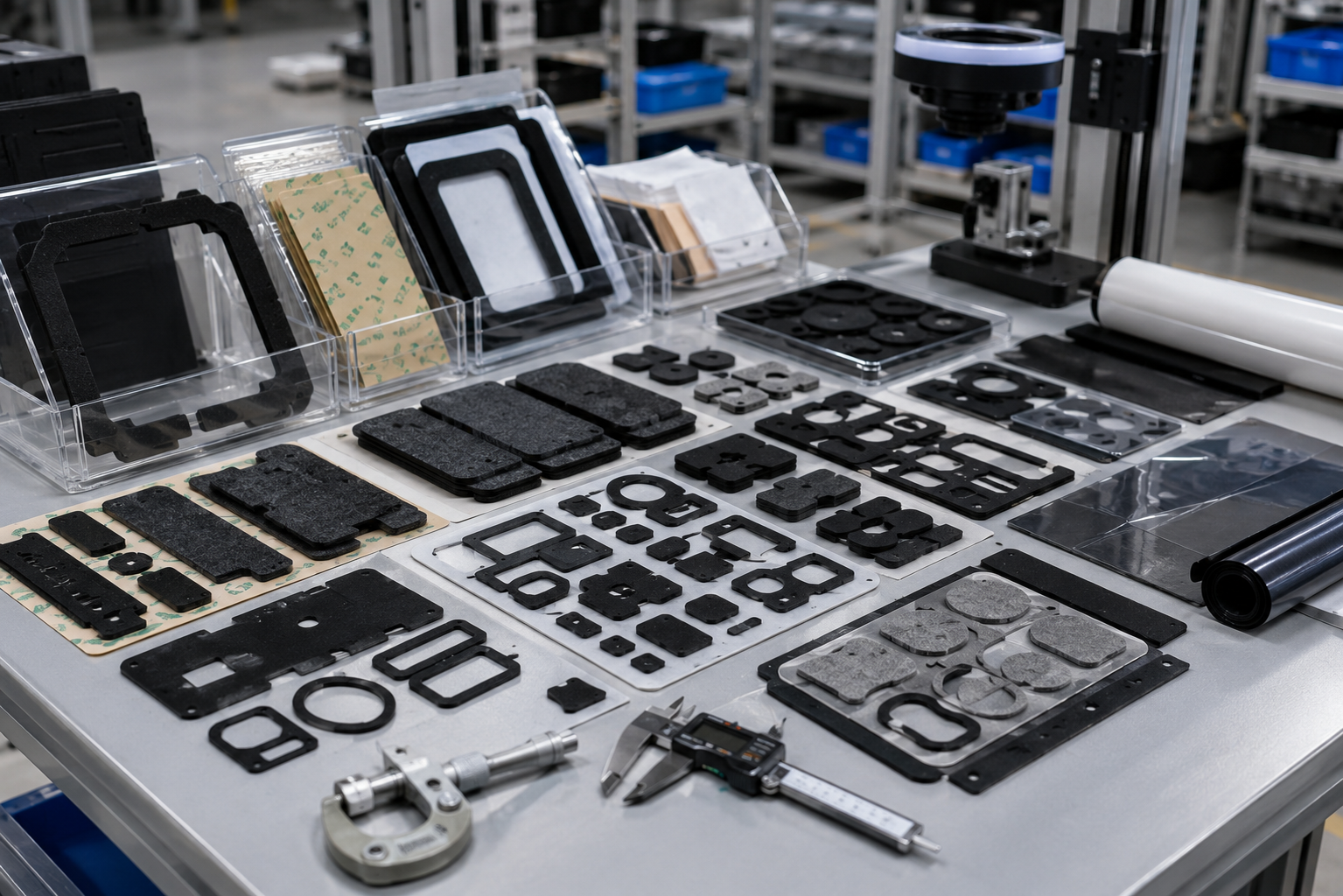
EV Interiors Create New Requirements for Flexible Components
EV interiors contain many of the same structures found in conventional vehicles, but the performance priorities are changing.
Because electric powertrains produce less engine noise, occupants are more likely to notice smaller sounds from trim movement, airflow, wiring, seat structures, displays, and interior panels. This increases the importance of controlling squeaks, rattles, vibration, and local contact noise.
Modern EV cabins also use more electronic systems, including:
- Digital instrument clusters
- Large center displays
- Touch-control panels
- Interior cameras and sensors
- Ambient lighting
- Advanced climate-control systems
- Electronic seat controls
- Additional wiring and connectors
These assemblies require thin, accurately positioned flexible components that can seal gaps, isolate vibration, protect surfaces, and support reliable production.
Precision die cutting makes it possible to produce these parts with repeatable shapes, hole positions, thicknesses, and adhesive structures.
Non-Woven Felt Supports NVH and Anti-Rattle Performance
Non-woven felt is widely used in automotive interiors for noise, vibration, and harshness control. It can be placed between contacting components to reduce friction, prevent rattling, and absorb local sound.
Typical EV interior applications include:
| Application Area | Function of Die Cut Felt |
|---|---|
| Door trim panels | Reduces contact noise and rattling |
| Dashboard assemblies | Controls squeaks between plastic parts |
| Center consoles | Cushions hidden contact points |
| Wiring harnesses | Reduces movement and abrasion |
| HVAC ducts | Limits vibration and airflow-related noise |
| Seat structures | Prevents friction between adjacent parts |
| Interior pillars | Improves acoustic performance |
Felt components must fit accurately around clips, fasteners, openings, and curved trim features. If a pad is too large, it may interfere with assembly. If it is too small or incorrectly positioned, it may fail to isolate the contact area.
Die cutting allows felt to be produced as strips, pads, rings, frames, or irregular components. Adhesive backing can also be added to simplify positioning during assembly.
For EV interiors where cabin noise is especially noticeable, properly designed automotive die cut components can improve both acoustic comfort and production consistency.
Foam Components Provide Cushioning and Gap Control
Foam materials are used throughout vehicle interiors to cushion components, fill controlled gaps, reduce vibration, and prevent direct contact between hard surfaces.
Common materials include PE, EVA, PU, EPDM, and silicone foam. Each offers different compression, density, resilience, and environmental performance.
| Foam Material | Typical Strength | Interior Application |
|---|---|---|
| PE foam | Lightweight and dimensionally stable | Spacing pads and protective components |
| EVA foam | Flexible and economical | General cushioning and support |
| PU foam | Soft and conformable | Low-pressure gap filling |
| EPDM foam | Durable and resilient | Sealing and vibration isolation |
| Silicone foam | Temperature resistant | Demanding electronic or lighting areas |
A foam part must be selected according to its real function. A soft foam may work well as a light cushioning pad but may compress too much when used as a structural spacer. A higher-density foam may maintain a gap more effectively but transmit more force to the surrounding assembly.
Important selection factors include:
- Thickness tolerance
- Density
- Compression force
- Compression recovery
- Adhesive compatibility
- Temperature exposure
- Moisture resistance
- Long-term deformation
Custom foam gaskets and seals can be produced with openings, narrow walls, tabs, adhesive backing, and release liners for vehicle interior assemblies.
Adhesive Tape Converting Improves Assembly Efficiency
Many EV interior parts must be installed quickly and accurately on high-volume production lines. Adhesive-backed die cut components help reduce separate bonding steps and keep flexible materials in position before final assembly.
Common converted adhesive parts include:
- Foam tape frames
- Double-sided tape strips
- Adhesive-backed felt pads
- Mounting pads
- Display perimeter frames
- Protective film pull tabs
- Rubber pads with positioning adhesive
The adhesive should be matched to the actual substrate, such as painted metal, molded plastic, glass, coated surfaces, rubber, or PET film.
Surface energy, texture, cleanliness, temperature, and expected service life all affect bonding performance. A material may show strong initial tack but still lift after heat exposure or repeated vibration if the adhesive system is not suitable.
Release-liner design is also important. Split liners and extended tabs can make large or narrow components easier to handle without stretching, folding, or touching the adhesive surface.
Sanken’s adhesive-backed die cut components can be supplied in sheets, rolls, or organized kits according to the customer’s installation process.
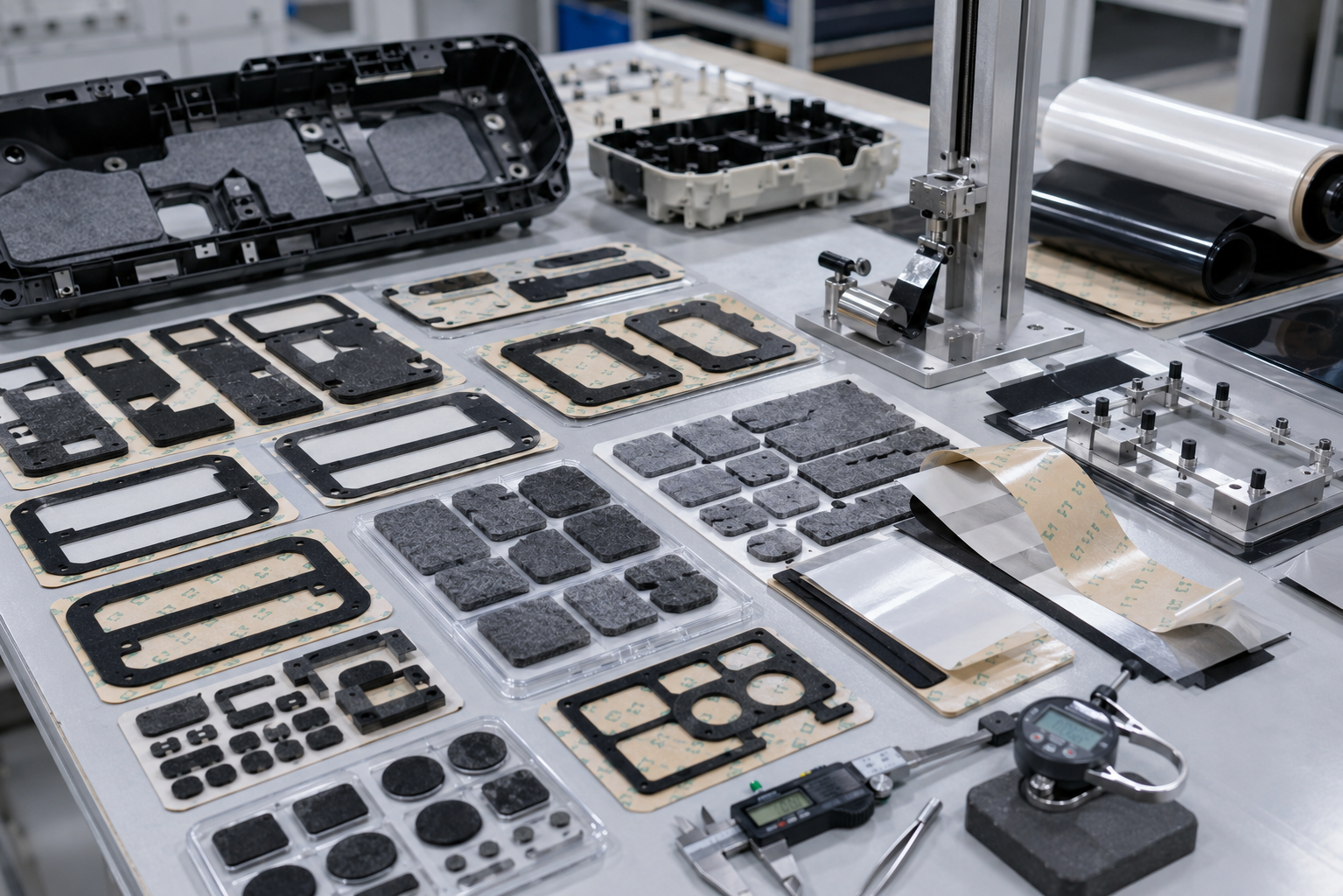
PET Insulation Films Protect Interior Electronics
EV interiors use a growing number of electronic components. Displays, lighting systems, sensors, cameras, switches, control boards, and wiring interfaces may require thin insulation and surface-protection parts.
PET insulation film can be die cut into:
- Flat insulation pads
- Adhesive-backed barriers
- Connector-area covers
- Frames around electronic assemblies
- Protective strips
- Components with holes and positioning tabs
PET film is useful where the design needs a thin, stable material rather than a compressible foam. Its low thickness allows it to fit into narrow electronic assemblies without adding unnecessary stack height.
Precision cutting is essential because openings and edges must align correctly with connectors, fasteners, and electronic components. Rough edges, inaccurate holes, or poorly positioned adhesive can create installation problems.
The insulation film, adhesive, and release liner should be evaluated together as one assembly structure. The part must remain flat, peel cleanly, and stay in position after installation.
Rubber Parts Support Sealing and Durable Contact Protection
EPDM and silicone rubber parts can be used where interior assemblies need durable sealing, contact protection, or vibration damping.
Potential applications include:
- HVAC interfaces
- Lighting housings
- Camera or sensor areas
- Control-panel seals
- Local vibration pads
- Protective spacers
- Water-resistant interface components
Solid rubber is less compressible than foam and can provide more durable contact protection. Sponge rubber offers greater conformity and may be better suited to uneven surfaces.
Hardness, thickness, compression, and adhesive backing must be carefully matched to the surrounding structure. A rubber pad that is too hard may transfer vibration rather than isolate it, while a soft part may deform or shift under load.
Custom rubber parts can be produced as rings, strips, pads, frames, and irregular seals through precision die cutting services.
Accurate Geometry Reduces Production Problems
Material choice alone does not guarantee a reliable EV interior component. Part geometry strongly affects manufacturability and installation.
Critical design features include:
| Design Feature | Possible Production Risk |
|---|---|
| Narrow walls | Stretching or tearing |
| Sharp internal corners | Stress concentration and difficult waste removal |
| Small holes near edges | Weak sections and deformation |
| Excess adhesive at edges | Contamination and difficult handling |
| Very tight tolerances | Higher cost without functional benefit |
| Large unsupported shapes | Curling or stretching during application |
| Poor liner layout | Difficult peeling and inaccurate placement |
Rounded corners can improve both production stability and handling. Adequate spacing between cut features helps prevent tearing during matrix removal.
Engineers should identify which dimensions are genuinely critical to assembly. Applying the same tight tolerance to every edge can increase tooling complexity and cost without improving performance.
Early drawing review helps determine whether the part should be kiss cut, through cut, supplied individually, or delivered on a carrier liner.
Roll and Sheet Formats Support Different Assembly Methods
The supply format of a die cut part can influence production speed as much as the component design itself.
Common formats include:
- Individual pieces
- Kiss-cut sheets
- Roll-to-roll parts
- Trays
- Pre-arranged kits
Roll formats are useful for automated or repeated assembly processes. Kiss-cut sheets help operators remove parts while keeping adhesive surfaces protected. Individual pieces may be appropriate for larger rubber or foam components, while kits can organize several parts for one trim or dashboard assembly.
The best format depends on the production station, installation sequence, part size, operator handling, and annual volume.
Sanken can provide die cut parts in sheets, rolls, or kits to match different OEM assembly requirements.
Quality Control Supports Consistent Interior Assembly
Interior components are highly visible to vehicle occupants, even when the die cut parts themselves are hidden. Poorly controlled flexible components may contribute to panel gaps, loose trim, visible lifting, noise, or inconsistent fit.
Important inspection areas include:
| Inspection Item | Purpose |
|---|---|
| Material verification | Confirms the approved material structure |
| Dimensional inspection | Ensures fit around clips, holes, and openings |
| Thickness measurement | Maintains compression and spacing |
| Adhesive alignment | Prevents exposed adhesive and installation errors |
| Cutting-depth inspection | Protects the release liner during kiss cutting |
| Appearance inspection | Detects contamination, damage, or deformation |
| Packaging review | Prevents curling and compression during transport |
For adhesive-backed parts, peel behavior and liner removal should also be checked. A component that is difficult to remove from the liner can slow assembly or become distorted before installation.
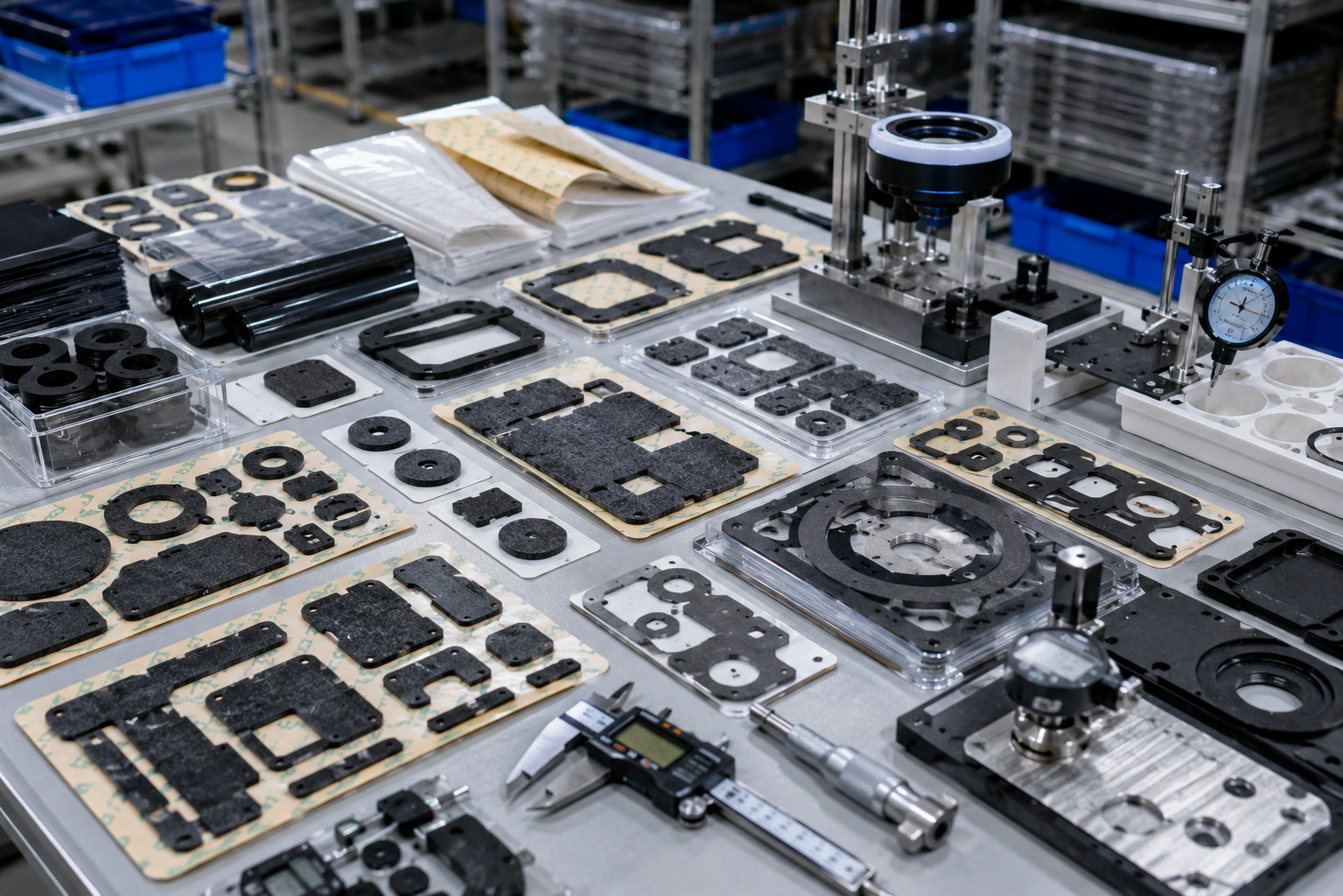
How Sanken Supports EV Interior Manufacturing
Sanken manufactures custom die cut foam, rubber, non-woven felt, adhesive tape, PET insulation film, protective film, and multilayer flexible components for automotive interior applications.
We support drawing review, material conversion, laminating, kiss cutting, through cutting, roll-to-roll production, prototype development, inspection, and sheet, roll, or kit delivery. Each part is developed around its actual installation position, performance requirement, and mass-production method.
You May Also Be Interested In
- Where Are Die Cut Parts Used in Automotive Manufacturing?
- Custom Die Cut Foam and Felt Parts for Sound Dampening and Vibration Reduction
- How Die Cut Parts Are Supplied in Sheets, Rolls, or Kits
- Adhesive-Backed Die Cut Components for OEM Assembly
- How to Avoid Costly Mistakes in Custom Die Cut Parts
Conclusion
Precision die cutting supports modern EV interior manufacturing by turning flexible materials into accurate components for NVH control, cushioning, sealing, electrical protection, surface protection, and assembly positioning.
Non-woven felt helps reduce squeaks and rattles, foam controls gaps and vibration, rubber provides durable protection, adhesive-backed parts improve installation, and PET film protects interior electronics. The performance of each component depends on material selection, geometry, adhesive structure, tolerance control, and supply format.
By reviewing these factors early and validating parts in the real assembly, EV manufacturers can reduce noise, improve interior quality, shorten installation time, and maintain consistent production across high-volume vehicle programs.