
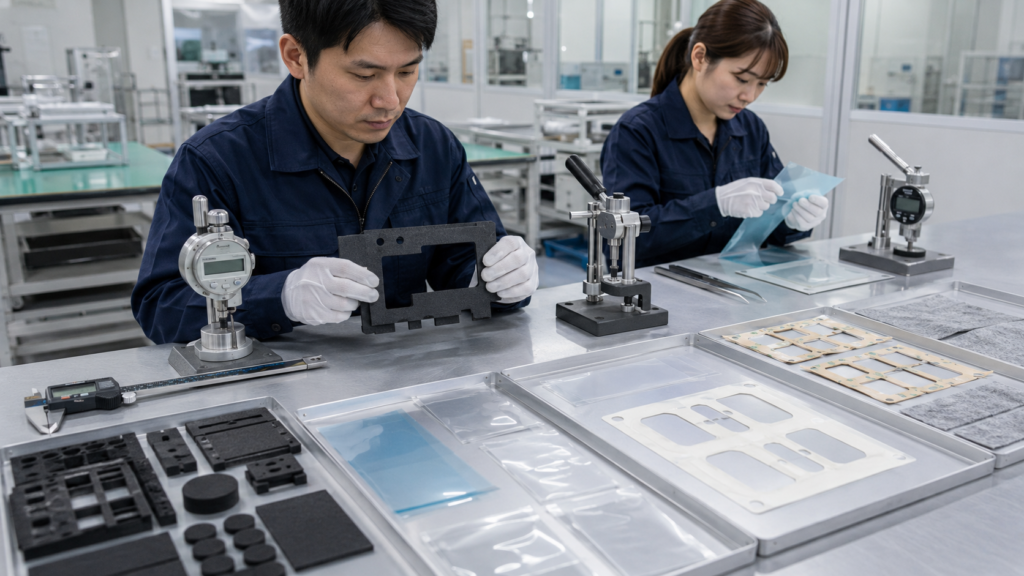
Electrical insulation is one of the most important considerations in EV battery pack design. As battery systems become more compact and power density continues to increase, flexible insulation materials must provide reliable electrical separation while supporting efficient assembly and long-term durability.
PET insulation films and pressure-sensitive adhesive tapes are widely used because they combine excellent dimensional stability, precise die-cutting capability, lightweight construction, and easy installation. Together, they help manufacturers improve electrical protection, simplify assembly, and maintain consistent product quality throughout mass production.
PET Films and Adhesive Tapes Work Together
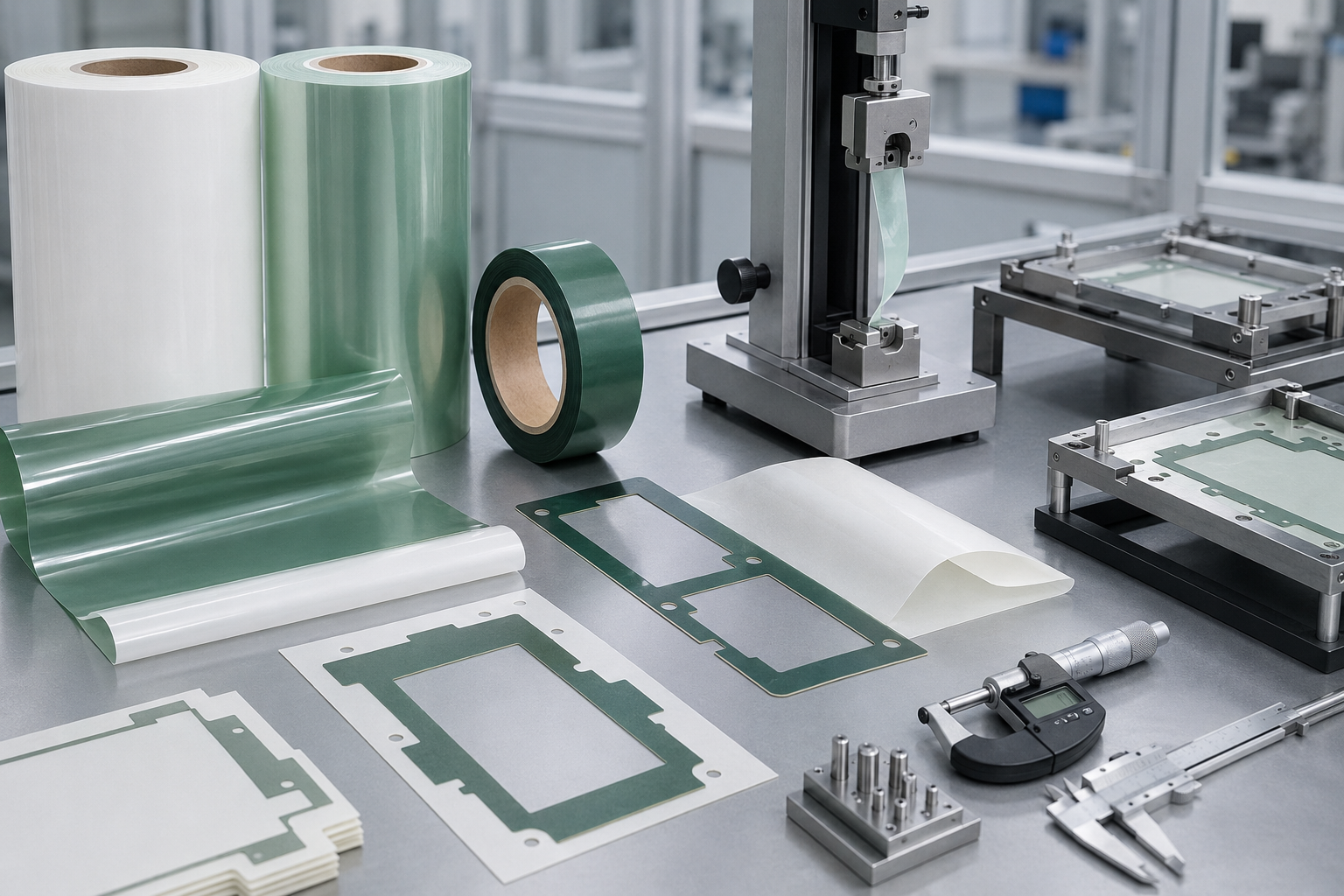
Although PET insulation films and adhesive tapes are different materials, they are often combined into a single die cut component.
PET film provides the electrical insulation and dimensional stability, while the adhesive layer keeps the insulation accurately positioned throughout production and product life.
Typical multilayer constructions include:
| Material Structure | Primary Function |
|---|---|
| PET Film | Electrical insulation |
| PET + Adhesive | Insulation and positioning |
| PET + Adhesive + Release Liner | Easy assembly and handling |
| PET + Foam + Adhesive | Insulation and cushioning |
| PET + Protective Film | Surface protection during assembly |
Instead of installing multiple individual materials, OEM manufacturers can use a single converted component that performs several functions simultaneously.
This approach reduces assembly time, improves positioning accuracy, and minimizes handling errors.
PET Insulation Film Provides Stable Electrical Protection
PET film is widely used because it offers a combination of electrical insulation, mechanical strength, dimensional stability, and excellent converting performance.
Typical applications include:
- Electrical insulation barriers
- Connector insulation
- Busbar protection
- Terminal insulation
- Electronic module insulation
- Sensor protection
- Insulation around metal brackets
Unlike compressible foam materials, PET maintains its dimensions well during assembly, making it suitable for applications where accurate positioning is critical.
Important material properties include:
| Property | Importance |
|---|---|
| Electrical insulation | Prevents unintended conductive contact |
| Dimensional stability | Maintains accurate positioning |
| Mechanical strength | Resists tearing during assembly |
| Thickness consistency | Supports repeatable production |
| Surface quality | Improves adhesive bonding |
Different PET grades provide different electrical and mechanical properties. Engineers should evaluate the complete application instead of selecting material solely by thickness.
Our Precision Die Cutting Services convert PET insulation films into custom parts for automotive and electronic OEM applications.
Adhesive Tapes Improve Positioning and Assembly Efficiency
Adhesive tapes are not only bonding materials—they also improve manufacturing efficiency.
Pressure-sensitive adhesive allows insulation parts to remain securely positioned before the battery enclosure is fully assembled.
Benefits include:
- Faster installation
- Improved positioning accuracy
- Reduced manual handling
- Better compatibility with automated assembly
- More consistent production quality
Depending on the application, adhesive systems may be selected for aluminum, coated metal, engineering plastics, painted surfaces, or PET substrates.
The adhesive should remain stable throughout the product's operating environment without lifting, shrinking, or contaminating surrounding components.
Release liner design also influences production efficiency. Split liners, extended pull tabs, and kiss-cut delivery formats often simplify installation for complex insulation parts.
Sanken also manufactures adhesive-backed die cut components that combine PET films, adhesive tapes, and other flexible materials into assembly-ready solutions.
Precision Die Cutting Ensures Accurate Insulation Components
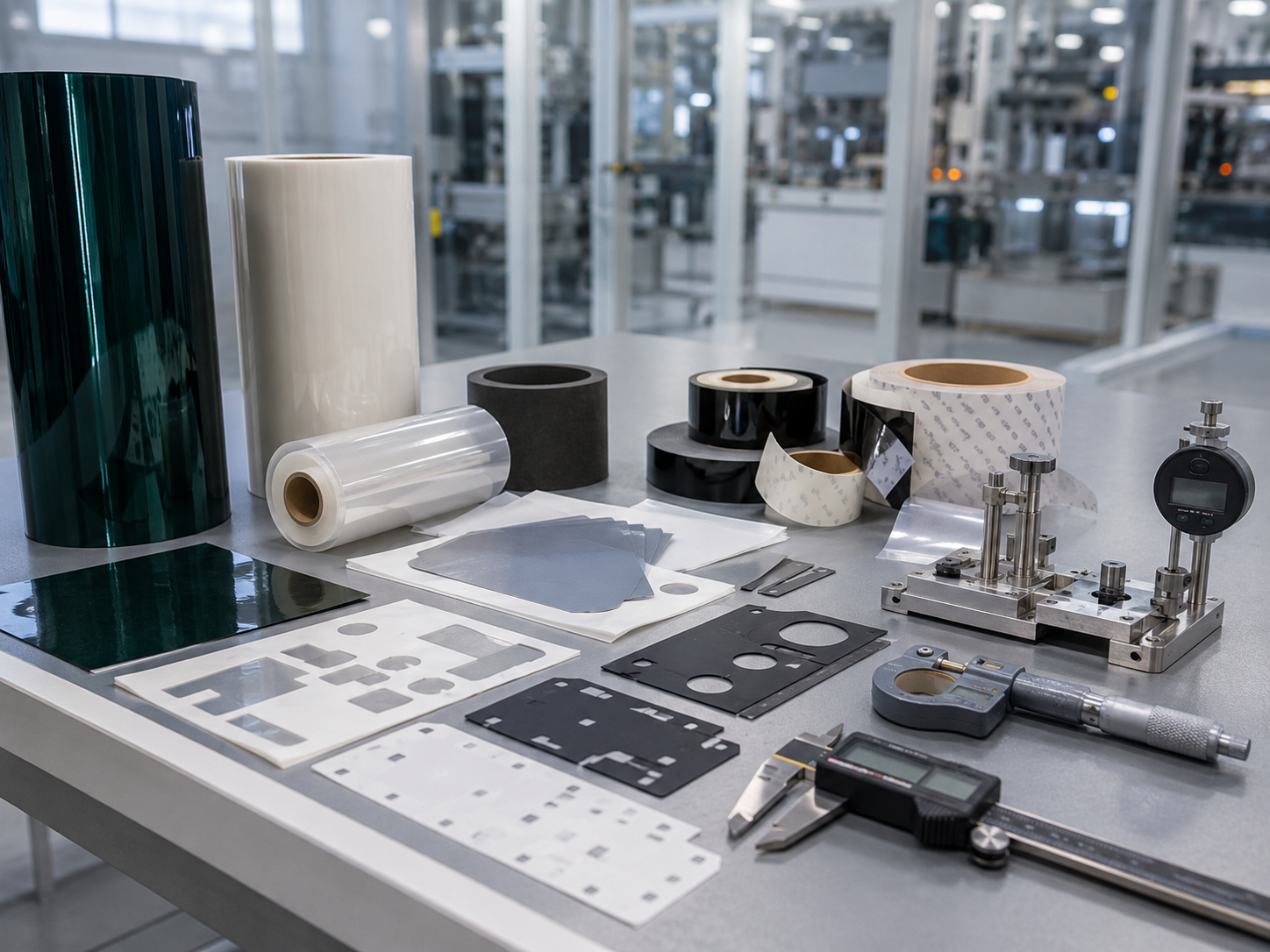
Battery insulation parts frequently include narrow strips, holes, slots, irregular outlines, and positioning features.
These details require high manufacturing accuracy.
Precision die cutting controls:
- Part dimensions
- Hole positions
- Corner quality
- Adhesive alignment
- Kiss-cut depth
- Layer registration
- Edge cleanliness
Poor cutting quality may create burrs, edge damage, dimensional variation, or adhesive misalignment that affects assembly.
For adhesive-backed PET films, kiss cutting is often preferred because the insulation component remains attached to the release liner until installation.
This protects the adhesive surface while allowing fast and accurate placement on the production line.
Engineers designing battery insulation parts should also consider practical geometry. Rounded internal corners, adequate spacing between holes, and reasonable tolerances help improve manufacturing stability while reducing tooling wear.
Material Selection Should Match the Application
Although PET film is widely used, not every insulation application requires the same material structure.
OEM engineers should evaluate:
| Selection Factor | Design Consideration |
|---|---|
| Operating voltage | Required insulation performance |
| Temperature | Material stability |
| Assembly method | Manual or automated production |
| Installation surface | Adhesive compatibility |
| Mechanical stress | Durability requirements |
| Production volume | Manufacturing efficiency |
Some insulation parts only require a thin PET barrier, while others benefit from laminated structures that combine PET film with adhesive, foam, or protective films.
Selecting the appropriate material structure early in development often reduces assembly complexity and improves long-term reliability.
For general guidance on insulation materials, engineers may also refer to the technical resources published by the IEC (International Electrotechnical Commission), which develops internationally recognized electrical standards for industrial products and systems.
Quality Control Is Essential for Battery Insulation Parts
Battery insulation components are small, but dimensional variation can create significant assembly issues.
Typical inspection items include:
| Inspection Item | Purpose |
|---|---|
| Material verification | Confirms approved specifications |
| Thickness measurement | Maintains dimensional consistency |
| Die cut dimensions | Ensures assembly fit |
| Adhesive position | Prevents installation errors |
| Edge inspection | Detects burrs or damage |
| Kiss-cut depth | Protects release liner |
| Packaging inspection | Prevents deformation during shipment |
Rather than inspecting only finished products, many manufacturers monitor production continuously to detect process variation before it affects large production batches.
How Sanken Supports EV Battery Insulation Projects
Sanken manufactures custom die cut PET insulation films, adhesive-backed insulation parts, protective films, and multilayer flexible components for automotive and electronic OEM applications. From prototype development through mass production, we help customers optimize material selection, component design, adhesive structures, and manufacturing processes to improve assembly efficiency and long-term product reliability.
You May Also Be Interested In
- PET vs PI Insulation Films: Which Is Better for Electronic Components?
- What EV Battery Insulation Materials Should OEM Buyers Consider?
- How to Avoid Burrs, Size Drift, and Edge Defects in PET Insulation Film Die Cutting
- How Are Die Cut Parts Supplied in Sheets, Rolls, or Kits?
- How to Choose the Right Die Cutting Manufacturer for Your OEM Project
Conclusion
PET insulation films and adhesive tapes play complementary roles in EV battery electrical insulation. PET films provide stable electrical protection and dimensional accuracy, while adhesive tapes simplify positioning and improve manufacturing efficiency. Combined through precision die cutting, they become reliable, assembly-ready components that support modern battery production.
Selecting the right material structure, adhesive system, and converting process early in development helps OEM manufacturers improve assembly consistency, reduce production risks, and ensure long-term electrical insulation performance in EV battery packs.