
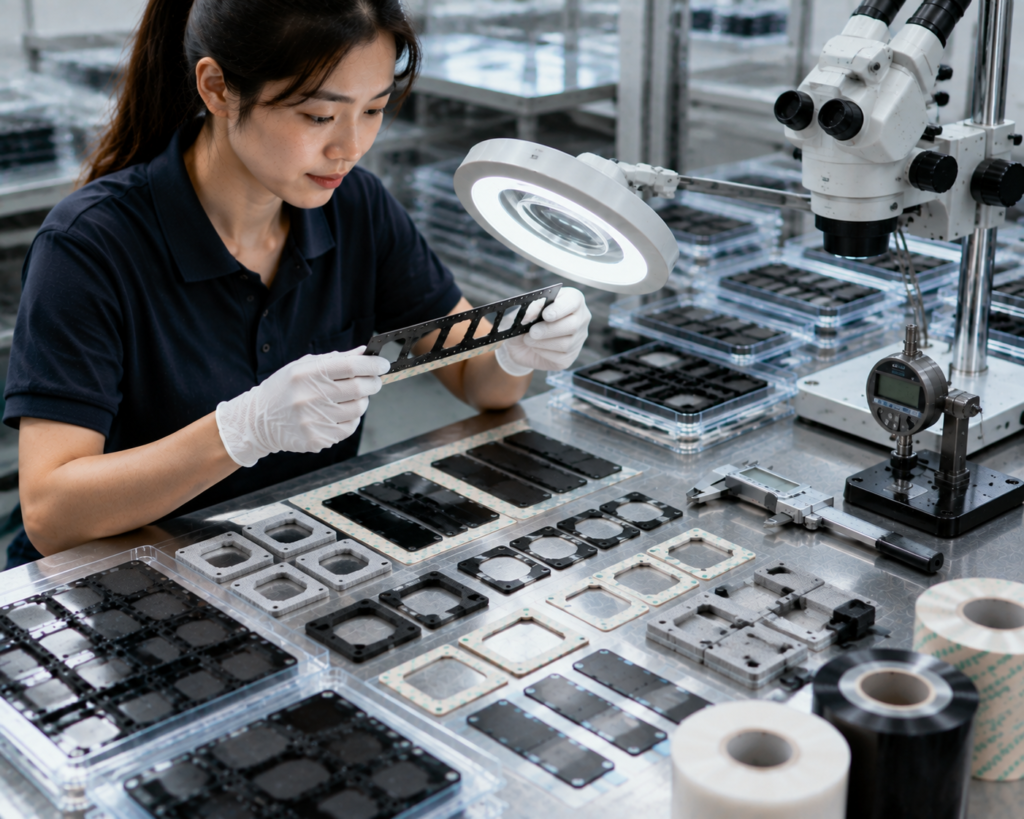
Camera modules require precise protection against dust, moisture, vibration, and mechanical stress. As optical components become smaller and more integrated, manufacturers need reliable sealing and cushioning solutions that fit limited spaces while maintaining stable performance.
Precision die-cut foam tape and cushion parts provide an effective solution by combining sealing support, gap filling, vibration control, and component positioning. Compared with manually applied foam materials, custom die-cut components offer better dimensional accuracy, cleaner assembly, and improved production consistency.
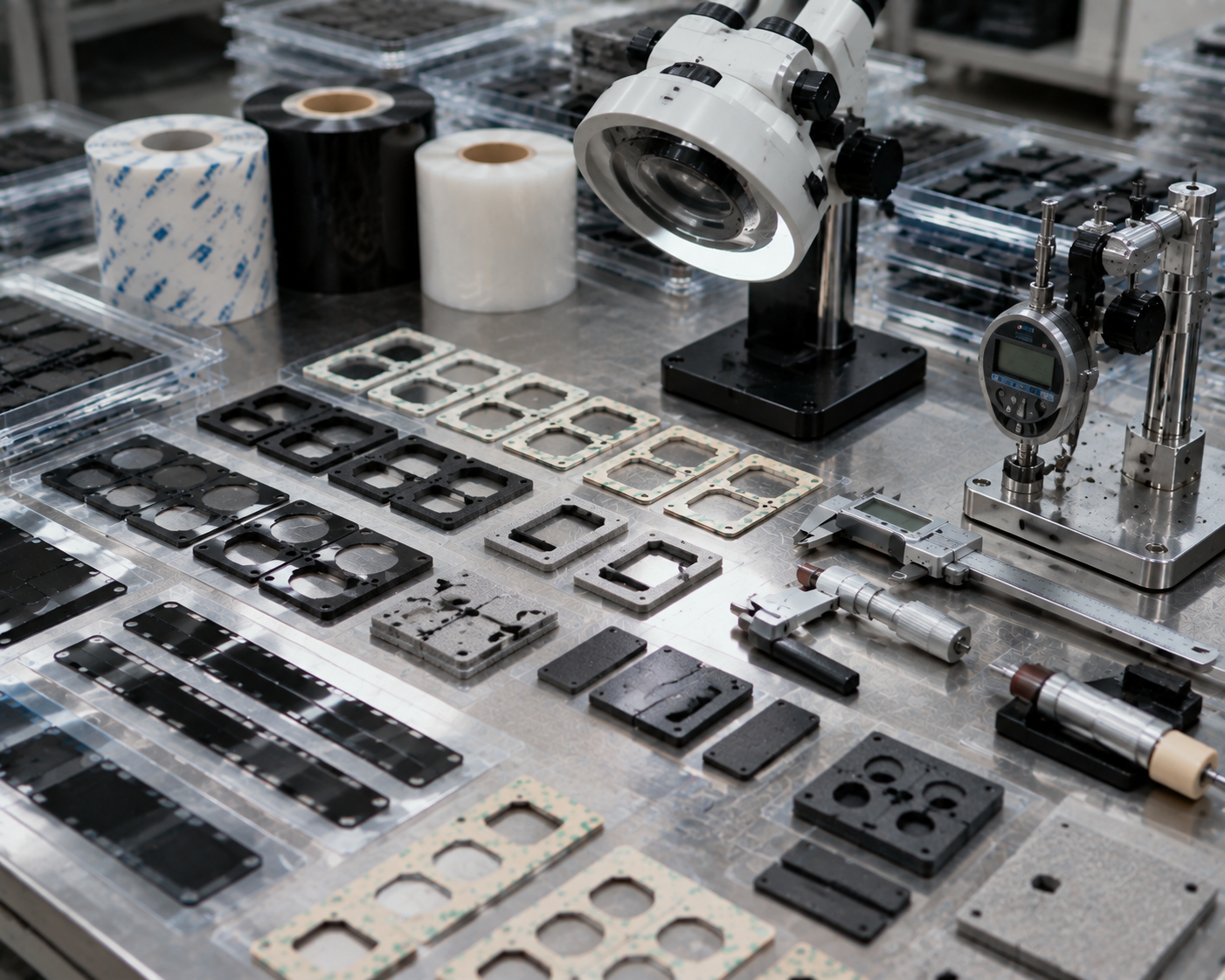
Why Camera Modules Need Foam Sealing and Cushioning Components
Camera modules contain sensitive optical and electronic structures that must maintain accurate alignment throughout the product lifecycle.
Small gaps or uncontrolled movement can create issues such as:
- Dust contamination
- Moisture entry risk
- Component movement
- Vibration noise
- Mechanical stress
- Optical alignment variation
Foam tape and cushion parts help solve these challenges by creating controlled contact between components while absorbing assembly tolerances.
Typical functions include:
| Function | Purpose |
|---|---|
| Sealing support | Helps reduce dust and moisture paths |
| Gap filling | Compensates for dimensional variation |
| Cushioning | Protects sensitive components |
| Vibration control | Reduces movement between parts |
| Positioning | Keeps components stable during assembly |
Unlike rigid sealing structures, foam components can adapt to small surface variations while maintaining consistent contact pressure.
Foam Tape Provides Thin and Reliable Sealing Performance
Foam tape is commonly used in camera module assemblies because it combines a flexible foam carrier with pressure-sensitive adhesive.
A typical foam tape structure includes:
| Layer | Function |
|---|---|
| Foam carrier | Provides cushioning and gap filling |
| Adhesive layer | Bonds the component in position |
| Release liner | Protects adhesive before assembly |
Foam tape can provide:
- Compression recovery
- Surface conformity
- Vibration absorption
- Bonding support
- Lightweight construction
Common applications include:
- Camera housing sealing
- Lens support structures
- Internal frame bonding
- Component cushioning
- Dust protection areas
The correct foam tape depends on the required compression, thickness, temperature environment, and bonding surface.
A foam that is too soft may lose recovery over time, while a foam that is too firm may create excessive stress on optical components.
Common Foam Materials Used for Camera Module Components
Different foam materials provide different performance characteristics.
| Material | Characteristics | Typical Application |
|---|---|---|
| PE Foam | Lightweight, stable, moisture resistant | Cushioning and gap filling |
| EVA Foam | Flexible and economical | General sealing and support |
| PU Foam | Soft and conformable | Vibration absorption |
| EPDM Foam | Durable and weather resistant | Environmental sealing |
| Silicone Foam | Temperature resistant | High-performance applications |
PE and EVA Foam for General Cushioning
PE and EVA foam are widely used for camera module support parts because they provide good flexibility and dimensional stability.
They are suitable for:
- Cushion pads
- Spacer components
- Contact protection
- Assembly tolerance compensation
These materials are easier to convert into stable die-cut parts compared with highly elastic materials.
PU Foam for Conformable Applications
PU foam provides excellent softness and conformity, making it useful where components require gentle contact.
However, because PU foam compresses more easily, engineers should consider:
- Compression set
- Recovery performance
- Long-term stability
- Environmental conditions
EPDM and Silicone Foam for More Demanding Conditions
When applications require higher durability or temperature resistance, EPDM or silicone foam may be considered.
These materials are often selected when the camera module operates in:
- Automotive environments
- Outdoor equipment
- Industrial systems
- Temperature-variable conditions
Precision Die Cutting Improves Camera Module Foam Component Accuracy
Camera module foam parts often contain complex geometries that must match the surrounding structure precisely.
Common features include:
- Circular openings
- Narrow sealing frames
- Irregular profiles
- Adhesive borders
- Multiple cutouts
- Thin sections
Precision die cutting helps control:
- Part dimensions
- Foam thickness
- Adhesive alignment
- Edge quality
- Repeatability
This is important because sealing performance depends on consistent compression around the entire component.
A small dimensional variation may cause:
- Uneven compression
- Incomplete sealing contact
- Assembly interference
- Reduced reliability
Sanken provides precision die cutting services for foam, adhesive tape, PET film, and other flexible materials used in optical and electronic assemblies.
Adhesive Selection Affects Sealing Reliability
Foam sealing components often rely on adhesive backing to maintain accurate placement during assembly.
The adhesive must provide reliable bonding without affecting optical or electronic performance.
Important factors include:
| Factor | Importance |
|---|---|
| Surface compatibility | Ensures stable bonding |
| Adhesion strength | Prevents movement |
| Temperature resistance | Supports operating conditions |
| Thickness | Controls assembly height |
| Aging performance | Maintains long-term reliability |
Common bonding surfaces include:
- Plastic housings
- Metal frames
- Coated components
- PET films
- Optical structures
For camera modules, adhesive overflow should be carefully controlled because exposed adhesive may attract contamination or interfere with nearby optical areas.
Sanken manufactures adhesive-backed die-cut components combining foam, adhesive, film, and liner structures for OEM applications.
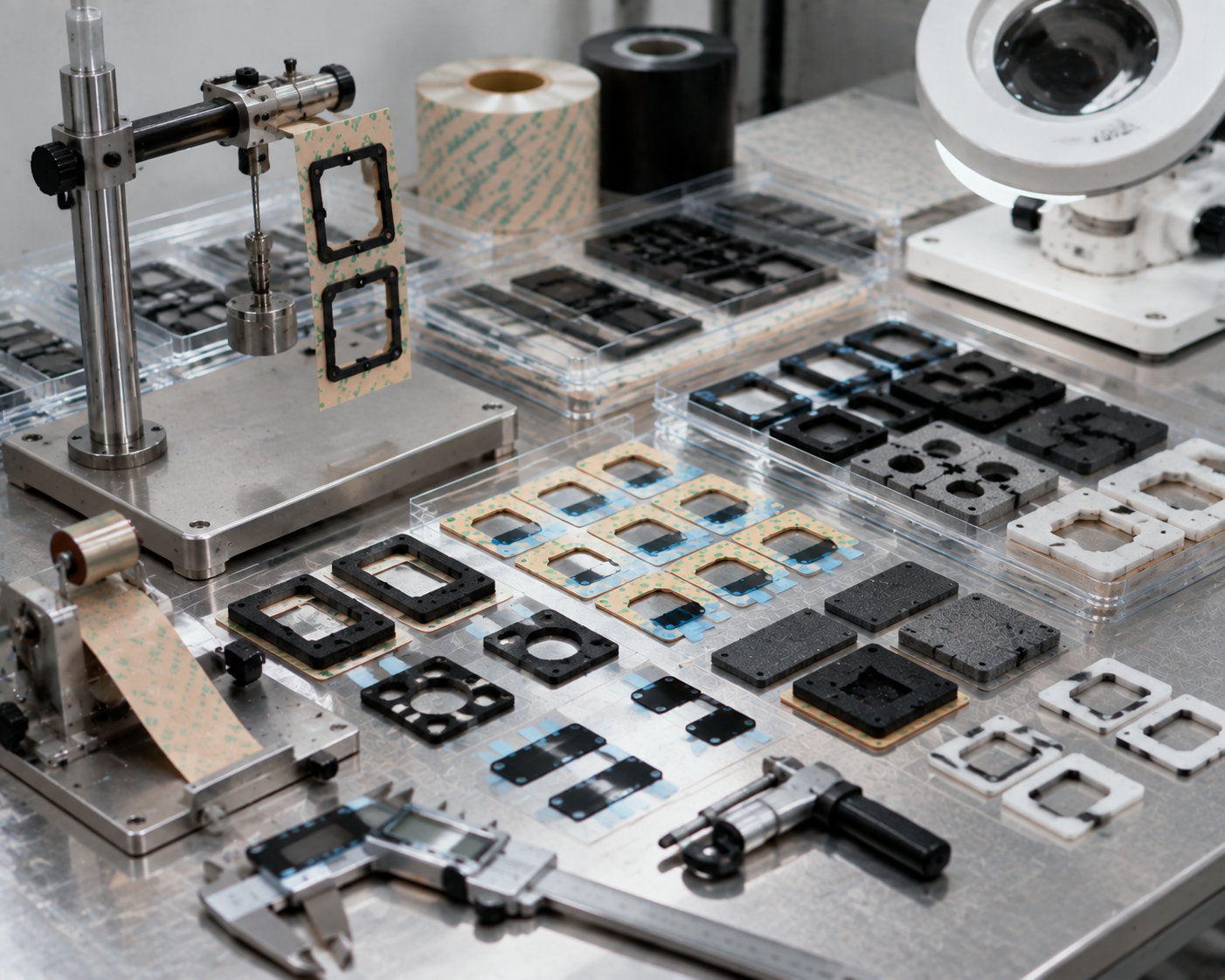
Foam Cushion Parts Protect Against Shock and Vibration
In addition to sealing, foam cushion parts help protect camera modules from mechanical stress.
During manufacturing, transportation, and product operation, components may experience:
- Vibration
- Impact
- Assembly pressure
- Thermal expansion
- Mechanical movement
Foam cushions help absorb these forces by providing controlled compression.
Typical applications include:
- Camera module support pads
- Spacer cushions
- Contact protection pads
- Internal vibration dampers
The foam thickness and hardness should match the available space and required compression.
A properly designed cushion maintains contact without applying excessive force to sensitive optical structures.
Design Considerations for Die-Cut Foam Sealing Parts
Successful foam sealing components require both material selection and manufacturing-friendly design.
Important design factors include:
| Design Factor | Impact |
|---|---|
| Compression range | Determines sealing performance |
| Foam thickness | Controls gap filling |
| Part width | Affects sealing coverage |
| Corner radius | Improves cutting stability |
| Adhesive setback | Prevents contamination |
| Tolerance requirements | Influences production stability |
Common design problems include:
- Extremely narrow sealing walls
- Sharp internal corners
- Excessively tight tolerances
- Poor adhesive positioning
- Insufficient compression allowance
Early design review helps optimize both sealing performance and production yield.
Multilayer Foam Components Combine Sealing and Protection
Some camera module applications require multiple functions from one component.
Multilayer structures may combine:
- Foam cushioning
- Adhesive bonding
- PET carrier layers
- Protective films
Examples include:
- Foam + adhesive
- PET + foam + adhesive
- Foam gasket + liner
- Foam tape + protective carrier
These structures reduce assembly steps and improve component handling.
However, multilayer converting requires accurate control of:
- Lamination alignment
- Material thickness
- Adhesive placement
- Cutting depth
- Layer stability
Prototype validation is recommended before mass production.
Quality Control Ensures Reliable Foam Sealing Performance
Camera module sealing components require consistent quality because small variations may affect final assembly performance.
Inspection may include:
| Inspection Item | Purpose |
|---|---|
| Foam thickness | Controls compression |
| Part dimensions | Ensures proper fit |
| Adhesive position | Prevents bonding issues |
| Edge quality | Maintains sealing consistency |
| Compression performance | Confirms function |
| Appearance inspection | Detects defects |
For high-volume production, process control is essential to maintain consistent sealing performance across batches.
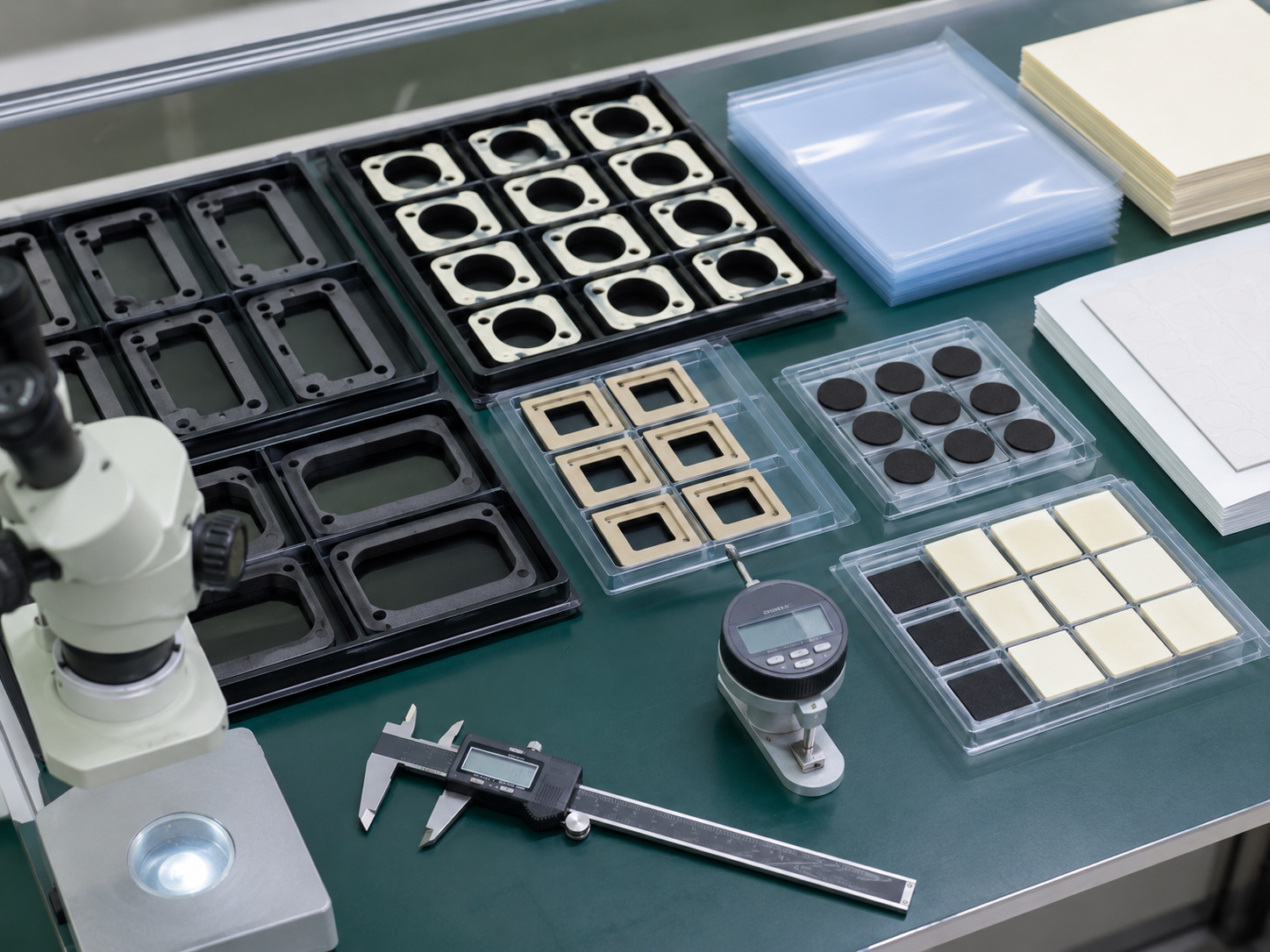
How Sanken Supports Camera Module Foam Solutions
Sanken manufactures custom die-cut foam tape, foam gaskets, cushioning pads, adhesive-backed components, PET films, and other flexible parts for optical and electronic OEM applications.
We support customers from material selection and drawing review through laminating, precision die cutting, prototype development, inspection, and mass production.
By combining suitable foam materials with accurate converting processes, Sanken helps manufacturers improve camera module sealing, vibration control, assembly efficiency, and product reliability.
You May Also Be Interested In
- How Precision Die-Cut Adhesive Tapes Improve Camera Module Assembly Reliability
- How to Prevent Light Leakage in Camera Modules with Custom Die-Cut Black PET Films
- How Precision Die Cutting Helps Protect Sensors, Cameras, and Display Modules
- Foam Gasket Materials: How to Choose the Right Foam for Sealing and Cushioning
- How to Choose the Right Die Cutting Manufacturer for Your OEM Project
Conclusion
Precision die-cut foam tape and cushion parts provide reliable sealing, protection, and positioning solutions for camera module assemblies.
By selecting the correct foam material, adhesive structure, thickness, and die-cut design, OEM manufacturers can reduce contamination risks, improve assembly consistency, and protect sensitive optical components.
For compact camera modules where space, accuracy, and reliability are critical, custom foam components provide a practical solution that supports both product performance and efficient mass production.