
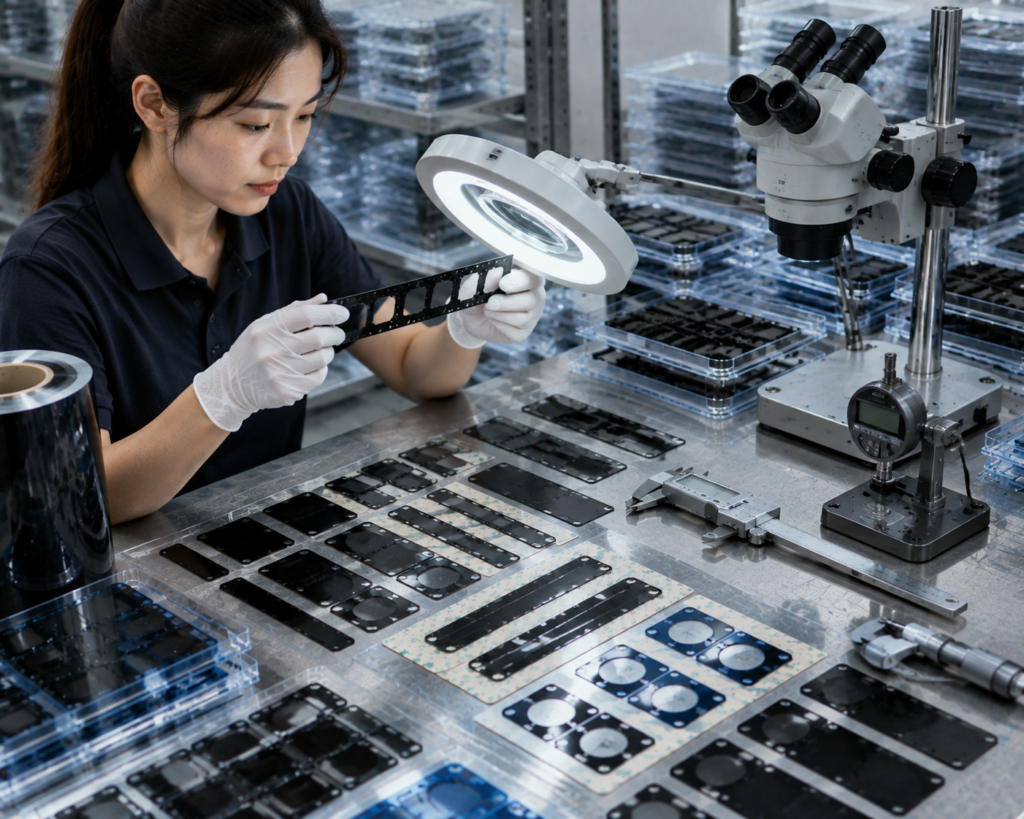
Camera modules require precise control of light paths to achieve stable image quality. As camera systems become smaller and more integrated, even minor gaps, reflections, or unwanted light entering the optical area can affect image performance.
Light leakage is a common challenge in camera module design. It may cause reduced contrast, flare, image distortion, or inconsistent optical performance. Custom die-cut black PET films provide a practical solution by creating accurate light-blocking structures around sensitive optical areas.
By combining black PET materials with precision die cutting and adhesive converting, manufacturers can produce thin, reliable components that improve light control while maintaining compact module designs.
Why Light Leakage Happens in Camera Modules
Camera modules contain multiple optical and mechanical layers that must work together with high accuracy.
Even when the lens and sensor are correctly aligned, unwanted light may enter through small gaps between components.
Common sources of light leakage include:
- Gaps around lens openings
- Misalignment between optical layers
- Reflections from internal surfaces
- Insufficient light absorption around the sensor area
- Poorly controlled component tolerances
- Adhesive overflow or incorrect positioning
These issues become more noticeable in compact camera designs because there is less space for additional shielding structures.
A light-blocking component must therefore provide:
- Accurate positioning
- Consistent edge quality
- Stable dimensions
- Reliable adhesion
- Long-term performance
Custom die-cut black PET films are designed specifically for these requirements.
Black PET Film Provides Effective Light Blocking
Black PET film is widely used in optical and electronic assemblies because it combines light absorption, dimensional stability, and thin construction.
Unlike decorative black materials, optical light-blocking films are selected based on their ability to control unwanted light transmission and maintain performance during the product lifecycle.
Key characteristics include:
| Property | Benefit |
|---|---|
| Light absorption | Reduces unwanted light entering optical paths |
| Dimensional stability | Maintains accurate positioning |
| Thin structure | Fits compact camera modules |
| Surface consistency | Supports clean optical appearance |
| Die-cut compatibility | Enables complex custom shapes |
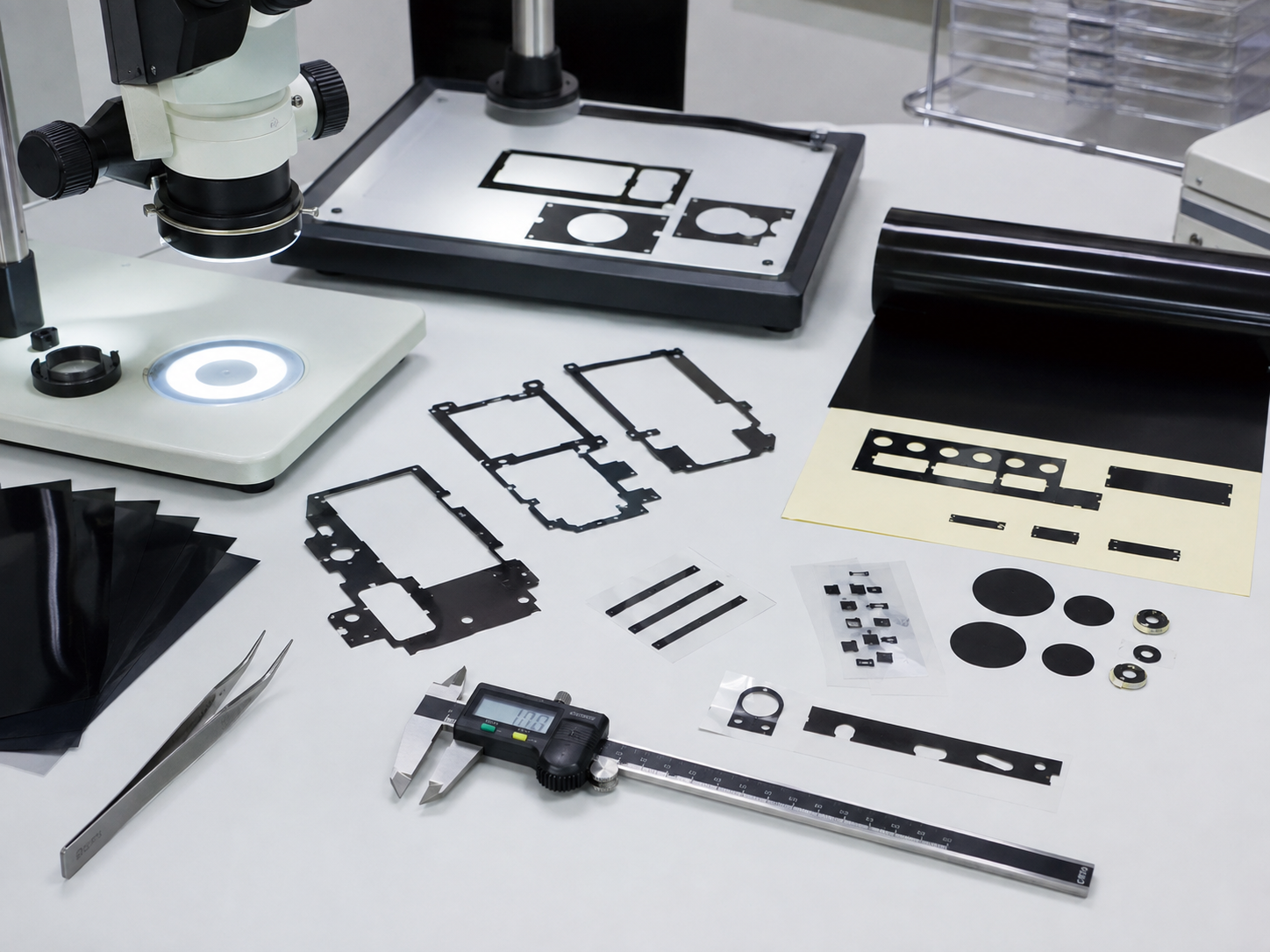
Black PET films can be converted into:
- Lens opening frames
- Optical masks
- Sensor surrounds
- Light-blocking rings
- Internal shielding pieces
Because these components remain inside the final product, material stability is essential.
A film that changes size, curls, or shifts after installation may create gaps that reduce light-blocking performance.
Precision Die Cutting Creates Accurate Optical Structures
Camera modules often require very small components with complex geometries.
A light-blocking film may include:
- Circular openings
- Narrow frames
- Multiple holes
- Irregular outlines
- Adhesive borders
- Alignment features
Precision die cutting allows manufacturers to control these features with repeatable accuracy.
Important factors include:
| Manufacturing Factor | Impact |
|---|---|
| Cutting accuracy | Maintains optical alignment |
| Edge quality | Prevents light gaps and contamination |
| Hole position | Ensures correct lens or sensor alignment |
| Adhesive registration | Prevents exposed adhesive areas |
| Thickness control | Maintains optical stack height |
Poorly cut film parts may create problems such as:
- Uneven light blocking
- Misalignment around the lens
- Adhesive exposure
- Assembly interference
For optical components, small dimensional differences can influence final image performance.
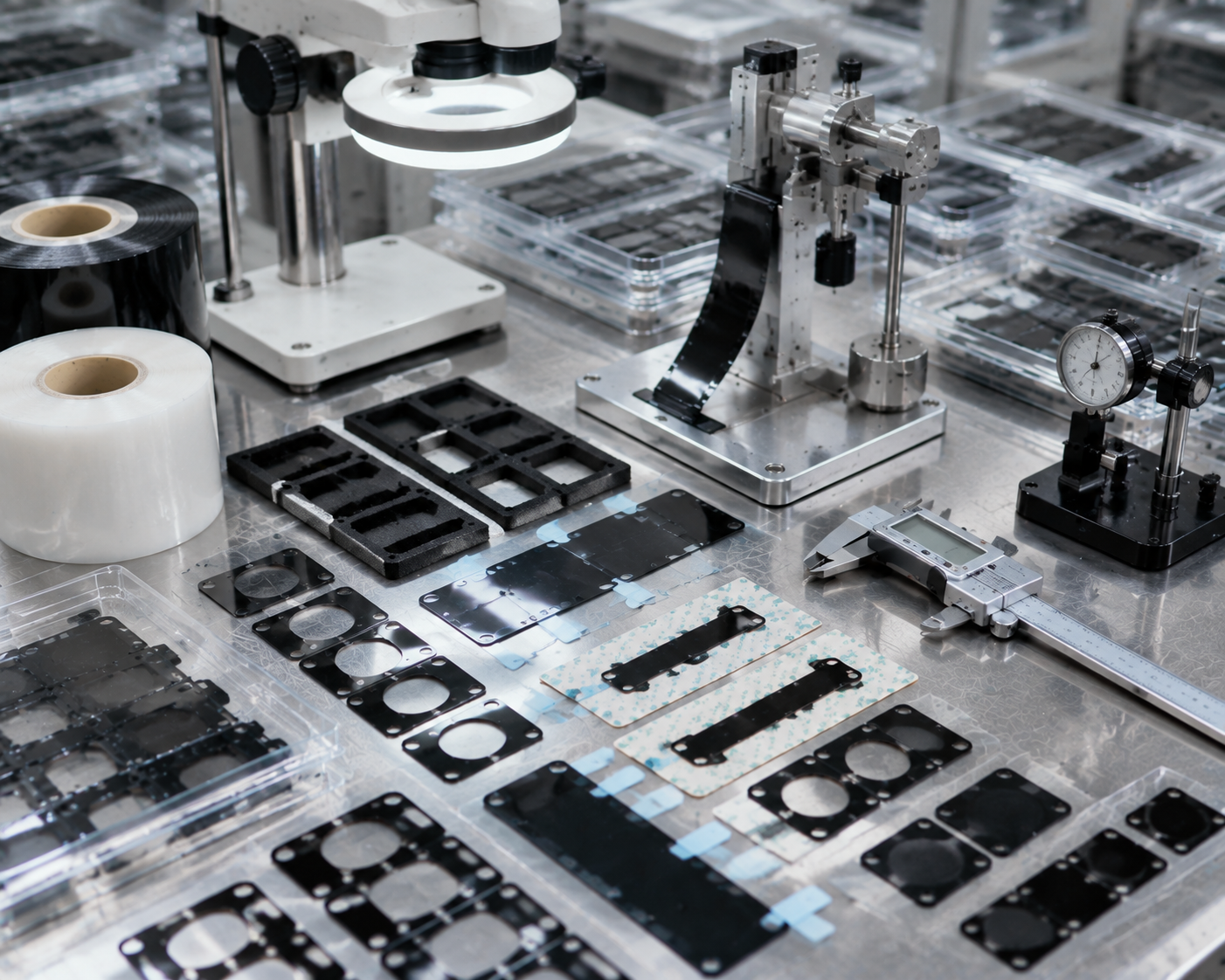
Sanken provides precision die cutting services for black PET films, adhesive films, protective films, and other optical components.
Adhesive Structures Improve Light-Blocking Film Reliability
Many black PET light-blocking components require adhesive backing to maintain accurate positioning inside the camera module.
Adhesive-backed structures provide:
- Stable placement
- Faster assembly
- Reduced manual adjustment
- Better production repeatability
A typical structure may include:
| Layer | Function |
|---|---|
| Black PET film | Blocks unwanted light |
| Adhesive layer | Fixes component position |
| Release liner | Protects adhesive before assembly |
Adhesive selection is important because optical assemblies often contain sensitive surfaces.
The adhesive should provide:
- Reliable bonding
- Low contamination risk
- Controlled thickness
- Long-term stability
Excess adhesive near the edge can create contamination or interfere with optical areas. Incorrect adhesive placement may also reduce assembly consistency.
Sanken manufactures adhesive-backed die-cut components using film, adhesive, and liner structures designed for OEM applications.
Film Thickness and Design Affect Optical Performance
The thickness of a black PET film component influences both optical performance and mechanical integration.
A thicker film may provide better handling stability, but it can increase the total assembly height. A thinner film saves space but requires tighter manufacturing control.
Engineers should evaluate:
| Design Factor | Consideration |
|---|---|
| Film thickness | Controls stack height |
| Adhesive thickness | Affects final component height |
| Opening size | Influences optical alignment |
| Edge width | Determines light-blocking coverage |
| Corner design | Affects cutting stability |
For camera modules, the goal is not simply maximum light blocking. The component must balance:
- Optical performance
- Mechanical fit
- Assembly efficiency
- Manufacturing feasibility
A properly designed black PET component prevents light leakage without adding unnecessary thickness.
Common Design Mistakes That Cause Light Leakage
Even a high-performance black PET film can fail if the part design does not consider manufacturing and assembly conditions.
Common issues include:
Insufficient Light-Blocking Width
A narrow frame around the optical opening may not provide enough coverage after assembly tolerance is considered.
Incorrect Hole Position
A slightly shifted opening can create uneven coverage around the lens or sensor area.
Poor Adhesive Placement
Adhesive extending beyond the intended area may create contamination or assembly problems.
Excessive Tolerance Requirements
Unnecessary tight tolerances can increase cost without improving optical performance.
Sharp Internal Corners
Sharp corners may increase stress concentration and create cutting defects.
Design optimization should consider both optical requirements and converting capability.
Multilayer Black PET Structures Combine Multiple Functions
Some camera module applications require more than light blocking alone.
Multilayer structures can combine:
- Black PET film
- Adhesive layers
- Foam cushioning
- Protective films
- Carrier layers
Examples include:
- Black PET + adhesive
- PET + foam + adhesive
- Optical film + protective layer
These structures can provide:
- Light blocking
- Cushioning
- Positioning
- Protection
- Assembly support
However, multilayer components require accurate control of:
- Layer alignment
- Lamination pressure
- Adhesive thickness
- Cutting depth
- Material stability
Prototype validation is recommended before mass production to confirm that the complete structure performs correctly.
Quality Control Is Critical for Optical Film Components
Camera module components require strict quality control because small defects can affect final product performance.
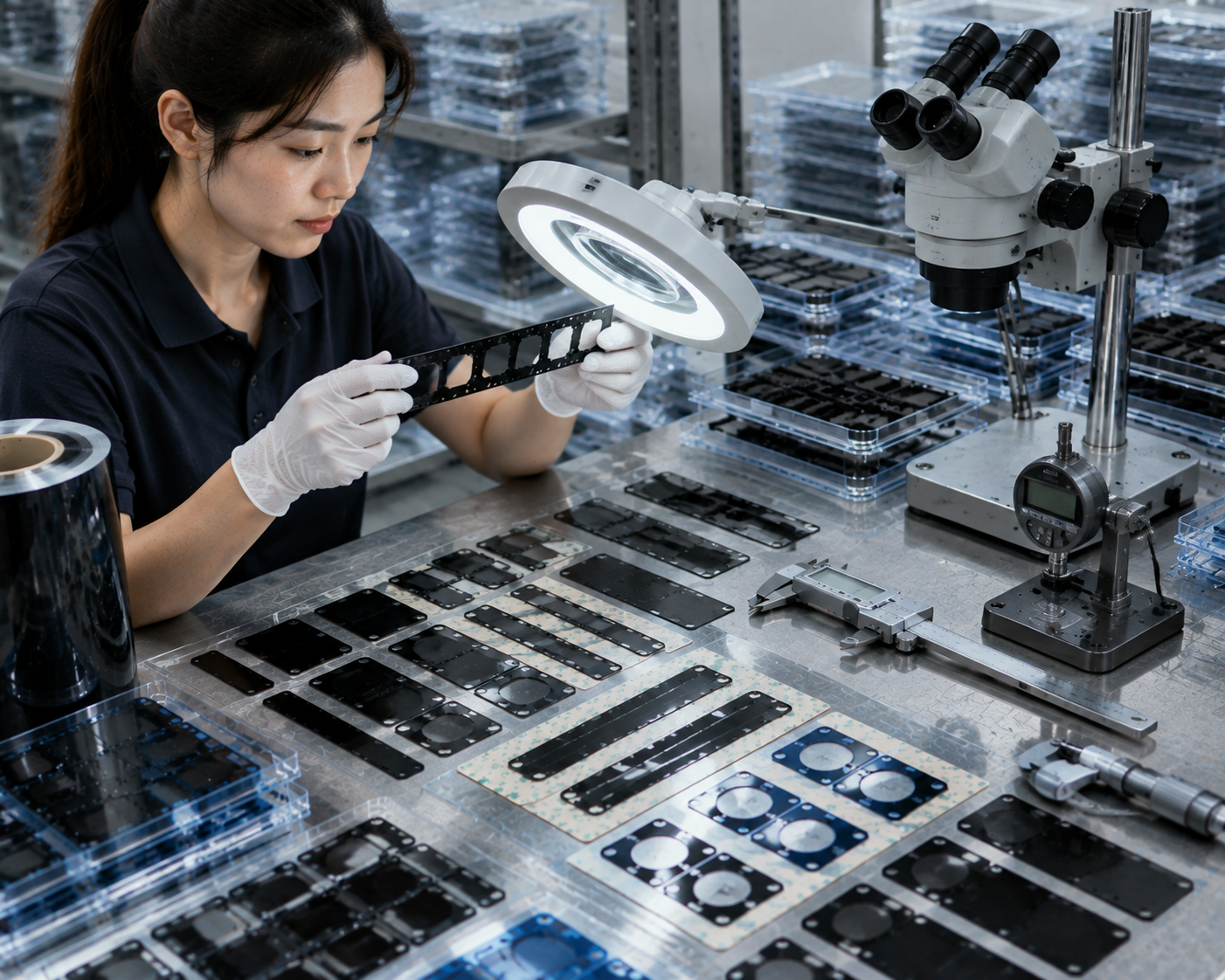
Inspection may include:
| Inspection Item | Purpose |
|---|---|
| Material verification | Confirms approved black PET specification |
| Dimensional inspection | Ensures optical alignment |
| Edge inspection | Detects cutting defects |
| Adhesive position | Prevents contamination |
| Thickness measurement | Controls assembly height |
| Appearance inspection | Maintains optical quality |
For optical applications, consistency between batches is especially important.
A reliable converting process should control not only the raw material but also tooling condition, cutting parameters, inspection methods, and packaging.
How Sanken Supports Camera Module Light-Blocking Solutions
Sanken manufactures custom die-cut black PET films, optical film components, adhesive-backed film parts, protective films, and multilayer flexible components for camera modules and electronic assemblies.
We support customers from material selection and drawing review through laminating, precision die cutting, prototype development, inspection, and mass production.
By combining suitable materials with accurate converting processes, Sanken helps OEM manufacturers improve light control, assembly reliability, and product consistency.
You May Also Be Interested In
- Die-Cut Light-Blocking Films for Optical and Electronic Components
- How Precision Die-Cut Adhesive Tapes Improve Camera Module Assembly Reliability
- How Precision Die Cutting Helps Protect Sensors, Cameras, and Display Modules
- Black PET Film vs Protective Film: What Is the Difference for OEM Applications?
- How to Choose the Right Die Cutting Manufacturer for Your OEM Project
Conclusion
Light leakage prevention is a critical part of camera module design. Custom die-cut black PET films provide accurate light blocking, stable positioning, and reliable integration into compact optical assemblies.
By combining suitable black PET materials, adhesive structures, precision die cutting, and quality control, OEM manufacturers can reduce optical defects, improve assembly consistency, and achieve more reliable camera module performance.