
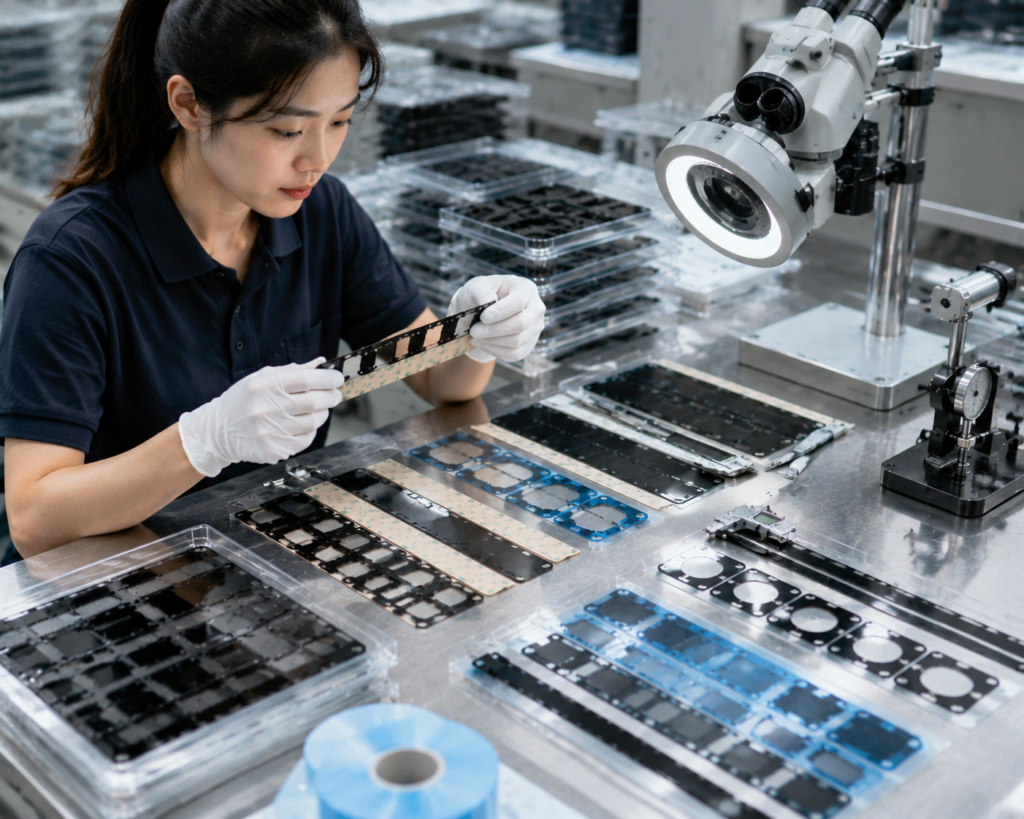
Camera modules are becoming smaller, thinner, and more complex in smartphones, automotive systems, industrial equipment, and smart devices. As optical performance requirements increase, manufacturers must control not only lens and sensor alignment but also the reliability of every supporting component inside the module.
Precision die-cut adhesive tapes play an important role in camera module assembly by providing accurate bonding, component positioning, sealing support, and vibration resistance. Compared with manually applied tape or standard adhesive sheets, custom die-cut adhesive components offer better dimensional accuracy, cleaner assembly, and more consistent production performance.
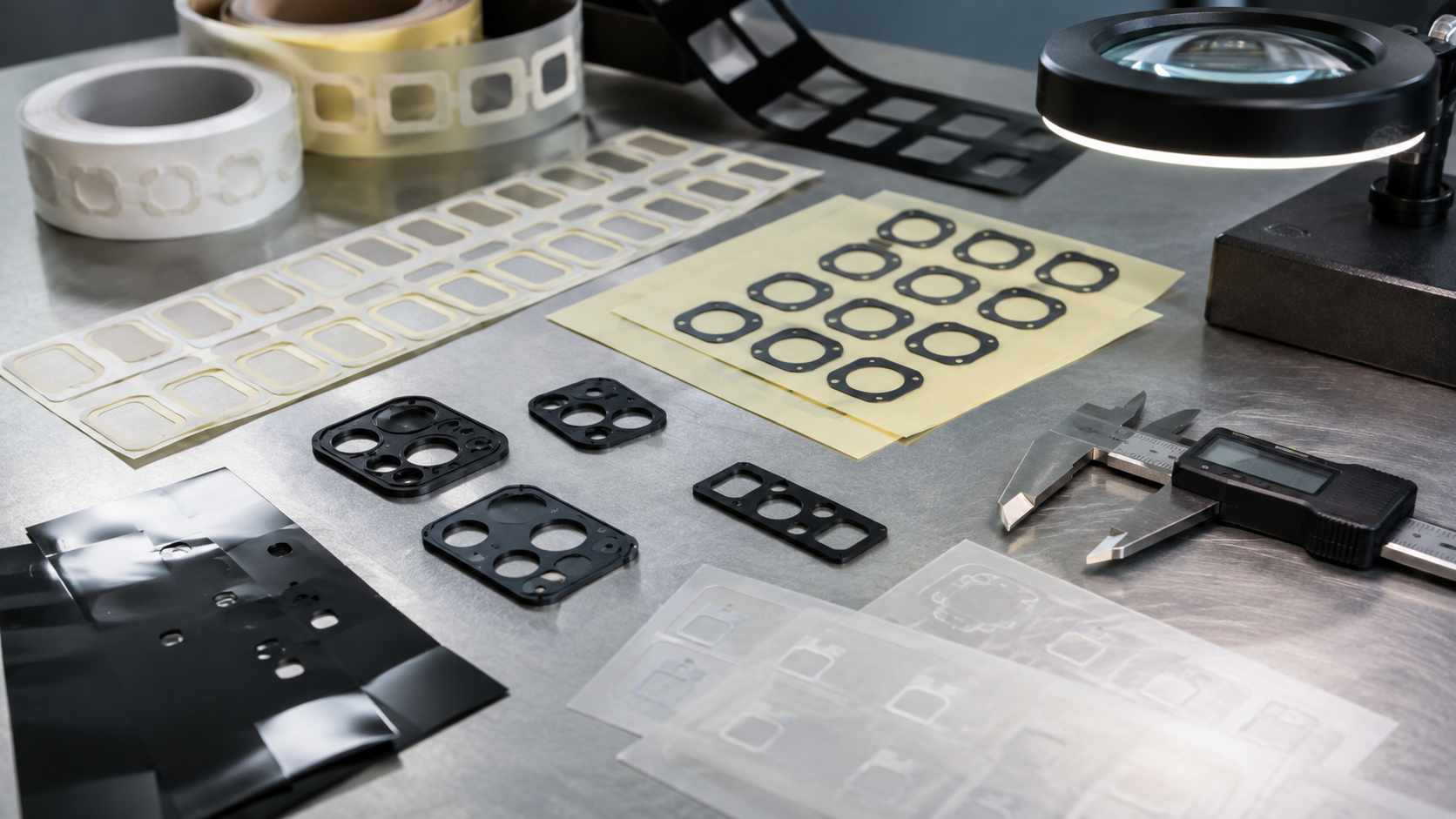
Adhesive Tapes Are Critical Components Inside Camera Modules
Although adhesive tapes are thin and often hidden after assembly, they directly influence the stability and reliability of camera modules.
A camera module contains multiple precision components, including:
- Lens structures
- Sensor assemblies
- Optical filters
- Protective windows
- Housing components
- Electronic connectors
- Internal support frames
These components require accurate positioning and stable fixation during manufacturing and operation.
Die-cut adhesive tapes help provide:
| Function | Purpose |
|---|---|
| Component bonding | Fixes parts in the correct position |
| Positioning support | Maintains alignment during assembly |
| Light control support | Helps prevent unwanted gaps and leakage |
| Vibration resistance | Reduces movement between components |
| Dust and contamination control | Supports cleaner internal structures |
| Assembly efficiency | Simplifies automated production |
For optical assemblies, even small positional changes can affect image quality. Therefore, adhesive component accuracy is just as important as adhesive strength.
Why Camera Modules Require Custom Die-Cut Adhesive Parts
Standard adhesive tape rolls are useful for general bonding, but camera modules usually require complex shapes that match specific component designs.
Custom die-cut adhesive tapes can be produced as:
- Circular rings
- Optical frames
- Narrow strips
- Irregular profiles
- Multi-opening structures
- Layered adhesive components
These designs allow adhesive materials to fit precisely around:
- Lens openings
- Sensor areas
- Mechanical structures
- Housing edges
- Internal mounting features
Compared with manually cut tape, precision die cutting improves:
- Dimensional consistency
- Edge quality
- Assembly speed
- Material utilization
- Repeatability
A small variation in adhesive width or position may create problems such as uneven bonding pressure, exposed adhesive, or interference with optical areas.
Sanken provides precision die cutting services for adhesive films, PET materials, protective films, and other precision components used in optical and electronic applications.
Adhesive Tape Selection Affects Camera Module Reliability
Not all adhesive tapes provide the same performance. Camera modules require adhesive structures that match the material surfaces, environmental conditions, and assembly process.
Important selection factors include:
| Factor | Importance |
|---|---|
| Adhesion strength | Maintains long-term bonding |
| Thickness | Controls assembly height |
| Temperature resistance | Supports operating conditions |
| Outgassing performance | Protects optical surfaces |
| Surface compatibility | Ensures reliable bonding |
| Aging resistance | Maintains performance over time |
Different substrates may include:
- Plastic housings
- Metal frames
- Glass surfaces
- PET films
- Coated components
The adhesive must be compatible with the actual bonding surface.
A tape with strong initial adhesion does not always provide the best long-term performance. Environmental exposure, vibration, temperature cycling, and aging behavior must also be considered.
Thin Adhesive Structures Support Compact Camera Designs
Modern camera modules require thinner and smaller components. Increasing adhesive thickness may affect optical stack height and mechanical design.
Precision die-cut adhesive tapes help manufacturers achieve:
- Controlled thickness
- Accurate placement
- Reduced material overlap
- Compact assembly structures
Thin adhesive components are especially useful where space is limited, such as:
- Miniature camera modules
- Automotive cameras
- Sensor assemblies
- Optical inspection systems
However, thinner does not always mean better. The adhesive structure must still provide enough bonding reliability and handling strength.
Engineers should evaluate the complete assembly, including:
- Adhesive thickness
- Carrier material
- Liner structure
- Compression requirements
- Assembly tolerance
Black PET and Adhesive Films Help Control Light Leakage
Camera modules are sensitive to unwanted light entering areas outside the intended optical path.
Die-cut black PET films combined with adhesive structures can help create controlled light barriers around optical areas.
Applications include:
- Lens surrounds
- Optical frames
- Internal light barriers
- Sensor protection structures
Black PET film provides:
- Light absorption
- Dimensional stability
- Thin construction
- Precise die-cut capability
When combined with adhesive backing, it becomes an assembly-ready component that can be accurately positioned during production.
This is especially important for camera applications where stray light may reduce contrast, create reflections, or affect image quality.
Sanken also supports die-cut light-blocking film components for optical and electronic applications.
Adhesive Tape Design Influences Assembly Efficiency
In high-volume camera module production, assembly efficiency is closely connected to adhesive component design.
A well-designed adhesive part can reduce:
- Manual alignment time
- Operator handling
- Material waste
- Assembly variation
Features that improve assembly include:
| Design Feature | Benefit |
|---|---|
| Extended liner tabs | Easier adhesive release |
| Split liners | Supports accurate placement |
| Kiss-cut structures | Keeps parts organized |
| Proper adhesive setback | Reduces contamination |
| Carrier support | Improves handling |
For automated or semi-automated assembly, consistent tape presentation is essential.
A component that is difficult to remove from the liner or easily deforms during handling can slow production and increase defect rates.
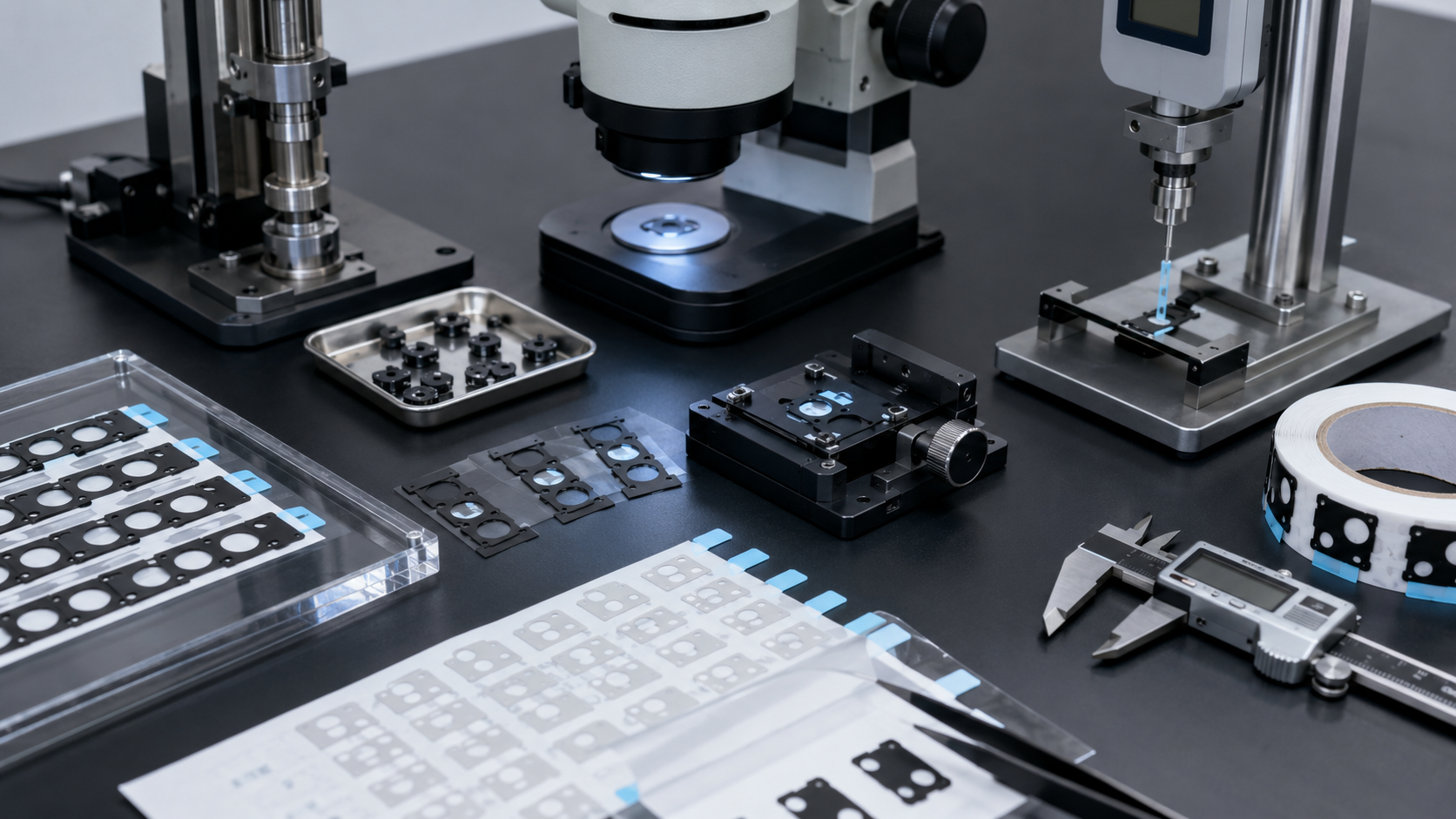
Multilayer Adhesive Components Combine Multiple Functions
Camera modules often require adhesive components that perform several functions at the same time.
Common multilayer structures include:
- PET film + adhesive
- Black PET + adhesive
- Foam + adhesive
- PET + foam + adhesive
- Protective film + removable adhesive
These structures can provide:
- Bonding
- Cushioning
- Light blocking
- Insulation
- Surface protection
However, multilayer adhesive parts require precise manufacturing control.
Important process factors include:
- Layer alignment
- Lamination pressure
- Adhesive thickness
- Cutting depth
- Material stability
- Release liner performance
Poor alignment between layers may create exposed adhesive edges, uneven thickness, or assembly interference.
Prototype validation is recommended before mass production to confirm that the complete structure performs as expected.
Precision Die Cutting Controls Camera Module Component Quality
Camera module adhesive parts often include complex geometries and tight dimensional requirements.
Precision die cutting helps control:
- Outer profile accuracy
- Inner opening dimensions
- Adhesive registration
- Edge cleanliness
- Repeatability
Common defects caused by poor converting include:
- Uneven adhesive edges
- Incorrect openings
- Adhesive overflow
- Film deformation
- Poor liner cutting
For optical applications, these defects can affect both assembly efficiency and final product performance.
A controlled converting process includes:
- Material inspection
- Tool selection
- Cutting parameter control
- In-process inspection
- Packaging protection
Quality Inspection Supports Reliable Optical Assembly
Because camera modules require high precision, adhesive components should be inspected throughout production.
Typical inspection items include:
| Inspection Item | Purpose |
|---|---|
| Dimensions | Confirms assembly fit |
| Thickness | Controls optical stack height |
| Adhesive position | Prevents alignment issues |
| Edge quality | Detects cutting defects |
| Surface condition | Prevents contamination |
| Liner condition | Supports assembly handling |
For optical applications, consistency between production batches is critical.
A reliable supplier should control not only the adhesive material but also the complete converting process.
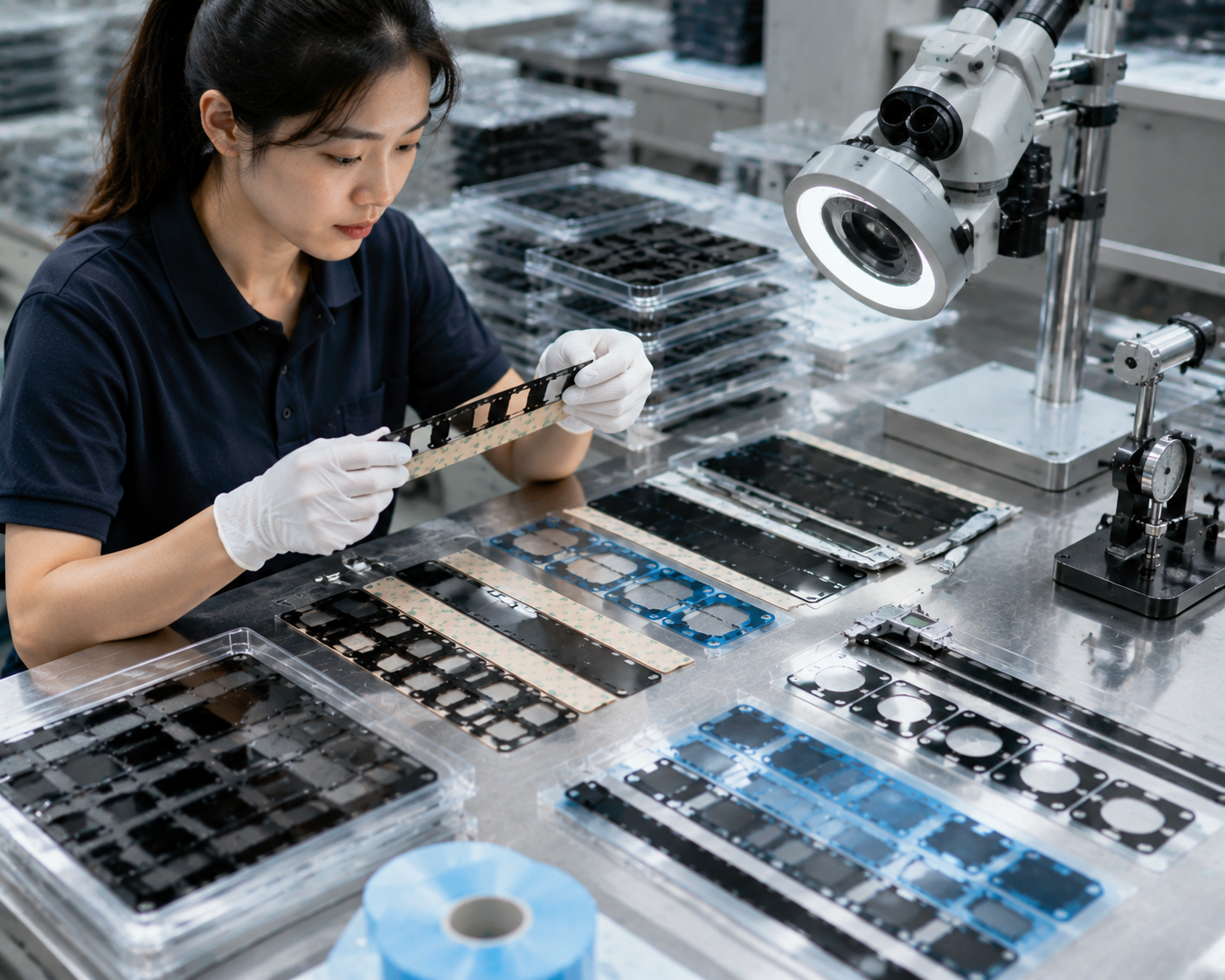
How Sanken Supports Camera Module Adhesive Solutions
Sanken manufactures custom die-cut adhesive tape components, PET films, black PET light-blocking films, protective films, and multilayer flexible parts for optical and electronic OEM applications.
We support customers from material selection and drawing review through laminating, precision die cutting, prototype development, inspection, and mass production.
By combining suitable adhesive structures with accurate converting processes, Sanken helps camera module manufacturers improve assembly reliability, production consistency, and product performance.
You May Also Be Interested In
- Die-Cut Light-Blocking Films for Optical and Electronic Components
- How Precision Die Cutting Helps Protect Sensors, Cameras, and Display Modules
- Black PET Film vs Protective Film: What Is the Difference for OEM Applications?
- How to Choose Die Cut Films, Foams, and Adhesive Parts for Electronic Components
- How to Choose the Right Die Cutting Manufacturer for Your OEM Project
Conclusion
Precision die-cut adhesive tapes are essential components for reliable camera module assembly. They provide accurate bonding, stable positioning, light control support, and improved production efficiency.
By selecting the right adhesive structure, film material, thickness, and converting process, OEM manufacturers can reduce assembly risks and improve the reliability of advanced optical products.
For camera modules where accuracy is critical, custom die-cut adhesive components provide a more consistent and scalable solution than standard tape materials.