
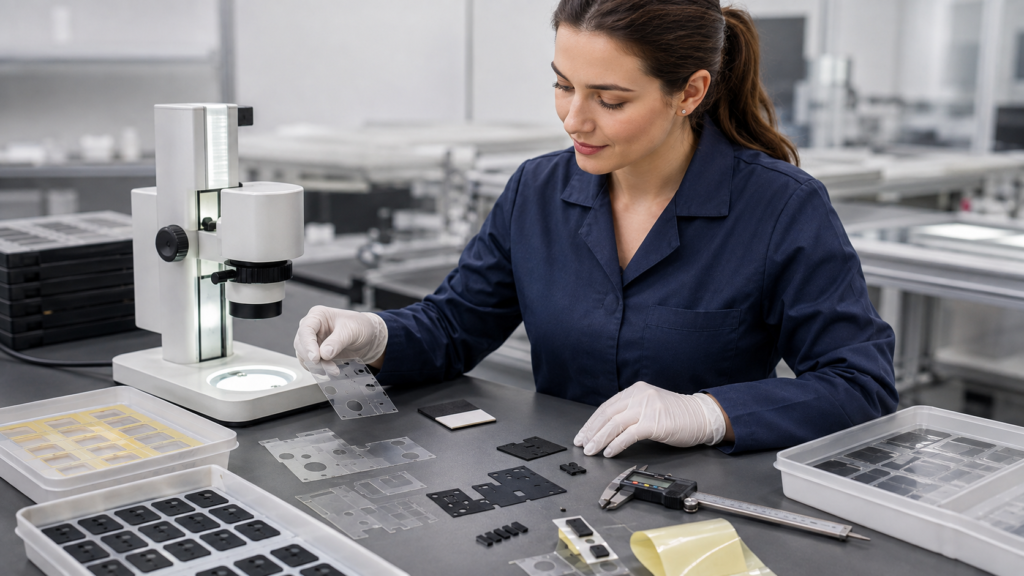
Electronic products continue to become smaller, thinner, and more integrated. Inside compact devices, flexible materials such as films, foams, and adhesive parts play important roles in insulation, cushioning, protection, sealing, and component positioning.
Although these materials may appear simple, choosing the wrong structure can lead to assembly difficulties, poor protection, adhesive failure, contamination, or inconsistent production quality.
For OEM engineers and purchasing teams, material selection should consider the complete application environment, including electrical requirements, mechanical stress, assembly method, temperature, surface conditions, and production volume.
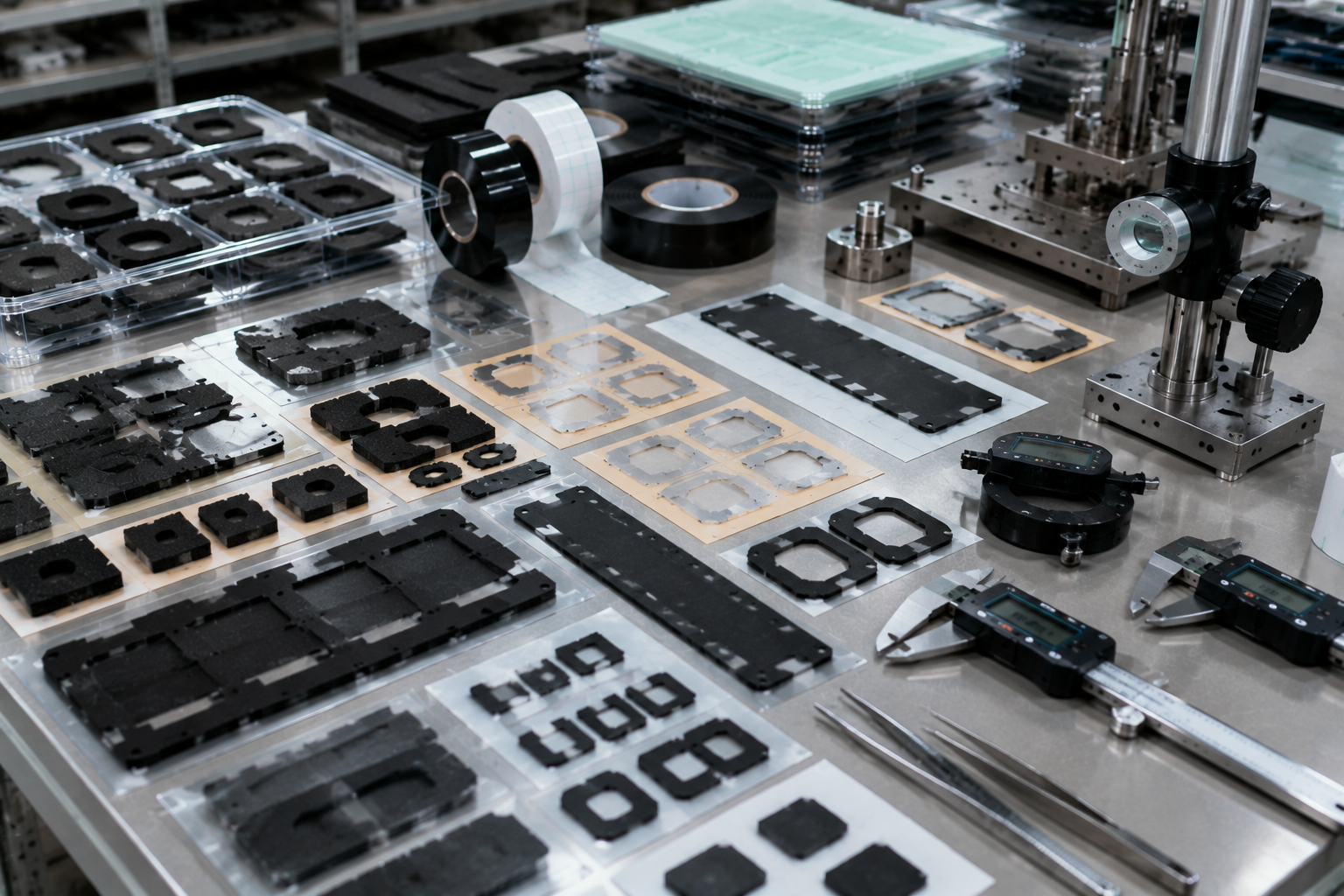
Flexible Die Cut Materials Support Multiple Electronic Functions
Electronic components often require several flexible materials working together rather than a single material solution.
A die cut part may provide:
| Function | Typical Material |
|---|---|
| Electrical insulation | PET film |
| Light blocking | Black PET film |
| Cushioning | EVA, PE, PU foam |
| Sealing | Foam gasket, rubber components |
| Surface protection | Protective film |
| Bonding and positioning | Adhesive tape |
These materials help manufacturers solve different engineering challenges:
- Preventing electrical contact
- Protecting sensitive surfaces
- Reducing vibration and impact
- Filling assembly gaps
- Controlling light leakage
- Improving installation efficiency
The best material choice depends on the function of the component, not simply the material cost.
PET Films for Electrical Insulation and Light Management
PET film is one of the most commonly used materials in electronic component assemblies because it combines electrical insulation, dimensional stability, and thin construction.
Typical applications include:
- Electrical insulation barriers
- Battery and electronic insulation parts
- Display-related components
- Sensor protection
- Connector insulation
- Internal electronic separators
PET film provides advantages such as:
| Property | Benefit |
|---|---|
| Dimensional stability | Maintains accurate component positioning |
| Thin profile | Fits compact assemblies |
| Mechanical strength | Resists tearing during installation |
| Surface consistency | Supports clean appearance |
| Die-cut compatibility | Enables complex shapes |
For optical and display-related applications, black PET film can also help control unwanted light leakage.
Black PET components are commonly converted into:
- Light-blocking frames
- Optical masks
- Sensor surrounds
- Display-related barriers
Unlike temporary protective films, these components remain inside the final product and must maintain stable performance throughout the product lifecycle.
Sanken provides precision die cutting services for PET films, adhesive materials, protective films, and other flexible components used in electronic assemblies.
Foam Parts Provide Cushioning, Sealing, and Vibration Control
Foam materials are widely used in electronics because they can provide cushioning, gap filling, sealing support, and vibration reduction.
Common foam materials include:
| Foam Material | Main Characteristics | Applications |
|---|---|---|
| EVA Foam | Flexible and economical | Cushioning pads, support parts |
| PE Foam | Lightweight and moisture resistant | Protection and spacing |
| PU Foam | Soft and conformable | Gap filling and vibration absorption |
| EPDM Foam | Durable and resilient | Sealing applications |
| Silicone Foam | Temperature resistant | Higher-performance environments |
Foam selection should consider:
- Compression performance
- Thickness tolerance
- Density
- Recovery after compression
- Temperature resistance
- Adhesive compatibility
For example, a display module may require a thin foam frame to absorb assembly tolerance, while an electronic housing may require a gasket that maintains sealing pressure over time.
A softer foam is not always better. Excessive compression may reduce long-term performance, while a material that is too firm may create assembly stress.
Custom foam gaskets and sealing components can be designed with adhesive backing, holes, frames, and irregular profiles to match OEM requirements.
Adhesive Parts Improve Assembly Efficiency
Adhesive tape components are widely used in electronic manufacturing because they reduce mechanical fastening steps and improve assembly consistency.
Common applications include:
- Display bonding frames
- Component mounting pads
- Foam tape parts
- Protective film attachment
- Internal positioning parts
- Electronic housing assemblies
Pressure-sensitive adhesives provide:
- Fast installation
- Accurate positioning
- Reduced assembly variation
- Compatibility with automated processes
However, adhesive selection requires careful evaluation.
Important factors include:
| Factor | Importance |
|---|---|
| Substrate material | Determines bonding compatibility |
| Surface condition | Affects adhesion reliability |
| Temperature exposure | Influences long-term performance |
| Required holding force | Prevents movement |
| Removal requirements | Determines adhesive behavior |
Different electronic surfaces, such as plastics, metals, glass, and coated materials, require different adhesive solutions.
Sanken manufactures adhesive-backed die cut components using films, foams, tapes, and liners for OEM assembly applications.
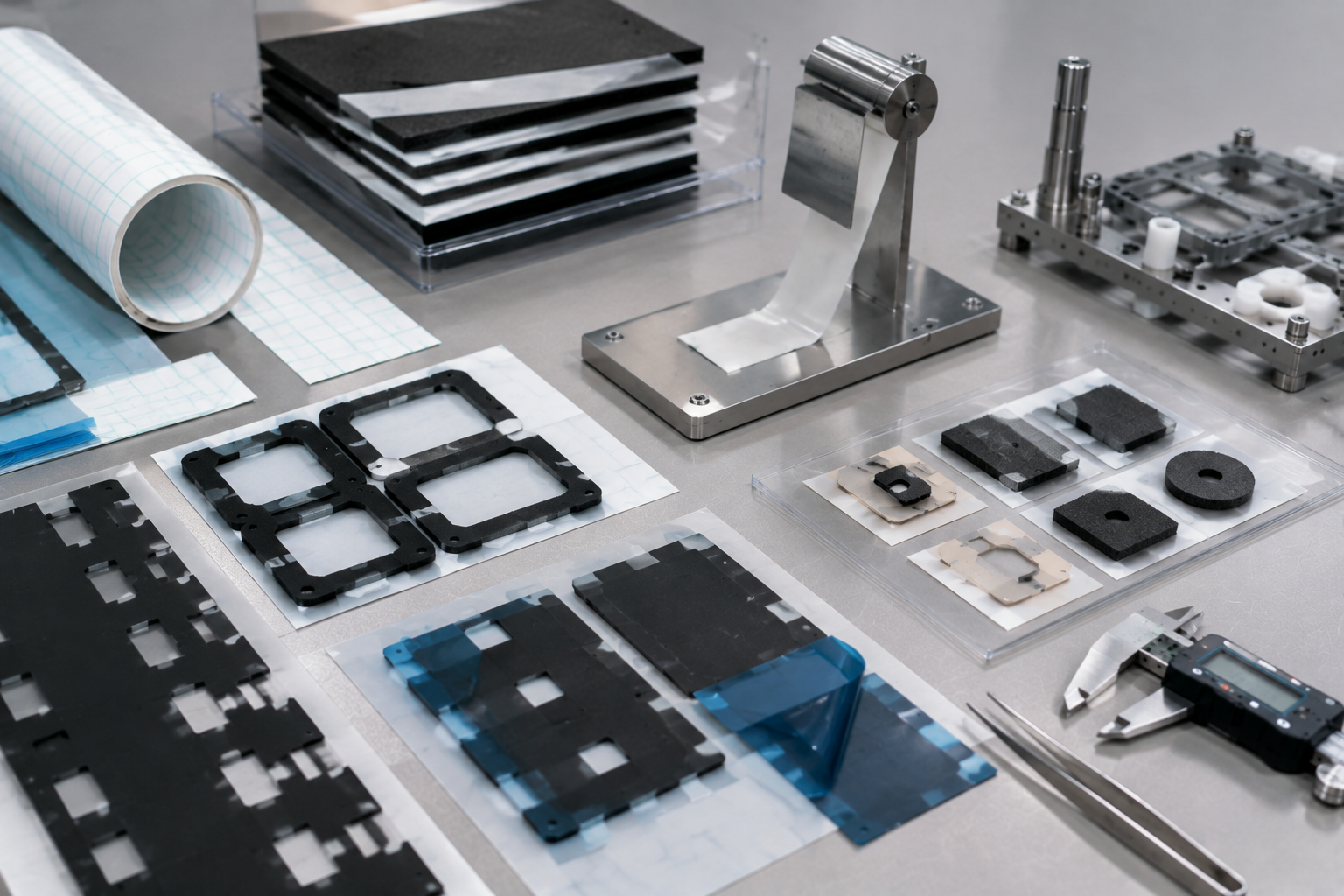
Material Selection Should Match the Application Environment
Electronic components operate under different conditions depending on the product type.
Before selecting materials, engineers should review:
| Requirement | Material Consideration |
|---|---|
| Electrical isolation | PET insulation film performance |
| Space limitation | Film thickness and foam compression |
| Vibration | Foam density and recovery |
| Moisture exposure | Closed-cell foam and sealing structure |
| Temperature | Film, foam, and adhesive stability |
| Assembly process | Adhesive and liner design |
| Product lifetime | Long-term material durability |
For example:
- A sensor assembly may prioritize thin insulation and precise positioning.
- A display module may require light control and adhesive accuracy.
- An electronic enclosure may require cushioning and sealing.
- A control panel may require protective films during manufacturing.
The same material should not be applied to every electronic product.
Multilayer Structures Combine Different Material Benefits
Many electronic components use multilayer constructions because one material cannot provide every required function.
Examples include:
- PET film + adhesive
- Foam + double-sided tape
- PET + foam + adhesive
- Protective film + removable adhesive
- Black PET + adhesive liner
Multilayer parts can reduce assembly steps by combining several functions into one component.
However, additional layers increase manufacturing complexity.
The converter must control:
- Layer alignment
- Adhesive thickness
- Lamination pressure
- Cutting depth
- Material movement
- Liner performance
Poor layer registration may cause exposed adhesive, uneven edges, or assembly interference.
For multilayer components, early prototype validation is important before moving into mass production.
Precision Die Cutting Determines Final Part Quality
Even high-quality materials may fail if the converting process is not controlled.
Precision die cutting helps maintain:
- Accurate dimensions
- Clean edges
- Consistent openings
- Stable adhesive placement
- Repeatable production quality
Electronic components often include:
- Small holes
- Narrow frames
- Complex outlines
- Multiple layers
- Tight assembly clearances
These features require experienced process control.
Important manufacturing considerations include:
- Tool selection
- Cutting pressure
- Material support
- Waste removal
- Inspection frequency
- Packaging method
For adhesive-backed parts, kiss cutting is commonly used because components remain organized on the release liner until assembly.
Prototype Development Reduces Production Risk
Before mass production, prototype samples allow engineers to verify:
- Part fit
- Adhesive performance
- Material behavior
- Assembly efficiency
- Dimensional accuracy
- Surface appearance
Prototype evaluation can identify issues such as:
- Incorrect foam thickness
- Adhesive incompatibility
- Difficult liner removal
- Excessive tolerance requirements
- Poor part handling
Making adjustments during prototype development is usually faster and more cost-effective than changing components after production begins.
How Sanken Supports Electronic Component Projects
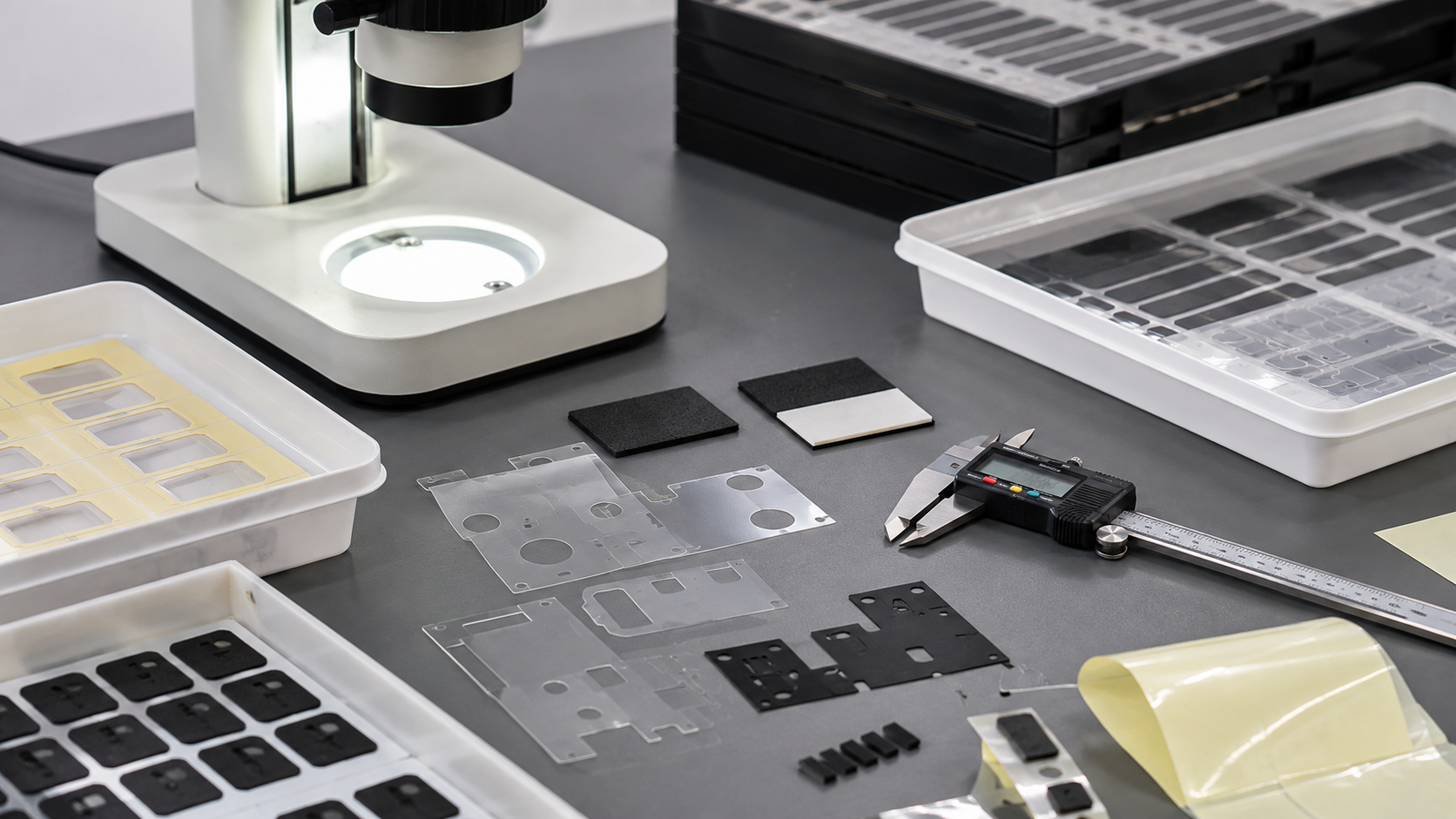
Sanken develops custom die cut films, foams, adhesive tape parts, protective films, and multilayer flexible components for electronic OEM applications.
We support customers from drawing review and material selection through laminating, precision die cutting, prototype development, inspection, and mass production. Components can be supplied as individual parts, sheets, rolls, or assembly-ready kits depending on the customer’s production requirements.
You May Also Be Interested In
- What Die Cut Parts Are Used in Consumer Electronics Assembly?
- How to Choose Die Cut Protective Films for Electronics and Display Modules
- How to Choose Die Cut Films and Adhesive Materials for Display Module Assembly
- PET vs PI Insulation Films: Which Is Better for Electronic Components?
- How to Choose the Right Die Cutting Manufacturer for Your OEM Project
Conclusion
Choosing die cut films, foams, and adhesive parts for electronic components requires balancing electrical performance, mechanical protection, assembly efficiency, and manufacturing reliability.
PET films provide stable insulation and light control, foam materials offer cushioning and sealing support, and adhesive components improve positioning and production efficiency. The correct solution depends on the application requirements rather than choosing a single universal material.
By combining suitable materials with precision converting processes, OEM manufacturers can achieve more reliable assemblies, reduce production issues, and improve product consistency.