
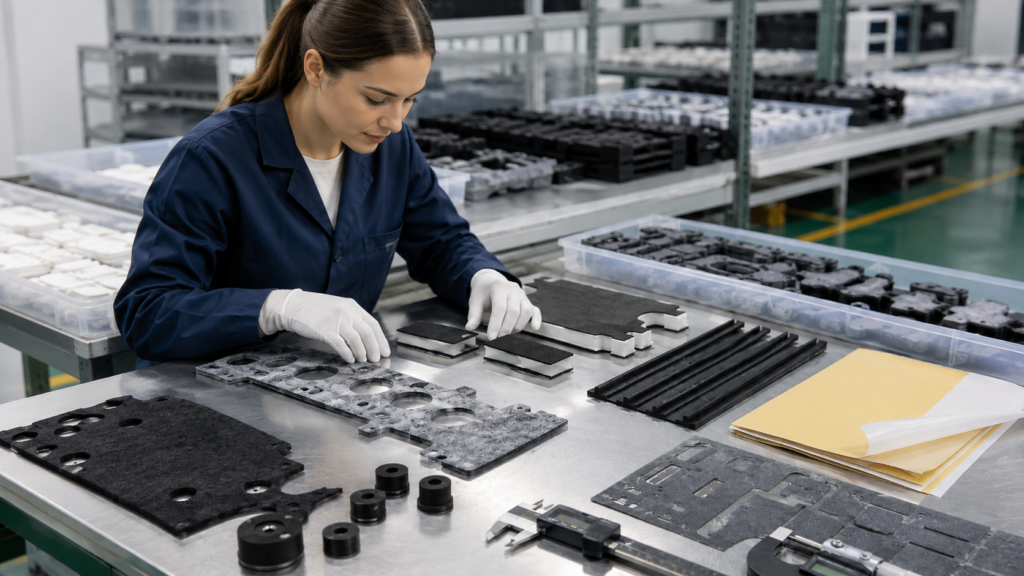
Electric vehicles create a new challenge for interior noise control. Without traditional engine noise, occupants can notice more subtle sounds such as panel vibration, airflow noise, trim movement, and component friction.
To improve cabin comfort, EV manufacturers use different noise reduction materials throughout the vehicle interior. Foam, non-woven felt, rubber, and adhesive-backed components are commonly converted into precision die-cut parts that reduce vibration, absorb sound, prevent rattles, and improve assembly consistency.
The best material depends on the specific noise source, installation location, space limitation, temperature environment, and required performance.
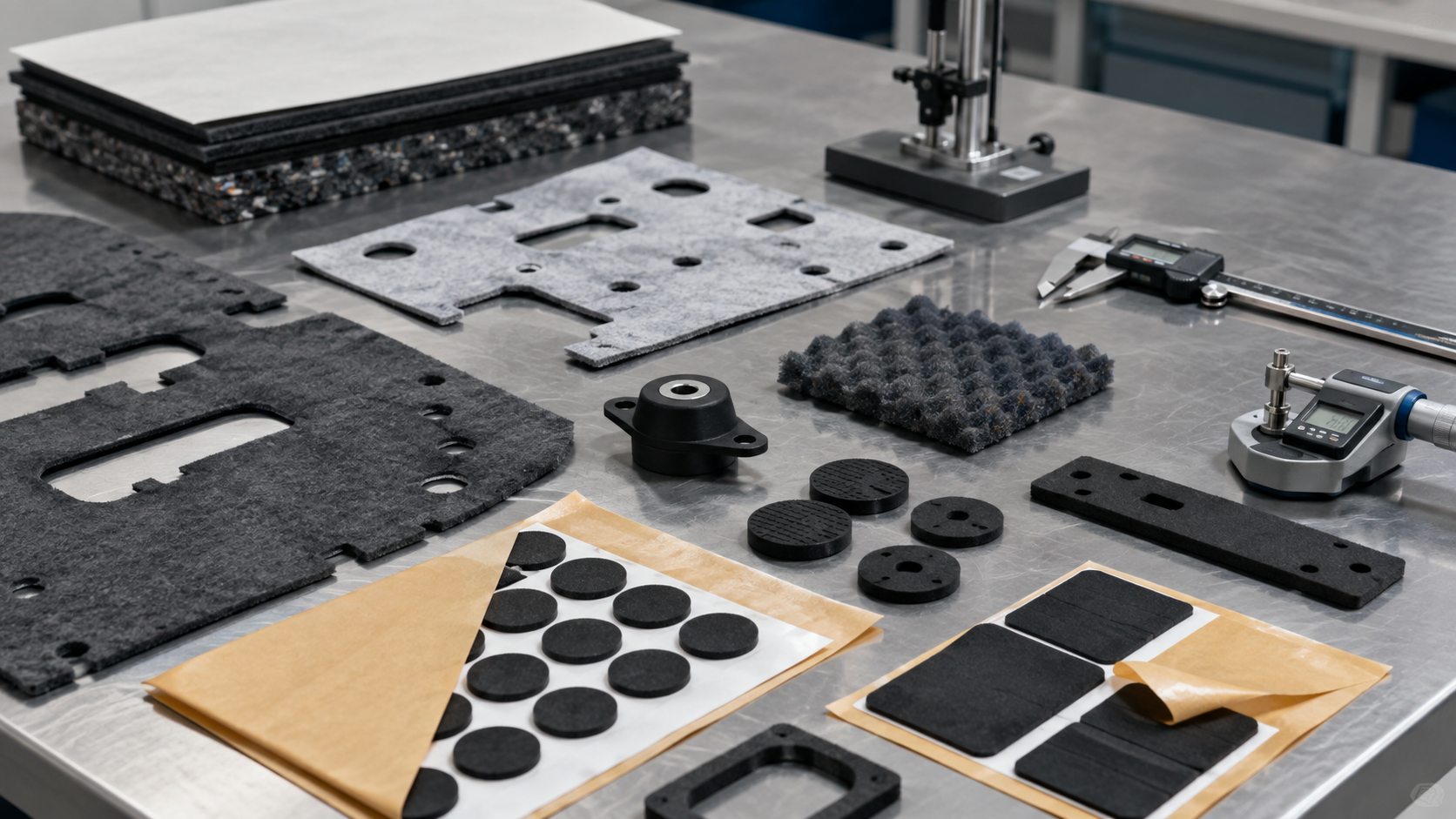
Why EV Interiors Require More Advanced Noise Control
Electric vehicles are generally quieter than vehicles with internal combustion engines. This is a major comfort advantage, but it also changes how engineers approach NVH (Noise, Vibration, and Harshness) control.
When the powertrain becomes quieter, other sources become easier to notice:
- Plastic panel vibration
- Trim-to-trim friction
- Wiring movement
- HVAC airflow noise
- Motor and actuator vibration
- Structural vibration transfer
- Small gaps between assembled components
Many of these issues are not solved by adding thicker insulation everywhere. Instead, engineers use targeted materials placed at specific contact points, gaps, and vibration paths.
Precision die-cut components allow manufacturers to place the right material exactly where it is needed without increasing unnecessary weight or assembly complexity.
Non-Woven Felt for Automotive NVH and Anti-Rattle Applications
Non-woven felt is one of the most common materials used for automotive interior noise reduction.
Needle-punched felt provides a combination of:
- Friction reduction
- Vibration damping
- Surface protection
- Lightweight construction
- Easy die-cut processing
Typical applications include:
| Application Area | Function |
|---|---|
| Door panels | Reduces trim vibration and rattling |
| Instrument panels | Controls contact noise |
| Center consoles | Prevents friction between plastic parts |
| Wiring areas | Limits movement and abrasion |
| Interior trim | Improves acoustic comfort |
| HVAC areas | Reduces vibration transmission |
Felt components are often installed between contacting surfaces where small movements can create unwanted noise.
Compared with rigid solutions, felt can conform to irregular surfaces while maintaining stable contact. Adhesive backing can also improve positioning during assembly.
For EV interiors, felt is particularly valuable because reducing small contact noises becomes more important when occupants can hear lower-level sounds.
Sanken manufactures automotive die-cut components including non-woven felt pads, foam parts, adhesive components, and other NVH solutions.
Foam Materials for Sound Absorption and Vibration Isolation
Foam materials provide different noise reduction benefits depending on their structure and density.
Common automotive NVH foam materials include:
| Material | Main Characteristics | Typical Use |
|---|---|---|
| PU Foam | Good sound absorption | Acoustic insulation areas |
| EVA Foam | Flexible and economical | Cushioning and anti-rattle parts |
| PE Foam | Lightweight and stable | Gap filling and protection |
| EPDM Foam | Durable and resilient | Sealing and vibration control |
| Silicone Foam | Temperature resistant | Higher-performance applications |
PU Foam for Acoustic Absorption
Polyurethane foam is commonly selected where sound absorption is important.
Its open-cell structure helps reduce airborne noise by allowing sound energy to be absorbed within the foam structure.
Potential applications include:
- Interior acoustic pads
- Electronic enclosure insulation
- HVAC noise reduction areas
- Cabin sound absorption components
The performance depends on:
- Foam density
- Thickness
- Cell structure
- Installation location
A thicker foam layer is not always the best solution. Available space, weight targets, and assembly constraints must also be considered.
EVA and PE Foam for Cushioning and Anti-Rattle
EVA and PE foam are widely used for vibration control and contact protection.
They help:
- Fill small gaps
- Prevent direct plastic contact
- Reduce impact noise
- Cushion assembled components
- Maintain component position
These materials are especially useful where the main problem is mechanical contact rather than airborne noise.
Custom foam gaskets and sealing components can be produced with specific thicknesses, adhesive layers, and complex geometries for automotive assemblies.
Rubber Materials for Vibration Damping and Contact Protection
Rubber materials provide excellent elasticity and durability, making them useful for vibration control and protective contact points.
Common materials include:
- EPDM rubber
- Silicone rubber
Rubber components may be used for:
- Vibration isolation pads
- Contact buffers
- Sealing interfaces
- Protective spacers
- Local damping components
Compared with foam, solid rubber generally provides higher durability and resistance to repeated compression.
However, material hardness must be carefully selected.
A rubber component that is too hard may transfer vibration instead of absorbing it. A component that is too soft may deform over time and lose positioning accuracy.
Important selection factors include:
| Factor | Impact |
|---|---|
| Hardness | Determines vibration response |
| Thickness | Influences compression behavior |
| Elastic recovery | Supports long-term performance |
| Temperature resistance | Maintains stability |
| Surface condition | Affects bonding |
Adhesive-Backed NVH Components Improve Assembly Efficiency
Many EV interior noise reduction parts require precise positioning during assembly.
Adhesive-backed materials simplify installation by combining the functional material and attachment method into one component.
Examples include:
- Adhesive felt pads
- Foam tape parts
- Rubber pads with adhesive backing
- Acoustic insulation frames
- Protective liners
Benefits include:
- Faster installation
- Reduced manual adjustment
- Better positioning accuracy
- Improved production consistency
The adhesive should be selected according to the substrate, such as plastic trim, metal brackets, painted surfaces, or composite materials.
Poor adhesive selection can cause:
- Part lifting
- Noise caused by movement
- Contamination
- Assembly delays
Sanken provides adhesive-backed die-cut components using foam, felt, rubber, PET film, and adhesive tape structures.
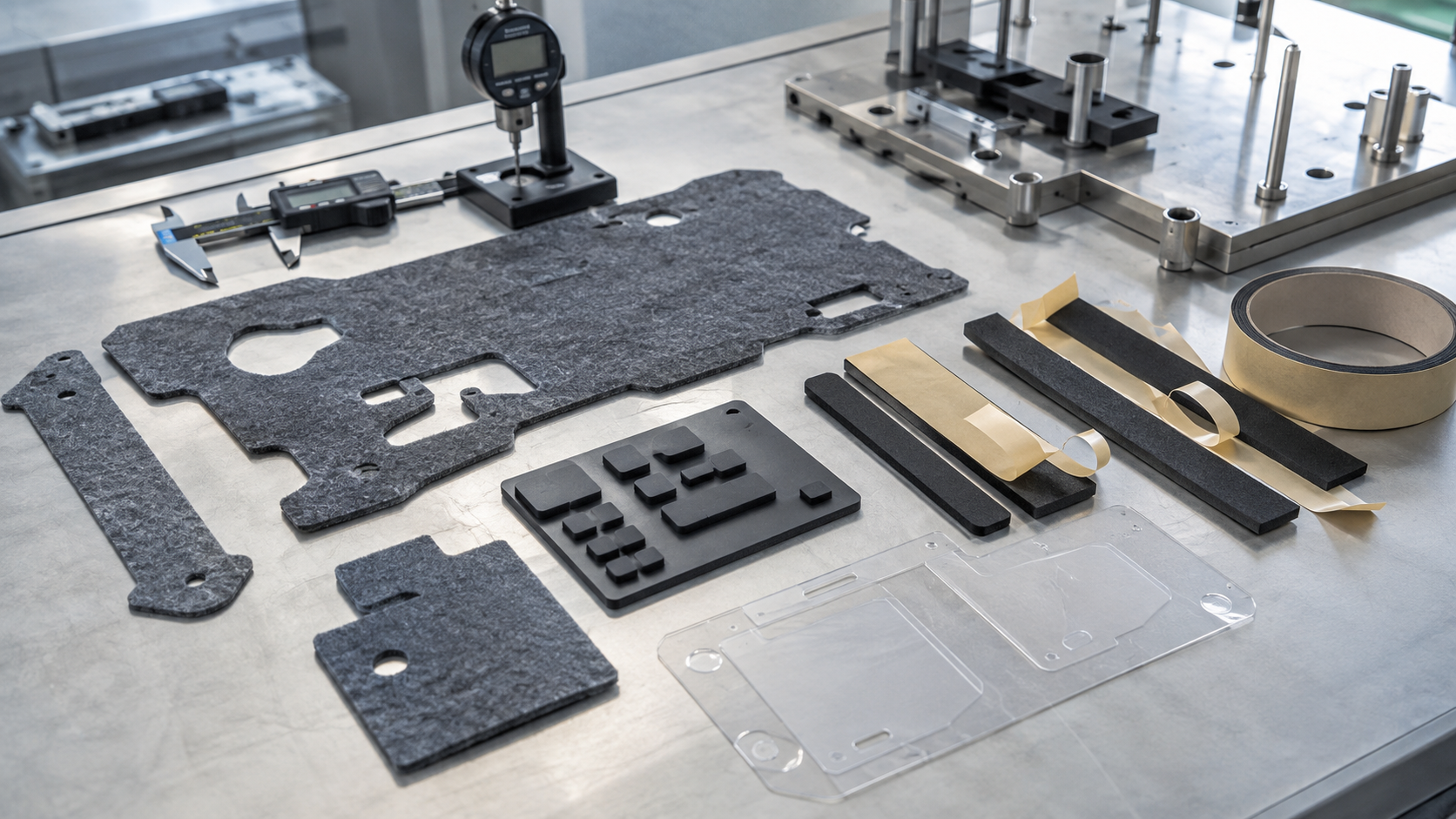
Choosing the Right Noise Reduction Material
There is no single material that provides the best NVH performance for every EV interior application.
Engineers should evaluate:
| Requirement | Recommended Material Consideration |
|---|---|
| Reduce rattling | Felt, EVA foam, PE foam |
| Absorb sound | PU foam, acoustic materials |
| Reduce vibration transfer | Rubber, EPDM foam |
| Fill assembly gaps | Foam gasket materials |
| Protect contacting surfaces | Felt, foam, rubber |
| Improve installation | Adhesive-backed structures |
The material should match the actual noise source.
For example:
- A rattling trim panel may require felt or foam contact pads.
- A vibrating bracket may require rubber damping.
- An acoustic cavity may require sound-absorbing foam.
- A sealing gap may require a foam gasket.
Selecting materials based only on thickness or hardness can result in ineffective noise control.
Precision Die Cutting Improves NVH Component Performance
NVH materials are often flexible and lightweight, but they still require precise manufacturing.
Precision die cutting helps control:
- Part dimensions
- Thickness consistency
- Hole locations
- Adhesive alignment
- Edge quality
- Repeatable installation
Complex automotive NVH parts may include:
- Irregular profiles
- Multiple holes
- Narrow sections
- Adhesive areas
- Layered constructions
Manufacturing consistency is important because small changes in position or thickness can affect compression, contact pressure, and noise performance.
For high-volume EV programs, stable tooling and inspection processes help maintain consistent NVH performance across production batches.
Prototype Validation Helps Prevent NVH Problems
Noise issues are often difficult to predict only from drawings.
Prototype testing allows engineers to evaluate:
- Actual fit
- Compression behavior
- Contact areas
- Installation process
- Noise reduction effectiveness
- Long-term durability
During prototype development, engineers may discover:
- Incorrect foam density
- Insufficient contact pressure
- Poor adhesive performance
- Incorrect part placement
- Material thickness problems
Early validation reduces the risk of changing components after mass production begins.
The article on how to choose automotive NVH materials for noise and vibration control provides additional guidance on material selection.
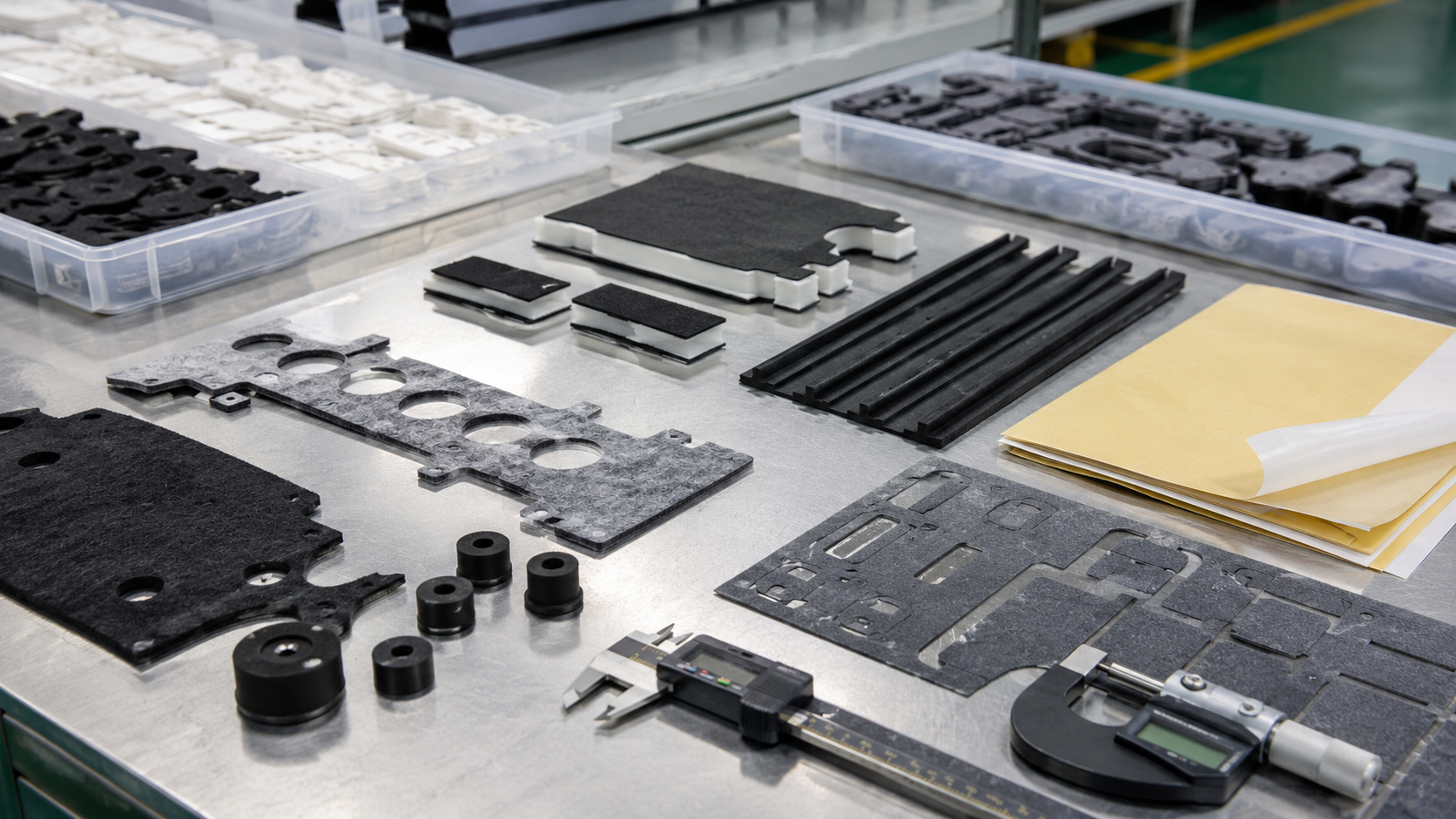
How Sanken Supports EV Interior NVH Solutions
Sanken manufactures custom die-cut foam, non-woven felt, rubber, adhesive tape, PET film, and protective components for automotive OEM applications.
We support customers from material selection and drawing review through laminating, precision die cutting, prototype production, inspection, and mass production.
By combining suitable materials with accurate converting processes, Sanken helps EV manufacturers reduce interior noise, improve assembly efficiency, and achieve consistent NVH performance.
You May Also Be Interested In
- Automotive NVH Materials: Foam, Felt, Rubber, and Adhesive Solutions
- How to Choose Automotive NVH Materials for Noise and Vibration Control
- Non-Woven Felt Pads for Automotive NVH, Cushioning, and Noise Reduction
- Die-Cut Sound-Absorbing Foam Parts: Materials, Shapes, and OEM Applications
- How to Choose the Right Die Cutting Manufacturer for Your OEM Project
Conclusion
The best noise reduction materials for electric vehicle interiors depend on the specific NVH problem, installation location, and production requirements.
Non-woven felt is effective for anti-rattle and friction control, foam materials provide sound absorption and cushioning, rubber components help isolate vibration, and adhesive-backed structures improve assembly consistency.
Successful EV interior noise control is not achieved by using one material everywhere. It requires selecting the right material, designing the right geometry, and converting each component with precision to ensure reliable performance in mass production.