
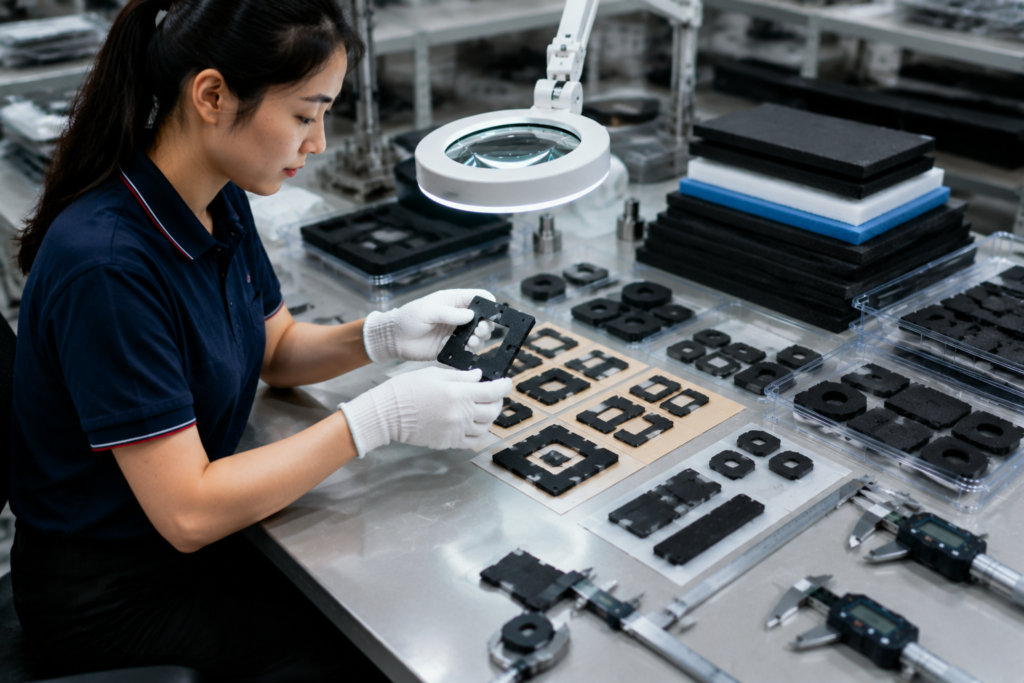
Noise reduction has become an important design requirement across automotive, electronics, appliances, and industrial products. As products become more compact and quieter, unwanted vibration, air noise, and contact noise become more noticeable to end users.
Die-cut sound-absorbing foam parts provide a flexible solution by combining acoustic control, cushioning, sealing support, and precise assembly positioning. Unlike standard foam sheets, custom die-cut parts are manufactured according to specific product drawings, allowing engineers to control shape, thickness, adhesive structure, and installation method.
Sound-Absorbing Foam Parts Do More Than Reduce Noise
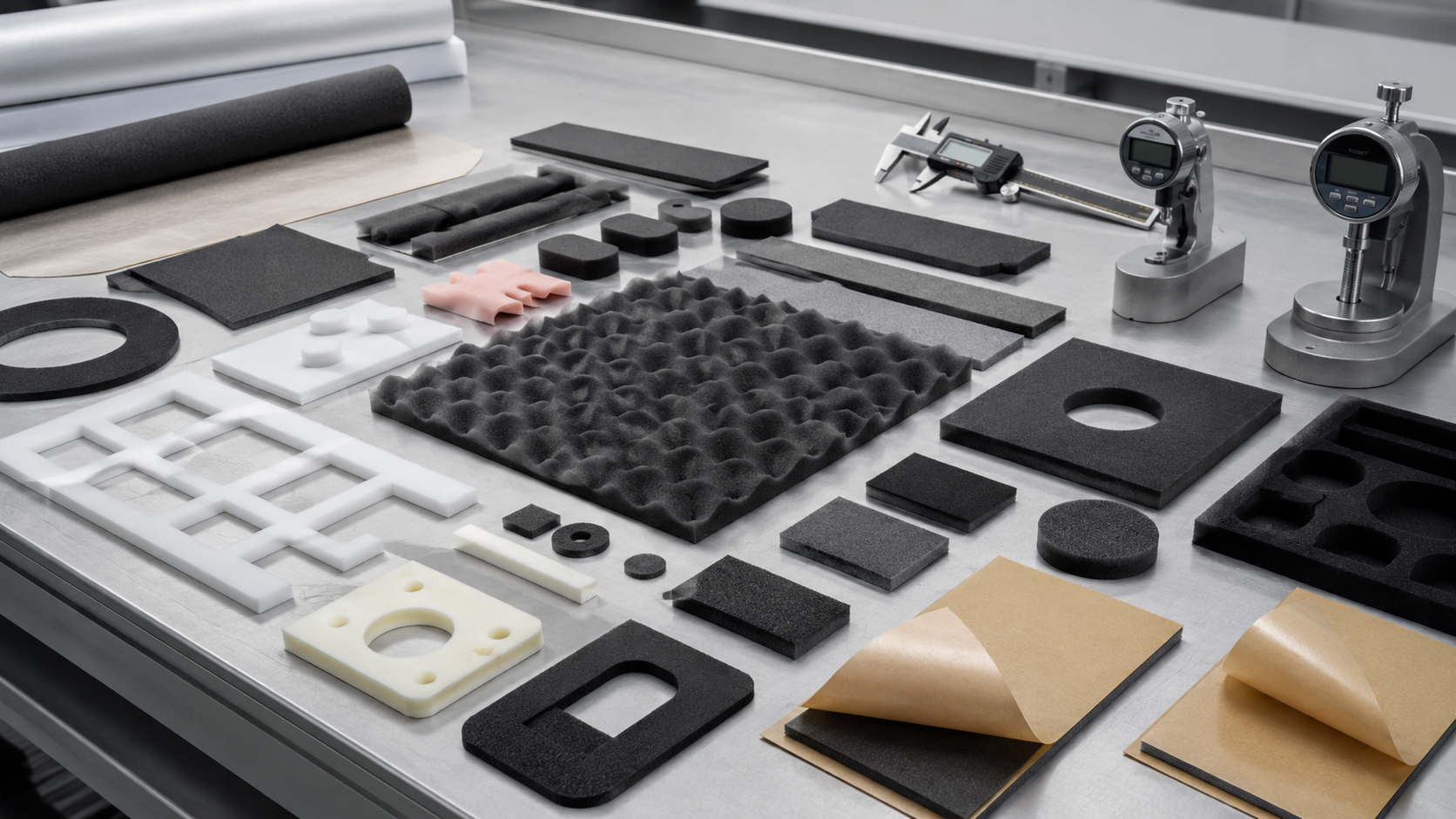
Sound-absorbing foam is often associated only with acoustic performance, but OEM applications usually require multiple functions from the same component.
A die-cut foam part may help:
| Function | Purpose |
|---|---|
| Sound absorption | Reduces unwanted noise transmission |
| Vibration control | Limits movement and contact noise |
| Cushioning | Protects components from impact |
| Gap filling | Controls spacing between parts |
| Sealing support | Helps reduce air leakage paths |
| Anti-rattle protection | Prevents friction between components |
| Assembly positioning | Keeps parts fixed during production |
For example, an automotive interior foam pad may reduce squeaks between plastic panels while also absorbing vibration. A foam component inside an appliance may reduce motor noise while preventing contact between moving parts.
Therefore, material selection should be based on the complete application requirement rather than acoustic performance alone.
Common Foam Materials Used for Sound Absorption
Different foam materials provide different combinations of softness, durability, compression recovery, and acoustic performance.
The most suitable material depends on the environment, temperature, required thickness, and mechanical conditions.
| Foam Material | Main Characteristics | Typical Applications |
|---|---|---|
| PU Foam | Open-cell structure, good sound absorption | Acoustic pads, interior noise reduction |
| EVA Foam | Flexible, economical, good cushioning | General vibration and noise control |
| PE Foam | Lightweight, moisture resistant | Protection and gap filling |
| EPDM Foam | Durable and weather resistant | Automotive sealing and vibration control |
| Silicone Foam | Temperature resistant | High-performance environments |
PU Foam for Acoustic Absorption
Polyurethane (PU) foam is commonly used where sound absorption is the primary requirement.
Its open-cell structure allows air movement through the material, helping reduce certain types of airborne noise.
Typical applications include:
- Interior acoustic pads
- Electronic equipment noise reduction
- Appliance sound insulation
- Equipment enclosures
However, PU foam selection requires attention to density, thickness, compression behavior, and environmental exposure.
A softer foam may absorb sound effectively but may not provide enough mechanical support. A denser foam may improve durability but change acoustic performance.
EVA and PE Foam for Cushioning and Noise Control
EVA and PE foam are frequently used when noise reduction is combined with cushioning and protection.
They are suitable for applications requiring:
- Contact noise reduction
- Vibration isolation
- Gap filling
- Component protection
- Lightweight structures
These materials are easier to process and can be combined with adhesive layers for efficient assembly.
Sanken converts custom foam gasket and sealing components using various foam materials for OEM applications.
Die-Cut Foam Shapes Match Complex OEM Designs
One of the biggest advantages of die-cut foam parts is the ability to create custom shapes that fit specific product structures.
Common shapes include:
- Pads
- Strips
- Frames
- Rings
- Irregular profiles
- Multi-hole components
- Adhesive-backed inserts
| Shape Type | Typical Purpose |
|---|---|
| Foam pads | Local cushioning and vibration reduction |
| Foam strips | Edge sealing and noise isolation |
| Foam frames | Perimeter sealing and acoustic barriers |
| Foam rings | Around openings or components |
| Custom profiles | Complex assembly requirements |
Compared with manually cut foam, precision die cutting provides better consistency for repeated production.
This is especially important when foam parts must align with:
- Clips
- Screws
- Housings
- Plastic trim
- Electronic components
- Internal brackets
A small dimensional difference can affect assembly quality, compression, and acoustic performance.
Adhesive-Backed Foam Improves Assembly Efficiency
Many sound-absorbing foam components require adhesive backing to maintain accurate positioning during assembly.
Adhesive-backed foam provides:
- Faster installation
- Reduced manual adjustment
- Better positioning accuracy
- Improved production consistency
- Compatibility with automated assembly
The adhesive does not replace mechanical fixing. Its main role is to keep the foam correctly located before final assembly.
Important adhesive considerations include:
- Bonding surface
- Temperature exposure
- Required holding force
- Surface cleanliness
- Long-term aging
- Removal requirements during service
Different substrates, such as plastic, metal, painted surfaces, and coated materials, require different adhesive systems.
Sanken provides adhesive-backed die-cut components combining foam, adhesive tapes, and liners according to OEM assembly requirements.
Automotive NVH Applications for Die-Cut Foam Parts
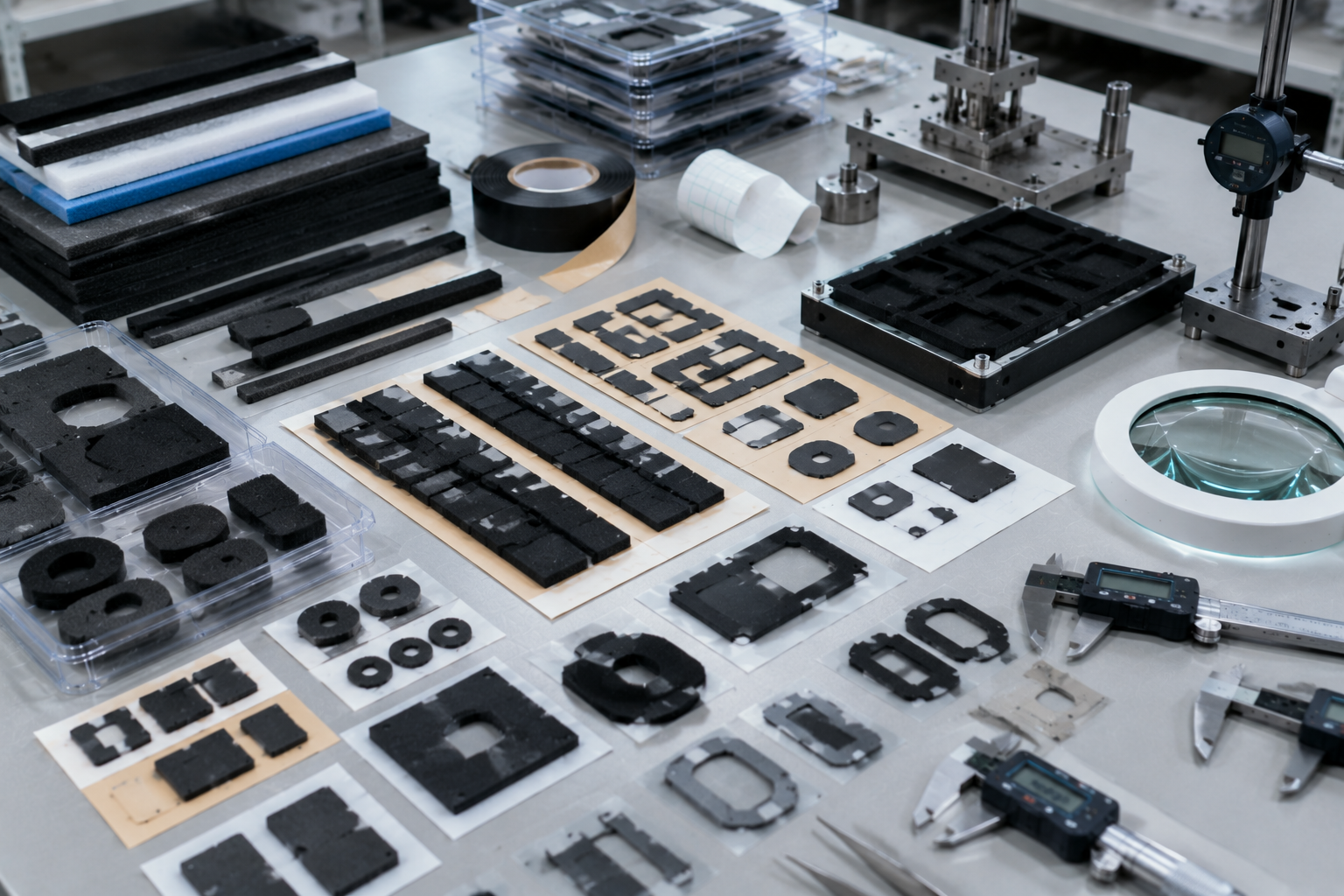
Automotive manufacturers use many types of foam and felt components to improve NVH (Noise, Vibration, and Harshness) performance.
EV vehicles create new challenges because reduced engine noise makes other sounds more noticeable.
Common automotive applications include:
| Location | Function |
|---|---|
| Door panels | Reduces rattling and vibration |
| Instrument panels | Controls contact noise |
| Center consoles | Prevents friction noise |
| Wiring areas | Reduces movement and abrasion |
| Interior trim | Improves acoustic comfort |
| HVAC areas | Supports vibration and noise reduction |
Foam components must fit accurately around clips, fasteners, and curved trim structures.
A poorly positioned foam pad may fail to contact the intended area, reducing its effectiveness. Precision die cutting helps ensure every part is installed consistently.
For automotive applications, Sanken supports customers with automotive die-cut components including foam, felt, adhesive, and protective parts.
Appliance and Electronics Applications
Sound-absorbing foam parts are also widely used outside automotive applications.
Home Appliances
Appliances often require noise control around motors, fans, compressors, and moving assemblies.
Common uses include:
- Motor vibration pads
- Internal acoustic barriers
- Panel cushioning
- Anti-rattle foam strips
- Gap-filling components
Electronics
Electronic products may use foam components to reduce mechanical noise and protect sensitive assemblies.
Applications include:
- Device housings
- Internal supports
- Speaker areas
- Display-related assemblies
- Electronic enclosures
The foam design must balance acoustic performance with limited internal space.
Thin foam structures, precise cutouts, and adhesive-backed designs help manufacturers integrate noise-control solutions without increasing product size.
Material Thickness and Density Affect Performance
Selecting sound-absorbing foam requires more than choosing the thickest material available.
Important factors include:
| Factor | Impact |
|---|---|
| Thickness | Influences acoustic absorption and spacing |
| Density | Affects stiffness and durability |
| Cell structure | Influences sound absorption |
| Compression recovery | Determines long-term performance |
| Surface treatment | May affect bonding |
| Adhesive thickness | Changes total assembly height |
A thicker foam may improve absorption but create assembly interference. A softer foam may provide better conformity but compress permanently over time.
OEM engineers should evaluate the complete operating environment before finalizing the material.
Precision Die Cutting Improves Foam Part Quality
Foam is flexible, which makes accurate converting more challenging than cutting rigid materials.
Precision die cutting controls:
- Outer dimensions
- Hole positions
- Thickness consistency
- Edge quality
- Adhesive alignment
- Waste removal
- Part presentation
Poor cutting conditions may cause:
- Uneven edges
- Compression marks
- Deformed holes
- Adhesive contamination
- Size variation
For high-volume OEM programs, stable tooling and process control are essential.
Sanken’s precision die cutting services support foam, adhesive tape, protective film, PET film, and other flexible materials from prototype through mass production.
Prototype Testing Helps Optimize Acoustic Components
Before mass production, foam parts should be tested in the actual assembly environment.
Important validation includes:
- Fit verification
- Compression evaluation
- Adhesive positioning
- Noise reduction performance
- Vibration behavior
- Long-term deformation
- Installation efficiency
Prototype testing may reveal that a different foam density, thickness, or adhesive structure provides better performance.
Early design review can also identify manufacturing issues such as:
- Excessively narrow sections
- Difficult waste removal
- Poor adhesive access
- Incorrect compression requirements
How Sanken Supports Sound-Absorbing Foam Applications
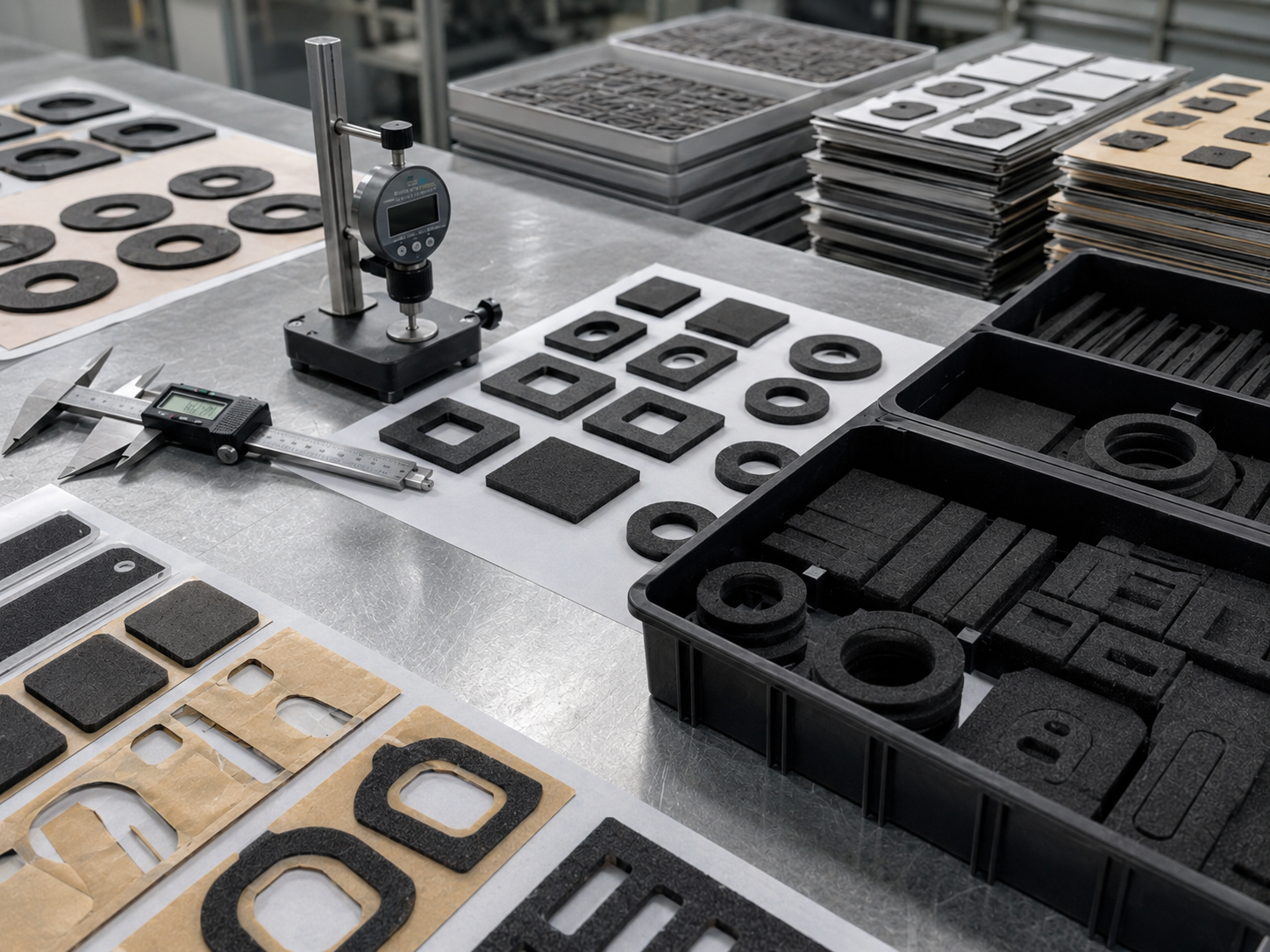
Sanken manufactures custom die-cut foam components for automotive, appliance, electronics, and industrial OEM applications.
We support material selection, laminating, adhesive application, precision die cutting, prototype development, inspection, and production delivery. Foam parts can be supplied as individual components, sheets, rolls, or assembly-ready kits based on customer requirements.
By combining suitable foam materials with accurate converting processes, Sanken helps OEM manufacturers improve noise control, assembly efficiency, and product reliability.
You May Also Be Interested In
- Automotive NVH Materials: Foam, Felt, Rubber, and Adhesive Solutions
- How to Choose Automotive NVH Materials for Noise and Vibration Control
- Foam Tape vs Foam Gasket: What Is the Difference for OEM Applications?
- From Foam Rolls to Finished Parts: How Die Cutting Works
- How to Choose the Right Die Cutting Manufacturer for Your OEM Project
Conclusion
Die-cut sound-absorbing foam parts provide OEM manufacturers with flexible solutions for noise reduction, vibration control, cushioning, sealing support, and assembly efficiency.
PU foam, EVA, PE, EPDM, and silicone foam each offer different performance advantages. The correct choice depends on acoustic requirements, environmental conditions, compression behavior, geometry, and production needs.
With precision die cutting, adhesive converting, and proper material selection, foam components can deliver consistent performance across automotive, appliance, electronics, and industrial applications.