
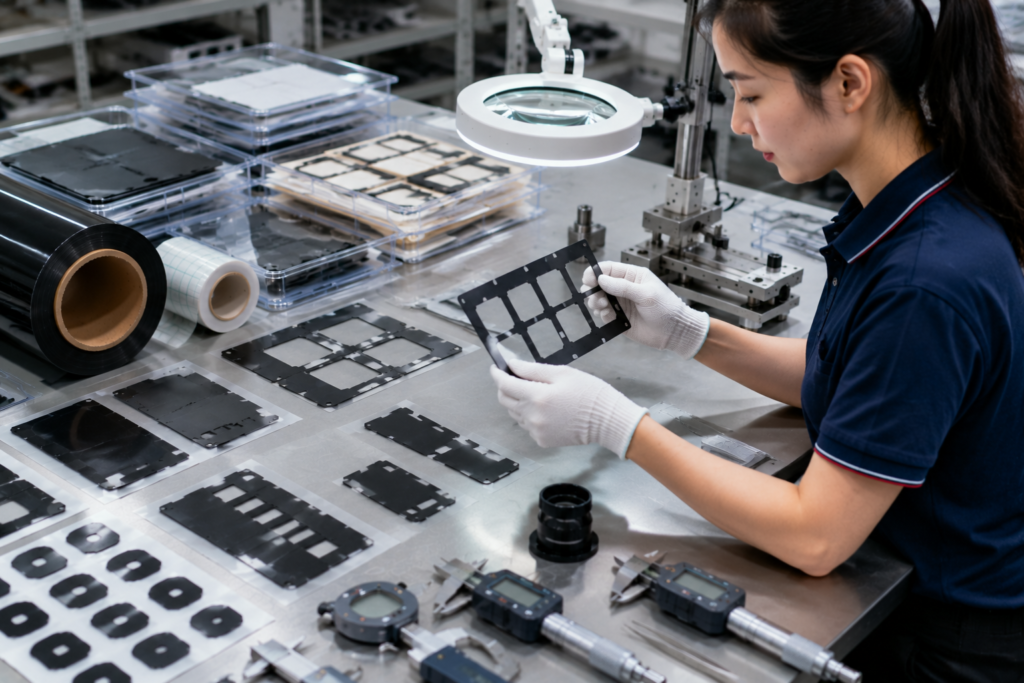
Black PET film and protective film are both widely used in electronic and optical product manufacturing, but they serve completely different purposes. Choosing the wrong film type can lead to poor optical performance, assembly problems, surface damage, or unnecessary production costs.
Black PET film is mainly used as a functional component for light control, insulation support, and internal separation. Protective film is mainly used as a temporary protection layer to prevent scratches, dust, and contamination during manufacturing, transportation, and assembly.
For OEM engineers and purchasing teams, understanding the difference between these two materials helps ensure the right film structure is selected for each application.
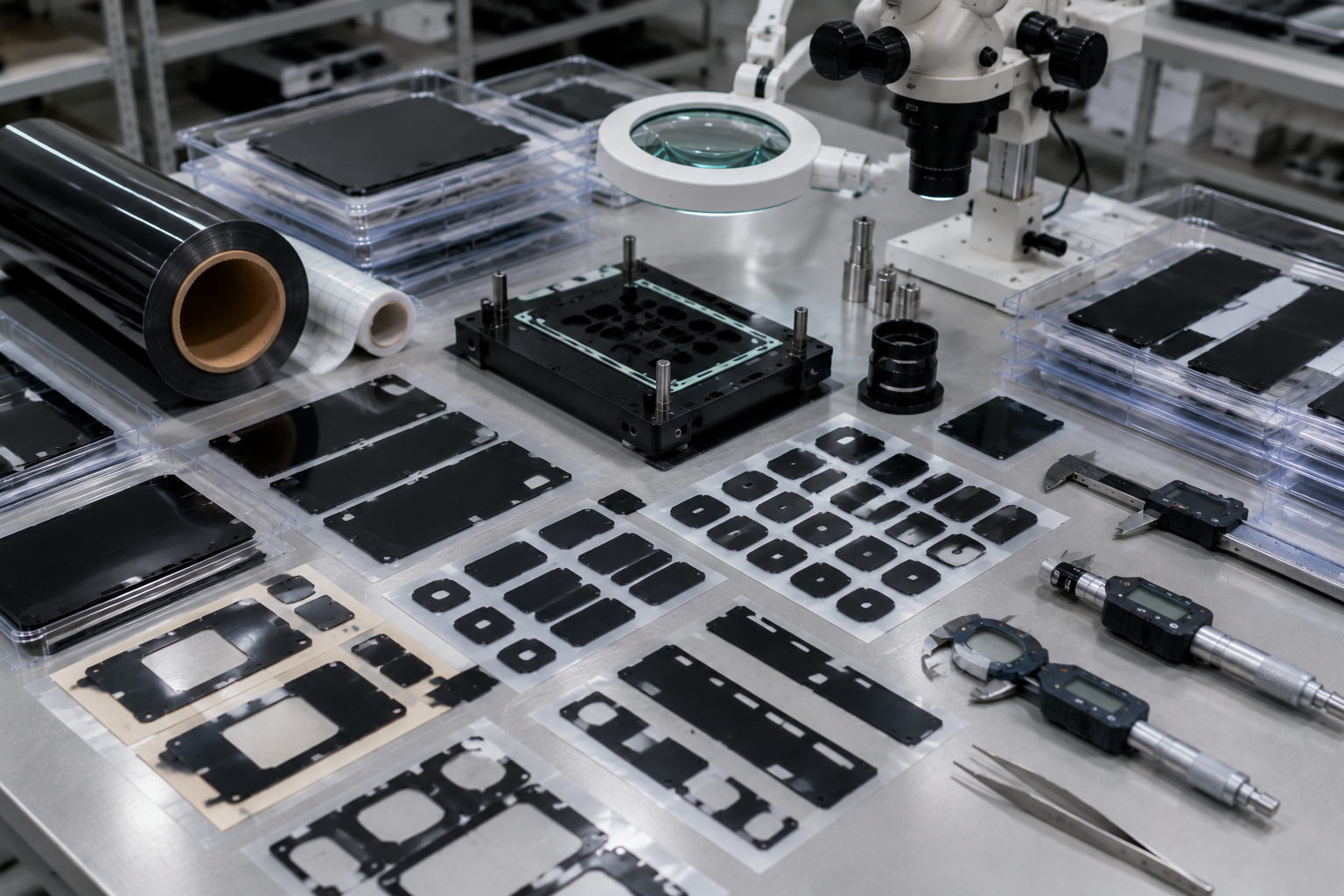
Black PET Film and Protective Film Have Different Functions
Although both materials are thin polymer films, their roles inside an OEM product are very different.
Black PET film is designed to remain as part of the final assembly. It performs a specific function after the product is completed, such as blocking unwanted light or creating a controlled internal barrier.
Protective film is usually removed after manufacturing. Its purpose is temporary protection during handling and processing.
| Material | Main Purpose | Remains in Final Product |
|---|---|---|
| Black PET Film | Light blocking, insulation support, optical control | Yes |
| Protective Film | Surface protection during manufacturing | Usually No |
This difference affects every design decision, including adhesive selection, thickness, durability, and die-cut requirements.
Using protective film where a functional light-blocking component is required may result in poor optical performance. Using black PET where temporary protection is needed may increase unnecessary material cost.
Black PET Film Provides Light Control and Optical Performance
Black PET film is commonly selected for applications where controlling light transmission is important.
Its black appearance helps absorb or block unwanted light, making it useful in optical and electronic assemblies where stray light can affect product performance or appearance.
Typical applications include:
- Display module components
- Optical sensor areas
- Camera-related structures
- Electronic interfaces
- Light shielding frames
- Internal optical barriers
Important properties include:
| Property | Function |
|---|---|
| Light blocking | Prevents unwanted light leakage |
| Dimensional stability | Maintains accurate part shape |
| Thin structure | Fits compact assemblies |
| Surface consistency | Supports clean appearance |
| Die-cut compatibility | Enables complex custom shapes |
Black PET film is often converted into rings, frames, strips, pads, and irregular shapes with adhesive backing or protective liners.
Because it remains inside the final product, the material must maintain stable performance throughout the product lifecycle.
Sanken provides die-cut light-blocking film components and custom PET film converting solutions for optical and electronic OEM applications.
Protective Film Protects Surfaces During Manufacturing
Protective film has a different role. It is designed to protect finished surfaces during production, assembly, storage, and transportation.
Typical applications include:
- Display surface protection
- Plastic panel protection
- Metal surface protection
- Optical component protection
- Finished appearance protection
- Assembly process protection
Protective films typically include:
| Layer | Function |
|---|---|
| Base film | Provides physical protection |
| Adhesive layer | Holds film during processing |
| Release liner (if applicable) | Protects adhesive before use |
The adhesive is usually designed to provide temporary holding force while allowing clean removal without residue.
Key performance requirements include:
- Appropriate adhesion level
- Clean removal
- No adhesive residue
- Resistance to scratches
- Stability during storage
Unlike black PET film, protective film is not normally selected for long-term optical or mechanical performance after final assembly.
Adhesive Selection Is Different for Both Materials
Both black PET film and protective film may use adhesive backing, but the adhesive requirements are different.
For black PET film, the adhesive often needs to provide long-term positioning inside the final product.
For protective film, the adhesive needs controlled temporary bonding and easy removal.
| Requirement | Black PET Film Adhesive | Protective Film Adhesive |
|---|---|---|
| Bond duration | Long-term | Temporary |
| Main goal | Keep component positioned | Protect surface |
| Removal | Usually not required | Required |
| Residue tolerance | Low | Very low |
| Environmental exposure | Product lifetime | Manufacturing period |
For optical and electronic assemblies, adhesive thickness and edge position are especially important. Excess adhesive may squeeze out beyond the film edge and create contamination or appearance problems.
Release liner design also affects production efficiency. Split liners, pull tabs, and kiss-cut structures can simplify installation and removal.
Sanken converts adhesive-backed die-cut components using different film, adhesive, and liner combinations according to OEM requirements.
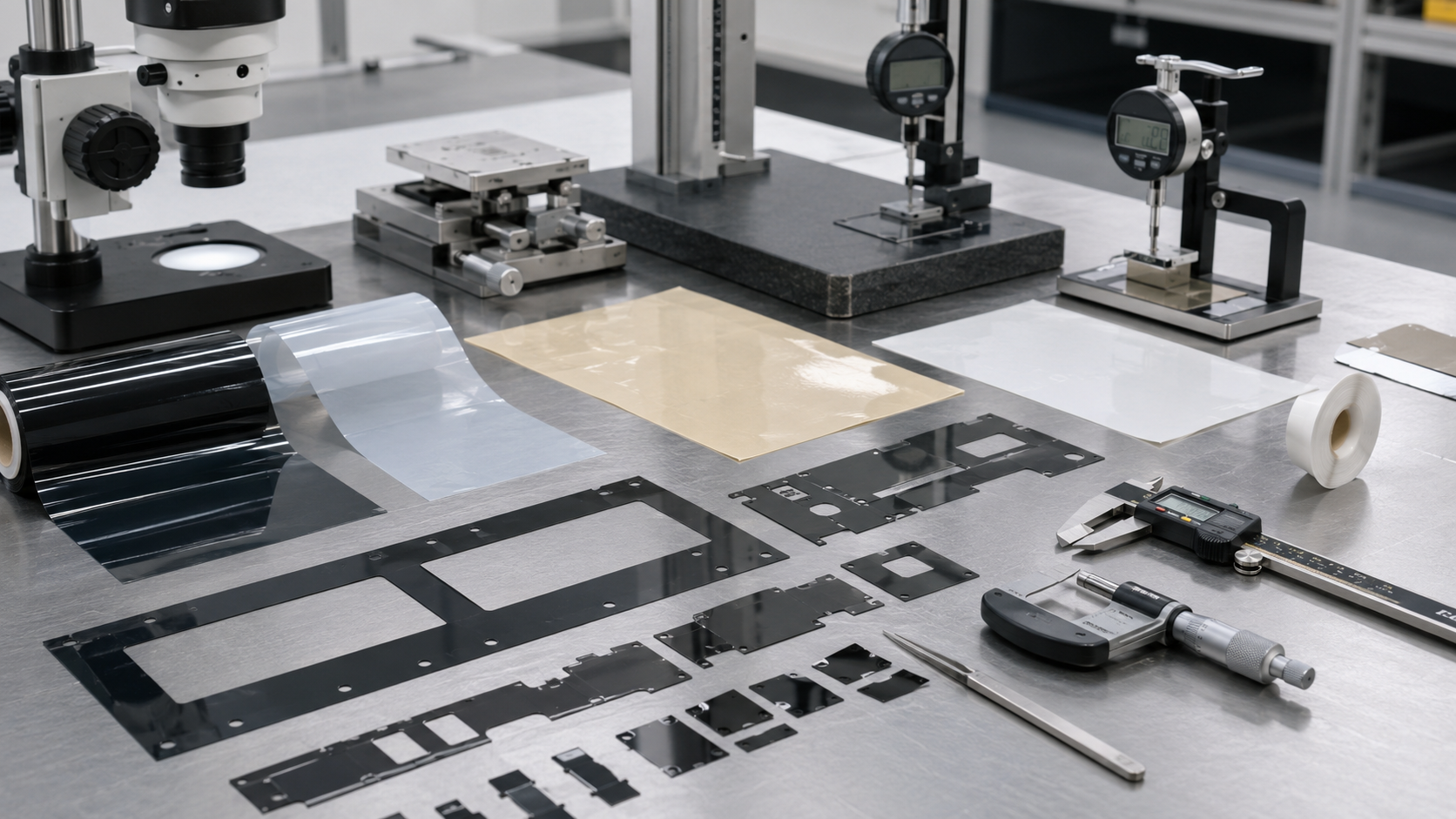
Die Cutting Requirements Are Different
Both materials can be precision die cut, but the manufacturing considerations are not identical.
Black PET film usually requires higher dimensional accuracy because it remains inside the final product and directly affects optical performance.
Protective film requires clean cutting while maintaining easy removal characteristics.
Important converting factors include:
| Factor | Black PET Film | Protective Film |
|---|---|---|
| Dimensional accuracy | Critical | Important |
| Edge appearance | High requirement | Prevent damage to protected surface |
| Adhesive control | Long-term stability | Clean removal |
| Kiss-cut depth | Protects final component | Controls removal layer |
| Part geometry | Optical alignment | Coverage and handling |
Black PET components may require tight control of openings, frames, and narrow features. Protective film designs often focus more on coverage area, tabs, and removal convenience.
Precision die cutting helps maintain consistent dimensions, clean edges, and repeatable production quality for both material types.
Material Thickness Influences OEM Design
Film thickness affects assembly space, handling, and final product performance.
A thicker black PET film may provide better mechanical stability but can increase stack height. A thinner film saves space but may require more careful handling.
Protective film thickness affects:
- Scratch resistance
- Handling strength
- Removal behavior
- Surface coverage
- Manufacturing protection level
OEM engineers should evaluate the entire material structure, including:
- Film thickness
- Adhesive thickness
- Liner thickness
- Lamination structure
- Application method
The final assembled thickness is often more important than the film thickness alone.
Design Considerations for Die-Cut Film Components
Good film performance depends heavily on part design.
Engineers should review:
- Minimum feature size
- Hole locations
- Corner radius
- Adhesive setback
- Part spacing
- Liner design
- Removal method
- Critical tolerances
Common issues include:
| Design Problem | Potential Result |
|---|---|
| Sharp internal corners | Film cracking or stress marks |
| Narrow sections | Tearing during handling |
| Excess adhesive near edges | Contamination |
| Poor liner design | Difficult installation |
| Incorrect tolerance | Assembly interference |
For black PET film, dimensional accuracy is often directly linked to optical performance.
For protective film, the design should prioritize easy application and clean removal without damaging the protected surface.
Quality Control Ensures Reliable Film Performance
Film components may be small, but defects can create significant production issues.
Quality inspection may include:
| Inspection Item | Purpose |
|---|---|
| Film thickness | Controls assembly height |
| Part dimensions | Ensures fit |
| Edge quality | Detects cutting defects |
| Adhesive position | Prevents contamination |
| Surface inspection | Detects scratches or particles |
| Peel performance | Confirms removal behavior |
For black PET components, visual inspection is especially important because uneven edges or incorrect alignment may affect product appearance.
For protective films, clean removal testing helps prevent residue and surface damage.
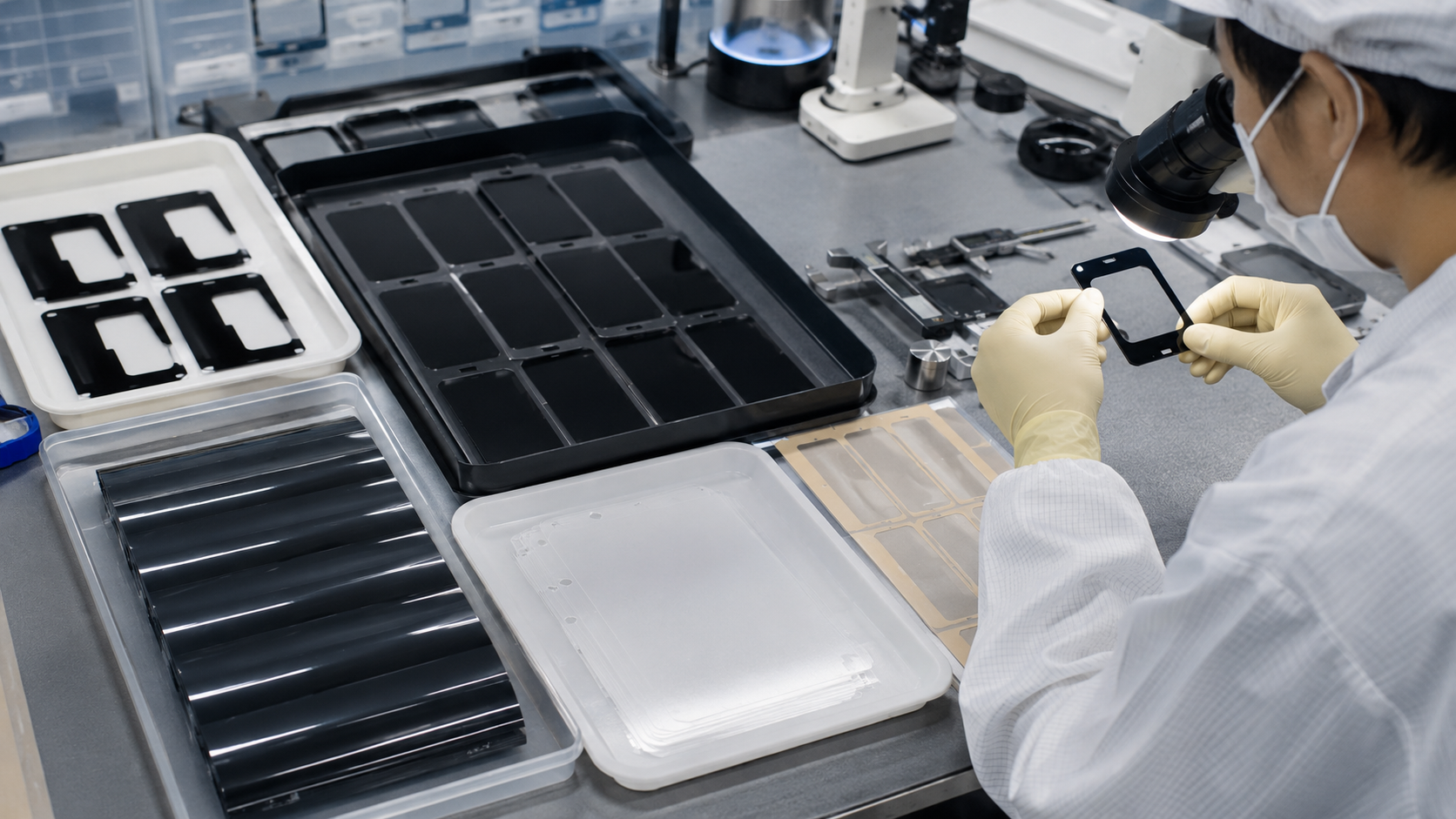
How Sanken Supports OEM Film Converting Projects
Sanken manufactures custom die-cut black PET films, protective films, adhesive-backed film components, and multilayer flexible parts for optical, electronic, automotive, and industrial OEM applications.
We support material selection, laminating, slitting, precision die cutting, kiss cutting, prototype development, inspection, and mass production. Each component is developed according to its actual function, assembly method, dimensional requirements, and production process.
You May Also Be Interested In
- Die-Cut Light-Blocking Films for Optical and Electronic Components
- How to Choose Die Cut Protective Films for Electronics and Display Modules
- How to Choose Die Cut Films and Adhesive Materials for Display Module Assembly
- What Die Cut Parts Are Used in Consumer Electronics Assembly?
- How to Choose the Right Die Cutting Manufacturer for Your OEM Project
Conclusion
Black PET film and protective film may look similar, but they solve completely different OEM manufacturing problems. Black PET film is a functional component used for light blocking, optical control, and internal protection. Protective film is a temporary layer designed to protect surfaces during production and transportation.
Selecting the correct film requires understanding the final application, adhesive requirements, thickness limitations, assembly method, and production process.
With proper material selection and precision die cutting, OEM manufacturers can achieve reliable optical performance, cleaner assembly, reduced production risks, and consistent product quality.