
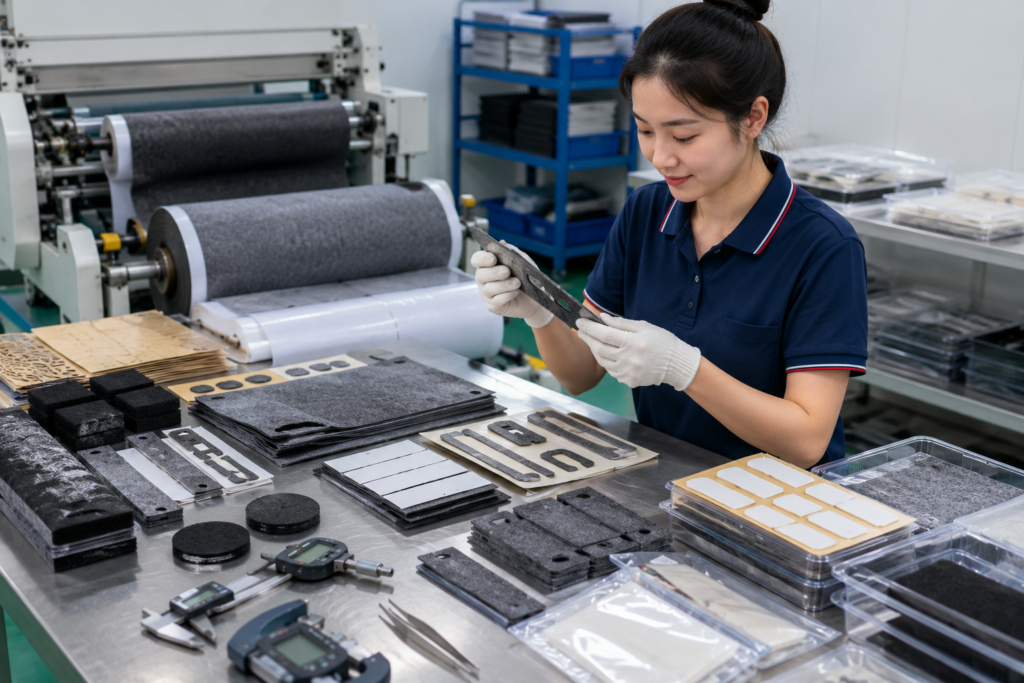
Polyethylene foam is widely used in industrial products because it can provide cushioning, gap filling, sealing support, surface protection, vibration reduction, and lightweight padding.
But choosing the right polyethylene foam is not only about selecting a foam sheet.
You need to consider the application, density, thickness, compression, surface contact, adhesive backing, die-cut shape, and delivery format.
At Sanken, we use precision die cutting to convert PE foam, adhesive-backed PE foam, foam tape, release liners, and laminated foam structures into custom components for electronics, appliances, automotive, industrial equipment, packaging support, and OEM assembly.
The right PE foam should not only look soft.
It should fit, compress, recover, bond, and assemble correctly.
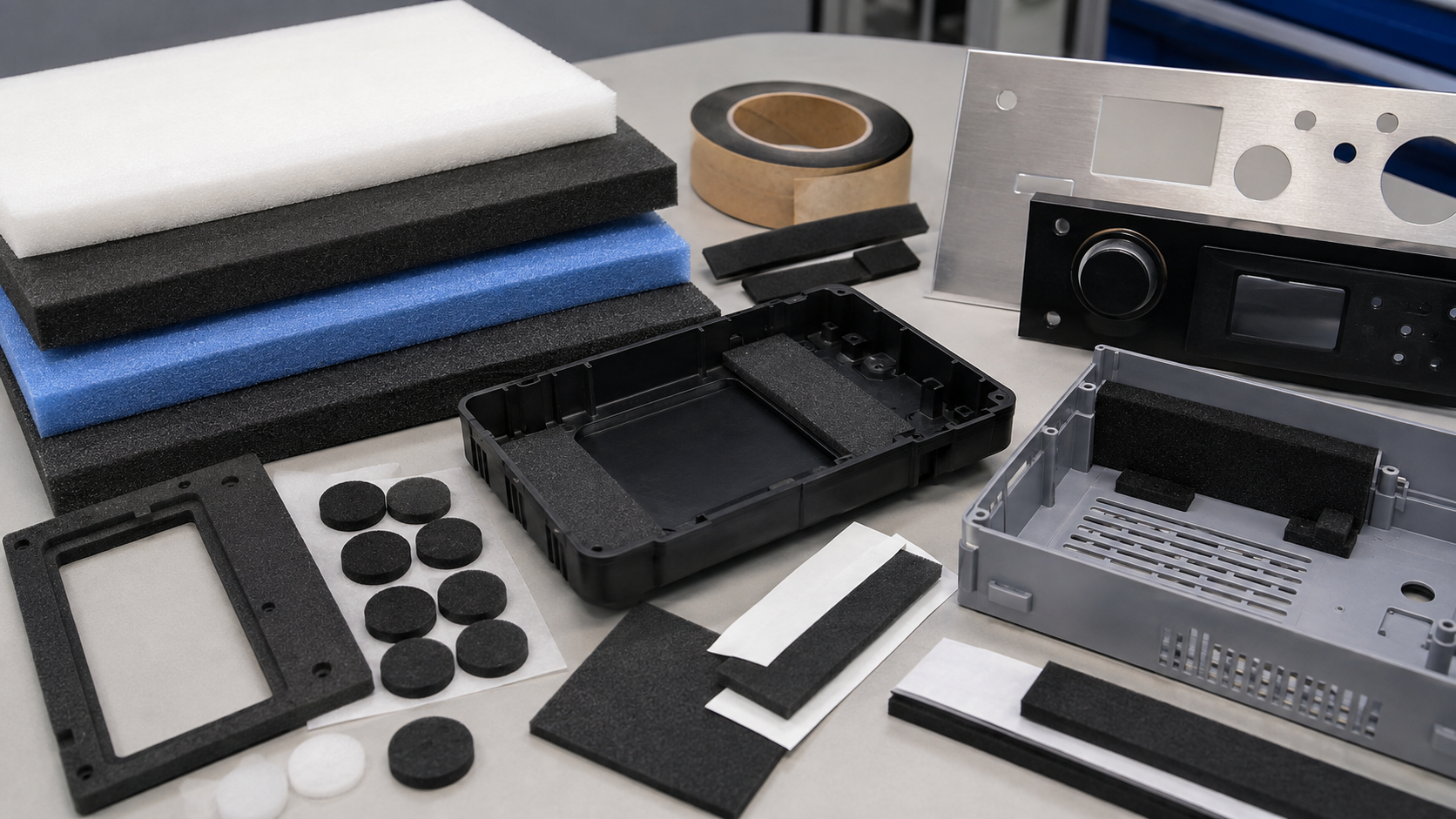
Start With the Industrial Application
Before choosing PE foam, define what the foam needs to do.
Different industrial applications require different foam behavior.
| Application Need | What PE Foam Should Provide |
|---|---|
| Cushioning | Absorb contact force and reduce impact |
| Gap filling | Compress into assembly gaps |
| Sealing support | Help reduce dust, air, or light leakage |
| Surface protection | Prevent scratches or pressure marks |
| Vibration reduction | Reduce hard contact and minor movement |
| Spacer function | Maintain controlled distance between parts |
| Assembly support | Improve handling and placement |
For industrial OEM projects, custom die cut parts help convert PE foam into shapes that match the actual product structure instead of relying on manual cutting.
Manual cutting may be acceptable for rough samples.
Mass production needs repeatability.
Choose the Right Density
Density affects how firm or soft the polyethylene foam feels and how it behaves under pressure.
Higher-density PE foam usually provides firmer support.
Lower-density PE foam may be lighter and easier to compress.
| Density Direction | Suitable Use | Risk If Wrong |
|---|---|---|
| Lower density | Light cushioning, surface protection, simple gap filling | May compress too easily |
| Medium density | General industrial pads, strips, spacers, gaskets | Must match the actual load |
| Higher density | Firmer support, stronger cushioning, more stable spacer function | May create assembly stress |
Density should be selected based on the load, contact area, compression gap, and expected product life.
A foam that feels good by hand may not perform correctly inside the final assembly.
For more background, buyers can review what the different types of foam density mean.
Review Thickness and Compression
Thickness is one of the most important PE foam selection factors.
If the foam is too thin, it may not contact the mating surface.
If it is too thick, it may create assembly stress, poor fit, or visible gaps.
| Factor | Why It Matters |
|---|---|
| Foam thickness | Controls contact and assembly height |
| Compression gap | Determines whether the foam can work |
| Compression recovery | Helps the foam continue performing over time |
| Contact surface flatness | Affects sealing and cushioning consistency |
| Gasket width | Influences stability and die cutting quality |
For sealing applications, foam gaskets and sealing components must be reviewed based on real compression conditions.
A foam gasket does not seal because it exists.
It seals because it compresses correctly.
Closed-Cell PE Foam and Industrial Use
Polyethylene foam is often selected when a closed-cell foam structure is useful for cushioning, protection, and selected sealing support.
Closed-cell PE foam can be useful for:
- Industrial pads
- Foam strips
- Protective inserts
- Foam spacers
- Cushioning parts
- Foam gasket frames
- Adhesive-backed foam components
However, the right choice still depends on density, thickness, surface contact, and assembly pressure.
For some applications, PE foam is a good choice.
For other applications, EVA foam, PU foam, EPDM foam, silicone foam, rubber, or felt may be more suitable.
Material selection should follow the function.
Not the habit.
Compare PE Foam With Other Materials
PE foam is useful, but it is not the answer for every industrial problem.
| Material | Better For | Main Selection Point |
|---|---|---|
| PE foam | Lightweight cushioning, gap filling, general pads | Density and thickness |
| EVA foam | Firmer cushioning and impact support | Hardness and recovery |
| PU foam | Softer contact and selected acoustic cushioning | Compression softness |
| EPDM foam | Sealing and anti-rattle support | Durability and environment |
| Rubber | Stronger damping and contact protection | Hardness and load |
| Felt | Friction control and anti-squeak support | Surface softness |
For noise, vibration, and impact-related parts, buyers can review how to choose die cut foam materials for noise, vibration, and impact control.
PE foam works best when its compression behavior matches the assembly requirement.
If the application needs stronger heat resistance, higher sealing force, or friction control, another material may be better.
Adhesive-Backed PE Foam
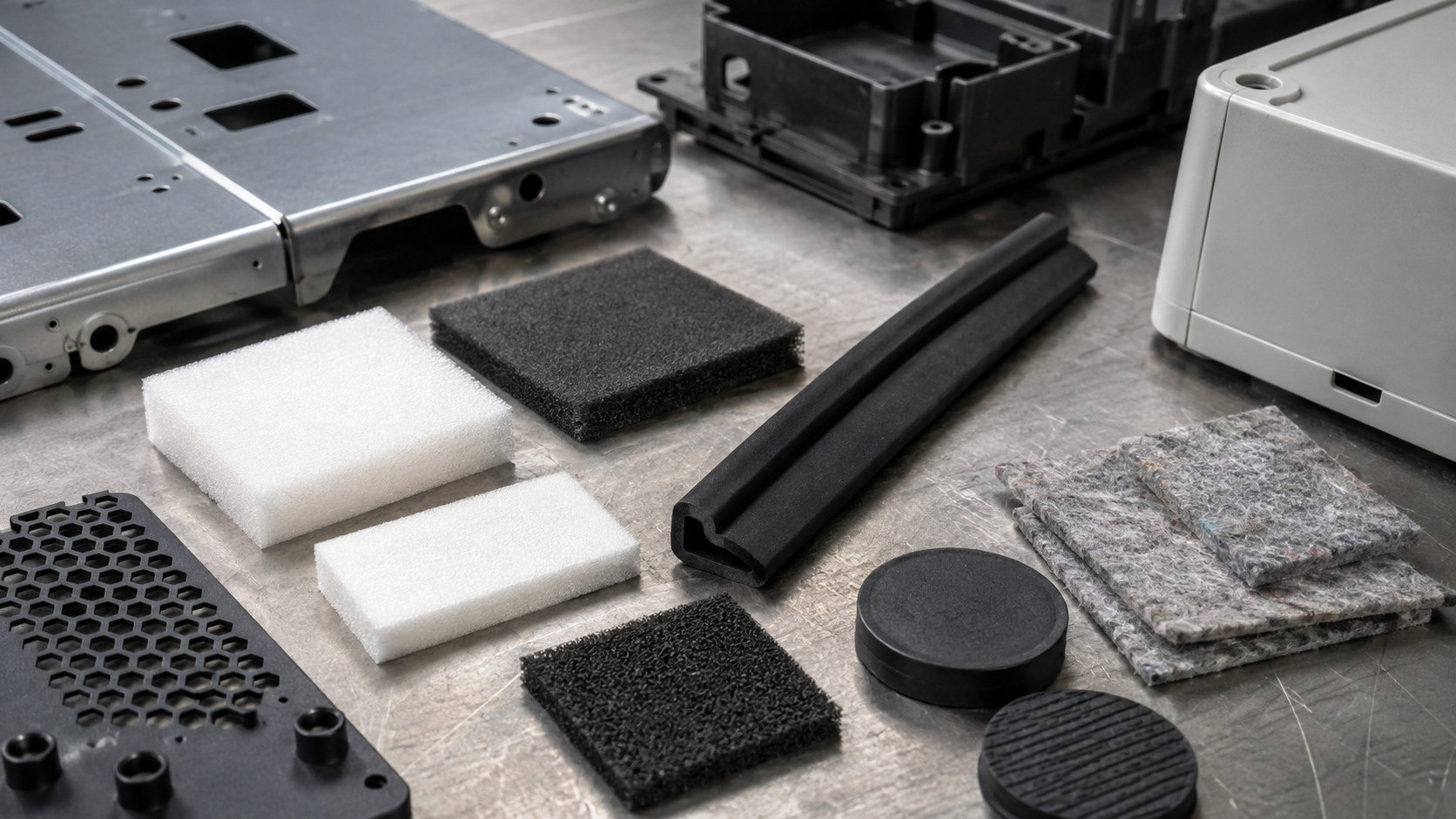
Many PE foam parts use pressure-sensitive adhesive backing.
Adhesive backing helps operators place foam pads, strips, and gasket frames quickly during assembly.
Common adhesive-backed PE foam parts include:
- Foam tape strips
- Cushioning pads
- Foam gasket frames
- Protective foam pads
- Spacer pads
- Assembly positioning pads
- Kiss-cut foam parts on release liner
The adhesive must match the bonding surface.
Industrial products may include plastic, metal, painted surfaces, coated panels, PET film, rubber, foam, or textured housings.
For adhesive-related risks, buyers can review why die cut adhesive parts fail after assembly.
A good adhesive-backed PE foam part should peel smoothly, stay flat, bond accurately, and resist lifting during handling and use.
Die-Cut Design Factors
PE foam is flexible, but the part design still needs to be manufacturable.
Important design points include:
| Design Factor | Why It Matters |
|---|---|
| Minimum width | Prevents tearing or deformation |
| Corner radius | Reduces stress and edge lifting |
| Hole-to-edge distance | Improves cutting stability |
| Foam thickness | Affects cutting and waste removal |
| Adhesive coverage | Prevents shifting during assembly |
| Pull tab design | Improves peeling for small parts |
| Part spacing on liner | Helps operators pick parts cleanly |
| Packaging method | Prevents compression marks |
Very narrow PE foam strips may stretch or tear.
Sharp corners may lift more easily.
Thick foam may need more space for clean cutting and waste removal.
For more design guidance, buyers can review what engineers should know about minimum width in die cut parts.
Manufacturing and Quality Control
Custom PE foam parts are usually produced through material review, lamination, die cutting, kiss cutting, waste removal, inspection, and packaging.
| Step | Main Purpose |
|---|---|
| Application review | Confirm cushioning, sealing, protection, or spacer function |
| Material selection | Choose PE foam density, thickness, adhesive, and liner |
| Lamination | Add adhesive backing or release liner if required |
| Die cutting | Cut pads, strips, frames, holes, and custom shapes |
| Kiss cutting | Keep adhesive-backed parts on liner |
| Waste removal | Remove unused foam cleanly |
| Inspection | Check size, thickness, edge, adhesive, and release behavior |
| Packaging | Prevent dust, sticking, curling, and compression deformation |
For process background, buyers can review how die cutting works from foam rolls to finished parts.
Key quality checks usually include dimensions, thickness, edge quality, adhesive position, liner release, compression behavior, cleanliness, and packaging condition.
The goal is simple: the PE foam part should be easy to use and consistent in production.
Supply Format for Industrial Assembly
PE foam parts can be supplied in different formats depending on the assembly process.
| Supply Format | Suitable Use |
|---|---|
| Individual pieces | Simple or low-volume assembly |
| Sheets | Manual picking and organized placement |
| Rolls | High-volume adhesive-backed foam parts |
| Kiss-cut on liner | Foam pads, strips, and gaskets with adhesive |
| Kits | Multi-part product assembly |
| Clean bags or trays | Parts needing dust and deformation protection |
For assembly planning, buyers can review how die cut parts are supplied in sheets, rolls, or kits.
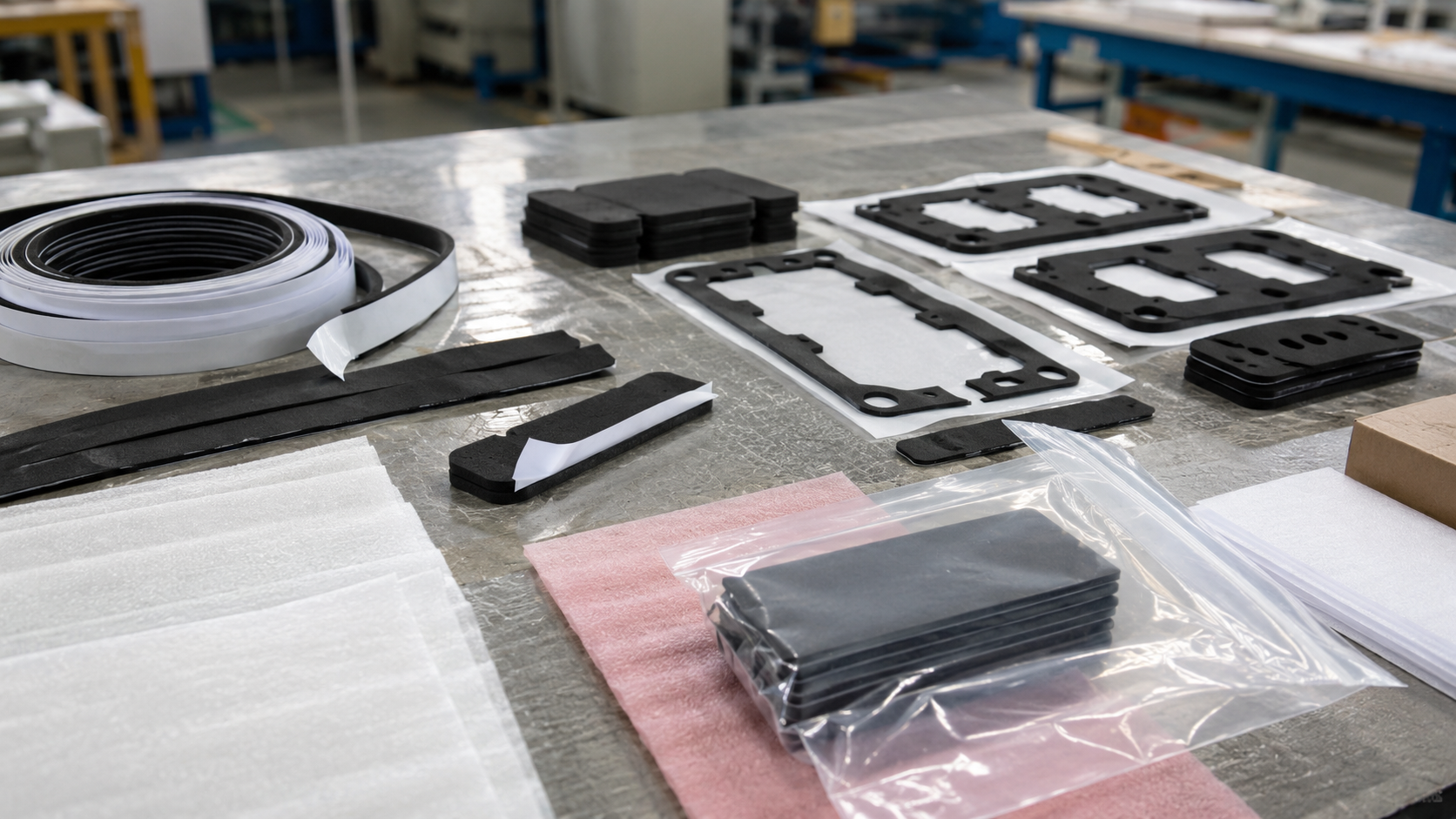
Packaging is especially important for foam.
If PE foam is packed under pressure for too long, it may arrive with compression marks or deformation.
Quick Selection Checklist
Before choosing polyethylene foam for an industrial application, check these points:
| Key Question | Why It Matters |
|---|---|
| What function must the foam provide? | Defines material direction |
| What compression gap is available? | Determines thickness and density |
| What surface will it contact? | Affects sealing and adhesive choice |
| Is adhesive backing required? | Affects assembly efficiency |
| Is the part narrow or complex? | Affects die cutting feasibility |
| How will the foam be packaged? | Prevents deformation before use |
This checklist keeps the selection practical.
The best PE foam is the one that matches the actual assembly condition.
Need Custom Die-Cut Polyethylene Foam Parts?
If you need PE foam pads, adhesive-backed PE foam strips, foam gasket frames, spacer pads, protective cushioning parts, or laminated foam structures, Sanken can help review material direction, die-cut feasibility, adhesive backing, compression design, inspection points, and packaging format.
For quotation, please send the drawing, application location, foam thickness, density requirement if available, bonding surface, annual volume, and packaging preference.
Sanken can support custom PE foam die cutting from sample review to mass production.
You May Also Find These Articles Helpful
- What Are Foam Sheets Used For?
- What Are the Different Types of Foam Density?
- Why Is Foam Used Instead of Rubber?
- How to Choose Die Cut Foam Materials for Noise, Vibration, and Impact Control
- Custom Die-Cut Foam Gaskets: Materials, Manufacturing, and Quality Control
- From Foam Rolls to Finished Parts: How Die Cutting Works
- How Die Cut Parts Are Supplied in Sheets, Rolls, or Kits
Conclusion
Choosing the right polyethylene foam for industrial applications requires more than selecting a foam sheet from stock. Buyers should review the application function, density, thickness, compression gap, bonding surface, adhesive backing, die-cut geometry, quality control, and packaging format. When these details are confirmed early, PE foam can become a reliable custom component for cushioning, gap filling, sealing support, surface protection, and OEM assembly.