
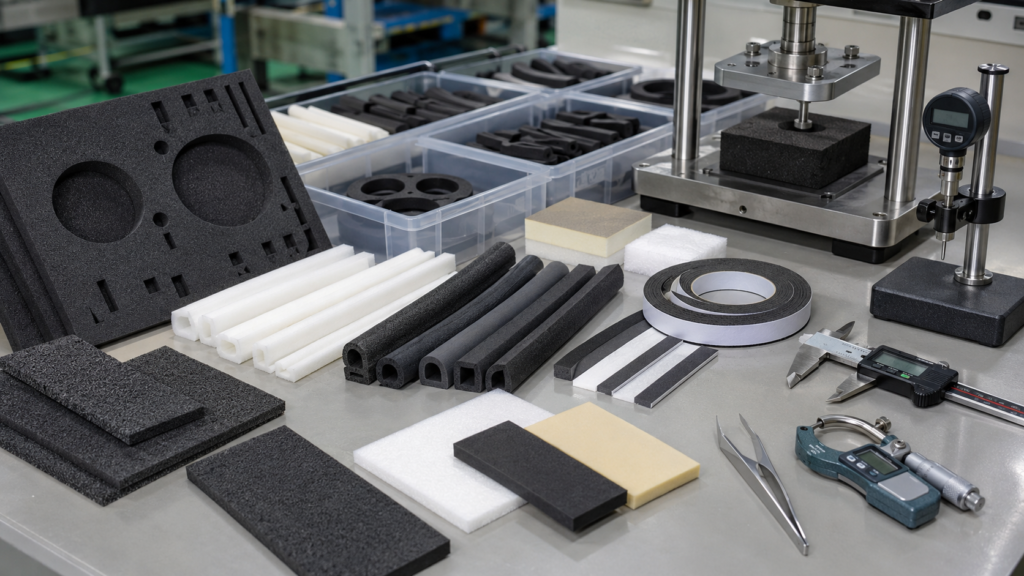
Noise, vibration, and impact problems often begin at small contact points.
A plastic housing touches another part.
A wire harness moves inside a panel.
A display module needs soft support.
A motor area transfers vibration.
A product is dropped, shipped, pressed, or assembled under production pressure.
Die cut foam materials help OEM products reduce these problems by adding cushioning, gap filling, soft contact, sealing support, anti-rattle performance, and impact protection exactly where the product needs it.
At Sanken, we use precision die cutting to convert EVA foam, PE foam, PU foam, EPDM foam, adhesive-backed foam, foam tape, and laminated foam structures into custom parts for electronics, automotive interiors, appliances, equipment, and OEM assembly.
The challenge is not simply choosing “soft foam.”
The challenge is choosing the right foam for the real noise, vibration, or impact condition.
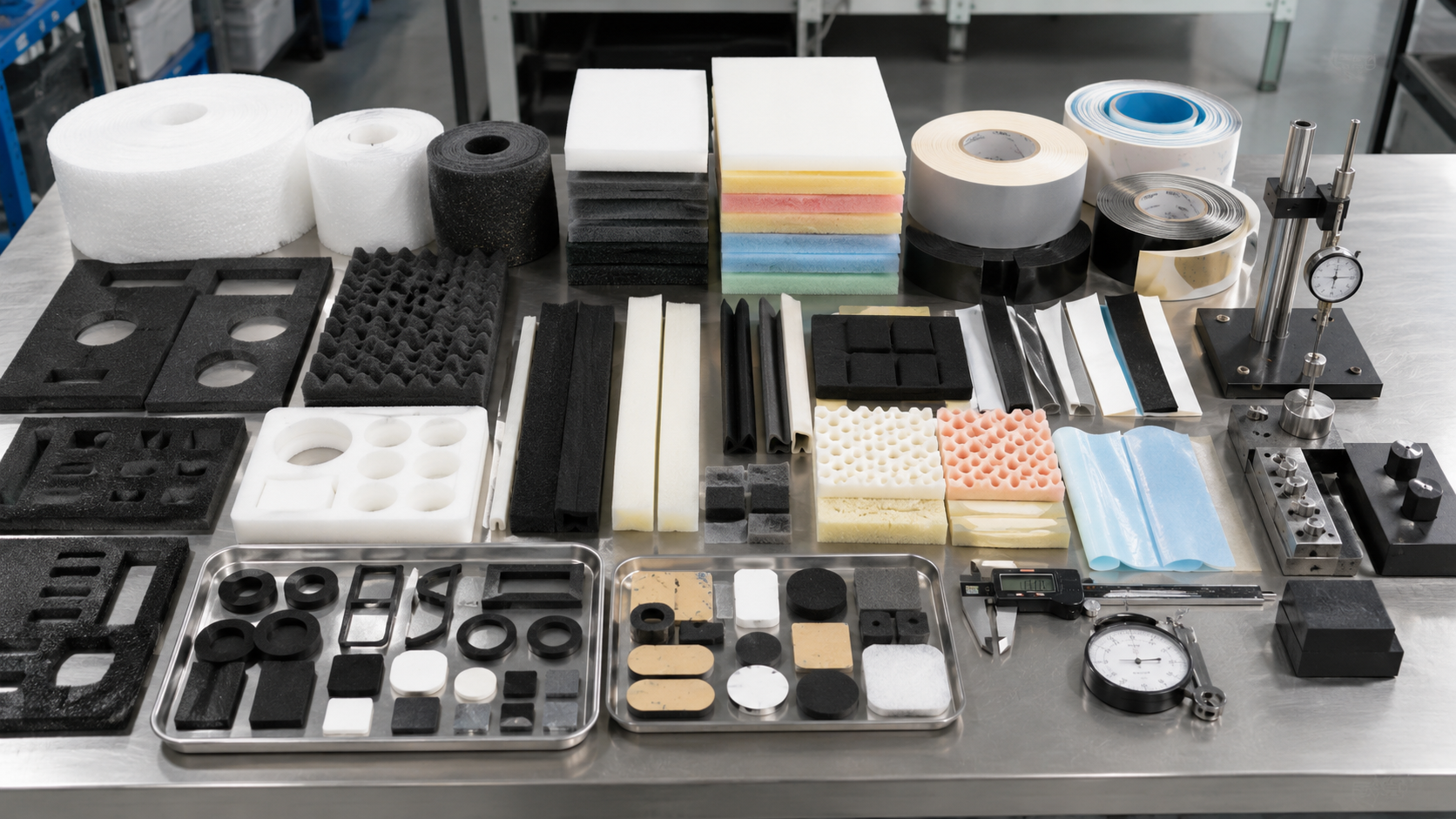
Start With the Real Problem
Before choosing a foam material, identify what problem the foam needs to solve.
Noise, vibration, and impact are related, but they are not the same problem.
| Problem Type | Common Cause | Foam Function |
|---|---|---|
| Rattle | Loose gap between parts | Gap filling and cushioning |
| Squeak | Surfaces rubbing during movement | Soft contact support |
| Buzz | Small part vibration | Anti-vibration cushioning |
| Impact | Drop, shock, or hard contact | Energy absorption |
| Harsh contact | Hard surfaces touching | Surface protection |
| Air or dust gap | Small opening or uneven surface | Foam sealing support |
| Assembly variation | Inconsistent gap or tolerance | Compression compensation |
For OEM projects, custom die cut parts should be designed around the actual product structure, not only the material name.
If the problem is a rattle, foam thickness and compression matter.
If the problem is impact, density and recovery matter.
If the problem is surface protection, softness and cleanliness matter.
One foam cannot solve every problem.
Foam is useful, not magical.
Choose Foam Based on Function
Different foam materials behave differently under compression, vibration, aging, handling, and impact.
The right choice depends on the function.
| Foam Material | Common Strength | Typical OEM Use |
|---|---|---|
| EVA foam | Shock absorption and soft support | Cushioning pads, protective pads, impact control |
| PE foam | Lightweight cushioning and gap filling | Spacers, strips, light sealing parts |
| PU foam | Soft compression and selected acoustic support | Surface cushioning, soft contact pads |
| EPDM foam | Durable sealing and anti-rattle support | Gaskets, sealing strips, automotive foam parts |
| Adhesive-backed foam | Easier placement and positioning | Foam tape gaskets, pads, strips |
| Laminated foam | Multiple functions in one part | Bonding, cushioning, sealing, and protection |
For sealing and cushioning applications, foam gaskets and sealing components are often selected because foam can compress into gaps and fit custom shapes.
Material choice should start from function.
Not from what happens to be available in stock.
Foam for Noise Control
Foam can help reduce noise in several ways.
It can reduce rattles by filling gaps.
It can reduce hard contact by cushioning surfaces.
It can reduce vibration-related noise by limiting movement.
In selected structures, softer foam materials may also support sound absorption.
Common noise control applications include:
- Automotive interior anti-rattle pads
- Door panel foam strips
- Display frame foam spacers
- Speaker area foam seals
- Appliance panel foam pads
- Electronic housing cushioning parts
- Wire harness protection foam
- Air duct foam seals
For automotive applications, automotive die cut components often use foam parts to improve cabin comfort, reduce rattles, and support NVH performance.
Noise control depends on contact.
If the foam does not touch the correct area, it cannot reduce the noise.
If the foam loses recovery, the noise may return later.
That is a very small part with a very loud complaint.
Foam for Vibration Control
Vibration control requires the foam to absorb, cushion, or isolate repeated movement.
This is common in appliances, automotive interiors, electronic modules, equipment panels, and housing assemblies.
Important foam selection factors include:
| Factor | Why It Matters |
|---|---|
| Density | Affects support and vibration response |
| Thickness | Controls compression and contact |
| Compression recovery | Helps the part continue working after use |
| Contact area | Affects how force is distributed |
| Adhesive stability | Keeps the foam in position |
| Temperature exposure | Affects long-term performance |
| Packaging condition | Prevents deformation before assembly |
Foam can reduce light to medium vibration when it is designed correctly.
For stronger vibration or heavier loads, rubber pads may also be reviewed as a related solution.
The key is matching material behavior to the real movement condition.
Too soft, and the foam may collapse.
Too hard, and it may transfer vibration instead of reducing it.
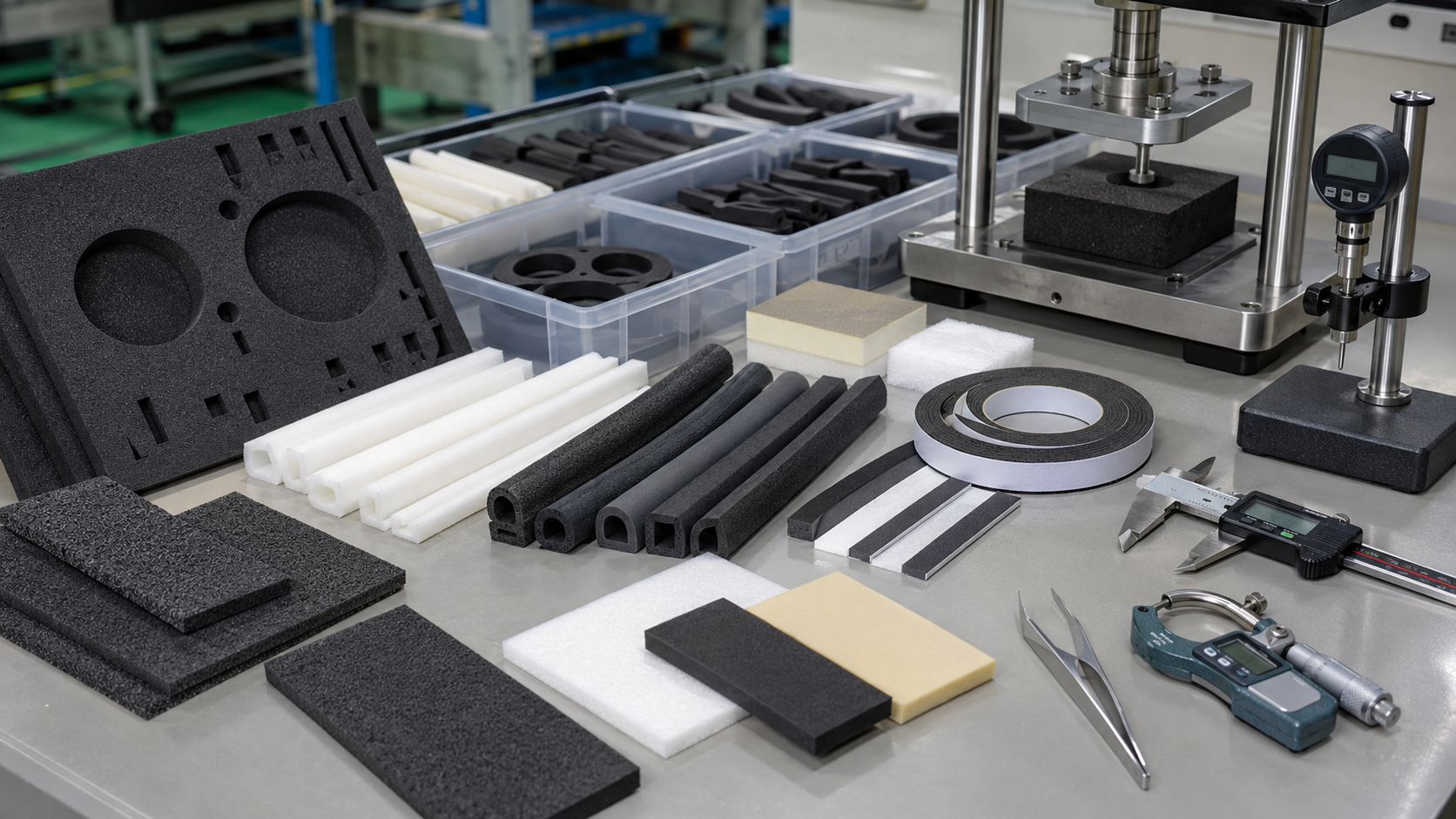
Foam for Impact Protection
Impact protection is different from simple cushioning.
The foam must absorb energy and protect the part from sudden force.
Common impact protection applications include:
- Electronic module cushioning pads
- Display support foam
- Sensor protection foam
- Battery-related electronic housing foam pads
- Appliance transport cushioning parts
- Control panel foam pads
- Industrial equipment contact protection
- Assembly protection pads
EVA foam is often reviewed for shock absorption and protective cushioning.
PE foam can support lightweight cushioning and gap filling.
PU foam can be useful where soft surface contact is important.
EPDM foam can support durable sealing and anti-rattle applications.
For impact control, buyers should review foam thickness, density, compression force, rebound behavior, contact area, and whether adhesive backing is needed.
The best foam is not always the thickest foam.
It is the foam that protects the product without blocking assembly.
Review Compression and Recovery
Foam works through compression.
This makes compression design one of the most important selection factors.
If compression is too low, the foam may not contact the surface.
If compression is too high, the foam may deform, collapse, or create assembly stress.
| Compression Factor | Why It Matters |
|---|---|
| Original thickness | Defines the starting height |
| Compressed thickness | Defines final assembly fit |
| Compression ratio | Affects sealing and cushioning |
| Compression recovery | Supports long-term performance |
| Foam density | Affects force and support |
| Surface flatness | Affects continuous contact |
| Gasket or pad width | Affects stability and durability |
Good foam should compress enough to work, but recover enough to continue working.
Poor recovery can turn a good sample into a weak production part after repeated use.
Foam should not retire early.
Decide Whether Adhesive Backing Is Needed
Many die cut foam parts use pressure-sensitive adhesive backing.
Adhesive backing helps operators place the foam quickly and keeps it in the correct position during assembly.
Common adhesive-backed foam parts include:
- Foam tape strips
- Adhesive-backed foam gaskets
- Foam cushioning pads
- Foam spacers
- Foam sealing rings
- Anti-rattle foam pads
- Laminated foam and adhesive structures
Adhesive selection must match the bonding surface.
OEM products may include plastic, metal, glass, rubber, painted surfaces, PET film, coated panels, and textured housings.
These surfaces do not bond the same way.
A good adhesive-backed foam part should peel smoothly, stay flat, bond accurately, and resist lifting after heat, vibration, handling, or long-term use.
For adhesive-related problems, buyers can review why die cut adhesive parts fail after assembly.
Design Shape, Width, and Corners Carefully
Foam is soft, so die cut design must consider manufacturability.
Narrow foam walls can tear.
Sharp corners can deform.
Small pads can be hard to peel.
Poor liner release can stretch the part.
Bad packaging can compress the foam before use.
Important design points include:
| Design Point | Why It Matters |
|---|---|
| Minimum width | Prevents tearing and deformation |
| Corner radius | Reduces stress concentration |
| Hole-to-edge distance | Improves cutting stability |
| Adhesive coverage | Supports stable placement |
| Pull tab design | Improves manual peeling |
| Part spacing on liner | Helps picking and handling |
| Compression contact area | Supports stable function |
| Packaging orientation | Prevents deformation before use |
Rounded corners are often better than sharp corners for foam parts.
Very narrow foam strips should be reviewed before tooling.
A small CAD detail can become a large production issue.
Manufacturing Process for Die Cut Foam Materials
Die cut foam parts are usually produced through material review, lamination, die cutting, kiss cutting, waste removal, inspection, and packaging.
A typical process includes:
| Step | Purpose |
|---|---|
| Application review | Confirm noise, vibration, impact, sealing, or cushioning need |
| Material selection | Choose EVA, PE, PU, EPDM foam, adhesive, or liner |
| Lamination | Add adhesive backing, liner, or film if required |
| Tooling design | Prepare die cutting tool based on drawing |
| Die cutting | Cut pads, strips, gaskets, frames, or custom shapes |
| Kiss cutting | Keep adhesive-backed foam parts on release liner |
| Waste removal | Remove unused foam cleanly |
| Inspection | Check size, thickness, edge, adhesive, and liner release |
| Packaging | Prevent compression marks, dust, sticking, and deformation |
For foam process background, buyers can review how die cutting works from foam rolls to finished parts.
For high-volume adhesive-backed foam parts, roll-to-roll die cutting can improve liner control, part spacing, waste removal, and production consistency.
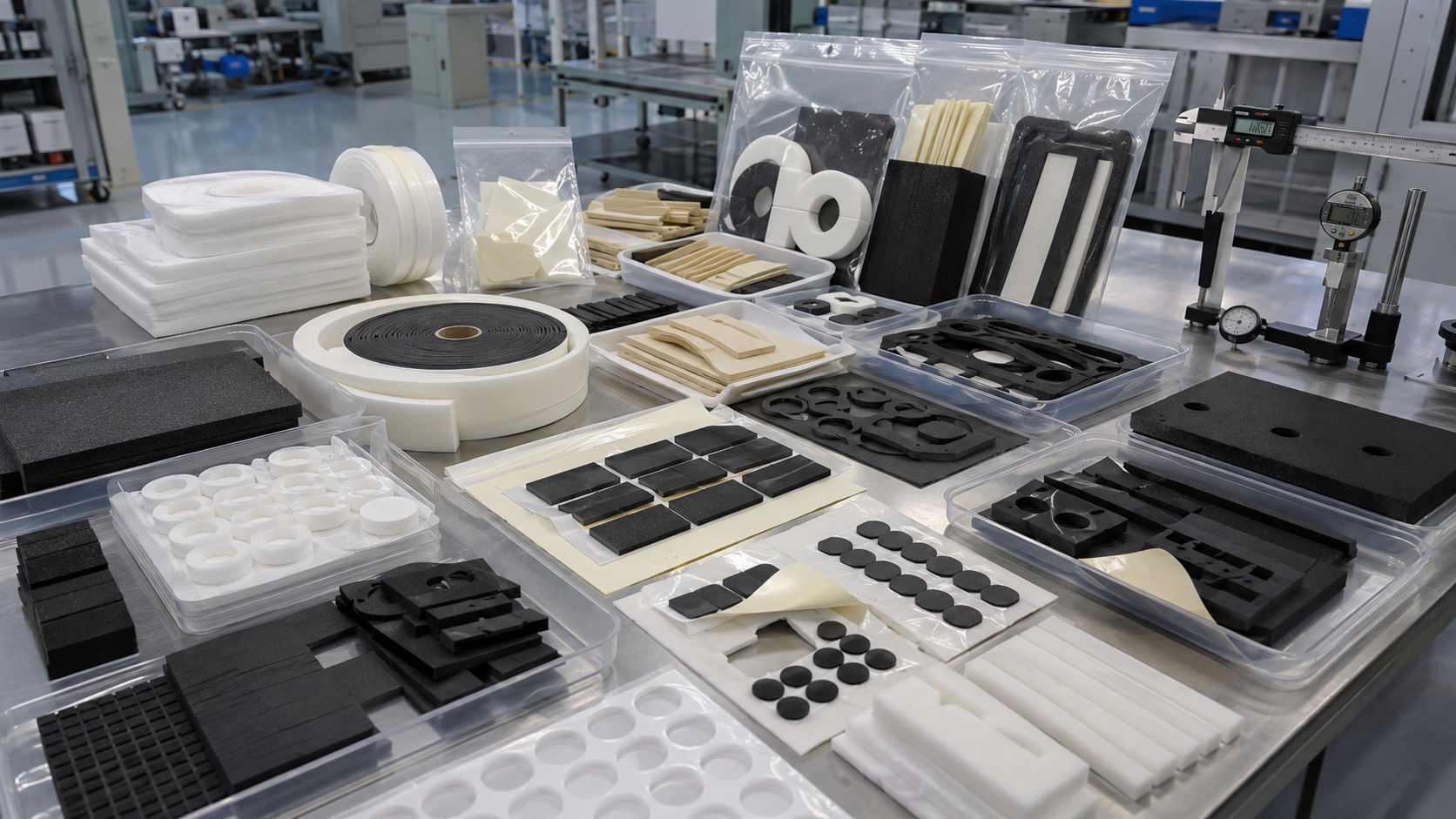
Choose the Right Delivery Format
Delivery format affects assembly speed and part protection.
Foam parts can be supplied in several formats:
| Delivery Format | Suitable Use |
|---|---|
| Individual pieces | Simple or lower-volume assembly |
| Sheets | Manual picking and organized production |
| Rolls | High-volume or automated placement |
| Kiss-cut on liner | Adhesive-backed foam parts |
| Kits | Multi-part module assembly |
| Clean trays or bags | Parts needing deformation protection |
For assembly planning, buyers can review how die cut parts are supplied in sheets, rolls, or kits.
Packaging is especially important for foam.
If parts are packed under pressure, the foam may arrive with compression marks or reduced recovery.
A foam part should not be damaged before it has a chance to protect anything.
Quality Checks Before Mass Production
A foam material may perform well in one sample, but OEM production needs repeatability.
Important quality checks include:
| Inspection Item | Why It Matters |
|---|---|
| Dimensions | Ensures correct fit and coverage |
| Thickness | Controls compression and assembly height |
| Density | Affects support and cushioning |
| Compression recovery | Supports long-term function |
| Edge quality | Reduces tearing and poor fit |
| Adhesive position | Prevents shifting and lifting |
| Liner release | Improves peeling and placement |
| Surface cleanliness | Reduces contamination risk |
| Packaging condition | Prevents deformation before use |
For noise, vibration, and impact control, consistency matters.
A foam part that changes thickness, density, or compression behavior can change product performance.
Common Mistakes to Avoid
Many foam material problems can be prevented during early design review.
Common mistakes include:
- Choosing foam only by thickness
- Ignoring compression ratio
- Using one foam material for every problem
- Making foam walls too narrow
- Using sharp internal corners
- Selecting adhesive without checking the bonding surface
- Ignoring liner release force
- Packaging foam under pressure
- Skipping trial assembly
- Not defining inspection standards
The earlier these details are reviewed, the easier they are to correct.
After mass production begins, a small foam issue can become a big assembly problem.
What Buyers Should Provide Before Quotation
To recommend the right die cut foam material, we usually need clear project details.
Helpful information includes:
- Drawing or sample
- Application location
- Noise, vibration, or impact problem
- Foam material preference
- Thickness and tolerance
- Density requirement
- Compression gap
- Adhesive requirement
- Bonding surface
- Temperature exposure
- Indoor or outdoor use
- Annual volume
- Delivery format
- Packaging preference
- Testing or validation requirement
If the material is not confirmed, Sanken can help compare EVA foam, PE foam, PU foam, EPDM foam, adhesive backing, release liner, and laminated foam structures.
For supplier selection, buyers can also review how to choose the right die cutting manufacturer before moving from sampling to mass production.
Need Die Cut Foam Materials for Noise, Vibration, or Impact Control?
Die cut foam materials help OEM products reduce noise, vibration, impact, hard contact, gap movement, and assembly variation.
But the final result depends on foam type, thickness, density, compression recovery, adhesive backing, bonding surface, die cutting accuracy, inspection, packaging, and delivery format.
If you need EVA foam pads, PE foam strips, PU foam cushioning parts, EPDM foam gaskets, adhesive-backed foam parts, foam tape components, or laminated foam structures, send us your drawing, sample, application location, material requirement, tolerance, annual volume, and packaging preference.
Sanken can help review material selection, lamination structure, die cutting method, quality control points, and supply format before mass production.
Related Articles
You may also find these articles helpful:
- Why Foam Materials Are Used for Sound Absorption and Shock Protection in OEM Products
- Custom Die-Cut Foam and Felt Parts for Sound Dampening and Vibration Reduction
- What Are Foam Sheets Used For?
- What Are the Different Types of Foam Density?
- How Is EVA Foam Used in Die-Cut and Converted Products?
- Why Is Foam Used Instead of Rubber?
- From Foam Rolls to Finished Parts: How Die Cutting Works
Conclusion
Choosing die cut foam materials for noise, vibration, and impact control requires more than selecting a soft material. Buyers should review the real problem, foam type, thickness, density, compression recovery, adhesive backing, bonding surface, part design, packaging, and production method. When these details are controlled early, foam parts can improve product comfort, protection, and assembly stability.