
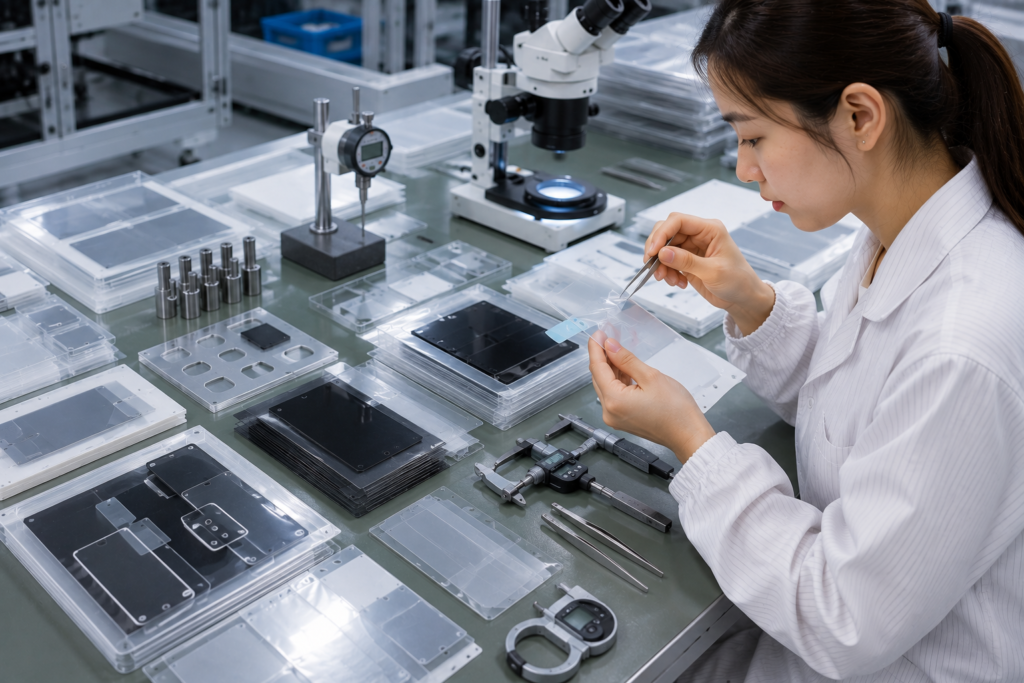
OEM products often go through many handling steps before final delivery.
A panel may be touched during assembly.
A display window may be exposed during transport.
A plastic cover may rub against a fixture.
A metal surface may be scratched before inspection.
A glossy decorative part may collect dust, fingerprints, or small marks.
Custom die-cut surface protection films help reduce these risks.
At Sanken, we use precision die cutting to convert PET protective films, adhesive-backed protective films, pull-tab films, black PET films, PET insulation films, release liners, and laminated film structures into custom parts for electronics, automotive interiors, appliances, displays, semiconductor equipment, and OEM assembly.
A protection film should protect the product.
It should not create residue, curling, scratches, dust, or removal problems.
What Are Custom Die-Cut Surface Protection Films?
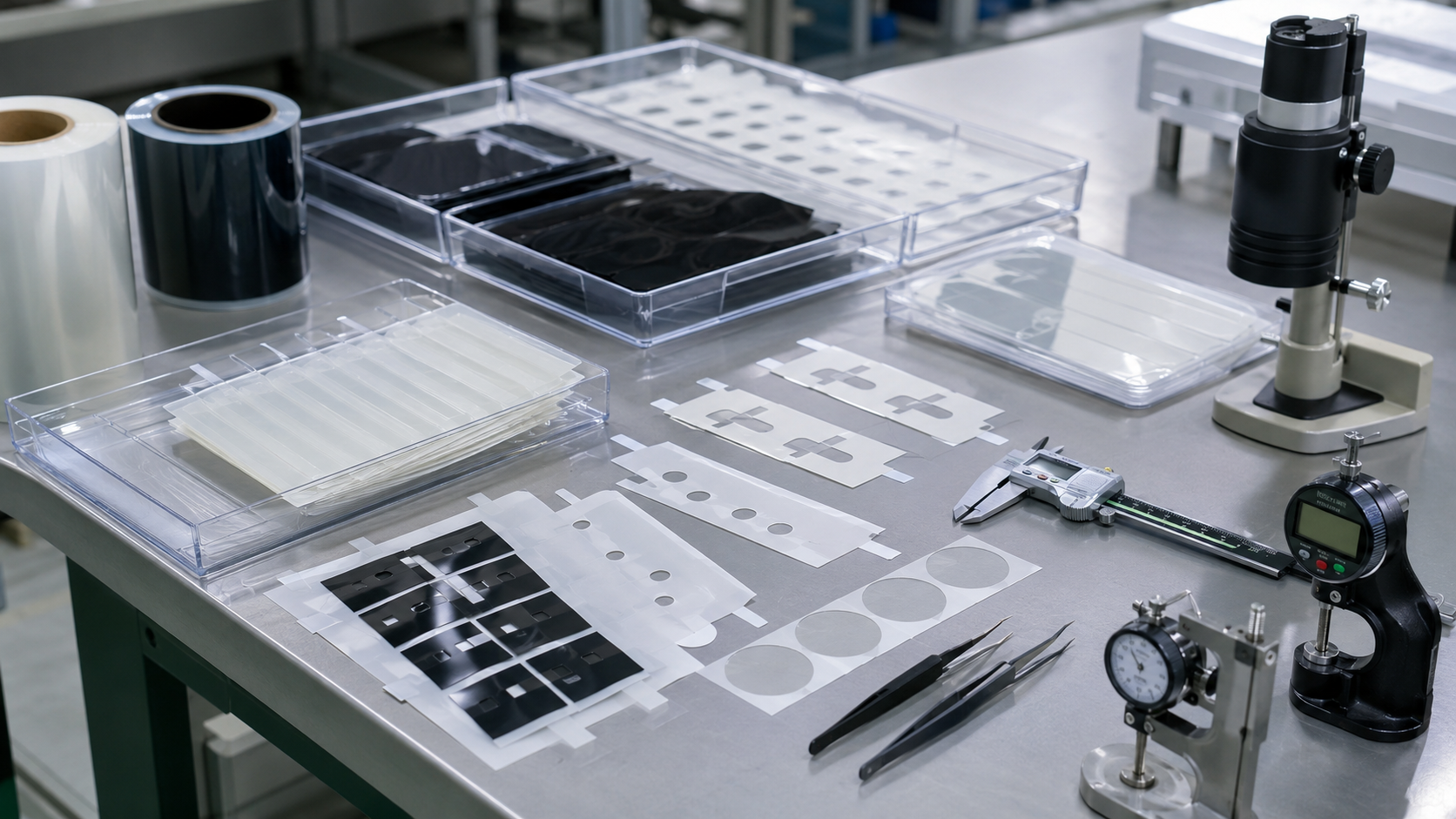
Custom die-cut surface protection films are film parts cut to match a specific product surface, panel, window, cover, fixture, or assembly area.
Unlike a standard film roll, a custom die-cut film can include holes, windows, tabs, slots, adhesive-free areas, special liners, or pull tabs.
Common forms include:
| Film Form | Common Function |
|---|---|
| PET protective films | Scratch and handling protection |
| Adhesive-backed protective films | Temporary surface protection |
| Pull-tab films | Easy removal after assembly |
| Black PET films | Light blocking and visual border control |
| PET insulation films | Electrical separation and protection |
| Kiss-cut films on liner | Easy picking and placement |
| Laminated film structures | Combined protection, bonding, and insulation |
For OEM projects, custom die cut parts help the film match the real product shape instead of forcing workers to trim film manually.
Manual trimming may look flexible.
In mass production, it often creates variation.
When Do OEM Products Need Surface Protection Films?
OEM products need custom die-cut surface protection films when surfaces may be damaged, contaminated, touched, scratched, or exposed before final assembly or delivery.
Common situations include:
| Situation | Why Protection Film Helps |
|---|---|
| Visible surface handling | Reduces fingerprints and scratches |
| Display or window assembly | Protects transparent or glossy areas |
| Fixture contact | Reduces marks during repeated handling |
| Shipping and transport | Protects surfaces before final installation |
| Temporary masking | Covers selected areas during assembly |
| Electronic module assembly | Reduces dust and surface contact risk |
| Appliance panel production | Protects decorative or control surfaces |
| Automotive interior assembly | Protects trim, display, and glossy parts |
If the surface is visible, sensitive, coated, glossy, polished, or easily scratched, protection film should be reviewed early.
Waiting until defects appear is more expensive than designing the film correctly from the beginning.
Products and Surfaces That Often Need Protection Films
Many OEM products use surface protection films during production or assembly.
Common protected surfaces include:
| Product Area | Common Protection Need |
|---|---|
| Displays and touch panels | Scratch, dust, and fingerprint protection |
| Sensor windows | Surface cleanliness and window protection |
| Control panels | Appearance protection and easy removal |
| Automotive trim | Glossy surface and decorative part protection |
| Appliance panels | Transport and assembly protection |
| Electronic housings | Surface scratch prevention |
| Metal covers | Handling and fixture contact protection |
| Plastic parts | Surface marking and rubbing protection |
| Fixtures and trays | Contact protection during repeated use |
For display and optical-related assemblies, optical film die cut components may include protective films, black PET films, adhesive frames, PET insulation films, and foam spacers.
A surface protection film is often temporary.
But its effect on final product appearance can be permanent.
Temporary Protection vs Functional Film
Not all protective films have the same purpose.
Some are removed after assembly.
Others remain as part of the product structure.
| Film Type | Design Focus |
|---|---|
| Temporary protection film | Clean removal, no residue, easy peeling |
| Assembly handling film | Stable placement and dust control |
| Shipping protection film | Stronger surface coverage and packaging stability |
| Fixture protection film | Replaceable surface protection |
| Functional protective film | Long-term adhesion and durability |
| Black PET film | Light blocking and appearance control |
| PET insulation film | Electrical separation and surface protection |
For temporary films, clean removal is critical.
For functional films, long-term stability matters more.
For fixture protection, replacement convenience may be important.
The film should match the real use case, not only the surface shape.
Adhesive Behavior Is Critical
The adhesive on a surface protection film must be balanced.
It needs enough tack to stay in place during handling.
But it should not leave residue, damage coatings, or make removal difficult.
Important adhesive factors include:
| Adhesive Factor | Why It Matters |
|---|---|
| Tack level | Controls holding force |
| Removal force | Affects peeling speed and surface safety |
| Residue control | Prevents contamination after removal |
| Surface compatibility | Avoids coating damage or poor adhesion |
| Temperature exposure | Prevents adhesive behavior changes |
| Storage time | Affects final peeling performance |
| Application pressure | Influences bonding and removal |
OEM products may include glass, metal, coated plastic, PET surfaces, painted parts, rubber, decorative trim, or textured housings.
These surfaces do not behave the same way.
For adhesive-related risks, buyers can review why die cut adhesive parts fail after assembly.
The strongest adhesive is not always the best adhesive.
For protection films, removal performance can be just as important as holding power.
Pull Tabs Improve Assembly and Removal
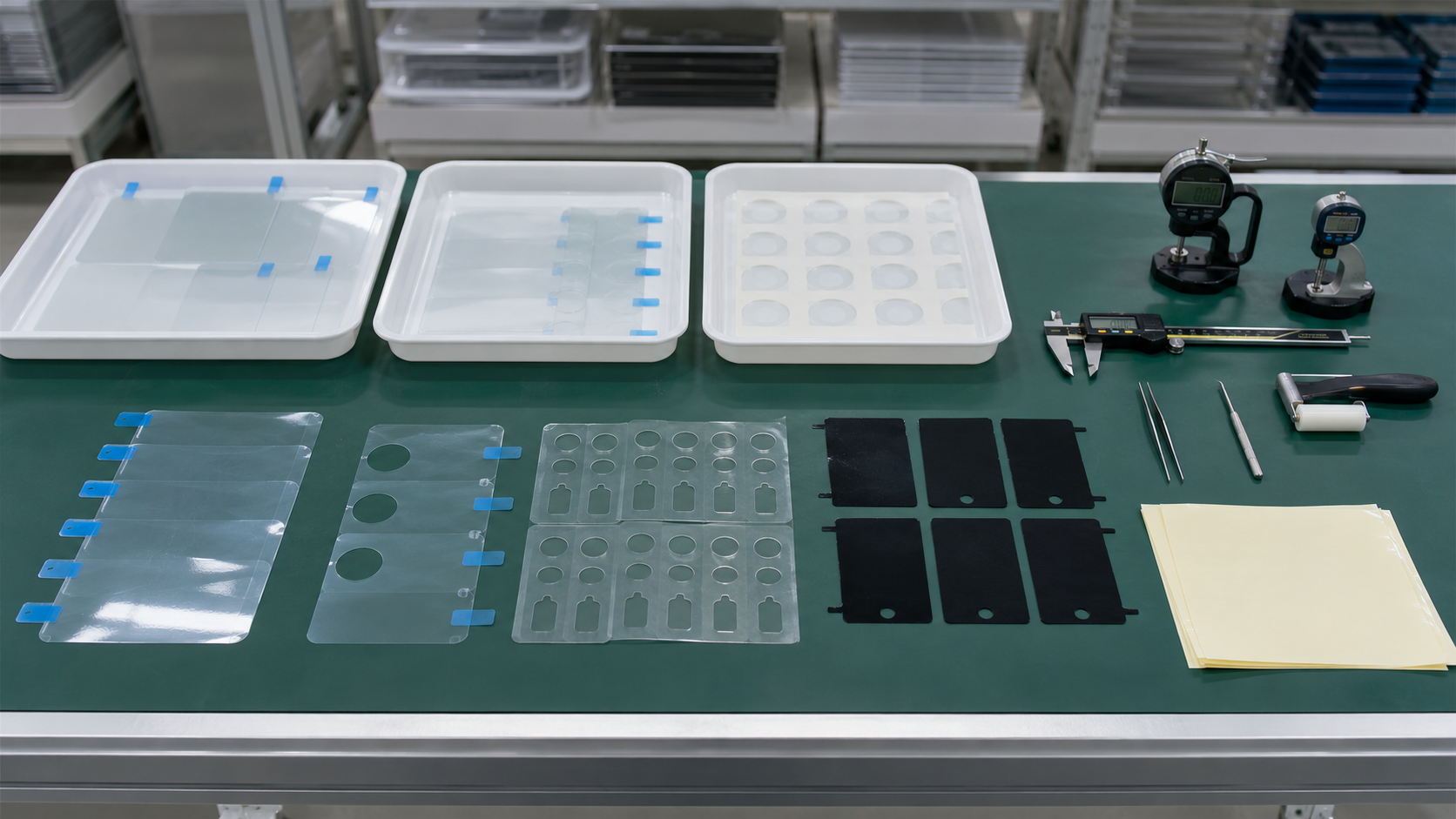
Pull tabs are small design details that can make protective films much easier to use.
They help operators peel and remove the film without touching the protected surface too much.
Pull tabs can improve:
- Manual peeling speed
- Removal control
- Surface cleanliness
- Reduced fingerprint contact
- Lower risk of film stretching
- Easier assembly inspection
- Better operator handling
Pull tab position should be designed around the actual assembly process.
It should be easy to reach.
It should not interfere with screws, sensors, display windows, fixture contact points, or final assembly features.
For adhesive protective films supplied on liners, kiss cutting is often useful because it keeps the film organized before application.
For process comparison, buyers can review Die Cut vs Kiss Cut: What OEM Buyers Should Know for Adhesive Parts and Protective Films.
Shape Design Matters
Custom die-cut surface protection films often need holes, slots, windows, corners, tabs, or narrow areas.
Good design improves both protection and production efficiency.
Important design points include:
| Design Point | Why It Matters |
|---|---|
| Outer contour | Matches the protected surface |
| Window accuracy | Keeps display, sensor, or opening areas clear |
| Hole position | Avoids interference with assembly features |
| Corner radius | Reduces lifting and tearing |
| Minimum width | Prevents stretching and deformation |
| Pull tab location | Improves peeling and removal |
| Liner type | Affects handling and release |
| Part spacing | Improves picking and placement |
Sharp corners may lift.
Very narrow film strips may stretch.
Poor hole alignment may block assembly features.
A protection film must be designed for cutting, peeling, applying, staying flat, and removal.
Where Custom Protection Films Are Used
Custom surface protection films are used across many OEM industries.
| Industry | Common Protection Film Applications |
|---|---|
| Consumer electronics | Displays, covers, sensors, housings |
| Automotive interiors | Touch panels, trim, glossy parts, display areas |
| Appliances | Control panels, doors, decorative covers |
| Semiconductor equipment | Panels, fixtures, sensor windows, modules |
| Industrial equipment | Metal covers, control interfaces, inspection surfaces |
| Optical products | Display windows, lens-related areas, light-control structures |
For semiconductor and electronics equipment, protective films may be used on panels, fixtures, modules, covers, sensor windows, and handling contact areas.
For automotive interiors, protective films may support display and trim assembly.
For appliances, they help protect visible surfaces during production and transport.
Different industries have different risks, but the goal is the same: protect the surface until the product is ready.
Manufacturing Process for Die-Cut Surface Protection Films
Custom surface protection films are usually produced through material review, lamination, die cutting, kiss cutting, waste removal, inspection, and packaging.
A typical process includes:
| Step | Purpose |
|---|---|
| Application review | Confirm protected surface and assembly method |
| Material selection | Choose protective film, adhesive, liner, or PET film |
| Lamination | Add adhesive, liner, pull-tab layer, or backing if needed |
| Tooling design | Prepare die cutting tool based on drawing |
| Die cutting | Cut outer shape, windows, holes, slots, and tabs |
| Kiss cutting | Keep adhesive-backed films on release liner |
| Waste removal | Remove unwanted film cleanly |
| Inspection | Check size, edge, surface, adhesive, and liner release |
| Packaging | Prevent dust, scratches, curling, and deformation |
For process background, buyers can review how die cutting transforms raw materials into precision components.
For high-volume film parts, roll-to-roll die cutting can improve spacing, liner control, waste removal, and production consistency.
Supply Formats for OEM Assembly
Surface protection films can be supplied in different formats depending on how they are used in production.
| Supply Format | Suitable Use |
|---|---|
| Individual pieces | Simple placement or lower-volume projects |
| Sheets | Manual picking and organized production |
| Rolls | High-volume or automated application |
| Kiss-cut on liner | Adhesive-backed protective films |
| Pull-tab format | Easier manual removal |
| Kits | Multi-part product or module assembly |
| Clean trays or bags | Dust and scratch protection |
For assembly planning, buyers can review how die cut parts are supplied in sheets, rolls, or kits.
The right format can reduce missing parts, fingerprints, difficult peeling, film curling, surface contact damage, and production delays.
Quality Checks Before Mass Production
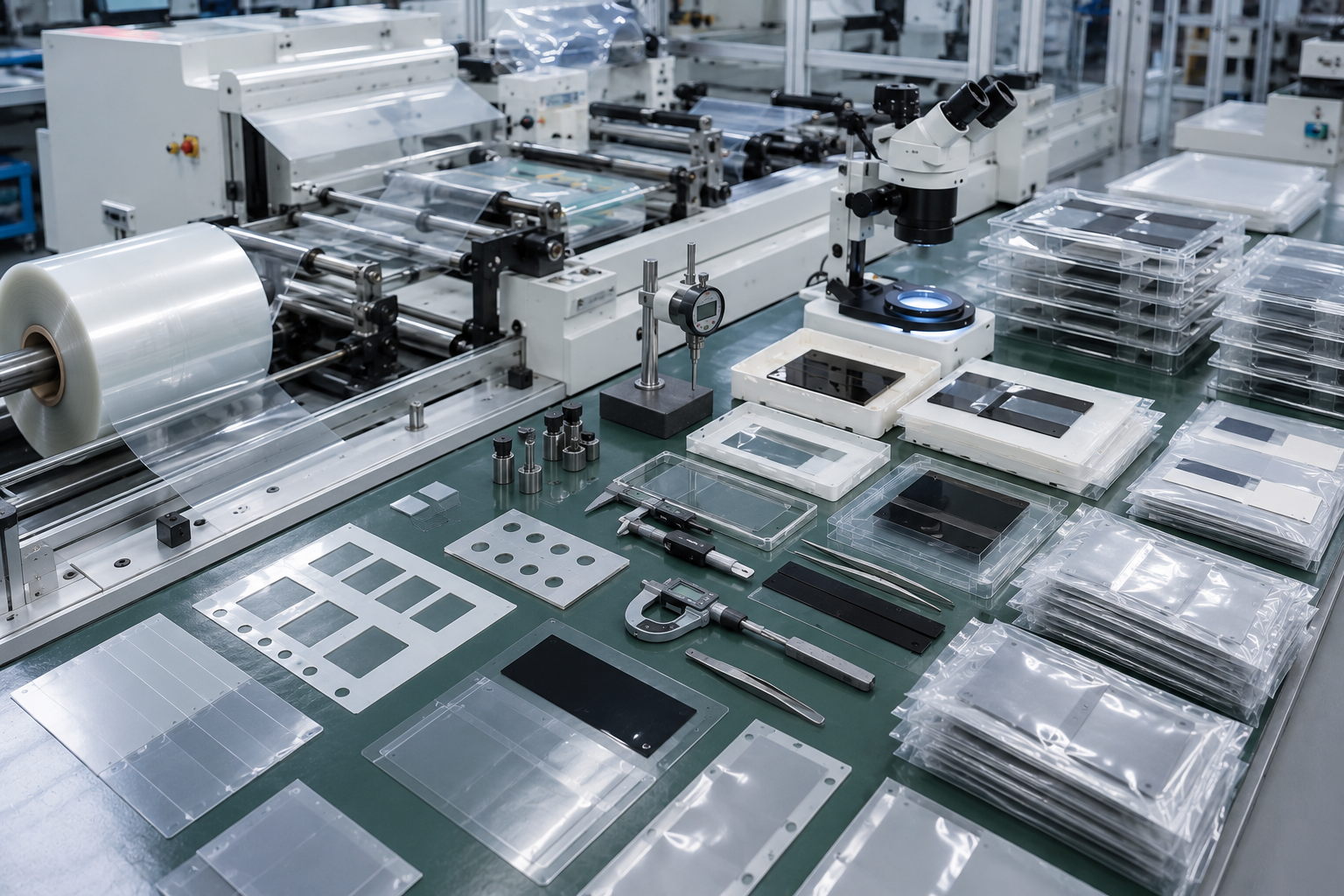
Protective films must stay consistent from sample approval to production.
Important quality checks include:
| Inspection Item | Why It Matters |
|---|---|
| Dimensions | Ensures correct surface coverage |
| Window and hole alignment | Prevents assembly interference |
| Edge quality | Reduces lifting, burrs, and particles |
| Surface cleanliness | Prevents visible defects |
| Adhesive behavior | Controls bonding and clean removal |
| Liner release | Improves peeling and placement |
| Pull tab position | Supports easy removal |
| Flatness | Reduces bubbles and curling |
| Packaging condition | Prevents scratches and dust exposure |
For visible surfaces, a small defect can become a customer complaint.
A protective film should arrive clean, flat, easy to peel, and ready to use.
Common Mistakes to Avoid
Many surface protection film problems can be prevented during design review.
Common mistakes include:
- Choosing adhesive only by bonding strength
- Ignoring residue requirements
- Forgetting pull tabs for manual removal
- Using sharp corners that lift easily
- Making film strips too narrow
- Ignoring the protected surface material
- Using the wrong liner release force
- Packaging films in a way that causes curling
- Skipping cleanliness requirements
- Not defining removal timing or storage conditions
The earlier these issues are reviewed, the easier they are to fix.
After mass production begins, a small film issue can create rework across many finished products.
What Buyers Should Provide Before Quotation
To recommend the right custom die-cut surface protection film, we usually need clear project details.
Helpful information includes:
- Drawing or sample
- Surface to be protected
- Product application area
- Temporary or long-term use
- Film material requirement
- Adhesive requirement
- Residue requirement
- Pull tab requirement
- Hole or window design
- Surface cleanliness requirement
- Temperature exposure
- Storage or removal timing
- Annual volume
- Delivery format
- Packaging preference
If the material is not confirmed, Sanken can help compare PET protective films, adhesive-backed protective films, black PET films, PET insulation films, release liners, pull-tab structures, and laminated film solutions.
For supplier selection, buyers can also review how to choose the right die cutting manufacturer before moving from sampling to mass production.
Need Custom Die-Cut Surface Protection Films?
OEM products need custom die-cut surface protection films when visible or sensitive surfaces may face scratches, dust, fingerprints, fixture marks, handling damage, adhesive residue, or transport risk.
But the final result depends on the protected surface, film material, adhesive behavior, pull-tab design, shape accuracy, liner release, cleanliness, packaging, and delivery format.
If you need PET protective films, adhesive-backed protective films, pull-tab films, black PET films, PET insulation films, or laminated film structures, send us your drawing, sample, protected surface, film requirement, adhesive structure, tolerance, annual volume, and packaging preference.
Sanken can help review material selection, lamination structure, die cutting method, inspection points, and supply format before mass production.
Related Articles
You may also find these articles helpful:
- Die Cut Protective Films for Semiconductor Equipment, Fixtures, and Assembly Processes
- How to Choose Die Cut Protective Films for Semiconductor and Electronics Equipment
- Black PET Light-Blocking Film for Displays, Sensors, and Electronic Assemblies
- Why Is Precision Film Die Cutting Important for Consumer Electronics Screens?
- How to Solve Residual Adhesive Issues of Die-Cut Optical Protective Films?
- Die Cut vs Kiss Cut: What OEM Buyers Should Know for Adhesive Parts and Protective Films
- How Die Cutting Transforms Raw Materials Into Precision Components
Conclusion
OEM products need custom die-cut surface protection films when surfaces must remain clean, scratch-free, residue-free, and easy to handle during production, shipping, fixture use, or final assembly. The best film solution depends on the protected surface, adhesive behavior, shape design, pull-tab position, liner release, cleanliness, packaging, and die cutting accuracy.