
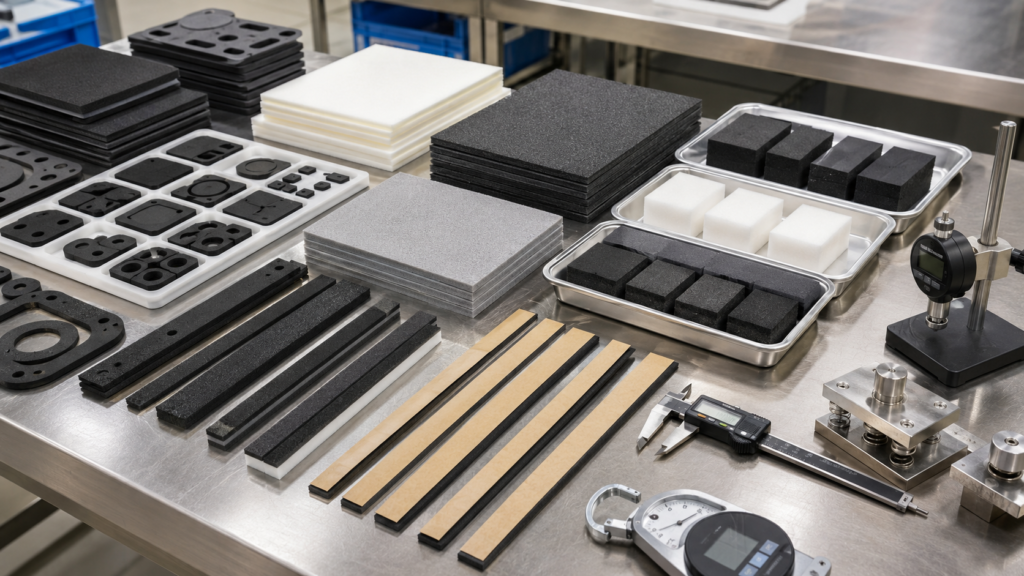
Foam materials are widely used in OEM products because they solve practical assembly problems.
They cushion impact.
They reduce vibration.
They help absorb unwanted sound.
They fill gaps.
They protect surfaces.
They support sealing and anti-rattle performance.
At Sanken, we use precision die cutting to convert foam materials into custom gaskets, pads, strips, spacers, cushioning parts, adhesive-backed foam components, and laminated foam structures for electronics, automotive, appliances, and industrial OEM assembly.
Foam may look soft and simple.
But choosing the wrong foam can lead to poor compression, weak shock protection, noise problems, adhesive failure, or unstable assembly.
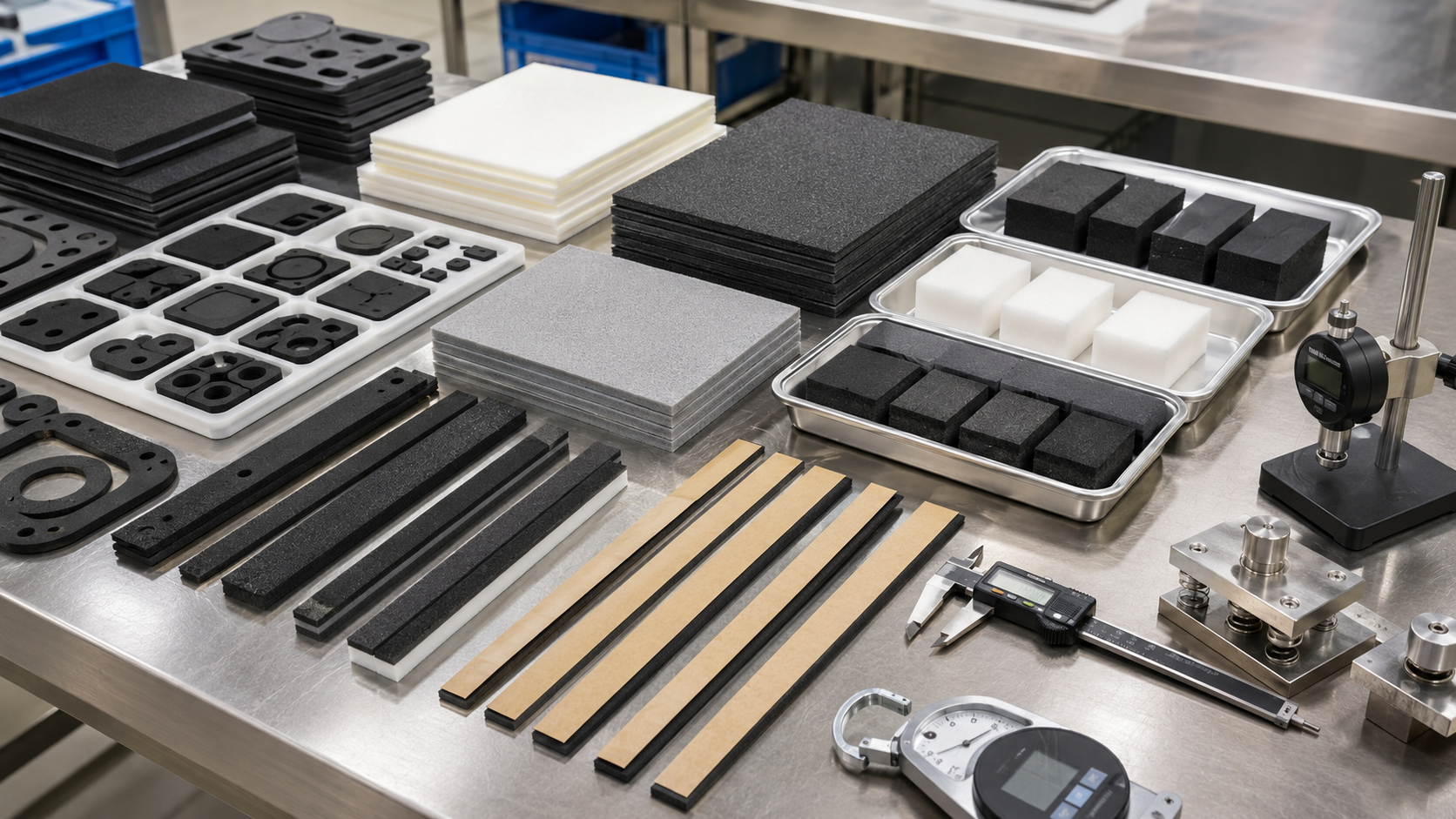
Why Foam Is Useful in OEM Products
OEM products often contain gaps, contact points, moving parts, vibration sources, sensitive surfaces, and fragile electronic components.
Foam is useful because it can compress, recover, cushion, and conform to uneven surfaces.
Common OEM functions include:
| Function | How Foam Helps |
|---|---|
| Sound absorption | Reduces airborne noise in selected structures |
| Shock protection | Cushions impact and protects components |
| Vibration control | Reduces contact vibration and rattling |
| Gap filling | Compresses into uneven spaces |
| Sealing | Blocks dust, air, and minor leakage paths |
| Surface protection | Prevents scratches and hard contact damage |
| Assembly support | Improves fit and positioning |
For OEM projects, foam is often converted into custom die cut parts so the material matches the exact product shape and assembly process.
The foam does not only need to be soft.
It needs to be the right soft.
Sound Absorption: What Foam Can and Cannot Do
Foam can help reduce noise, but not all foam materials perform the same way.
Open-cell foam usually performs better for sound absorption because air can move through the structure and sound energy can be dissipated inside the foam.
Closed-cell foam is usually better for sealing, cushioning, and water or dust resistance, but it may not absorb sound as effectively as open-cell foam.
| Foam Structure | Common Strength |
|---|---|
| Open-cell foam | Sound absorption, soft cushioning, acoustic control |
| Closed-cell foam | Sealing, shock protection, gap filling, moisture resistance |
| Higher-density foam | Stronger support and impact protection |
| Softer foam | Surface cushioning and gentle compression |
| Adhesive-backed foam | Easier positioning during assembly |
For sound-related OEM applications, foam may be used near housings, panels, speakers, ducts, interior trim, motors, and equipment covers.
However, foam should be selected based on the real noise source.
Airborne noise, vibration noise, squeak, rattle, and impact noise are different problems.
One foam cannot solve everything.
Foam is helpful, not magical.
Shock Protection: Why Foam Works
Foam protects products by absorbing and spreading impact energy.
When a product is dropped, pressed, shipped, assembled, or exposed to vibration, foam can reduce hard contact between components.
Common shock protection applications include:
- Electronic module cushioning pads
- Battery area cushioning pads
- Display support foam
- Sensor protection foam
- Appliance motor cushioning parts
- Automotive interior anti-rattle pads
- Industrial enclosure foam pads
- Packaging and transport protection inserts
For sealing and cushioning applications, foam gaskets and sealing components are often used when the part needs both compression and custom geometry.
Good shock protection depends on foam thickness, density, compression recovery, contact area, and working environment.
If the foam is too soft, it may bottom out.
If it is too hard, it may transfer impact instead of absorbing it.
The best foam is not always the thickest one.
It is the foam that matches the impact condition.
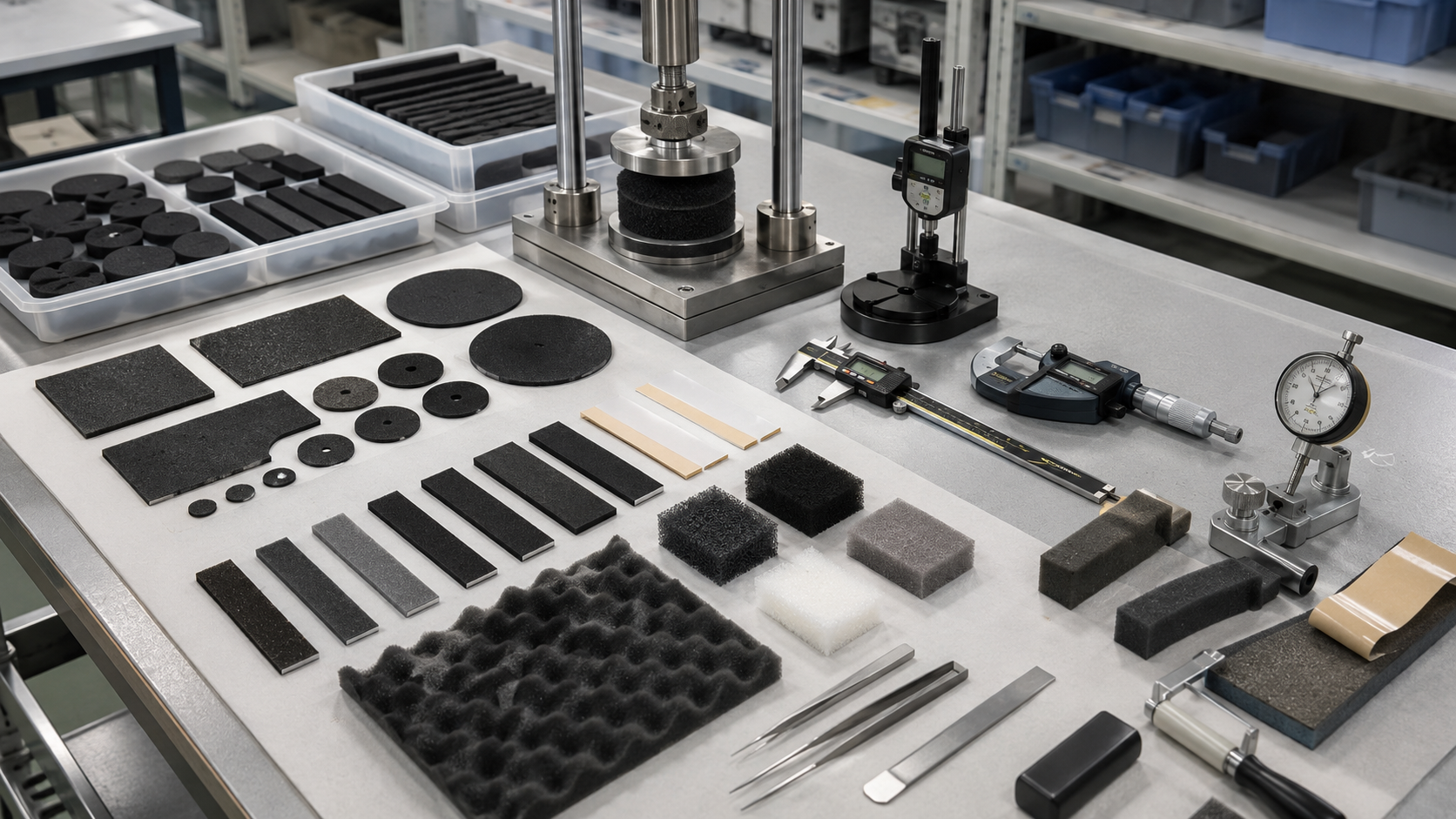
Common Foam Materials Used in OEM Parts
Different foam materials are used for different OEM applications.
| Foam Material | Common OEM Use |
|---|---|
| PE foam | General cushioning, gap filling, and light sealing |
| EVA foam | Shock absorption, soft support, and protective pads |
| PU foam | Soft cushioning and selected acoustic applications |
| EPDM foam | Durable sealing, anti-rattle, and weather-resistant areas |
| CR / neoprene foam | Sealing, cushioning, and selected industrial uses |
| Silicone foam | Heat-resistant cushioning in selected applications |
| Acrylic foam tape | Bonding with cushioning and gap compensation |
For sound absorption, PU foam and selected open-cell foam structures may be useful.
For shock protection, EVA, PE, EPDM, and other closed-cell foams are often considered depending on the load and compression requirement.
For sealing, EPDM foam and adhesive-backed foam gaskets are commonly reviewed.
Material selection should start from the function.
Not from the material name alone.
Foam Parts in Electronics
Electronic products use foam for cushioning, dust protection, anti-rattle support, and protection of sensitive parts.
Common electronics foam parts include:
| Application Area | Foam Part Function |
|---|---|
| Display modules | Cushioning, spacing, and dust control |
| Speakers | Acoustic sealing and vibration control |
| Sensors | Dust protection and soft support |
| Battery areas | Cushioning and impact protection |
| PCB housings | Gap filling and contact protection |
| Control panels | Dust sealing and soft assembly support |
In electronics, foam parts often work together with PET films, adhesive tape frames, protective films, and insulation parts.
Clean cutting and packaging are important because particles, deformation, or adhesive overflow can affect assembly quality.
For electronics, a foam part must be soft enough to protect.
But stable enough to stay useful.
Foam Parts in Automotive Interiors
Automotive interiors use foam materials for NVH control, anti-rattle protection, cushioning, gap filling, and sealing.
In electric vehicles, foam parts are especially important because quiet cabins make small noises easier to notice.
Common automotive applications include:
- Dashboard foam pads
- Door panel foam strips
- Center console cushioning pads
- HVAC duct foam seals
- Wire harness protection foam
- Speaker sealing foam rings
- Display foam spacers
- Adhesive-backed anti-rattle foam
For automotive die cut components, foam selection depends on compression, recovery, bonding surface, temperature range, and long-term durability.
If the foam loses recovery, the rattle may return.
Nobody wants a rattle with a comeback plan.
Foam Parts in Appliances and Industrial Products
Home appliances and industrial products use foam for sealing, vibration control, cushioning, dust protection, and assembly support.
Common applications include:
| Product Area | Foam Function |
|---|---|
| Refrigerators | Air sealing, cushioning, and panel gap filling |
| Air conditioners | Duct sealing and vibration reduction |
| Washing machines | Cushioning and vibration support |
| Control panels | Dust sealing and bonding support |
| Industrial enclosures | Dust sealing and internal cushioning |
| Equipment housings | Surface protection and anti-rattle control |
For high-volume adhesive-backed foam strips or foam gasket tape, roll-to-roll die cutting can improve consistency, part spacing, liner control, and production efficiency.
For thicker foam pads or custom sheets, flatbed die cutting may be more suitable.
Adhesive-Backed Foam for Easier Assembly
Many OEM foam parts use pressure-sensitive adhesive backing.
Adhesive backing helps operators place foam parts quickly and accurately.
Common adhesive-backed foam parts include:
- Foam gasket tape
- Adhesive foam strips
- Foam cushioning pads
- Foam tape frames
- Foam spacers
- Foam sealing rings
- Laminated foam and film structures
Adhesive selection must match the bonding surface.
Plastic, metal, glass, rubber, painted surfaces, coated parts, and foam surfaces do not bond the same way.
A good adhesive-backed foam part should peel smoothly, stay flat, bond accurately, and resist lifting after heat, vibration, or long-term use.
For adhesive failure risks, buyers can review why die cut adhesive parts fail after assembly.
How Die Cutting Converts Foam Into OEM Parts
Foam materials are usually converted through lamination, die cutting, kiss cutting, waste removal, inspection, and packaging.
For foam process background, buyers can review how die cutting works from foam rolls to finished parts.
A typical process includes:
| Step | Purpose |
|---|---|
| Application review | Confirm sound, shock, sealing, or cushioning need |
| Material selection | Choose foam type, thickness, density, and adhesive |
| Lamination | Add adhesive, liner, film, or backing layer if required |
| Tooling design | Prepare die cutting tool based on drawing |
| Die cutting | Cut pads, strips, frames, rings, or custom shapes |
| Kiss cutting | Keep adhesive-backed foam parts on release liner |
| Waste removal | Remove extra foam cleanly |
| Inspection | Check size, thickness, edge, adhesive, and liner release |
| Packaging | Prevent deformation, dust, sticking, and compression marks |
Foam is soft and can deform during processing.
That means die cutting pressure, tool design, waste removal, and packaging must be controlled carefully.
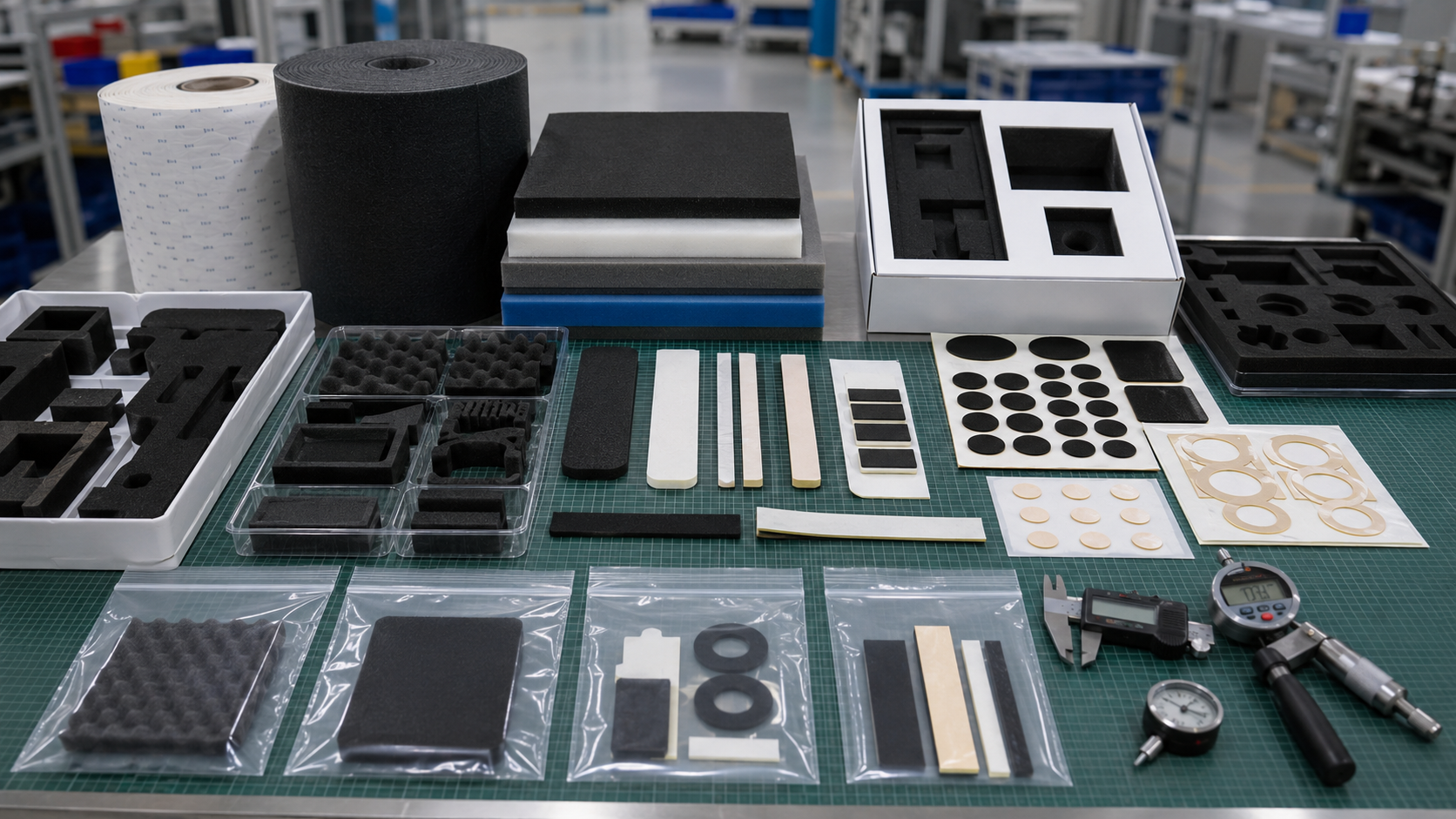
Key Design Points for Foam Parts
Foam performance depends on design as much as material.
Important points include:
| Design Point | Why It Matters |
|---|---|
| Thickness | Controls cushioning, compression, and fit |
| Density | Affects shock absorption and support |
| Compression recovery | Supports long-term performance |
| Foam structure | Affects sound absorption or sealing ability |
| Part width | Affects cutting stability and strength |
| Corner radius | Reduces tearing and edge lifting |
| Adhesive coverage | Supports positioning and bonding |
| Delivery format | Affects assembly efficiency |
For narrow foam parts, minimum width and corner radius are especially important.
Sharp corners can tear.
Very thin walls can deform.
Poor packaging can compress the foam before it is even used.
Foam is soft.
The process cannot be careless.
What Buyers Should Provide Before Quotation
To recommend the right foam material and die cut structure, we usually need clear project details.
Helpful information includes:
- Drawing or sample
- Application location
- Sound absorption or shock protection requirement
- Foam material preference
- Foam thickness and density
- Adhesive requirement
- Bonding surface
- Compression gap
- Temperature range
- Indoor or outdoor use
- Annual volume
- Delivery format
- Packaging preference
- Testing requirement
If the material is not confirmed, Sanken can help compare PE foam, EVA foam, PU foam, EPDM foam, CR foam, silicone foam, adhesive tape, liner, and laminated structures.
For supplier selection, buyers can also review how to choose the right die cutting manufacturer before moving from sampling to mass production.
Need Foam Parts for Sound Absorption or Shock Protection?
Foam materials help OEM products improve sound absorption, shock protection, vibration control, sealing, cushioning, and assembly stability.
But the final result depends on foam type, density, thickness, compression recovery, adhesive backing, die cutting accuracy, and packaging.
If you need custom foam pads, foam gaskets, adhesive-backed foam strips, acoustic foam parts, shock protection foam, or laminated foam structures, send us your drawing, sample, material requirement, adhesive structure, tolerance, annual volume, and packaging preference.
Sanken can help review material selection, die cutting method, lamination structure, inspection points, and delivery format before mass production.
Related Articles
You may also find these articles helpful:
- What Are Foam Sheets Used For?
- What Are the Different Types of Foam Density?
- How Is EVA Foam Used in Die-Cut and Converted Products?
- Why Is Foam Used Instead of Rubber?
- Custom Die Cut Foam Gaskets for Electronics, Automotive, and Appliance Assembly
- Foam Gasket Tape for Industrial Sealing: What OEM Buyers Should Know
- From Foam Rolls to Finished Parts: How Die Cutting Works
Conclusion
Foam materials are used for sound absorption and shock protection because they can cushion impact, reduce vibration, absorb selected noise, fill gaps, protect surfaces, and support sealing. For OEM products, the best foam part depends on the real application, foam structure, thickness, density, compression recovery, adhesive backing, die cutting method, and packaging.