
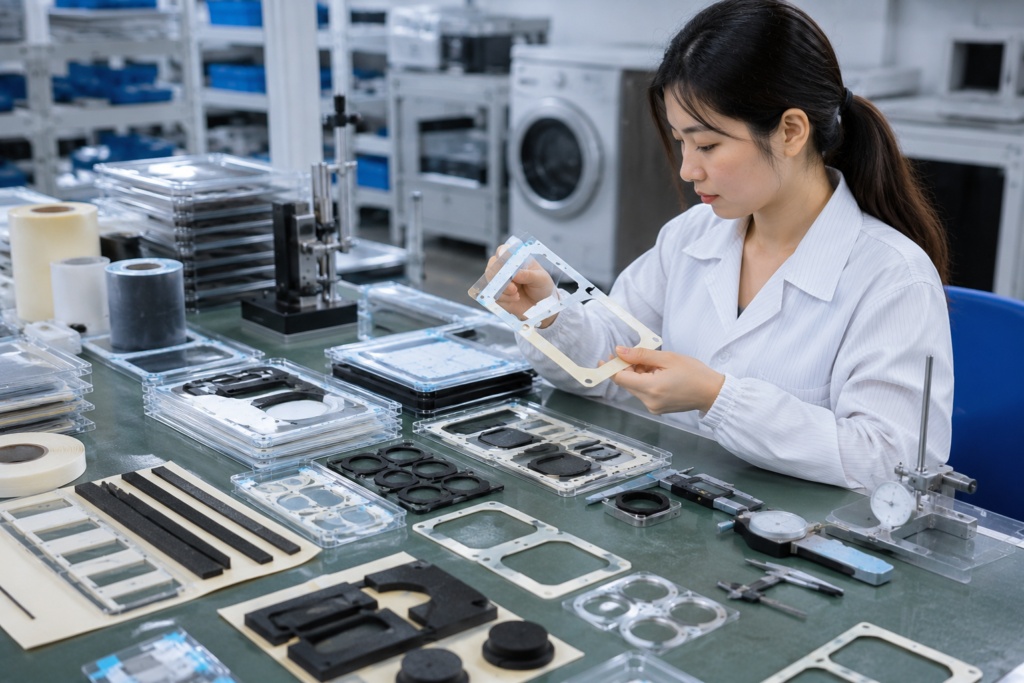
EV battery packs contain tightly arranged electrical, structural, and protective components. Insulation materials help separate conductive surfaces, protect sensitive areas, control spacing, reduce abrasion, and keep components correctly positioned during assembly.
For OEM buyers, material selection should not be based on a single specification such as thickness or dielectric strength. The right solution depends on the part location, operating temperature, mechanical stress, surface condition, installation method, production volume, and required service life.
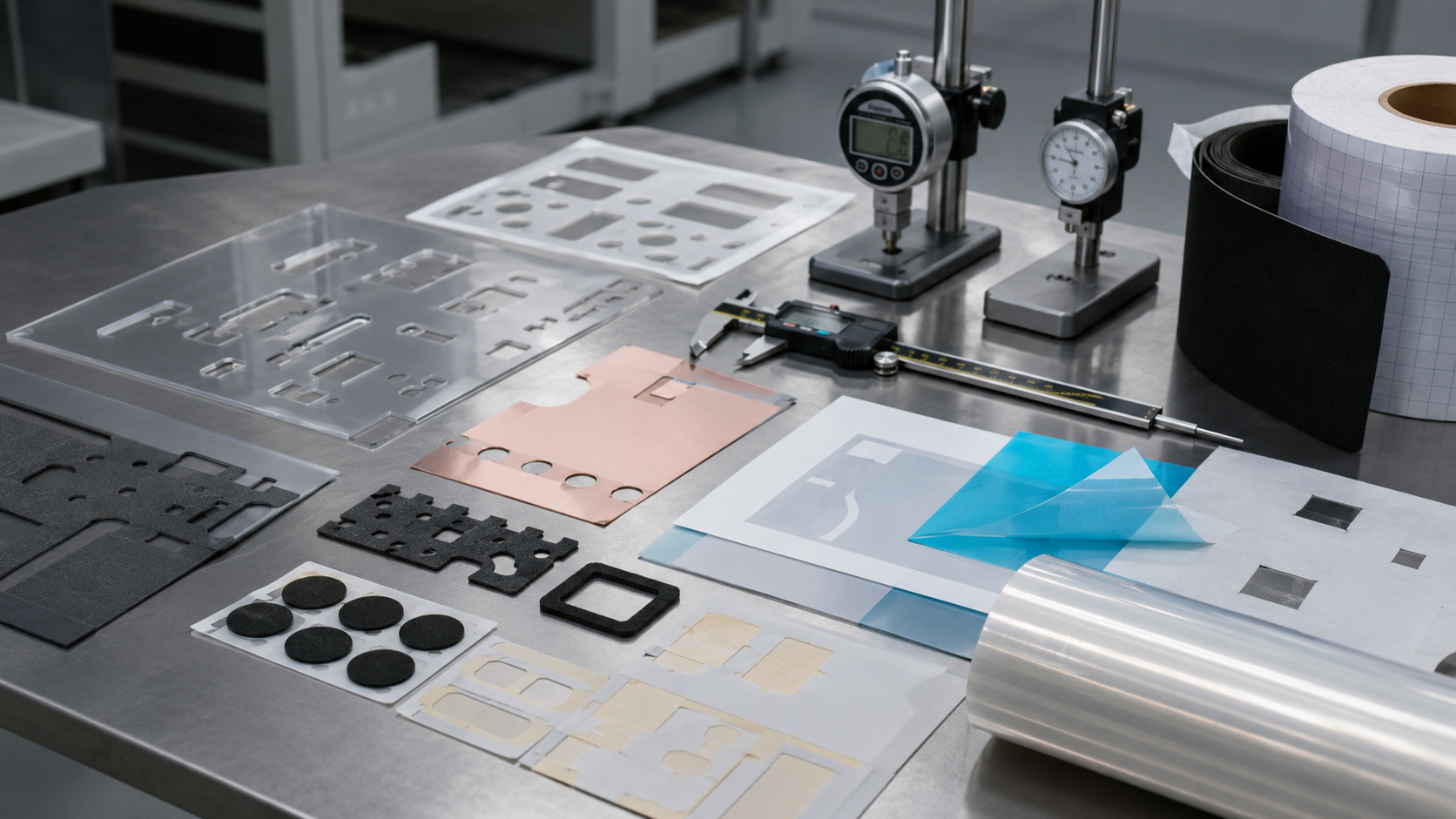
Battery Insulation Is More Than Electrical Separation
Electrical isolation is a primary requirement, but many insulation components also serve mechanical and assembly functions. A thin barrier may prevent contact between conductive areas, while an adhesive-backed pad may also protect a surface and hold nearby components in position.
Common functions include:
| Function | Role in an EV Battery Pack |
|---|---|
| Electrical separation | Prevents unintended conductive contact |
| Surface protection | Reduces scratching and abrasion |
| Controlled spacing | Maintains clearance between components |
| Positioning | Holds flexible parts during assembly |
| Cushioning | Reduces vibration and local impact |
| Sealing support | Helps close gaps around covers and interfaces |
| Temporary protection | Prevents damage during production and transport |
The same material should not be expected to perform every function equally well. PET film, foam, rubber, and protective film each serve different purposes and should be selected according to the actual risk in the assembly.
PET Insulation Film for Thin Electrical Barriers
PET film is one of the most practical materials for custom battery insulation parts because it combines low thickness, dimensional stability, electrical insulation, and good converting performance.
It can be processed into:
- Flat insulation barriers
- Connector-area covers
- Adhesive-backed pads
- Frames around openings
- Custom strips
- Parts with slots, holes, and positioning tabs
- Multilayer structures with adhesive and release liners
PET film is especially useful when the assembly requires a thin, stable component that does not compress significantly. It can provide insulation without adding excessive stack height, making it suitable for compact designs.
OEM buyers should still compare individual PET grades carefully. Different grades can vary in thickness tolerance, tensile strength, surface treatment, heat resistance, electrical performance, and compatibility with adhesive systems.
For custom shapes, precision die cutting allows PET films to be converted into accurate components that fit around fasteners, connectors, edges, and other restricted areas.
Adhesive-Backed PET for Faster Installation
PET insulation film is often laminated with pressure-sensitive adhesive to simplify installation and keep the part from moving before final assembly.
Adhesive-backed PET can provide several production benefits:
- Faster placement
- More consistent positioning
- Reduced movement during handling
- Easier integration into manual assembly
- Compatibility with automated placement
- Fewer separate bonding operations
However, the adhesive layer must be selected as carefully as the film.
The bonding surface may be aluminum, coated metal, plastic, painted material, or another film. Each surface can have different surface energy, texture, cleanliness, and temperature behavior.
OEM buyers should provide the supplier with details such as:
| Adhesive Selection Factor | Why It Matters |
|---|---|
| Substrate material | Determines bonding compatibility |
| Surface cleanliness | Affects initial adhesion |
| Operating temperature | Influences long-term bond stability |
| Required peel strength | Prevents lifting or movement |
| Repositioning needs | Affects assembly flexibility |
| Liner design | Controls peeling and handling |
The release liner also affects production efficiency. Extended pull tabs, split liners, or kiss-cut delivery can make thin insulation films easier to remove and apply without curling.
Sanken converts adhesive-backed die cut components into custom sheet and roll formats for OEM production.
Foam Materials for Cushioning and Gap Control
Foam is not normally used as a direct substitute for a thin PET electrical barrier. Its main value lies in cushioning, spacing, sealing, compression, and vibration control.
Common foam materials include PE, EVA, EPDM, PU, and silicone foam. Each has different compression behavior, density, recovery, and environmental resistance.
| Foam Material | Typical Strength | Potential Battery Application |
|---|---|---|
| PE foam | Lightweight and moisture resistant | Cushioning and protective spacing |
| EVA foam | Flexible and economical | General pads and separators |
| PU foam | Soft and conformable | Low-pressure cushioning |
| EPDM foam | Durable and weather resistant | Sealing and vibration control |
| Silicone foam | Temperature resistant | Demanding sealing locations |
For battery pack applications, foam selection should consider compression ratio, compression recovery, density, thickness tolerance, and long-term deformation.
A foam that is too soft may collapse and lose spacing. A foam that is too firm may create excessive pressure on nearby components. The correct grade should provide controlled compression without causing assembly interference.
Custom foam gaskets and sealing components can be die cut with adhesive backing, release liners, holes, and positioning features to support repeatable installation.
Rubber Components for Durable Contact Protection
Rubber materials such as EPDM and silicone are useful where a component requires greater durability, resilience, or environmental resistance than a lightweight foam.
Rubber parts can be used for:
- Contact protection
- Localized cushioning
- Vibration damping
- Sealing interfaces
- Protective spacers
- Support around covers or structural areas
EPDM rubber is often considered for applications requiring resistance to aging and changing environmental conditions. Silicone rubber may be suitable where higher temperature performance or long-term flexibility is needed.
Solid rubber and sponge rubber behave differently. Solid rubber is less compressible and can provide more durable mechanical support. Sponge rubber offers greater conformity and can help seal uneven surfaces.
OEM buyers should clearly specify whether the requirement is for electrical insulation, physical protection, sealing, or damping. A rubber part should not be described only as an “insulator” when its main role is actually mechanical.
Protective Films for Manufacturing and Assembly
Temporary protective films are commonly used during production, handling, assembly, and transportation. They help protect metal, plastic, coated, and finished surfaces from scratches, contamination, and processing damage.
Protective films may be applied to:
- Coated metal surfaces
- Plastic covers
- Finished panels
- Sensitive assembly areas
- Components requiring clean handling
The adhesive should provide sufficient hold during production but remove cleanly without residue or surface damage.
Important sourcing considerations include:
- Surface type
- Required adhesion level
- Removal time
- Storage conditions
- Temperature exposure
- Risk of adhesive residue
- Film thickness
- Cutting and liner configuration
Protective film components can be supplied as individual pieces, sheets, or kiss-cut parts on a carrier. Pull tabs can also be added to improve removal during final assembly.
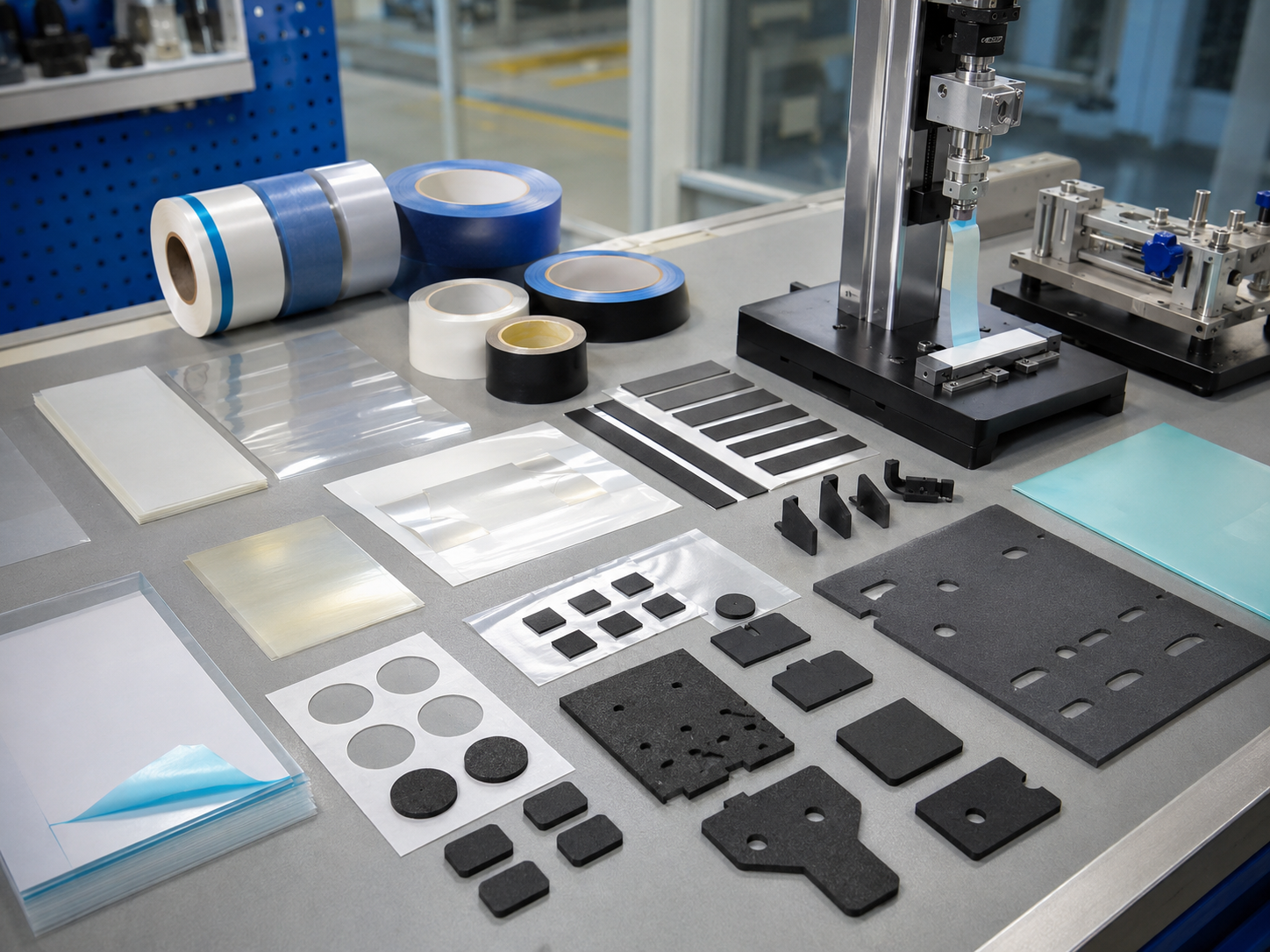
Multilayer Insulation Components Can Reduce Assembly Steps
Some battery pack applications require more than one material. A multilayer component may combine PET film, adhesive, foam, rubber, or a protective liner into one converted part.
For example:
- PET film with adhesive backing
- PET film laminated to foam
- Foam with double-sided tape
- Rubber with a positioning adhesive
- Protective film with a pull tab
- Insulation frame supplied on a release liner
Combining layers can reduce installation steps and improve consistency, but it also creates additional manufacturing risks.
The supplier must control:
- Layer alignment
- Adhesive overflow
- Lamination pressure
- Air bubbles
- Material shrinkage
- Cutting depth
- Release liner integrity
- Part flatness
If the layers are not accurately aligned, the finished component may interfere with fasteners, openings, connectors, or adjacent surfaces.
Kiss cutting is particularly useful for adhesive-backed multilayer parts because the finished component remains on the release liner. Through cutting may be better for non-adhesive barriers or parts supplied individually in kits.
Electrical, Thermal, and Mechanical Requirements Must Be Defined
OEM buyers should provide a complete application profile before requesting quotations or samples.
The supplier needs more than a drawing. Important project information includes:
| Requirement | Information to Provide |
|---|---|
| Electrical | Voltage, dielectric requirement, clearance needs |
| Thermal | Operating and storage temperature |
| Mechanical | Compression, vibration, abrasion, puncture risk |
| Dimensional | Thickness, tolerances, hole positions |
| Adhesive | Substrate, peel strength, liner preference |
| Environmental | Moisture, aging, chemical exposure |
| Assembly | Manual or automated installation |
| Supply format | Sheet, roll, individual part, or kit |
Without this information, suppliers may recommend a material based only on general assumptions.
For example, a material may have sufficient dielectric strength but poor resistance to puncture. A foam may provide cushioning but lose too much thickness after compression. An adhesive may bond well initially but lift after temperature cycling.
Material selection should therefore be validated in the actual assembly.
Die Cut Design Influences Insulation Performance
The material itself is only part of the solution. Part geometry strongly affects manufacturing stability and field performance.
Critical features include:
- Minimum wall width
- Distance between holes
- Internal corner radius
- Edge coverage
- Positioning tabs
- Adhesive setback
- Liner split location
- Hole and slot tolerances
Sharp internal corners can create weak areas where films tear during peeling or installation. Narrow sections may deform during matrix removal. Adhesive extending too close to the edge can attract dust or interfere with neighboring surfaces.
Engineers should also identify which dimensions are truly critical. Applying unnecessarily tight tolerances to every feature can increase tooling complexity and cost without improving performance.
The guide on what can go wrong before mass production covers common risks involving geometry, material selection, adhesive lamination, and production handling.
Prototype Validation Should Reproduce Real Assembly Conditions
A material data sheet cannot replace a real assembly trial. OEM buyers should test prototype parts under the same conditions expected in production.
Useful checks include:
- Dimensional fit
- Coverage of conductive areas
- Liner removal
- Adhesive positioning
- Curling or wrinkling
- Compression behavior
- Edge durability
- Temperature exposure
- Vibration and abrasion
- Packaging and storage stability
Operators should also be observed during application. A part may meet drawing requirements but still be difficult to peel, align, or press into place.
Small design changes, such as adding a pull tab, adjusting a corner radius, changing the liner split, or increasing spacing between parts, can make the component much easier to use in mass production.
How Sanken Supports EV Battery Insulation Projects
Sanken manufactures custom die cut PET insulation films, adhesive-backed insulation parts, foam cushioning pads, rubber protection components, protective films, and multilayer converted parts for automotive and energy-related OEM assemblies.
We review material structure, drawing feasibility, adhesive selection, liner design, cutting method, tolerance requirements, delivery format, and inspection points before volume production. Components can be supplied in sheets, rolls, individual parts, or organized kits based on the customer’s assembly process.
You May Also Be Interested In
Custom Die-Cut PET Insulation Films for Electronics Assembly
Why Insulation Films Must Be Precision Die Cut for Electronics
Custom Die Cut Parts: What Can Go Wrong Before Mass Production?
Conclusion
OEM buyers should evaluate EV battery insulation materials according to the actual function of each part. PET film is suitable for thin electrical barriers, adhesive-backed PET improves positioning, foam supports cushioning and spacing, rubber provides durable mechanical protection, and protective films reduce surface damage during production.
The most reliable solution is often not a single material but a carefully designed converted component that fits the battery assembly and production process. Clear specifications, early design review, precision die cutting, and realistic prototype testing help reduce movement, tearing, poor adhesion, assembly delays, and costly changes during mass production.