
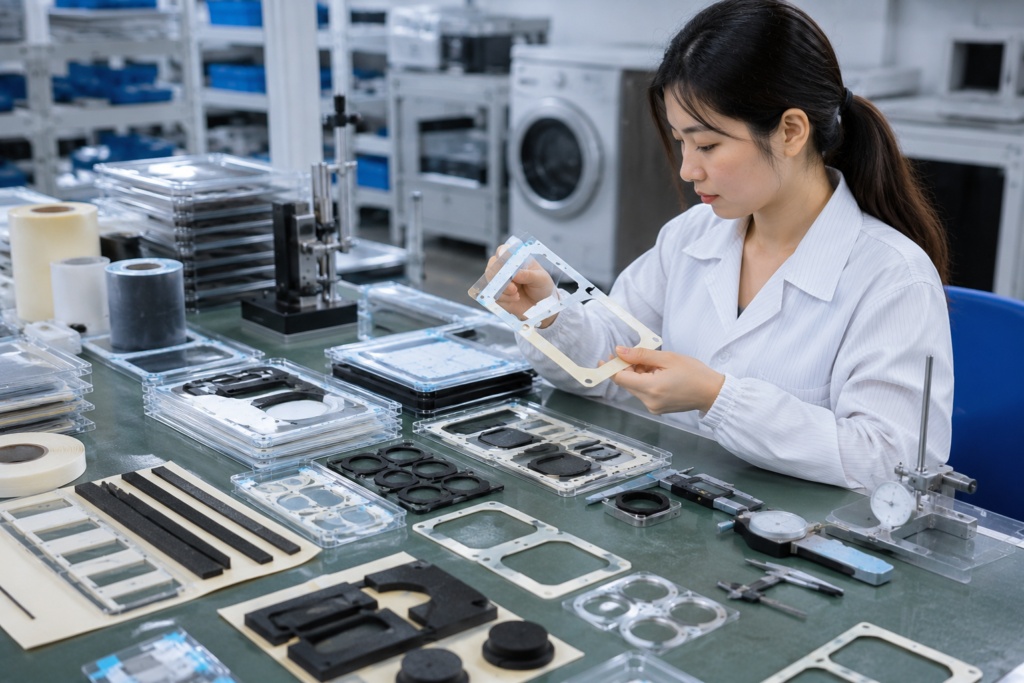
Battery insulation materials help separate conductive areas, protect sensitive components, reduce the risk of unintended electrical contact, and support stable assembly inside electric vehicle battery packs. Their performance depends on more than dielectric strength alone.
Engineers must also evaluate operating temperature, thickness, mechanical durability, dimensional stability, adhesive compatibility, edge quality, and the way the part will be installed. A material that performs well in a laboratory may still create problems if it curls, shifts, tears, or does not fit the production assembly.
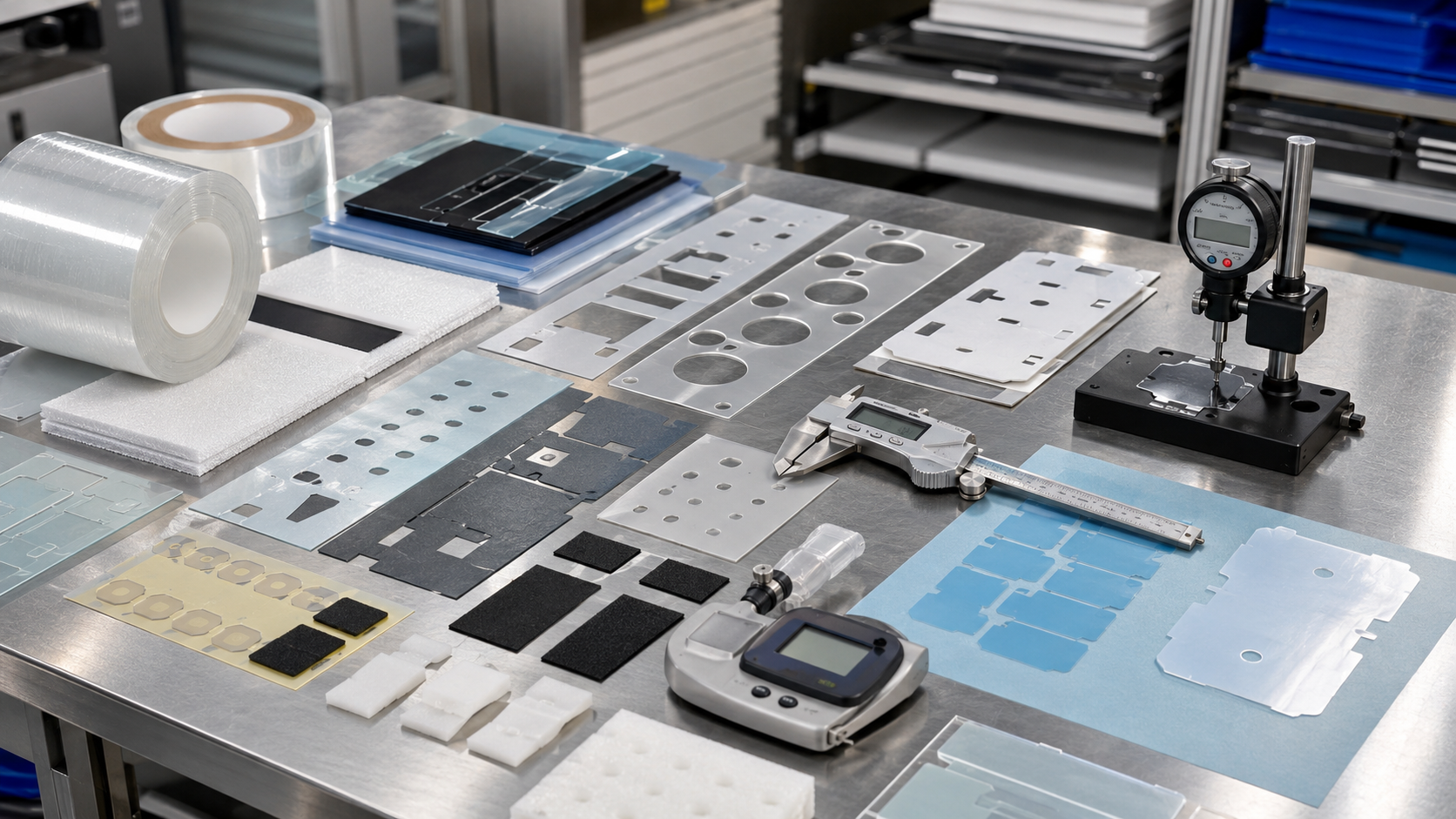
Battery Insulation Materials Perform Several Functions
Electrical insulation is the main purpose, but a die cut battery insulation part may perform several functions at the same time.
Depending on its position, it may:
- Separate conductive surfaces
- Protect busbar or connector areas
- Cover exposed metal edges
- Prevent contact between adjacent components
- Support spacing and positioning
- Protect surfaces during assembly
- Reduce abrasion caused by vibration
- Hold other flexible components in place
| Function | Importance in EV Battery Packs |
|---|---|
| Electrical separation | Reduces unintended conductive contact |
| Surface protection | Prevents abrasion and damage |
| Dimensional spacing | Maintains controlled clearance |
| Component positioning | Supports repeatable assembly |
| Mechanical protection | Resists tearing and handling damage |
| Adhesive fixation | Prevents movement before final assembly |
The correct material depends on where the insulation part is installed and what failure mode it is intended to prevent. A flat barrier film has different requirements from a narrow adhesive-backed strip positioned around an opening or connector.
PET Film Is Commonly Used for Die Cut Battery Insulation
PET film is widely used in battery and electronic assemblies because it combines electrical insulation, dimensional stability, low thickness, and efficient converting.
It can be manufactured into:
- Flat insulation barriers
- Adhesive-backed insulation pads
- Connector protection pieces
- Busbar-area covers
- Custom frames and strips
- Parts with holes, slots, and positioning tabs
- Multilayer film and adhesive structures
PET is often suitable where the design requires a thin, stable insulation layer rather than a compressible sealing material. It is easier to keep flat than many softer materials and can be die cut accurately for compact assembly spaces.
The final material specification should still be confirmed against the project’s electrical, temperature, and regulatory requirements. PET grades can differ in thickness, surface treatment, mechanical strength, and electrical performance.
Sanken converts PET insulation films for electronics assembly into custom shapes based on OEM drawings and assembly requirements.
Electrical and Thermal Requirements Must Be Reviewed Together
Battery insulation material selection should begin with the actual electrical and thermal environment.
Important information includes:
- System voltage
- Required dielectric performance
- Normal operating temperature
- Short-term temperature exposure
- Distance from heat-generating components
- Required insulation thickness
- Expected service life
- Safety and validation requirements
A thicker film may provide additional physical separation, but thickness also affects stack height and assembly clearance. Increasing thickness without reviewing the surrounding structure can create interference or additional pressure.
Temperature is equally important. The insulation film and any adhesive layer must remain stable under the expected operating and storage conditions. If the adhesive softens, shrinks, or loses strength, the insulation part may move even if the film itself remains functional.
For this reason, the complete structure should be assessed as a system:
| Component | Main Selection Focus |
|---|---|
| Insulation film | Dielectric performance and dimensional stability |
| Adhesive layer | Bonding strength and temperature resistance |
| Release liner | Clean peeling and production handling |
| Foam or rubber layer | Cushioning, protection, or controlled spacing |
| Protective film | Temporary surface protection |
Material data should be reviewed together with real assembly testing rather than used as the only approval method.
Thickness and Mechanical Durability Affect Assembly Reliability
Thin insulation films are useful in compact battery structures, but they can be more sensitive to wrinkles, curling, tearing, and edge damage. Thicker films may be easier to handle but can interfere with tight clearances.
Engineers should consider:
- Film thickness tolerance
- Tensile and tear resistance
- Resistance to puncture
- Flexibility around bends
- Edge exposure
- Contact with sharp metal features
- Movement caused by vibration
- Handling during installation
Sharp housing or metal edges can damage an insulation film over time if the part is not properly designed. Internal corners, narrow bridges, and small areas around holes may also become weak points during die cutting or assembly.
The drawing should identify critical areas where the film must maintain minimum coverage. Where possible, sharp internal corners can be replaced with suitable radii to reduce tearing and improve production stability.
Precision converting is especially important because rough edges or incomplete cuts can create particles and make the part difficult to install. The article on why insulation films must be precision die cut for electronics explains why edge control and dimensional accuracy matter in sensitive assemblies.
Adhesive-Backed Insulation Improves Positioning
Battery insulation films are often laminated with pressure-sensitive adhesive so that the part stays in the correct position during assembly.
Adhesive backing can improve:
- Placement accuracy
- Manual assembly speed
- Compatibility with automated placement
- Stability before enclosure closure
- Repeatability between operators
- Protection against shifting during handling
The adhesive must match the bonding surface. Aluminum, coated metal, engineering plastics, PET surfaces, and painted parts may require different adhesive properties.
Surface condition is also critical. Oil, dust, mold-release residue, low surface energy, or rough texture may reduce bonding performance. Even a high-performance adhesive can fail when applied to an unsuitable or contaminated surface.
Liner design should be considered early. A liner that is difficult to remove may cause the thin film to stretch or curl. Split liners, extended tabs, or kiss-cut delivery formats can make larger or more delicate insulation parts easier to apply.
For assemblies that use multiple flexible components, adhesive-backed die cut parts can reduce separate installation steps and improve production consistency.
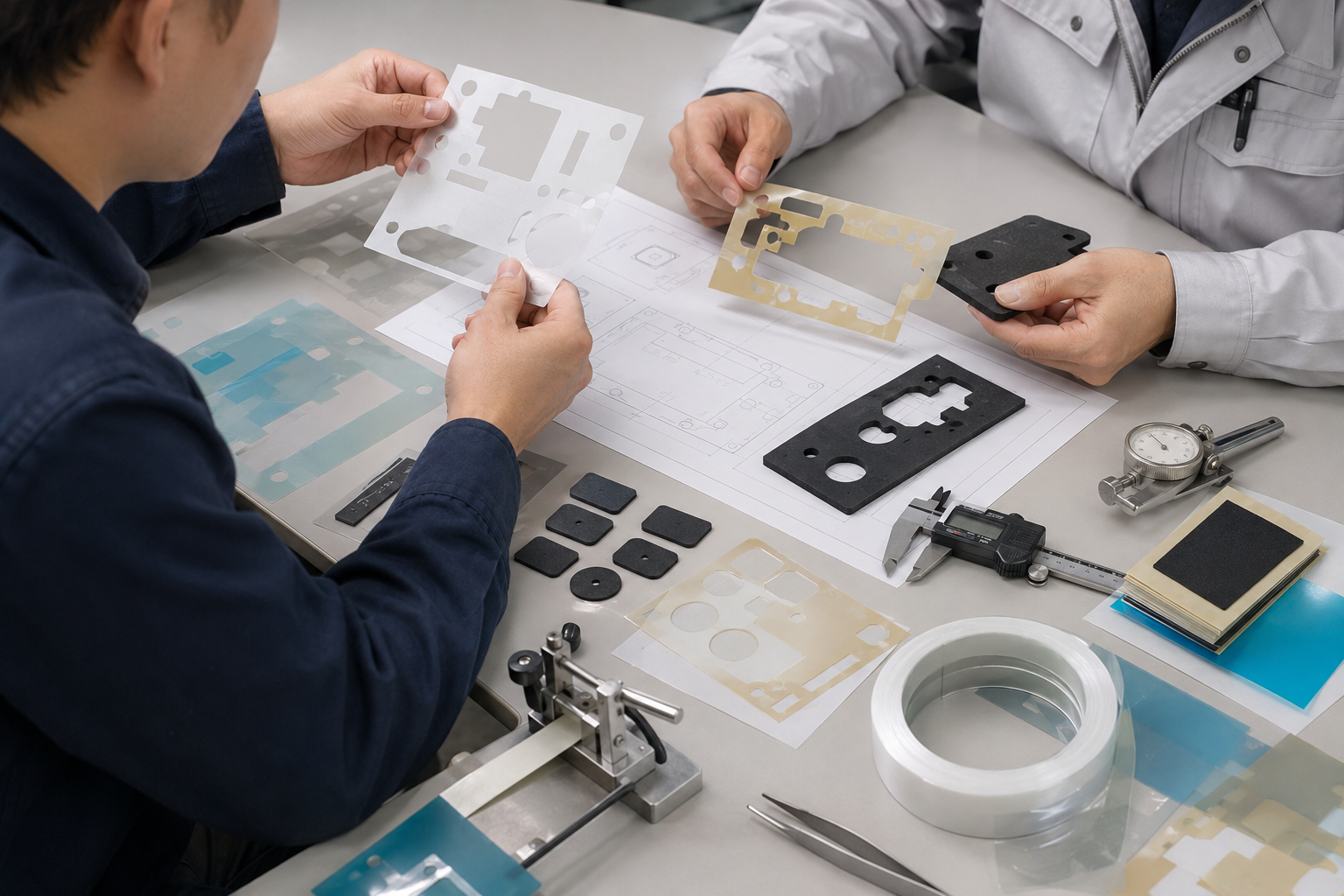
Foam and Rubber Support Insulation but Serve Different Purposes
Foam and rubber can support battery protection, but they should not automatically be treated as replacements for film insulation.
PET film is primarily used as a thin electrical barrier. Foam and rubber are generally selected for mechanical functions such as cushioning, spacing, compression, vibration control, and surface protection.
| Material | Main Role |
|---|---|
| PET insulation film | Electrical separation and thin barrier protection |
| Adhesive-backed PET | Insulation plus positioning |
| Foam pad | Cushioning, gap filling, and vibration protection |
| Rubber pad | Durable contact protection and damping |
| Protective film | Temporary surface protection during production |
A multilayer part may combine PET film with adhesive, foam, or a release liner. This can simplify assembly, but the structure must be carefully designed.
The foam should not compress so much that the insulation film folds or shifts. The adhesive should not extend beyond the part edge, where it may attract dust or interfere with adjacent components. Layer alignment must remain stable during mass production.
Precision Die Cutting Controls Fit, Edges, and Alignment
Battery insulation parts frequently include complex outlines, holes, windows, narrow strips, and location features. These details must align with the battery assembly without covering connectors, fasteners, or other functional areas.
Precision die cutting helps control:
- Outer dimensions
- Hole and slot positions
- Minimum wall widths
- Edge cleanliness
- Film flatness
- Adhesive alignment
- Liner cutting depth
- Multilayer registration
- Part spacing on sheets or rolls
Kiss cutting is often used for adhesive-backed film parts because the finished components remain on the release liner. This protects the adhesive and keeps the parts organized until installation.
Through cutting may be more appropriate for non-adhesive barriers or individual pieces supplied in trays or kits. The best delivery format depends on the customer’s assembly process, production volume, and handling method.
Sanken’s precision die cutting services support custom film and adhesive components in sheet, roll, and assembly-ready formats.
Prototype Testing Should Reflect Real Battery Assembly Conditions
A prototype should be tested in the intended assembly rather than evaluated only as a loose part.
Useful validation checks include:
| Inspection or Test | Purpose |
|---|---|
| Dimensional inspection | Confirms fit and coverage |
| Assembly trial | Identifies interference and handling issues |
| Adhesive peel test | Evaluates bonding and liner release |
| Temperature exposure | Checks film and adhesive stability |
| Vibration evaluation | Identifies movement or abrasion risks |
| Visual edge inspection | Detects burrs, tears, and particles |
| Packaging review | Prevents curling and deformation |
The prototype stage is also the best time to adjust tabs, corner radii, liner splits, hole positions, and packaging.
A part may meet every drawing dimension but still be difficult to apply. Engineers should observe how operators peel, align, and press the part into position. These practical details often determine whether a design is suitable for mass production.
For complex projects, reviewing what can go wrong before mass production can help teams identify risks before releasing production tooling.
How Sanken Supports Battery Insulation Projects
Sanken supports OEM customers with custom die cut PET insulation films, adhesive-backed insulation parts, foam cushioning components, rubber protection pads, and related flexible converted parts.
We review the drawing, material structure, critical dimensions, adhesive requirements, liner design, delivery format, and inspection points before mass production. The goal is to provide components that fit accurately, remain easy to handle, and support stable assembly from sample validation through volume production.
You May Also Be Interested In
Custom Die-Cut PET Insulation Films for Electronics Assembly
Why Insulation Films Must Be Precision Die Cut for Electronics
Custom Die Cut Parts: What Can Go Wrong Before Mass Production?
Conclusion
Choosing battery insulation material for an EV pack requires a complete review of electrical protection, temperature, thickness, mechanical durability, adhesive compatibility, part geometry, and production handling.
PET film is commonly used when the application needs a thin and dimensionally stable electrical barrier. Foam and rubber can provide additional cushioning or mechanical protection, while adhesive-backed structures improve positioning and assembly efficiency. Precision die cutting ensures that these materials fit correctly and maintain clean edges, accurate openings, and stable layer alignment.
The final choice should always be validated in the real battery assembly. Early testing and design review help reduce insulation gaps, material movement, installation difficulties, and costly changes during mass production.